| |
US Stock Market Sentiment Indicator
 TSI
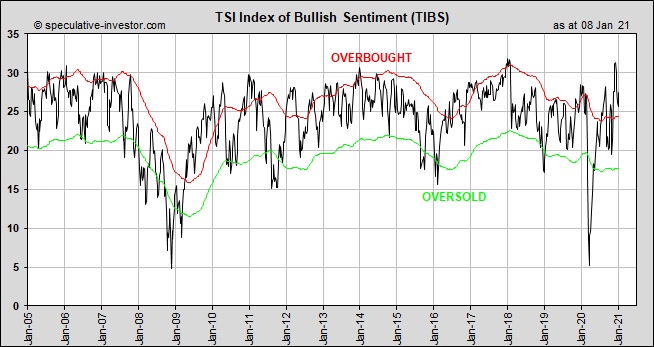
Index of Bullish Sentiment (TIBS) - updated weekly TSI
Index of Bullish Sentiment (TIBS) - updated weekly
TIBS is a medium-term stock market indicator. It is
an amalgamation of six different sentiment indicators: the Investors
Intelligence, AAII, Consensus-inc and Market Vane sentiment surveys, the 5-day
MA of the VIX and the 5-day MA of the Equity Put/Call Ratio.
Gold and Stock Market Fundamental Indicators
The
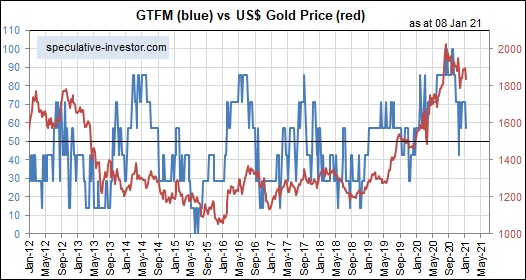
Gold True Fundamentals Model (GTFM) - updated weekly
The GTFM takes into account the seven most important
fundamental drivers of the US$ gold price (the real interest rate, the yield
curve, credit spreads, the relative strength of the banking sector, the US
dollar's exchange rate, the general trend in commodity prices and the
bond/dollar ratio) to arrive at a number between 0 and 100 that indicates the
extent to which the fundamental backdrop is gold-bullish. 100 signifies maximum
bullishness and 0 signifies minimum bullishness (maximum bearishness).
The
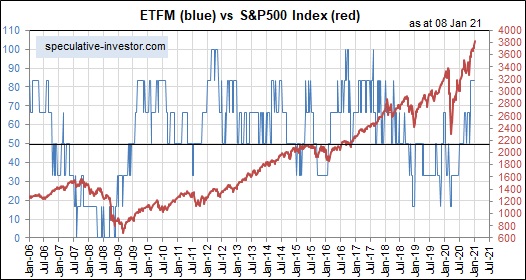
Equity True Fundamentals Model (ETFM) - updated monthly
The inputs to the ETFM are the six most important fundamental drivers of US
equity prices (as represented by the S&P500 Index). These drivers are the
monetary inflation rate as determined using our "G2 TMS" calculation (refer to
Global Monetary Indicators below), the real interest rate, the yield
curve, credit spreads, the level of US economic activity as indicated by the ISM
New Orders Index (NOI) and the relative strength of the banking sector. The output of the ETFM is a number between 0 and 100 that indicates the
extent to which the fundamental backdrop is bullish for the stock market. 100 signifies maximum
bullishness and 0 signifies minimum bullishness (maximum bearishness).
Global Monetary Indicators
Money
Supply Growth - updated monthly
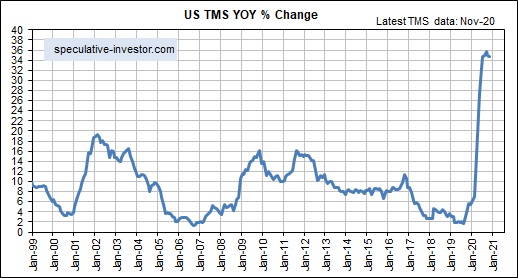
TMS (True Money Supply) is
the most accurate monetary aggregate. Whereas popular measures such as M2 and M3
contain credit instruments, TMS only comprises money. Specifically, TMS comprises
currency, checkable deposits and savings deposits.
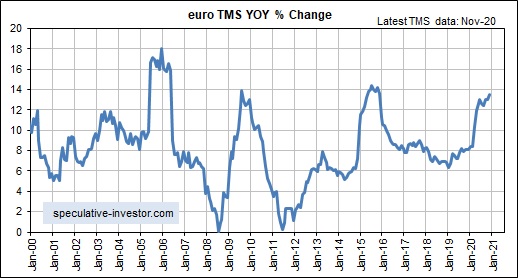
The first of the below charts shows the year-over-year TMS growth rate (the
monetary inflation rate) in the US and the second of the charts shows the
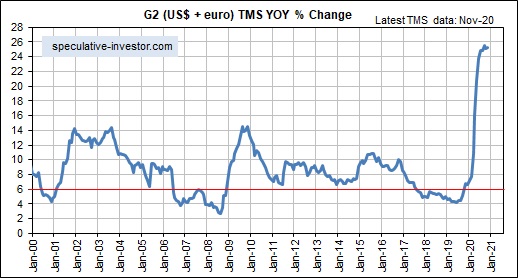
monetary inflation rate in the euro-zone. The third chart shows the annual rate
of change in a monetary aggregate that we call "G2 TMS", which combines the US
and euro-zone money supplies.
The
rate of change in the G2 TMS growth rate has been the most useful leading
indicator of the global boom-bust cycle over the past two decades. Of particular
significance, a decline in the G2 TMS growth rate from well above 6% to below 6%
warns of a shift from boom to bust within 12 months.
US Economic Indicators
The
US Future Inflation Gauge (FIG) - updated monthly
The FIG
is published by the Economic Cycle Research Institute (ECRI) and leads the CPI
by an average of 11 months. In the following chart it is compared with the Fed
Funds Rate.

Real
Gross Private Domestic Investment (RGPDI) - updated quarterly
RGPDI is our favourite long-term leading indicator of US recession. It has
never generated a false recession signal, but its lead time can be up to two
years and it only gets reported quarterly. The vertical red lines on the
following chart mark the official starting points of the most recent two
recessions.

The
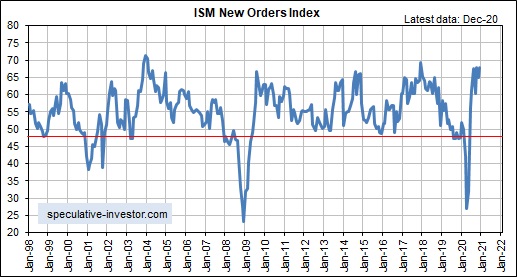
ISM Manufacturing New Orders Index (NOI) - updated monthly
As a leading indicator of US recession the ISM Manufacturing NOI is not quite as
reliable as RGPDI, but it has the advantage of being reported in a more timely
fashion (the NOI for a month is reported near the beginning of the next month).
The NOI warns that a recession is about to begin when it moves below 48.
The
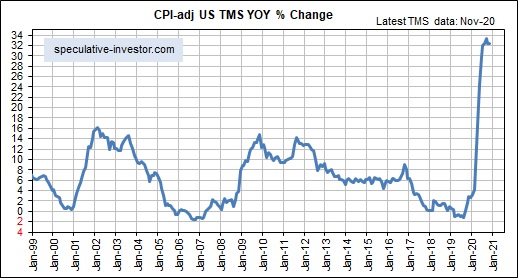
CPI-Adjusted TMS Growth Rate - updated monthly
The CPI-adjusted year-over-year
TMS growth rate (the
US TMS growth rate minus the annual rate of change in the "Median CPI" reported
by the Cleveland Fed) is a leading
economic indicator with a lead time of 6-18 months.
'Real' Performance Indicators
Inflation-Adjusted
US$ Prices - updated monthly
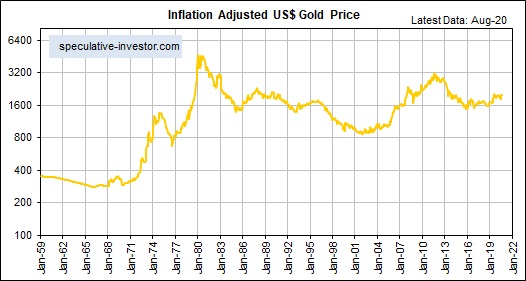
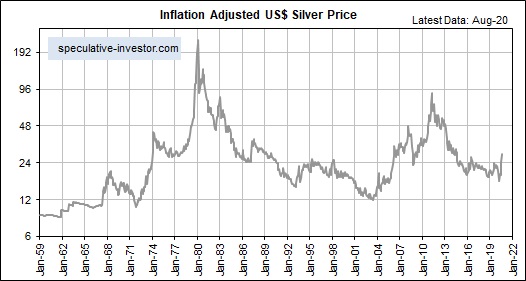
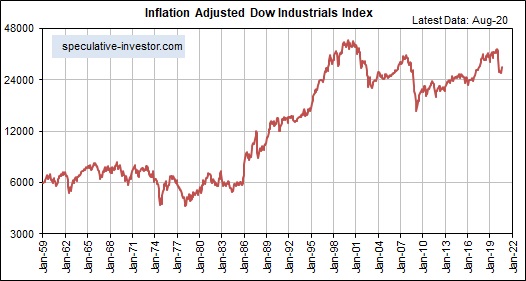
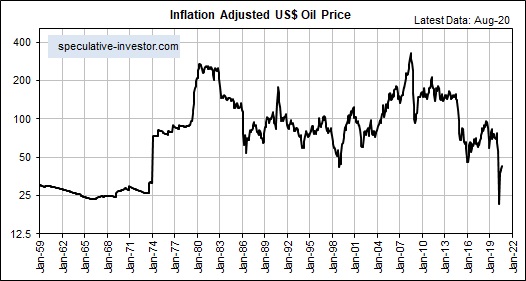
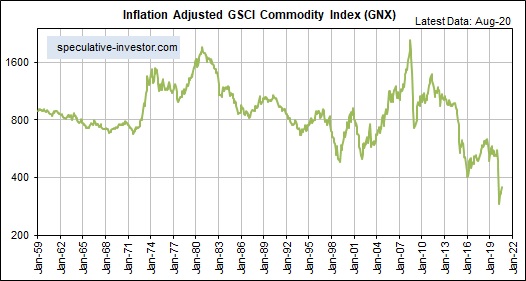
The following monthly charts show the inflation-adjusted (IA)
performances (in current US dollars) of gold, silver, the Dow Industrials Index,
oil, and the Goldman Sachs Spot Commodity Index (GNX) since 1959. In these
charts we use a method of adjusting for the effects of US$ inflation that was
first
outlined in a 2010 article. This method isn't reliable over periods of 2
years or less, but it should come close to reflecting reality over the long
term.
|



