2019 Yearly
Forecast
 Random Predictions For 2019
1) Early last year we predicted that the US stock market would experience
greater-than-average volatility over the year ahead. This obviously
happened, as there were more 2%+ single-day moves in the SPX during 2018
than in an average year.
We expect the same for this year, that is, we expect price volatility to
remain elevated. The reason is that the two most likely scenarios involve
abnormally-high price volatility. One of these scenarios is that a
cyclical bear market began last October, and bear markets are
characterised by periods of substantial weakness followed by rapid
rebounds. The other scenario is that a very long-in-the-tooth cyclical
bull market is about to embark on its final fling to the upside.
2) When attempting to predict when a period of economic growth will end it
is futile to look more than 6-12 months into the future, because there are
no leading recession indicators that can predict that far ahead with
acceptable reliability. There are, however, leading indicators that can be
used to determine the probability of a recession beginning within the next
few quarters.
Early last year these indicators told us that a US recession would not
begin during the first half of the year. They currently tell us that the
US economy stands a good chance of commencing a recession this year, most
likely during the second half of the year. Note, though, that if a
recession does get underway this year it won't become official until 2020,
because recessions usually aren't confirmed by the National Bureau of
Economic Research until about 12 months after they start.
3) Regarding 'cryptoassets', at around this time last year we wrote:
"...it's
a good bet that the Bitcoin bubble reached its maximum level of inflation
late last year. Also, the broader bubble in cryptoassets is set to burst
during the first quarter of this year."
And:
"By
the end of 2018 it will be apparent that the public's enthusiasm for
Bitcoin and the "alt-coins" was one of history's great speculative manias."
This assessment looks correct.
We don't have a strong opinion about what will happen to 'cryptoassets' in
2019. This is partly because there is no reasonable way to determine the
fair value of these assets. For Bitcoin, for example, a price of $3,000 is
no more or less sensible than a price of $30,000 or a price of $300.
Distributed ledgers can be very useful, but there should be ways to
implement them without consuming a lot of resources. If so, the price of
Bitcoin eventually will drop to almost zero.
A year ago we also predicted:
"Despite
spectacular collapses in the prices of the popular 'cryptoassets' during
2018, central banks including the Fed and the ECB will firm-up plans to
introduce their own blockchain-based currencies. This will be driven by a
desire to eliminate physical cash, the thinking being that if there is no
physical money it will be more difficult for the average person to
make/receive unreported payments and escape a negative interest rate."
As far as we know the major central banks didn't firm-up plans to
introduce their own blockchain-based currencies last year, but we continue
to expect that they will -- for the reasons mentioned above.
4) Regarding the Fed's expected actions in 2018, early last year we wrote:
"Due
to rising commodity prices it's a good bet that "price inflation" will
become a higher-profile issue during the first half of 2018, prompting the
Fed to move ahead with its quantitative tightening (QT) and make two more
rate hikes. However, both the QT and the rate-hiking will be put on hold
during the second half of the year in reaction to increasing downside
volatility in the stock market."
We got the anticipated rate hikes during the first half and the increasing
downside stock-market volatility during the second half of last year, but
the Fed stuck to its guns. However, over the past three weeks the Fed
Chairman has made it clear that the Fed will be quick to change direction
if the stock market continues to decline and/or the economic numbers point
to significant weakness.
For 2019 we expect one Fed rate hike, most likely in June. Also, we expect
that people 'in the know' will explain to senior Fed members that it's the
balance-sheet reduction program (QT) that really counts, prompting the Fed
to slow the pace of QT during the first half and conclude the QT program
before year-end.
5) The ECB has just ended its QE program and has a tentative plan to
implement its first rate hike during the third quarter of 2019. Given that
nothing has been learned from the failed monetary experiments of the past
few years, it's a good bet that evidence of declining economic activity in
the future will be met by the ramping-up or reintroduction of policies
that failed in the past. Therefore, we predict that the ECB will not
increase its targeted interest rates this year and will restart QE during
the second half of the year.
6) This is not a prediction for 2019, but rather an observation that could
apply for decades to come. We suspect that the age of real estate has
ended.
We don't mean that from now on it will be impossible to achieve good
returns by investing in real estate, but that gone are the days when
anyone could buy a house almost anywhere and likely end up with a sizable
profit as long as they held for 10 years or more. From now on only astute
investors will consistently make good returns from real estate, where
"astute" means able to time the cyclical swings in the broad market or
able to correctly anticipate future supply-demand imbalances in specific
areas.
For the average person, residential property will transition from an
investment to what it was prior to the 1970s: a consumer good (something
bought solely for its use value).
The reason for the change is the interest-rate trend. The 3-4 decade
downward trend in interest rates resulted in a 3-4 decade upward trend in
housing affordability for buyers using debt-based leverage (that is, for
the vast majority of buyers). There were corrections along the way, but
provided that long-term interest rates continued to make lower lows there
would eventually be a pool of new debt-financed buyers able to pay a much
higher price.
There's a good chance that the secular interest-rate trend reversed from
down to up during 2016-2018. If so, future house buyers that don't have
good timing and/or substantial area-specific knowledge generally won't
make long-term capital gains on their residential property purchases.
The US Stock Market
This was our 2018 stock market forecast, penned at around this time last
year:
"...the
monetary backdrop only turned negative about three months ago and it can
take 6-12 months for the effects of such a shift to become apparent in the
financial markets and the economy. Also, there is not yet any evidence in
the yield curve or credit spreads that the tightening of monetary
conditions has become critical. We therefore expect that the stock market
will work its way upward during the first half of 2018, although we also
expect that the advance will be 'choppy' and include a Q1 correction of
5%-10%.
At some point during the second half
of 2018 the tightening of monetary conditions should become critical, with
a 15%-25% SPX decline being one of the most obvious consequences. Whether
or not this decline marks an end to the bull market will depend on the
central-bank reaction at the time, in that a rapid policy shift from
monetary tightening to loosening could extend the long-term advance.
We expect that commodity-related
stocks will be among the best performers during the first half of the
year, but that all sectors of the stock market will suffer large declines
during the second half with the possible exception of the gold-mining
sector."
The annual forecast (educated guess) we made in early-2018 turned out to
be very close to the mark.
Here is this year's educated guess:
It isn't yet certain that the stock market decline that unfolded during
the final quarter of last year was the first leg of a bear market, but
arguing in favour of a bear market is:
a) The fact that the G2 monetary inflation rate has been in 'bust
territory' since September-2017.
We noted a year ago that it can take 6-12 months for the effects of a
substantial negative shift in the monetary backdrop to become apparent in
the financial markets and the economy. It is now 15 months since the
negative shift and the effects are readily apparent. Moreover, with the
Fed still intent on withdrawing money from the economy via its
balance-sheet 'normalisation' program there is no reason to expect a
meaningful up-turn in the 'liquidity' situation in the near future.
b) The widening of credit spreads that began last October.
c) The pronounced reversal in NYSE Margin Debt from expansion to
contraction.
d) The SPX/euro ratio's monthly close below its 20-month MA in
December-2018.
However, some early-warning signs of a bear market are still missing,
chief among them being a yield curve reversal from flattening to
steepening.
In any case, there is no requirement to make the big forecast (bear market
or not). This is because there is a high probability of the December-2018
lows being decisively breached during 2019 regardless of whether or not a
bear market has begun.
Getting more specific, over the past three weeks we have written that the
SPX probably would form a multi-month 'W' bottom, involving an initial
rally from the December low followed by a decline to test the low and then
a longer/larger rally. We continue to expect something along these lines
to materialise during the first half of the year, with reduced US-China
trade friction being one of the 'justifications' for the rally. If it does
it will set the stage for a multi-month decline to well below the
December-2018 low.
Our guess is that the SPX will end the year with only a single-digit
percentage loss, but that there will be a 15%-25% decline from the
first-half peak to the second-half trough. We expect the large decline
from the first-half peak to be driven, in part, by rising long-term
interest rates.
The
Currency Market
Last year's annual forecast for the currency market was more wrong than
right. We expected US$ weakness during the first half and US$ strength
during the second half of the year, but the Dollar Index (DX) trended
upward from a February low to a November high. However, our US$ True
Fundamentals Model (UTFM) was correct. The UTFM was bullish all year,
apart from a single week in April when it was whipsawed.
The DX is dominated by the USD/EUR exchange rate,
so the fundamental drivers of the DX are the same as the fundamental
drivers of the euro. Of these drivers, one of the two most important is
the interest-rate differential.
Now, there are many interest-rate differentials,
but we've found that the spread between Germany and US 10-year government
bond yields is the one with the strongest and most consistent relationship
with the euro/US$ exchange rate. The following chart compares this
interest-rate spread with the euro. Note that on this chart as well as on
the next two charts it's the direction of the fundamental driver that
matters, not the absolute level.

The other main driver of the EUR/USD exchange rate
is relative equity-market performance. For this we use the EZU/SPY ratio
(the iShares MSCI Eurozone ETF versus the S&P500 ETF). The following chart
compares this ratio with the euro.

The Germany-US 10-year interest-rate spread and
the EZU/SPY ratio are the only inputs to the UTFM. It's a simple model.
However, we also pay attention to how European bank stocks are performing
relative to their US counterparts by using the EUFN/KBE ratio (iShares
MSCI Europe Financials ETF versus the US S&P Bank ETF). Here's the chart:

With reference to the above charts, notice that
the sharp upward move in the euro from early-November of 2017 to
late-January of 2018 was counter to the fundamentals. This is not uncommon
in the currency market. The fundamentals are a form of pressure and if the
fundamental pressure persists it eventually will force the price into
line, but the price can diverge from the fundamentals for up to 6 months.
There are tentative signs in the above charts that
a fundamental shift in the euro's favour is underway. Due to the
relatively attractive equity valuations and the ridiculously low interest
rates (both relatively and absolutely) in Europe, our guess is that the
shift in the euro's favour will continue. Therefore, we expect that the
euro will trend upward, and by extension that the DX will trend downward,
for the bulk of this year.
Apart from that, we expect that the major commodity currencies (the A$ and
the C$) will perform well during the first half of the year in response to
rising prices for industrial and agricultural commodities, and that the
British Pound will have a good year despite the Brexit mess.
T-Bonds
Here's how we summed up our 2018 T-Bond forecast:
"We
expect that...major support [as defined by the 84-month MA] will hold if
tested during the first quarter but will be breached during the second
quarter in response to rising fear of "inflation".
In the second half of the year we
expect to encounter substantial 2-way bond-market volatility, with a
strong 2-3 month rally at some point in reaction to falling equity and
commodity prices.
Overall, we are anticipating a down
year for the T-Bond (an up year for long-term interest rates), but not a
large decline. We expect that major weakness in 'risk free' government
bonds will be one of the next decade's big stories."
Last year's guess was excellent for government work and still OK for the
private sector. We got the expected breach of major support during the
first half of 2018 and the strong 2-3 month rally in reaction to falling
equity and commodity prices late in the year. Also, it was a down year for
the T-Bond, but not a large decline (the T-Bond price was down by about
4%). The only 'miss' was that we expected the T-Bond's break below major
support to happen in Q2, but it happened in Q1.
This year's forecast (guess) is for an extension of the rebound that began
late last year to a top within the first four months of the year, followed
by a decline to a new 5-year low. Whereas last year's T-Bond price
weakness was driven by the Fed's tightening campaign and a small increase
in inflation expectations, this year's weakness will be driven by fear of
the veritable explosion in US federal debt that is bound to occur during
the next recession. It's likely that within the next three years there
will be a 12-month period during which the US government increases its
debt by more than $2 trillion, and that will be just the beginning of a
self-reinforcing debt spiral as rising interest rates lead to greater
deficits.
As was the case a year ago, we are anticipating a down year for the T-Bond
(an up year for long-term interest rates), but not a large decline. Our
bearishness regarding the T-Bond's prospects over the coming 12 months is
lessened by the likelihood that after the senior US stock indices break
well below their December-2018 lows there will be another flight towards
the perceived relative safety offered by Treasury debt. This should
mitigate the T-Bond's annual loss.
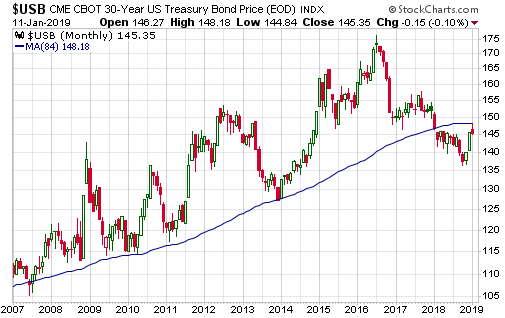
Also, we expect that the T-Bond's 84-month MA, which acted as support for
three decades prior to last year, will now act as resistance during
counter-trend rallies. As illustrated below, this MA is presently in the
high-140s. We won't be surprised if there is an intra-month spike into the
150s within the first few months of this year, but on a monthly closing
basis the T-Bond's upside should be capped at 148-149.
Due to the fear of future bond supply and an increasing general desire to
hold only the most liquid debt securities, the demand for short-term
Treasury debt should rise relative to the demand for long-term Treasury
debt during 2019. This will cause a pronounced steepening of the US yield
curve.
Lastly, we reiterate that major weakness in 'risk free' government bonds
will be one of the NEXT decade's big stories. Secular interest-rate trends
turn around like fully-laden supertankers.
Gold
and the Gold Mining Sector
There were hits and misses in our 2018 gold market forecast. We were right
that during the first half of 2018 gold would lose ground relative to
commodities in general. We were also right to mention the potential for
gold to be boosted during the second half of 2018 in both nominal dollar
terms and relative to commodities by serious stock market weakness and a
strong rebound in the T-Bond. However, we were wrong to expect gold to
make a significant first-half gain in US$ terms.
We usually find it easier to come up with a prediction for what gold will
do relative to commodities (as represented by a broad commodity index such
as GNX) than to predict what gold will do in US$ terms. The main reason is
that whereas there are several strong influences on the US$ gold price,
the gold/commodity ratio consistently trends in the same direction as the
30-year T-Bond.
The strong positive correlation between the T-Bond and the gold/commodity
ratio (gold/GNX) is depicted below.
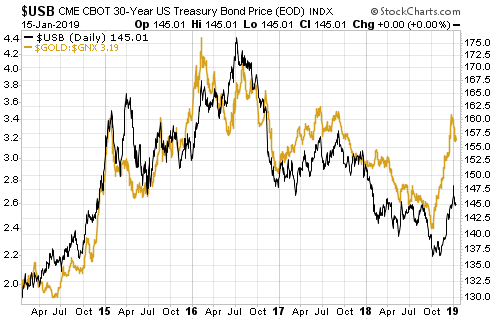
Our 2019 T-Bond forecast is for a price top during the first three months
of the year at not far above the early-January high, followed by a 1-2
quarter decline to new multi-year lows and then a rebound in response to
stock market weakness. This leads us to expect that the gold/commodity
ratio will top-out during the first quarter of this year (if it didn't
already peak near the end of last year), trend downwards for 1-2 quarters
and then rebound strongly into year-end.
What happens to the US$ gold price will depend to a large extent on what
happens to the Dollar Index (DX). In this regard it is significant that
the fundamental backdrop has begun to shift in the euro's favour. If this
shift continues then the US$ gold price will be boosted by US$ weakness
over the next several months. In fact, this is the most likely outcome.
We expect that the US$ gold price will rise during the first 3-6 months of
2019, but that the advance will be 'choppy' for two reasons. The first
reason is that the market began the year in an 'overbought' condition. The
second reason is that a continuing recovery in the stock market during the
first half of the year will reduce the demand for 'safe havens'.
During the second half of the year, a downside breakout in the stock
market could lead to substantial strength in the US$ gold price. Our guess
is that gold will trade near US$1500/oz before year-end.
Turning to the gold-mining sector, if the stock market was always rational
then gold-mining stocks would always trend with the gold/commodity ratio.
This is because the trend of the gold/commodity ratio indicates the trend
of gold-mining profit margins. On a long-term basis the gold/commodity
ratio does exert considerable influence on the gold-mining indices, but in
the short-term the US$ gold price tends to dominate.
Therefore, we expect that the gold-mining indices will do something
similar to the US$ gold price in 2019. This means that we are anticipating
a 'choppy' advance during the first 3-6 months and a substantial
multi-month rally at some point during the second half. The difference is
that the gold-mining indices likely will be much more volatile than the
bullion price. In particular, gold-mining stocks could be pulled down by a
large stock-market decline and then rebound ferociously after the Fed
makes a rescue attempt.
There's the potential for the gold-mining sector to make a big catch-up
move this year, that is, to greatly outperform gold in 2019. However, at
the time of writing there is no evidence that such a catch-up move has
begun.
Commodities
Early last year we wrote that the basket of commodity prices that
constitutes the GSCI Spot Commodity Index (GNX) was set to trend upward
during the first half of 2018. We also wrote: "If the first half pans
out roughly as expected then the second half should contain a lot more
downside volatility. In particular, we expect that a substantial decline
in the broad stock market during the second half will lead to pronounced
weakness in the prices of industrial commodities as the dominant concern
temporarily shifts from "inflation" to "deflation"."
The following chart shows that this forecast was
close to the mark, although not all of our reasoning was correct.

We suspect that this year will be similar to last
year, with strength in the industrial commodity markets during the first
half and a multi-month period of substantial weakness during the second
half in response to stock-market turmoil.
With regard to oil, there are three reasons to
expect an upward trend during the first 5-7 months of the year. The first
is oil's strong positive correlation with the stock market and the
likelihood of the stock market having an upward bias for a few months
before resuming its longer-term downward trend. The second is the extent
to which oil and oil service stocks were 'oversold' at the December-2018
bottom. The third is the 10-year cycle, which projected an important low
late in 2018. The 10-year cycle actually points to the oil-price upward
trend extending throughout 2019, but at this time all we are anticipating
is a first-half rally.
For
the base metals, a strong first half should result from the combination of
low inventory levels, a stock market recovery, the temporary winding-down
of the US-China trade conflict and US$ weakness. There is more uncertainty
in our second-half outlook, but if the stock market does what expect then
base metal prices could suffer large declines.
The only other commodities we will single out are
uranium and platinum.
We
doubt that uranium has commenced a bull market, but, as mentioned in the
past, we do think that it made a long-term price bottom near $18/pound in
late-2016. We think that it is in the process of building a long-term base
in the $20-$40 range and that the top of the base ($35-$40) will be tested
in 2019.
Of the commodities
we follow, in 2018 platinum was one of the two that deviated the most from
our expectations in a bearish way. The other was cobalt. We wrote a year
ago that the shift to a platinum/gold ratio of less than 1 was permanent,
with gold benefiting from the increasingly manipulative/counter-productive
efforts of central banks and platinum being hurt by the trend towards an
all-EV world. However, despite expectations that weren't over-the-moon
bullish, last year platinum still managed to disappoint.
Looking forward, there are signs in platinum's
price action that a major bottom was put in place last August near $760/oz
and we expect the recovery to continue over the months ahead. At a
minimum, the platinum price should return to the $900s during the first
half of this year.