- Interim Update 26th August 2020
Copyright
Reminder
The commentaries that appear at TSI
may not be distributed, in full or in part, without our written permission.
In particular, please note that the posting of extracts from TSI commentaries
at other web sites or providing links to TSI commentaries at other web
sites (for example, at discussion boards) without our written permission
is prohibited.
We reserve the right to immediately
terminate the subscription of any TSI subscriber who distributes the TSI
commentaries without our written permission.
Is the US stock market
disconnected from the economy?
The S&P500 Index made a new
all-time high during the first half of this week and is about 8% higher
now than it was at the end of last year, even though during the
intervening period the US economy was devastated by lockdowns. By most
measures the market is now more expensive than it has ever been, despite
substantially reduced economy-wide production and the on-going risk of new
government-imposed lockdowns to combat the coronavirus. It's easy to write
this off as stock market participants ignoring economic reality and being
irrationally exuberant, but there is more to this story than meets the
eye.
The view that there is a market-economy disconnect is linked
to the notion that rising equity prices imply a stronger economy. However,
history tells us that the most spectacular general rises in equity prices
go hand-in-hand with severe economic weakness. In these cases, the cause
of both the severe economic weakness and the rapidly rising equity prices
is hyperinflation of the currency.
There is almost no chance of the
US experiencing hyperinflation within the next two years. The point is
that the price of anything is determined not only by the supply of and the
demand for that thing, but also by the supply of and the demand for money.
If the supply of money increases rapidly relative to the desire to
hold cash balances, then many prices WILL rise rapidly regardless of
whether or not the economy is growing. It's not correct to view this as
prices becoming disconnected from economic reality, because the prices are
reflecting what's happening to the economy's general medium of exchange.
There is no doubt that stock market sentiment is optimistic, but is
this optimism irrational or a natural response to price action driven by
the depreciation of money? We suspect it's more the latter than the
former. What we do know for sure is that 30%+ year-over-year growth in the
money supply is bound to result in rapid price rises in some parts of the
economy, and with interest rates near zero it isn't a shock that obvious
signs of the monetary inflation can be found in the stock market.
We hasten to point out, though, that there are big performance disparities
within the stock market. The prices of most stocks have been boosted by
the monetary inflation, but most stocks have not done anywhere near as
well as the S&P500 Index. Instead, a small number of mega-cap stocks are
responsible for a relatively large proportion of the index's gains. This
is due to the increasing popularity of passive investing via ETFs and
mutual funds that track capitalisation-weighted indices.
To
explain, the bulk of the net new investment in the US stock market is
directed towards passive funds, that is, funds that allocate money in a
predetermined way regardless of value. For example, Apple (AAPL) currently
is about 7% of the S&P500, so about 7% of all new money going into S&P500
Index funds automatically will be used to purchase Apple shares.
Furthermore, the more expensive Apple becomes relative to the average
stock the greater the percentage of new investment dollars that will be
allocated to it, thus making it even more expensive, and so on.
Consequently, anyone who routinely puts money into index funds is --
unknowingly in the vast majority of cases -- following a
performance-chasing momentum strategy.
Summing up, the US stock
market is being buoyed by a flood of new money, and thanks to the
burgeoning popularity of passive investing a disproportionately large
share of the new money is adding to the demand for a relatively small
number of stocks. At its root this does not constitute a market-economy
disconnect, because the primary driver is the depreciation of money.
However, the shift towards passive investing has led to a structural flaw
(a market-economy disconnect of sorts) whereby most new investment now
gets allocated solely based on market capitalisation. That is, most new
investment gets allocated with no regard for current value or future
business prospects.
The rapid money-supply growth would lead to
mal-investment on its own, but it's likely that the mal-investment problem
is being magnified by the dominance of passive investing.
The Stock Market
Current Market Situation
The general shift towards passive investing won't end anytime soon,
but we expect that increasing fear of "inflation" will lead to more new
investment being directed towards passive funds that are focussed on
commodities. This is where most of the alpha (strength relative to the
overall market) probably will be generated over the next 6-12 months. The
reason is that whereas it takes a huge quantity of new investment dollars
just to maintain the current valuations of market behemoths such as Apple
and Amazon, a relatively small increase in the demand for oil and mining
stocks could result in large price increases.
We can't emphasise
enough that beyond the short-term the investing world will be dominated by
rising inflation expectations. Assuming we are right about this, a
ramification will be a shift in the way that money is allocated within the
stock market. Specifically, we expect a shift from large-cap general index
trackers such as SPY (an ETF that tracks the S&P500 Index) and QQQ (an ETF
that tracks the NASDAQ100 Index) to commodity-focussed ETFs such as XLE
(oil E&P), OIH (oil services), XME (industrial metals) and DBA
(agriculture).
The shift could be substantial, but it wouldn't have
to be to cause large changes in relative performance.
Right here
and now, though, "inflation" is not a major concern and the bulk of all
new demand for equities is mindlessly being channelled into the large-cap
index trackers. For example, the following charts show that the NASDAQ100
Index (NDX) gained another 2% on Wednesday 26th August and is up 37%
year-to-date, whereas the NYSE Composite Index (NYA) gained only 0.3% on
Wednesday and is DOWN by 6% year-to-date. A knock-on effect is that
expensive, mega-cap stocks are becoming even more expensive.
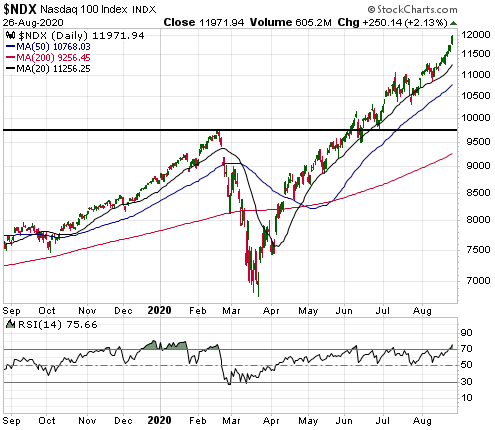
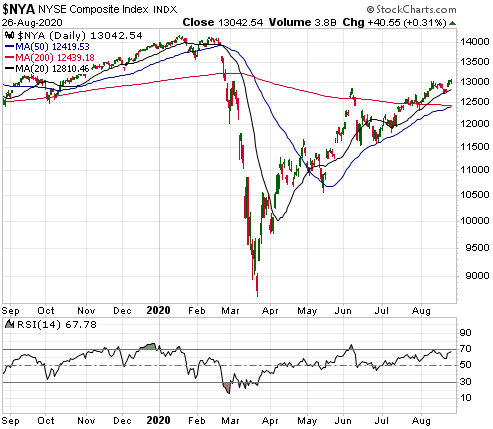
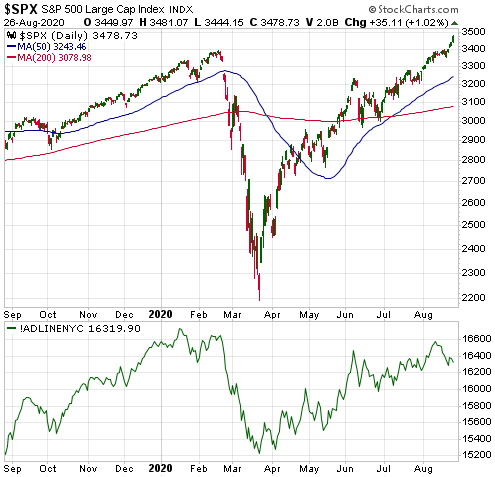
The NDX and to a lesser degree the SPX are immersed in upside
blow-offs. There are warning signs that the blow-offs will end soon, such
as the pronounced recent divergence between the SPX and the NYSE
Advance-Decline Line (ADL) illustrated below (over the past several days
the SPX accelerated upward into new-high territory while the ADL dropped
below where it was in early-June). However, even if the blow-offs continue
for only 1-2 more weeks the losses will be problematic for bearish
speculations linked to these indices. Consequently, for risk management
purposes we have removed the short-term trading position in QID, a
leveraged ETF that moves in the opposite direction to QQQ, from the TSI
List and recorded a loss of about 13%. We still like the idea of averaging
into QID call options expiring in October-2020 or later, but we now prefer
the $10 or $9 calls to the $11 calls previously suggested.
In the coming Weekly Update we'll revisit the 1930 and 1980 models
discussed in recent TSI commentaries. Both models remain applicable.
SPAC Fever
Every stock market mania has some
unique characteristics. A unique characteristic of the current mania is
the popularity of Special Purpose Acquisition Companies (SPACs), which are
also known as "blank check companies". These companies have no current
operations and are established solely for the purpose of buying another
company at some point in the future. Typically, they hold between a few
hundred million dollars and a few billion dollars of cash. They have been
around for decades, but prior to the past two years they were quite
obscure and it wasn't until this year that they became well known by the
investing public.
The recent rapid growth in the popularity of
SPACs is evidenced by the fact that they raised $3.2B in 2016, $13.6B in
2019 and $22B over the first seven months of this year. More than 50 SPACs
have been created during this year to date and it now seems that every
week a few new ones pop up. There aren't anywhere near enough good
acquisition opportunities and astute investment managers to justify the
proliferation of SPACs, but this is a case where the old saying "when the
ducks are quacking, feed them!" applies. The public has $ signs in its
eyes, has discovered SPACs and is eager to buy. As usual, Wall Street is
eager to supply what the public is clamouring to buy.
Time
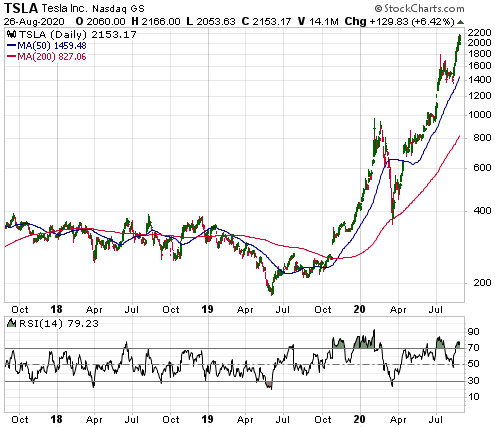
to short Tesla (TSLA)?
Periodically over the past three
years we thought that TSLA was absurdly over-priced and were tempted to
establish a bearish position, but apart from two brief and successful
put-option trades we have steered clear of bets against the stock.
Due to the extraordinary increase in the company's market capitalisation
over the past five months, an increase based on nothing more tangible than
dreams about what the company might accomplish in the distant future if
everything goes right, we are again tempted to establish a bearish
position. After all, the stock still would look very expensive if it lost
75% of its current market value.
We are again going to resist the
temptation, however, for two reasons. The first is that to limit our risk
we would only make such a bet via the purchase of put options, but TSLA
put options are too pricey for our liking. The second reason is that in a
world with crazily-high monetary inflation we want to limit ourselves to
bearish speculations that also hedge our long exposure. A TSLA put option
wouldn't do that.
Gold and the Dollar
Gold and Silver
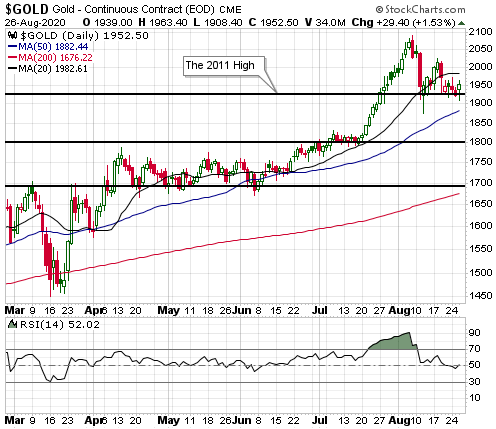
Over the past 6 trading days the US$ gold price thoroughly tested
support in the $1920s. This could be viewed as a successful test of the
late-July upside break into new all-time high territory.
The upward reversal on Wednesday 26th August following a spike below
support doesn't look particularly significant on the above daily chart,
but we suspect that it marked a multi-week low and that the next $50-$100
move will be to the upside. The overall pattern is unchanged, though, in
that a multi-month top probably was set in early-August and what we are
seeing at the moment is part of a topping formation.
That being
said, confirmation of a multi-month top requires a weekly close below
US$1920. Until that happens there will be a realistic chance that the
August decline was nothing more than a routine consolidation within a
continuing short-term upward trend.
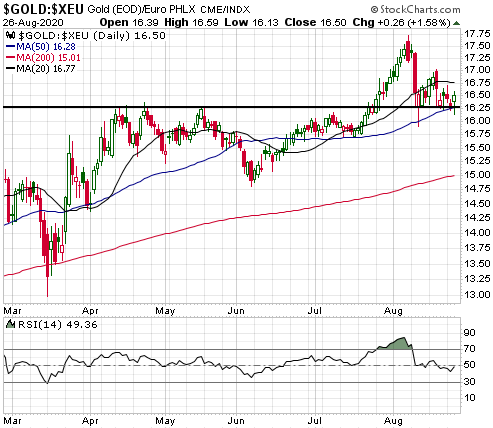
The euro gold price is
positioned similarly to the US$ gold price, in that on Wednesday 26th
August there was an upward reversal following a spike below support. A
rebound to the 1700-1750 range is likely.
The short-term US$ silver price chart displayed below looks more
bullish than the short-term US$ gold price chart displayed above. In
particular, we point out that over the past 6 trading days the gold price
dropped well below its 20-day MA to the vicinity of its early-August low,
but the silver price did no worse than test its 20-day MA before reversing
upward on Wednesday 26th August. This suggests to us that whereas gold
probably won't exceed its early-August high before commencing its next
meaningful decline, silver stands a decent chance of making a new high for
the year within the coming 2 weeks.
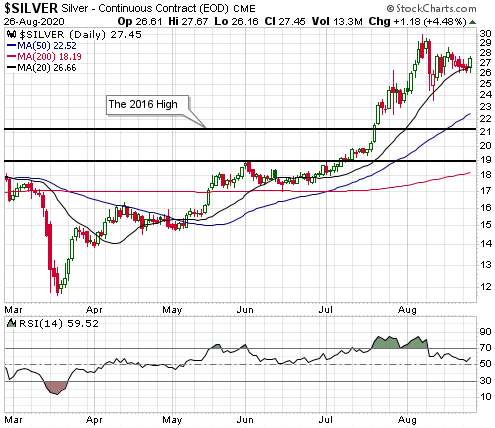
In summary, our guess is that the gold and silver markets commenced
rallies on Wednesday 26th August that probably will end within the next
two weeks at a lower year-to-date high for gold and a new year-to-date
high for silver. We expect that larger corrective moves than occurred
during the first half of August will then get underway.
Gold Stocks
To recap, our view has been that the HUI set a
multi-month price top at 374 on 5th August and a multi-week low at 319 on
11th August. Also, we thought that prior to the resumption of the
'corrective' decline there would be some consolidation that could
encompass a test of the 5th August high, and that 260 was a plausible
target for the ultimate correction low.
There has been no change
since our last report.
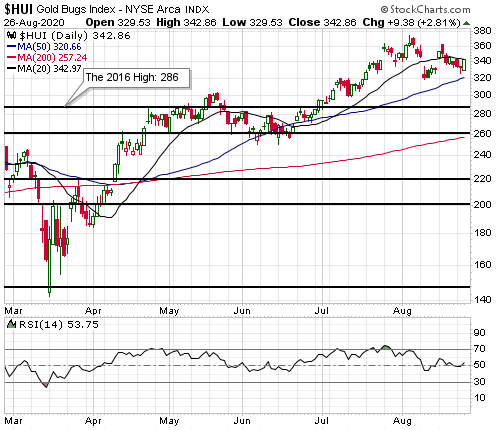
Needless to say (but we'll say it anyway), there is never just one
plausible scenario. As we mentioned a week ago, a weekly HUI close above
374 in the near future would indicate that something other than the
favoured scenario outlined above was playing out. If this (a solid break
to a new high for the year) were to happen soon it likely would be because
speculators were front-running the coming US "inflation", thus bringing
forward some of the US$ weakness and associated gains in asset prices that
we currently expect to see during the first half of next year.
Actually, the risk is significant that the price changes we expect to
happen over the next 12 months will instead be compressed into the next 4
months. This is why we have been emphasising the importance of maintaining
core exposure in line with the cyclical US$ decline. The idea is to insure
against a short-term US$ rebound by building-up cash and/or purchasing
some hedges, while keeping longer-term positions that should benefit from
US$ weakness.
The Currency Market
Almost
nothing happened in the currency market during the week since our last
report. Our interpretation continues to be that the Dollar Index (DX) is
building a short-term base, but validation of this view requires a daily
close above 94.
The potential for a countertrend rebound in the US$
is the biggest short-term threat facing the equity and commodity markets.
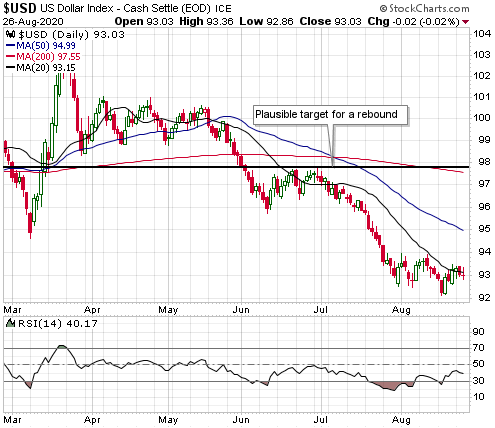
Chart Sources
Charts appearing in today's commentary
are courtesy of:
https://stockcharts.com/