|
- 18 December, 2002
The Reflation
Trade
Here is an extract from a recent commentary
entitled "The Reflation Trade" by Morgan Stanley's Stephen Roach:
"All this begs the critical question
as to whether the policies of reflation will ultimately work. For what
it's worth, I continue to have my doubts. Policy traction is an art, not
a science. And I continue to fear that the artistes have lost sight of
the canvas -- a dangerously US-centric world that still finds its principal
growth engine in the throes of a wrenching post-bubble shakeout. Policy
traction in America typically falls to three sectors -- consumer durables,
homebuilding, and business capital spending. With all three sectors having
gone to extreme excess in recent years, I still fear the impact of policy
stimulus could be surprisingly muted. And barring the emergence of a new
engine of global growth, the world would flounder in response to the inevitable
next relapse in America's post-bubble workout.
But I concede that the financial
markets probably won't see it that way -- at least for a while. The fix
is on, and this is the medicine that has always worked in the past. It
brings back all the glories of investor jingoism -- don't fight the Fed
and, above all, don't have the audacity to believe that this time is different.
The great bear market of our lifetime has dished out enough punishment.
The recent pullback in equity markets after an eight-week surge off the
early October lows has the appeal of an intriguing entry point. I suspect
we're about to enjoy a long overdue respite -- albeit a temporary one at
that. If that qualifies me as bullish, so be it. It's a good trade."
[Emphasis added]
Stephen Roach's views on the economy
have generally been 'on the mark' over the past two years, but he has not
been anywhere near the mark when it comes to inflation/deflation. He has
spent a lot of time this year explaining why the US was facing a major
deflation problem (he defines deflation as a decline in the general price
level), but due to the Fed's stated intention to "reflate" at all costs
he now perceives a more bullish equity environment. Actually, he's not
sure that the Fed will be successful in its attempts to reflate. Rather,
he thinks the markets will believe in the Fed's ability to reflate and,
therefore, that it's worth turning bullish for a trade.
Roach's recent semi-back-flip highlights
the trouble that people can get themselves into when their argument is
based on an incorrect premise. If Roach knew what deflation was then he
would realise that the US has faced, and continues to face, a major inflation
problem. Quite simply, there are way too many dollars in the world. The
effects of this excess dollar supply can't be seen by looking at the current
price-behaviour of the things that were bid-up to stratospheric heights
during the mania of the 1990s, but they can be seen by looking at the prices
of the things that did not benefit from the 1990s mania. These things include
gold, commodities, and the other major fiat currencies. An effect of the
excess supply of dollars can also be seen in the monthly US trade numbers
(the huge trade deficits are an indirect result of US$ inflation).
Someone who understood the true nature
of the problem facing the US would not need to contemplate whether it was
possible for the US monetary authorities to "reflate" their way out of
the current mess. It's as simple as this: If the problem is too many dollars,
then how can creating more dollars possibly do anything other than make
the problem even worse? If the problem really is too few dollars, then
why is the US$ falling against gold, commodities and other currencies?
If you start with the incorrect premise
that falling prices are THE problem, then you might seriously entertain
the absurd notion that 'reflation' could be a viable solution. If, however,
you understand that the current predicament was created by the excessive
expansion of credit (that is, by a high rate of inflation) then you will
realise that more of the same can't possibly be a solution. In fact, you
will realise that deflation isn't the problem, it's the only viable
solution. In order to cleanse the system of the enormous excesses
resulting from the great US credit bubble, a lengthy and painful period
of deflation will be necessary. Hyper-inflation is also a solution, but
not a viable one if the US$ is to maintain its utility as a medium of exchange.
Deflation is the solution, but it's
not going to happen prior to the 2004 presidential election. In the mean
time, those investments that benefit from the US$ inflation problem should
continue to do well. It's not the "reflation trade", Stephen, it's the
"inflation trade", and it's been working really well for about 2 years
now.
The US
Stock Market
The chips are down
According to Fred Hickey, one of the
world's best technology analysts, 40% of total semiconductor output ends
up in PCs and another 20% ends up in mobile phones. Based on what the major
sellers of PCs have been saying over the past few weeks, we know that the
demand for PCs is now well below expectations. As such, we can be confident
that the upward guidance to revenue estimates recently provided by Intel
and Advanced Micro Devices is purely associated with an inventory build
and, therefore, that revenue/earnings estimates for these two manufacturers
of microprocessors will have to be lowered at some point over the coming
2-3 months.
Based on information from Nokia we
also know that the demand for new mobile phones has not lived up to expectations,
meaning that the suppliers of chips for mobile phones are going to have
to reduce their revenue/earnings estimates over the coming few months.
Last week Cirrus Logic, a supplier
of chips for electronic consumer-entertainment devices such as DVDs, announced
that this quarter's sales were going to be about 20% lower than previously
expected due to order cancellations. So, another significant part of the
chip business is looking weak.
After the close of trading on Tuesday
Micron Technology (MU) reported that its first quarter revenue was way
below expectations. The Micron stock price fell 23% on Wednesday in response
to this news, but the fact that the news could have been a surprise shows
how little attention is being paid to underlying business health and valuation
in the tech sector. MU closed on Wednesday at its lowest price since 1996.
Technically, the stock is sitting right at long-term support so a bounce
from near current levels is likely, but since MU is still selling at a
hefty 3-times sales it will drop much lower after the obligatory bounce.
The rally since the 10th October low
was led by the chip stocks, which is evidence, in itself, that the buying
that powered the rally was not based on an educated view of fundamental
business prospects or on any sort of objective valuation analysis. In fact,
the entire rally appears to have been driven by fund managers who put the
fundamentals to one side and tried to generate short-term performance by
wagering other peoples' money on high-beta stocks (stocks that are highly
sensitive to movements in the overall market). The problem for the performance-chasers
comes, of course, when they try to 'lock in' the profits on the high-beta
stocks that they've all piled into in their efforts to generate short-term
performance.
Below is a 6-month chart of the Semiconductor
Index (SOX). The SOX is starting to break down and closed below its 50-day
MA on Wednesday, but the technical damage is not yet terminal. However,
a close below 281 would create a 'lower low' and also complete a head-and-shoulders
top formation. If this happens then a reasonable target over the ensuing
3 months would be 170 (about 43% below Wednesday's close).

Current Market Situation
The recent relative weakness of the
SOX has increased our confidence that the bear-market rally has ended,
but we are still looking for the major indices to close below their November
pullback lows to provide definitive technical evidence that the major downtrend
has resumed. The levels to watch are 872 for the S&P500, 8298 for the
Dow Industrials, 1319 for the NASDAQ Composite, and 972 for the NASDAQ100.
Gold and
the Dollar
The Inflation Trade
There are plenty of economists and
commentators on the economy, Lawrence Kudlow being a high-profile example,
who simply don't have a clue what is happening. They are "new economy"
cheerleaders who think that everything was just fine until the Fed raised
interest rates in 1999. According to them the Fed has been 'too tight'
over the past 2 years, regardless of the fact that last year's money-supply
growth rate was the highest since the early-1970s and despite the Fed having
implemented the most aggressive rate-reduction cycle in its history. If
only the Fed would lubricate the economy with a lot more money the wonders
of technology-induced productivity improvements would result in another
lengthy economic expansion and another stock bull market, or so the story
goes.
Then there are those who recognise
that the whole "new economy" concept was a fantasy concocted to justify
absurd stock prices and that the US economy is facing major problems as
a result of the excesses of the 1990s, but who also think that inflation
might possibly be a solution to the problem. John Mauldin and PIMCO's
Paul McCulley are in this group, as is Richard Russell (Mr Russell, someone
who has been right about most things over the past few years, says that
the Fed must "inflate or die"). But, as discussed earlier in today's commentary,
how could more money and credit ever, even in our wildest dreams, be a
solution to a problem caused by too much money and credit? The problem,
as also discussed earlier, is that this group is fixating on falling prices.
If you think falling prices are the problem, or even just part of the problem,
then of course you will think that anything that causes prices to move
higher is at least a partial solution.
Lastly, there is Doug Noland and a
small group of "Austrians" who understand that there is simply no easy
way out and that more inflation at this time will just make a very bad
situation even worse.
Now, assume there are only 3 economists
in the world and their names are Larry, John and Ludwig. When asked for
their opinions on how to 'fix' the US economy this is how they respond.
Larry says "the only thing necessary to create a sustainably-vibrant economy
is for the Fed to create lots of money. Technology and entrepreneurial
spirit will take care of the rest." John says "umm...arr...you probably
should try to create some inflation, perhaps by weakening the dollar, although
I doubt that such an action will allow the economy to do anything more
than just muddle through". And Ludwig says "there is no easy fix here.
Way too much debt has been created and a sustainable economic expansion
cannot possibly begin until debt levels have been substantially reduced.
The debt reduction process will be extremely painful, but that is the price
you must pay for permitting one of the greatest credit bubbles in history
to occur."
It's not hard to figure out which of
the above-mentioned economists will be the most popular and which one will
be shunned by policy-makers and anyone wanting to get re-elected in two
year's time. Ludwig will eventually be proven right, but those with the
power to implement and influence monetary policy will follow the course
set by Larry, a course that will receive the reluctant approval of John.
Don't let the daily fluctuations in
the various markets cause you to lose sight of the bigger trend. Even though
the US has a major inflation problem, powerful forces have been galvanised
to create even more inflation. Given that one of these forces is an institution
with an unlimited ability to create dollars, they will appear to be victorious
for a while. This is why the inflation trade - going long those things
that benefit from higher inflation and a weaker dollar - is probably going
to be a winner for another couple of years at least.
Gold Stocks
Below is a 3-year chart showing the
HMY/GG ratio (the Harmony Gold stock price divided by the Goldcorp stock
price). Two major differences between Harmony and Goldcorp are:
a) Harmony has substantial leverage
to the spot gold price whereas Goldcorp has minimal leverage (Goldcorp
is unhedged, but its low production costs and sky-high stock market valuation
mean that its leverage is low)
b) Harmony is based in South Africa
whereas Goldcorp is based in Canada.
These differences would be expected
to result in HMY out-performing GG when the gold price is strong and under-performing
GG when the gold price is weak. In fact, this is what has generally happened
over the past year. However, the recent action has been inconsistent with
what we would expect because the HMY/GG ratio has remained within its 6-month
consolidation range (GG out-performing HMY) even though the gold price
has shown considerable strength.

One possible explanation for HMY's
failure to out-perform during the recent gold rally is that the market
is concerned about the adverse effect of a strong Rand on HMY's earnings.
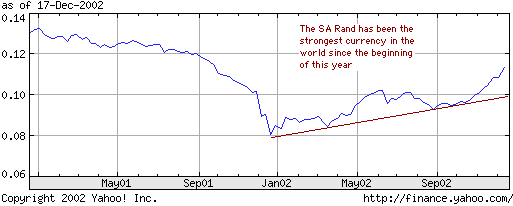
The SA Rand has been trending higher against the US$ since the beginning
of this year and has been particularly strong over the past 2 months (see
chart below). Because Harmony's costs are denominated in Rand and its revenues
are denominated in US Dollars, the immediate impact of an increase in the
US$/Rand exchange rate is a decrease in HMY's profit margin.
Another possible explanation is that
gold stock investors are still 'playing defense'. That is, because they
are not confident that the increase in the gold price is sustainable they
are focusing on the major stocks that appear to be the safest rather than
the ones that offer the most leverage. If this is the case and the gold
price continues to push higher then the Harmony stock price will soon surge
relative to the Goldcorp stock price.
We think the second of the above explanations
is more plausible, for two reasons. Firstly, there has been a strong correlation
between the HMY/GG ratio and the gold price over the past 18 months, but
no meaningful correlation between the US$/Rand exchange rate and the Harmony
stock price. Secondly, the greatest leverage to the gold price can be found
amongst the junior gold stocks, but there has been very little speculation
in the juniors over the past 2 weeks.
Current Market Situation
Below is a daily chart of gold futures.
On Wednesday the gold price closed above $340, thus bettering resistance
defined by the intra-day 'spike peak' during October of 1999. The best
case, if you are long (and the worst case if you are short), is that gold
will accelerate higher from here and that any subsequent pullbacks will
hold at, or above, $340. However, gold could drop all the way back to its
former downtrend-line (currently around $326) without doing major damage
to the bullish argument.

It's amazing how often a market that
breaks through an intermediate-term trend-line, as gold did last week,
will move back to test that trend-line before resuming its new trend. For
example, in late-November we mentioned that the Swiss Franc had done exactly
that (pulled back to its former downtrend-line). As the following chart
shows, the SF subsequently moved sharply higher and has broken decisively
above its July peak.

Note that we don't expect the gold
price to drop all the way back to the mid-320s in the near future, but
just wanted to point out the maximum decline that could occur at this time
without negating the short-term bullish argument.
The Dollar Index has not yet broken
down (see chart below), but since gold, the euro and the SF have all broken
out to the upside the probability is high that the Dollar Index will soon
move decisively below its July bottom. As mentioned in the latest Weekly
Update, 97 becomes a reasonable target for the Dollar Index once we get
a close below 103.50.

The gold bull market probably has years
to run, but an important intermediate-term peak (a peak that will be followed
by at least a 6-month correction) is likely at some stage over the coming
3 months. Such a peak could actually occur within the next 2-3 weeks if
we get sufficient blow-offs in the gold and currency markets. We'll monitor
various indicators, including the performances of gold stock prices relative
to the gold price as discussed in the Weekly Update, in an effort to identify
a good selling opportunity.
Although we don't yet have any evidence
that gold stocks are near a peak or that the downside risk substantially
outweighs the upside potential, it might be appropriate to take some
profits now. We say "might" because the decision will be different for
each person depending on their level of exposure and the stocks they own.
For example, someone who has made a large (relative to the size of their
total investment portfolio) commitment to gold stocks should probably start
taking some profits now, whereas someone with a relatively small exposure
should not. Also, some stocks, such as the over-priced North American favourites
(GG, MDG, AEM and GLG) are sale candidates right now whereas other stocks,
such as the major SA producers and most of the junior gold companies, are
not. Lastly, if at any time you have a gain of a few hundred percent in
any stock or option it always makes sense to at least retrieve your initial
investment even if the trend remains bullish.
Our plan is to take profits on call
options first, then to take profits on the major gold stocks, and finally
to take profits on our junior gold stocks.
Update
on Stock Selections
Desert Sun Mining (TSXV: DSM) has gained
57% so far this week. It has the potential to move much higher and can
still be bought if we get a decent pullback (a drop to C$0.65-$0.70 would
represent a buying opportunity).
Chart Sources
Charts used in today's commentary were
taken from the following web sites:
http://stockcharts.com/index.html
http://www.futuresource.com/
http://finance.yahoo.com/

|









