|
-- Weekly Market Update for the Week Commencing 31st December 2012
Big Picture
View
Here is a summary of our big picture
view of the markets. Note that our short-term views may differ from our
big picture view.
In nominal dollar terms, the BULL market in US Treasury Bonds
that began in the early 1980s will end by 2013. In real (gold)
terms, bonds commenced a secular BEAR market in 2001 that will continue
until 2014-2020. (Last
update: 23 January 2012)
The stock market, as represented by the S&P500 Index,
commenced
a secular BEAR market during the first quarter of 2000, where "secular
bear market" is defined as a long-term downward trend in valuations
(P/E ratios, etc.) and gold-denominated prices. This secular trend will bottom sometime between 2014 and 2020.
(Last update: 22 October 2007)
A secular BEAR market in the Dollar
began during the final quarter of 2000 and ended in July of 2008. This
secular bear market will be followed by a multi-year period of range
trading.
(Last
update: 09 February 2009)
Gold commenced a
secular bull market relative to all fiat currencies, the CRB Index,
bonds and most stock market indices during 1999-2001.
This secular trend will peak sometime between 2014 and 2020.
(Last update: 22 October 2007)
Commodities,
as represented by the Continuous Commodity Index (CCI), commenced a
secular BULL market in 2001 in nominal dollar terms. The first major
upward leg in this bull market ended during the first half of 2008, but
a long-term peak won't occur until 2014-2020. In real (gold) terms,
commodities commenced a secular BEAR market in 2001 that will continue
until 2014-2020.
(Last
update: 09 February 2009)
Copyright
Reminder
The commentaries that appear at TSI
may not be distributed, in full or in part, without our written permission.
In particular, please note that the posting of extracts from TSI commentaries
at other web sites or providing links to TSI commentaries at other web
sites (for example, at discussion boards) without our written permission
is prohibited.
We reserve the right to immediately
terminate the subscription of any TSI subscriber who distributes the TSI
commentaries without our written permission.
Outlook Summary
Market
|
Short-Term
(1-3 month)
|
Intermediate-Term
(6-12 month)
|
Long-Term
(2-5 Year)
|
|
Gold
|
Bullish
(17-Oct-12)
|
Bullish
(26-Mar-12)
|
Bullish
|
|
US$ (Dollar Index)
|
Neutral
(24-Dec-12)
|
Neutral
(09-Jan-12)
|
Neutral
(19-Sep-07)
|
|
Bonds (US T-Bond)
|
Neutral
(12-Nov-12)
|
Neutral
(18-Jan-12)
|
Bearish |
|
Stock Market
(DJW)
|
Bearish
(30-Jul-12)
|
Bearish
(28-Nov-11)
|
Bearish
|
|
Gold Stocks
(HUI)
|
Bullish
(24-Dec-12)
|
Bullish
(23-Jun-10)
|
Bullish
|
|
Oil |
Neutral
(30-Jul-12)
|
Neutral
(31-Jan-11)
|
Bullish
|
|
Industrial Metals
(GYX)
|
Neutral
(30-Jul-12)
|
Neutral
(29-Aug-11)
|
Neutral
(11-Jan-10)
|
Notes:
1. In those cases where we have been able to identify the commentary in
which the most recent outlook change occurred we've put the date of the
commentary below the current outlook.
2. "Neutral", in the above table, means that we either don't have a
firm opinion or that we think risk and reward are roughly in balance with respect to the timeframe in question.
3. Long-term views are determined almost completely by fundamentals,
intermediate-term views by
fundamentals, sentiment and technicals, and short-term views by sentiment and
technicals.
Schedule Reminder
There will be no Interim Update again this
week, but we'll be back to our normal publishing schedule thereafter.
China's Regression
Continues
When we relocated from Shanghai, China, to
Malaysian Borneo in August of 2011 it was for lifestyle reasons. We swapped life
in a crowded, polluted city where it was uncomfortably cold for about one-third
of the year for a more relaxed and healthier existence in the tropics. We had a
concern at the time that the attempts by China's government to censor the
internet would hinder our business activities, but this concern was not a big
part of our decision to leave. We assumed that we would be able to find ways
around whatever road blocks the government put in place.
It is now beginning to look like we made the right decision to leave for
business reasons as well as lifestyle reasons, because as discussed in a
28th December New York Times article the Chinese government is becoming far
more aggressive in its efforts to control information flow via the internet. For
example, the Chinese government has always blocked many web sites, but up until
recently it was possible to get around these blocks by using a VPN (virtual
private network). It seems, however, that the Chinese government has developed
methods of identifying and blocking VPNs. Private entrepreneurs will undoubtedly
figure out ways around the new censorship programs implemented by the
government, but it's a good bet that this will only prompt the government to
resort to more draconian measures. It is clear that China's government is 'hell
bent' on ensuring that its citizens only get access to information that the
Communist Party deems acceptable.
It's probably not a coincidence that this more strenuous clamp-down on
information flow is happening shortly after a) the internet was used to 'out' a
number of Chinese government officials engaged in unseemly behaviour, and b)
embarrassing details about the personal finances of Wen Jiabao (China's current
Premier) and Xi Jinping (the newly elected leader of China's Communist Party)
were made available on the internet by the New York Times and Bloomberg.
The measures that China's government is implementing to make it more difficult
to obtain and transmit useful information via the internet will have substantial
adverse implications for China's economy -- an economy that is already seriously
ill due to monetary inflation, corruption, and mal-investment. In effect,
China's government is working hard to put Chinese businesses and investors at a
competitive disadvantage.
Oil Update
The oil price bounced last week in reaction
to a little sabre-rattling by Iran's government, but in the grand scheme of
things last week's price action was irrelevant. As illustrated below, oil has
spent the past two years oscillating within a wide range. Last week's bounce did
nothing other than edge the price to the middle of this range and to just below
the 200-day moving average.

Oil's multi-year consolidation reflects the net effect of strong counteracting
forces. Downward pressure exerted by increasing US oil supply and global
economic weakness has been offset by "QE" and the fear that the Middle East's
oil supply will be disrupted.
We don't have a strong opinion on how these forces will resolve over the coming
12 months, although a decline to near the bottom of the 2-year range would
almost certainly prompt us to upgrade our intermediate-term oil price outlook to
"bullish" on the basis that monetary inflation is creating a rising floor that
has most likely reached the $60s.
The Stock
Market
The stock market generally doesn't do a good
job of discounting the future. Why would it when it represents the collective
opinion of millions of investors, most of whom are not well informed. That's why
the market will regularly make a big move in one direction, scream "oops!", and
then retrace the move. However, when the press harps on day after day about a
'big problem' and stock market yawns day after day, you can be sure that there
is not actually a big problem or that the problem is fully discounted in current
stock prices.
Since the Presidential election, the press in the US has been harping on day
after day about the "fiscal cliff". There have been dozens of "cliff"-related
headlines every day for the past few weeks. And yet, prior to last week the
stock market ignored the issue. Last week was the first week that there was any
noticeable stock market response to the "cliff" issue, although there is no way
of knowing for sure if the stock market has begun to show some concern about the
"fiscal cliff" or has finally begun to acknowledge the reality that the US
economy is in recession.
The concern that became evident last week wasn't reflected to a meaningful
extent in the performances of the senior stock indices. Indices such as the
S&P500 were down, but not by much. The concern to which we are referring was
reflected in the Volatility Index (VIX). As illustrated by the following chart,
the VIX moved sharply higher last week despite a fairly minor decline in the
S&P500 Index and is now well above where it peaked in reaction to the much
larger stock market decline that occurred during October-November. This tells us
that rather than significantly reducing their stock market exposure, investors
are using options to hedge -- just in case something unexpectedly-negative
happens over the coming month.

Our guess is that there will be a rebound over the next two weeks followed by a
multi-week decline, with the most likely catalyst for the decline being the
recognition that current prices don't reflect the recession reality. Although we
don't perceive the "debt ceiling" to be an important issue, arguments within the
US government over the raising of the debt ceiling could also contribute to
short-term weakness.
This week's
important US economic events
| Date |
Description |
| Monday Dec 31 |
Dallas Fed Mfg Survey
| | Tuesday Jan 01 |
Markets closed for New Year's Day | | Wednesday
Jan 02 |
FOMC Minutes
ISM Mfg Index
Construction Spending
Motor Vehicle Sales | | Thursday
Jan 03 |
No important events scheduled
|
| Friday Jan 04 |
Monthly Employment Report
ISM Non-Mfg Index
Factory Orders
|
Gold and
the Dollar
Gold
The US$ gold price spiked down to support in the $1630s during the week before
last and traded sideways just below its 200-day moving average last week.

There isn't much to add to what we've said in recent commentaries. Sentiment
remains supportive, with Market Vane's survey showing a decline in gold's
bullish percentage to 57 and the COT data showing a decline in the total
speculative net-long position in COMEX gold futures from a high of 269K
contracts in early October to 188K contracts last week. Also, the premium to net
asset value of the Sprott Physical Gold and Sprott Physical Silver Trusts is
around 1.5%, which in both cases is just above the all-time low.
This doesn't mean that a short-term price low is necessarily in place. It means
that the short-term risk/reward is skewed towards reward.
Our best guess is that a short-term price low is in place or will be put in
place via a drop to a marginal new multi-week low in the near future.
Gold Stocks
The Big Picture
In some ways the current economic and political situations are similar to those
of the 1930s, but the gold mining sector's performance over the past 10 years or
so has a lot more in common with its performance during the 1970s than with its
performance during the 1930s. Furthermore, there are two inter-related
fundamental reasons why this time around the gold mining sector is performing
similarly to how it did during the 1970s and very differently from how it did
during the 1930s. Before we get to these reasons we'll present charts that
illustrate the similarities and differences to which we are referring.
The following chart shows the Barrons Gold Mining Index (BGMI) in its top
section and the BGMI/gold ratio in its bottom section. Notice that:
a) The pace of the BGMI's advance from its 2000 low has been roughly the same,
up until now, as it was during the long-term bull market that began in the
early-1960s. This is illustrated by the angled green lines drawn on the chart.
These lines are parallel.
b) As was the case during the bull market of the 1960s and 1970s, the BGMI
strengthened relative to gold bullion during the first few years of the current
long-term bull market and then embarked on a major downward trend.

The next chart shows the BGMI/gold ratio from 1929 through to 1945, with the
share price of Homestake Mining (HM) used in lieu of the BGMI prior to 1938 (we
scaled the HM share price data to create a smooth transition between the HM and
BGMI data sets). Of particular note:
a) The gold mining sector was in a strong upward trend relative to gold bullion
from April of 1930 through to the end of 1935. It then traded sideways relative
to gold until mid-1939.
b) The gold mining sector even managed to handily outperform gold bullion during
a period when the Dow Jones Industrials Index lost 90% of its value (Oct-1929
through to Jul-1932).

(Thanks to Nick Laird, proprietor
of the excellent Sharelynx.com site, for
most of the historical data used to compile the above charts)
Now, the reasons for the differences.
The primary cause of the difference between the performance of the BGMI/gold
ratio during the 1930s and its performance during the more recent bull markets
is the difference in the monetary system. During the 1930s gold was officially
money and the dollar was defined in terms of gold. Due to this official link,
the rate of exchange between dollars and gold was fixed at 20.67 dollars per
ounce until 1933 and at 35 dollars per ounce from 1934 onwards (there was a
transition period of about 12 months over which the rate was steadily increased
from 20.67 to 35). The increase in the gold/US$ exchange rate during 1933-1934
ensured that the deflationary phase of the Great Depression ended in 1933, but
the remaining link between the dollar and gold restricted the amount of new
money that the Fed could create. This, in turn, restricted the extent of the US
federal government's deficit spending (the Roosevelt administration spent
aggressively by the standards of the day, but not by current standards).
The primary difference leads to the secondary difference, and the secondary
difference is the most important -- although certainly not the only -- reason
why gold mining stocks under-performed gold bullion during the bull market of
the 1970s and have under-performed gold bullion since 2004. The reason is "price
inflation". Due to the effects of rapid money-supply growth the cost of mining
an ounce of gold rose substantially during the gold-stock bull market of the
1960s-1970s (especially during the 1970s) and over the past 10 years. This
increase in mining costs was largely responsible for the failure of the average
gold stock to not only leverage gains in the gold price, but even to simply keep
pace with the gold price.
The effects of "price deflation" and "price inflation" on the performance of the
gold mining sector relative to the bullion were also evident during the 1930s.
First, even though the dollar-gold exchange rate was fixed at $20.67/ounce
during 1929-1933, the cost of mining an ounce of gold fell sharply due to the
monetary deflation of the period. This led to much greater profit margins for
gold miners, enabling the stocks of gold producers to buck one of the greatest
downward trends in stock market history. Gold miners were literally digging up
money at a time when the purchasing power of money was in a steep upward trend.
Second, although prices generally began rising in 1933, the pace at which the
general price level rose during 1933-1934 was slow and at the same time the gold
mining sector was helped by the large official upward revaluation of gold
bullion. Third, by early 1936 the gold mining industry had begun to feel the
effects of "price inflation". With the gold price fixed at $35/ounce, rising
costs were causing profit margins to erode and stock prices to fall. Fourth, a
brief resumption of "price deflation" during 1937-1938 led to a rebound in
gold-mining profit margins and enabled the gold mining sector to recoup its
losses of the preceding 1-2 years, but World War II then provided the US
government and the Fed with the perfect cover for dramatically ramping up
government spending and the money supply (the US money supply tripled and
government spending rose to almost 50% of GDP during the War). With the gold
price still fixed at $35/ounce, the resultant increase in mining costs caused
gold-mining profit margins to contract and the BGMI to lose more than half its
value in terms of gold and dollars.
Due to a) the effects of inflation on mining costs, b) the performance of gold
stocks relative to gold bullion during the 1970s and c) the need for gold
producers to invest a lot of money in exploration and/or acquisitions every year
to offset reserve depletion, we haven't been long-term bullish on the senior
gold mining stocks relative to gold bullion since early-2004. However, we have
still been a little surprised by how poorly these stocks have fared relative to
bullion. We have been more than a little surprised by how poorly the junior gold
mining stocks have fared, although to be fair the junior end of the market has
periodically delivered spectacular gains during the course of the bull market.
The most recent 20-month period was miserable, as was 2008. However, 2002, 2003,
2005, 2006, 2009 and 2010 were terrific.
Looking ahead, we continue to believe that it makes sense to focus on the junior
end of the market. The juniors can be adversely affected as much or more than
the seniors by "price inflation" (rising costs), but this risk is counteracted
by vastly greater upside potential. That being said, speculating in juniors
requires a different approach now than it did during 2001-2007. During 2001-2007
a speculator could be successful by placing a lot of emphasis on the current
market value of a company's in-ground resource, because the market would
eventually reward companies based on the amount of in-ground gold they were able
to prove-up. However, this is no longer the case. Many exploration-stage gold
miners are now trading at less than $20 per in-ground gold ounce. Some are even
trading at less than $10 per ounce of in-ground gold. The market didn't care
about cheap resources over the past 12 months and it probably won't care about
cheap resources anytime soon. The market's focus for the foreseeable future will
continue to be on the likelihood of a deposit being developed into a profitable
mine within the next few years, taking into account the financing, technical and
geopolitical risks associated with the deposit. That's why it will be more
important than ever, going forward, to direct most of our attention and money
towards two types of gold mining stock: exploration-stage miners with low
political and permitting risk, low technical risk, good management, sizeable
cash reserves and high net present values relative to projected capex
requirements, and profitable producers with low political risk.
Current Market Situation
When we compare the current positions of the BGMI and the BGMI/gold ratio with
their positions throughout the 1960s-1970s bull market we conclude that the
current situation is most similar to either December of 1972 or the second
quarter of 1977 (the points labeled A and B on the chart displayed above). If
the current situation is, in fact, similar to either of these prior times then
the gold mining sector will do well in nominal dollar terms over the next 12
months. Relative to gold, the mining stocks will do well over the coming 12
months if the current situation is analogous to late-1972 and poorly over the
next 12 months if the current situation is analogous to Q2-1977.
We like the comparison with the 1970s because we are dealing with the same
sector responding to similar problems and opportunities, and because the bull
markets of the 1960s-1970s and 2000s-2010s have unfolded similarly to date.
However, we should always be wary when it comes to historical comparisons, and
considering the fundamental differences between the present and any earlier time
period we should now be even more wary than usual of such comparisons. In other
words, don't hang your hat on the price action over the next year mimicking
either 1973 or 1977-1978.
One plausible way that 2013's price action could deviate from the 1973 and
1977-1978 scenarios involves a decline to test the May-2012 low during the first
half of the coming year.
Not much happened last week. The positive divergence between the HUI and the HUI/gold
ratio remained intact as prices essentially moved sideways. We are anticipating
a 1-2 month rebound, but the rebound doesn't appear to have started yet.

We are tempted to initiate another short-term trade in either GDXJ or GLDX, but
the set-up isn't quite right. However, we think that both of these junior
gold-stock ETFs are strong intermediate-term buys near their current prices. A
chart of GDXJ is shown below.

Currency Market Update
Over the past week Japan's new prime minister continued to step-up the pressure
on the BOJ to set an "inflation" target of at least 2%. This encouraged more
Yen-selling by currency speculators, pushing Yen futures down to important
support in the 115-117 range.

It will be interesting to see if the BOJ follows through with decisive action to
reduce the Yen's purchasing power. The only action that would do the trick is to
materially increase the rate of growth in the Yen supply. As shown below,
Japan's year-over-year money-supply growth rate is presently near its 20-year
average of 2%.

The financial markets are assuming that the BOJ will cave in to the political
pressure, but it's important to understand that nothing has actually happened
yet. The Yen's decline to date has been based solely on anticipation of future
actions that may or may not happen. Moreover, even if the BOJ inflates the Yen
supply enough to bring about a sustained 2% per year reduction in the Yen's
purchasing power it will still be inflating at a much slower pace than the Fed,
resulting in the Yen remaining a relatively strong currency on a long-term
basis.
Unfortunately, it will be at least a few months before we'll be able to tell,
from the money-supply data, whether or not the BOJ is taking the actions desired
by Japan's economically illiterate PM.
Almost regardless of what the BOJ does over the next couple of months, the Yen
could soon begin to rebound due to the extent to which it is now extended to the
downside. Speculators have piled into Yen short positions, surveys show that Yen
sentiment is the most negative it has been in many years, and momentum
indicators are at 'oversold' extremes on both daily and weekly bases. That's why
we shifted about 10% of our cash reserve into Yen late last week.
On to a different topic, we often find that what we expect to happen in the
markets actually does happen, but that it happens much later than we originally
expected. There are many examples, the one that we'll focus on now being an
upward revaluation of the Hong Kong Dollar (HK$) relative to the US$.
High and rising prices for goods, services and real estate are major problems in
Hong Kong. The root cause of this "price inflation" problem is the peg to the
US$, which forces Hong Kong's monetary authority to follow the Fed's monetary
policies. The Fed's monetary policies ARE going to cause a major "price
inflation" problem in the US. No ifs, buts or maybes. Very few people can see
this problem coming in the US because the moribund economy and the
private-sector de-leveraging have temporarily and partially counteracted the
purchasing-power-related effect of the monetary inflation, but in Hong Kong the
purchasing-power-related effect of the monetary inflation is blatant and has
been so for years. That's why we've been anticipating a change in the HK$-US$
peg for years.
A change will probably happen sooner or later, with the HK$ ending up being
worth at least 15% more relative to the US$ than it is today.
Anticipation of an upward revaluation of the HK$ has caused us to keep most of
what we think of as our US$ cash position in HK dollars. As long as the peg is
maintained at its current level there is no difference between holding US
dollars and holding HK dollars. However, there is upside potential and no
downside risk to holding the HK$ in lieu of the US$ because if there is a change
to the peg anytime soon it will involve an increase in the relative value of the
HK$.
Update
on Stock Selections
Notes: 1) To review the complete list of current TSI stock selections, logon at
http://www.speculative-investor.com/new/market_logon.asp
and then click on "Stock Selections" in the menu. When at the Stock
Selections page, click on a stock's symbol to bring-up an archive of
our comments on the stock in question. 2) The Small Stock Watch List is
located at http://www.speculative-investor.com/new/smallstockwatch.html
 Company
news/developments for the week ended Friday 28th December 2012: Company
news/developments for the week ended Friday 28th December 2012:
[Note: FS = Feasibility Study, IRR = Internal Rate of Return, MD&A =
Management Discussion and Analysis, M&I = Measured and Indicated,
NAV = Net Asset Value, NPV(X%) = Net Present Value using a discount
rate of X%, P&P = Proven and Probable, PEA = Preliminary Economic
Assessment, PFS = Pre-Feasibility Study]
*Energy Fuels (EFR.TO) has entered into an interesting financing
arrangement with Virginia Energy Resources (VUI.V). EFR will be
purchasing 9.4M VUI shares in exchange for $250K cash and 21.9M of
its own shares. At the time the deal was announced VUI shares were
trading at C$0.51, which means that the financing arrangement
implies a value of about C$0.21 for the EFR shares. This constitutes
a premium of about 20% to the EFR share price at the time of the
announcement.
This financing will result in EFR owning about 20% of VUI, a company
that has as its major asset the development-stage Coles Hill uranium
project in Virginia, USA. Coles Hill contains the largest known
untapped uranium deposit in the US. It has an Indicated resource of
133M pounds of U3O8 at a low average grade of about 0.05%, but
despite the low grade a PEA completed in September of 2012 showed
that it could be developed into a profitable 2M-pounds/year mine
assuming a long-term uranium price of $64/pound.
This seems like a reasonable deal for EFR. Also, VUI could become a
good speculation in its own right after the uranium price commences
a new bull market. VUI's current market cap (at C$0.50/share) is
only C$24M.
*Evolution Mining (EVN.AX) announced that commissioning has
commenced at its newly constructed Mt Carlton gold-silver-copper
mine in North Queensland. Mt Carlton is expected to contribute
25K-30K ounces of gold production during the first half of the 2013
calendar year and to produce an average of 80K ounces of gold per
year over its 12-year life.
Although Mt Carlton is a simple open-pit mine, it would be
surprising if there weren't a few hiccups during commissioning and
production ramp-up. If these hiccups occur they shouldn't present a
significant problem for EVN because the company has a strong balance
sheet and four existing cash-flow-positive gold mines.
EVN rebounded from the low-A$1.60s to the low-A$1.70s over the past
week, where it remains a good candidate for new buying.
Prospect
Generators
A prospect generator generates new projects with low-cost greenfields
exploration programs. The probability of any single project resulting in a major
discovery is very low, but a prospect generator greatly increases its chances of
success by having a large stable of projects in various stages of development.
Furthermore, many of the projects will be the subject of joint venture (JV)
agreements with other companies, with the JV partner typically earning 50%-70%
of the project by making cash or stock payments to the prospect generator and
funding drilling and other work programs.
When the right people are involved, the prospect generator model works well.
Risk is kept low and the probability of exploration success is increased by
having a large number of "irons in the fire". In addition, expenses are kept low
by having other companies fund the high-cost drilling programs. There aren't
many prospect generators, however, because the right people are scarce. The
right people include talented field geologists with a wealth of experience, and
managers who are good at identifying opportunities and negotiating deals.
The two best prospect generators that we know of in the gold mining industry are
Almaden Minerals (TSX: AAM, NYSE: AAU) and Eurasian Minerals (TSXV: EMX, NYSE:
EMXX). We wrote the following about EMX in the 11th April 2012 Interim Update:
"When its agreement to purchase Bullion Monarch (USOTC: BULM) is completed
during the second quarter of this year, EMX will have more than 145 projects
spread across five continents. More than 90 of these projects have been JV'd,
meaning that another company is funding all the exploration work in exchange for
a (typically) 50%-70% stake. EMX will also have a currently-paying 1-per-cent
gross smelter return royalty on several of Newmont Mining's operations in
Nevada. This royalty paid $6M in 2011.
Newmont Mining is currently EMX's most important JV partner. In addition to the
above-mentioned royalty linked to some of Newmont's Nevada operations, the major
has agreed to fund $30M of exploration on EMX's projects in Haiti in order to
earn a 65%-75% stake. Also, Newmont owns about 7% of EMX.
The prospect generator model can be a good business model in almost any
financial environment, but it is particularly attractive in the current
environment because it reduces all forms of risk, including political risk
(assuming the portfolio is geographically diverse, which is certainly the case
with EMX), and conserves money. With so many projects under joint venture, $44M
in the bank and regular cash infusions from the Newmont royalty, EMX could
develop its projects for many years without having to obtain additional
financing. Some of its JV partners will have to prove-up substantial in-ground
resources in order for EMX's stock price to make huge gains, but there isn't
anywhere near as much downside risk with a well-funded well-diversified prospect
generator such as EMX as there is with a single- or dual-project
exploration-stage miner that has to fund all of its own work."
Since then the stock price is little changed, the Bullion Monarch acquisition
has been completed and the working capital has dropped to $27M. The company has
72M shares issued and 91M shares on a fully diluted basis.

Almaden (AAU) has over 40 projects in various stages of exploration, $22M of
working capital and $10M of investments. It has 59M shares issued and 65M shares
on a fully diluted basis.
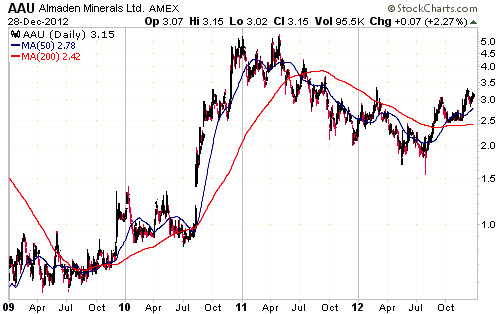
It's impossible to accurately value companies such as EMX and AAU because almost
all of their upside is related to potential exploration success. With dozens of
projects in their portfolios there's a good chance that at least a few projects
will be winners, but there is no reasonable way of placing a dollar value on
that chance. The best bet is simply to accumulate a position during times, like
the present, when the market is assigning a very low value to the exploration
potential. We estimate that the market is currently assigning a value of about
$58M ($145M market cap minus $27M working capital minus $60M for the
in-production royalties) to EMX's stable of exploration projects and a value of
about $154M ($186M market cap minus $32M of working capital and investments) to
AAU's stable of exploration projects. The likely reason for the much greater
value being assigned to AAU's exploration projects is that AAU appears to have
made an important discovery at a project that it has maintained 100% ownership
of. We are referring to the Tuligtic project in Mexico, for which a maiden
resource estimate is scheduled for early-2013.
At this stage we aren't going to add either of these prospect generators to the
TSI Stocks List, but we like both stocks and have begun to accumulate positions
for our own account. This is the lowest-risk way that we know of to speculate on
exploration success.
Chart Sources
Charts appearing in today's commentary
are courtesy of:
http://stockcharts.com/index.html

|









