-- 2004 Forecast
We
didn't do a separate Yearly Forecast at the beginning of 2004; instead,
we included the following summary in the 28th January Interim Update.
Yearly
Forecast
This year we are not going to do a
separate Yearly Forecast as we've done in previous years. This is because
a) we provide 12-month forecasts as part of the regular commentaries, and
b) we want to downplay the importance of forecasting (as explained in the
14th January Interim Update it is real-time risk/reward analysis that determines
how much money we make, not how accurate we happen to be with our longer-term
forecasts). However, just to make sure everyone is on the same page we
are including, below, a summary of our current expectations for the markets
over the remainder of this year. These forecasts are, of course, subject
to revision at any time as new information becomes available.
 The
US Stock Market The
US Stock Market
Our expectations for the stock market
as far as the next 2 years are concerned were outlined in the 14th January
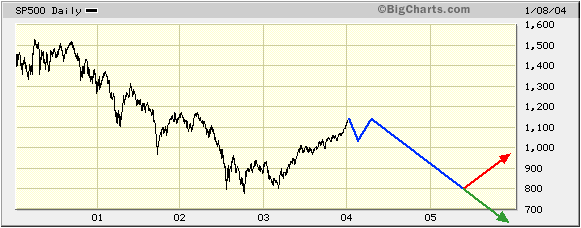
Interim Update under the heading "The Big Picture". In a nutshell, we expect
to see a topping process during the first half of this year -- perhaps
a January peak followed by a higher peak in March or April -- and then
a decline lasting 12 months or longer. The below chart, which was originally
included in the aforementioned commentary, roughly illustrates the expected
pattern. The red line on the chart shows what we think could happen if
the US government attempts Japanese-style intervention while the green
line represents what we think the market would do if left to its own devices.
Interest
Rates
Our view is that long-term interest
rates made a secular low last June and will move substantially higher over
the coming 12 months following a secondary low during the first half of
this year. We expect that the Fed will begin to hike the official short-term
interest rate aggressively soon after long-term interest rates move above
their August-2003 high, regardless of the state of the economy at the time
or the closeness of the presidential election.
Commodities
When the CRB Index recently moved above
its 1996 high (see chart below) it provided belated confirmation that a
long-term bull market was in progress. We say "belated confirmation" because
this breakout is not a reason for us to become bullish on commodities;
it simply confirms the bullish view we've held over the past 18 months.
The next obstacles will be the 1988 peak of around 270 and the 1980 peak
of around 340.

The CRB rose in almost straight-line
fashion from 230 to its recent high of around 270, so we'd be surprised
if the breakout above the 1996 high were followed, in the short-term, by
additional large gains. In fact, many of the commodities that led the CRB
Index higher over the past two years are likely to experience pullbacks
over the next few months, resulting in a multi-month period of consolidation
for the CRB. However, we expect that the Fed's determination to keep short-term
interest rates at a very low level for as long as possible will help the
CRB Index move up to near its 1980 peak within the next 12-18 months.
The
Dollar
We expect that the Dollar Index will
drop to test long-term support in the 78-80 range (equivalent to about
135 for the euro) during the first half of this year and that this test
will be successful (the support will hold).
The reason we anticipate a drop to
near the long-term support is that the Fed probably isn't going to tighten
monetary policy and thus remove one of the most important drivers of US$
weakness until US bonds break decisively lower; and we could still be a
few months away from a breakdown in the bond market.
The reasons we don't expect a breach
of long-term support THIS year are:
a) Significant additional weakness
in the US$ would most likely prompt other central banks -- particularly
the ECB -- to join with the Japanese central bank in a coordinated effort
to support the dollar. This dollar support could take the form of direct
intervention in the currency market or, in the ECB's case, reductions in
official interest rates.
b) Over the past two years the US bond
market has benefited from US$ weakness due, primarily, to Japanese buying
of US bonds in response to every dollar decline. However, this is a situation
that can only continue for as long as dollar weakness does not generate
inflation fears. Our guess, though, is that if the Dollar Index dropped
to near 80 then the possibility of this support giving way would cause
inflation fears to rise and precipitate large-scale selling of US bonds.
The resultant surge in long-term interest rates would, in turn, force the
Fed into action.
So, our Dollar forecast is for a bottom
during the next several months followed by a rebound over the remainder
of the year.
Gold
Our forecast for gold is illustrated
on the below chart and is necessarily the approximate opposite of our forecast
for the Dollar. In summary, we expect that the current correction will
bottom some time between now and the end of February and be followed by
a multi-month rally. A lengthy (6 months or longer) consolidation would
then follow.
Our upside price target for the aforementioned
rally is $460, but we wouldn't be surprised to see gold overshoot by $30-$50.

We expect the silver price to move
in roughly the same direction as the gold price, but with much greater
volatility.
Gold
Stocks
A low for the current correction in
the gold stocks is likely to precede a correction low for the gold price.
For example, if gold bottoms towards the end of February then we'd expect
that a correction low would be in place for the gold stocks by mid February.
Furthermore, gold stocks are likely to reach their next peak prior to a
peak in the gold price and after a peak in the Dow Industrials Index. Therefore,
based on what we know right now the sequence that makes the most sense
is:
- A Dow peak in March/April
- A gold stock peak in April/May
- A gold peak in May/June

|






