-- 2011 Forecast
Yearly
Forecast
 Random Thoughts Random Thoughts
*When we penned our 2010 forecast at around this time last year we
stated that similarities between the stock market's current situation
and its situation during the early 1930s had been eliminated. If any
more evidence were needed to rule out an early-1930s-like scenario,
2010's market action provided it.
*As also stated in our 2010 yearly forecast, the monetary
backdrop is the single most important difference between the early
1930s and the current situation. Specifically, there was massive
monetary deflation during the early 1930s and there has been massive
monetary inflation since September of 2008. Although it has helped to
support prices, the surge in money supply will have very negative
long-term consequences.
*Our view continues to be that a global economic depression of
the inflationary kind has begun. At this stage the symptoms of economic
depression are only evident in the US, Europe and Japan, but we expect
that the depression will become more widespread after China's
real-estate bubble bursts.
*We perceive the eventual bursting of China's real estate bubble
to be the biggest risk facing the stock and commodity markets in 2011.
The rising price of food is a potential catalyst for the bursting of
this bubble, the reason being that China's policy-makers will be forced
to bring about much tighter monetary conditions if food prices continue
along their upward path.
*China's isn't the only real estate market in bubble territory.
For example, property bubbles are alive in Canada and Australia. The
existence of these bubbles adds to the overall risk.
*We perceive the euro-zone government debt problem as the second
biggest risk facing the stock and commodity markets in 2011. The
euro-zone countries with the worst government balance sheets and the
weakest economies will, as a group, have to roll over about $1 trillion
of sovereign debt this year, which is unlikely to be achievable
(without massive ECB support) unless stock markets remain buoyant. If
the global stock-market rally ends then the world's financial markets
will become much less liquid as speculators retreat to cash and other
safe havens.
*Stock market risk is high, but if the stock market avoids a
large decline then uranium- and agriculture-related stocks will
probably do very well in both absolute and relative terms. If the stock
market goes into a lengthy retreat then gold will probably be the
best-performing sector.
*For equity and commodity speculators, money-making was
relatively easy during 2009 and 2010. At least, that's the way it
seemed to us. Our 'gut feeling' is that it will be far more difficult
in 2011 and that our primary focus over the coming 12 months should be
on retaining the large gains of 2009-2010. In this regard, we think
that a well-above-average cash position is warranted as the year
commences.
The US Stock Market
Going
into last year our expectation was that the stock market would roughly
track the average for the second year of the 4-year Presidential
Election Cycle, which would have meant an upward bias through to April
followed by a downward bias through to early October and then a strong
rebound into year-end. It ended up tracking this pattern quite closely
until late August, at which point there was a dramatic change in
response to the Fed's promise to create a veritable flood of new money.
The general belief that the Fed was committed to monetary profligacy
kept the US stock market in a short-term upward trend from late August
of last year through to mid January of this year.
The third year of the Presidential Election Cycle tends to be the
strongest of the cycle. Also, the bulk of the gains achieved during the
average third year occurred during the first half of the year, meaning
that from a cyclical perspective the outlook for the next 6 months is
very bullish. However, we think that the stock market's chances of
following the average for the Cycle's third year have greatly
diminished due to the substantial gains achieved over the past five
months.
Our best guess at this time is that the stock market will be 'choppy'
during the first half of this year, with a sizable downward correction
occurring within the first two months. A lengthy decline is expected to
begin during the third quarter of the year.
There is a significant risk that the aforementioned "lengthy decline"
will start much sooner than the third quarter. The main reasons we
think it will be delayed until the second half of the year are a) the
bullish cyclical influence, b) the Fed's debt monetisation, and c) the
tendency for major stock market tops to evolve over several months.
The earnings backdrop will probably remain positive for the next 1-2
quarters, but this shouldn't be cited as part of a bullish case for the
broad stock market. The reason is that the historical correlation
between earnings growth during a year and the broad stock market's
performance during the same year is approximately zero.
The last point before we move on is that although we perceive a lot of
downside risk in the stock market, we continue to believe that the
March-2009 lows will prove to be the ultimate bear-market lows in
nominal dollar terms. This is due to the effects of the Fed's policies
on the US$. To be more specific, there has been a large increase in the
US$ supply over the past two years, a consequence being that a US$ is
worth materially less today than it was two years ago. Furthermore,
whereas the Fed was quite slow to man the money pumps during the
2007-2008 equity bear market, it will almost certainly act very quickly
next time around. This places a floor under the stock market's
dollar-denominated price, but obviously not its 'real' price or its
price in gold terms.
The US Dollar
In the 2010 Yearly Forecast we wrote:
"There has been a strong
inverse relationship over the past two years between the perceived
strength of the global economy -- as indicated by the performances of
equities and high-yield bonds -- and the US dollar's value relative to
most other currencies. This inverse relationship is clearly illustrated
by the following chart comparison of Hong Kong's stock market and the
Dollar Index."
We went on to explain this relationship as follows:
"...when global growth is
widely believed to be strong or on the rise, investment demand shifts
towards the geographical areas that offer the most concentrated
exposure to the growth. For many years, the most concentrated exposure
to economic growth has been provided by the "emerging markets" and the
countries that supply these markets with commodities. Furthermore, it
makes sense to fund investments/speculations in the high-growth regions
by selling investments in slower-growth regions and/or borrowing in
terms of a liquid currency that offers a comparatively low interest
rate. During the global growth periods of the past few years, interest
rates have been lowest and growth has been slowest in Japan and the US.
It has therefore been logical -- from the perspective of, say, a
hedge-fund manager -- to borrow/sell the Yen and the US$ to finance
speculations in emerging markets and commodity producers. The demand
for Yen and US dollars thus rises whenever these speculations are
unwound."
The same comments apply today, except that the strong inverse
relationship has now been in effect for about three years. An updated
comparison of Hong Kong's stock market and the Dollar Index is
displayed below.
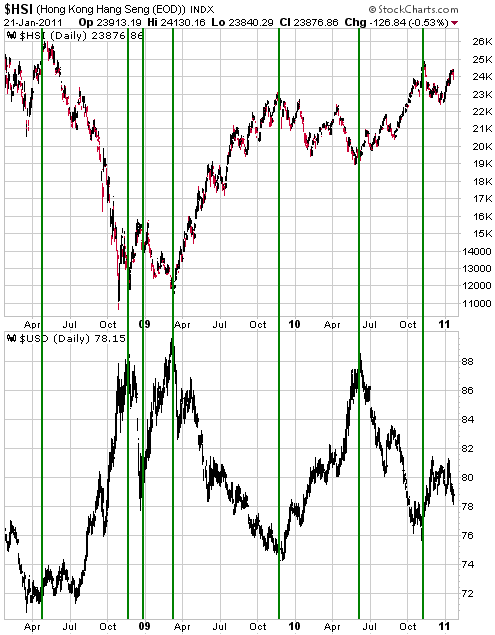
We don't have an
opinion on the path that the Dollar Index will take over the course of
the year, but we do think that it will trade up to near the top of its
3-year range (88-90) before the year is out and that its downside risk
is relatively low at the time of writing (the Dollar Index ended last
week at 78.2). In addition to stock market weakness, the US$ could
benefit from the re-kindling of European debt-default fears.
T-Bonds
Last
year's rally on the back of the Fed's promise to monetise a huge
quantity of the US Treasury's debt failed to take the T-Bond price
above its December-2008 peak. This lends credence to the view that US
government bonds are now a little over two years into a secular bear
market.
We would be anticipating considerable weakness in the T-Bond market
(rising bond yields) during this year's first half if not for the fact
that T-Bond futures are currently at the sort of 'oversold' extreme
that over the past decade has always been followed by at least 6 months
of T-Bond strength. This weekly chart illustrates what we are talking
about:

The 'oversold'
extreme in the T-Bond market meshes with the stock market's
'overbought' extreme, although T-Bond sentiment is presently not as
extreme as stock market sentiment (traders don't appear to be as
bearish on bonds as they are bullish on stocks).
Our best guess at this time is that 2011 will turn out to be a flat
year for the T-Bond. The bond market's downside should be mitigated
over the first half of the year by the fact that it began the year at
an 'oversold' extreme, and T-Bonds should benefit from stock market
weakness during the second half of the year.
Gold
In the yearly forecast posted at the beginning of 2010, we wrote:
"The fact that gold did
not experience an upside blow-off during 2009 means that 2010 should be
another good year in US$ terms, with a move to new all-time highs
following the completion of the current correction. Volatility will
probably be a lot greater, though, because the general level of
nervousness -- within the ranks of speculators, investors and
policy-makers -- will increase after it becomes clear that the economic
rebound has ended."
This forecast was roughly correct, except that volatility never
increased much. The main reason it didn't increase is that confidence
in the economic recovery theme remained high.
There was no upside blow-off in the gold market in 2010, which is
consistent with our view that gold's long-term bull market still has at
least a few years to run (major upside blow-offs usually occur near the
ends of long-term upward trends). Also, gold's downside risk has been
mitigated by the pullback that occurred over the first three weeks of
2011. That being said, gold has now risen for ten years in succession
and it would be unprecedented for a long-term bull market to run its
full course without experiencing at least one down year. We therefore
won't be surprised if 2011 turns out to be a down year, although we
will be surprised if it is down by much more than 10%. On an
intermediate-term basis we are now "neutral" on the US$ gold price.
In euro terms, gold is likely to have another 'up' year in response to concerns about sovereign debt default.
At the start of last year we thought that the economic recovery theme
would unravel during the year's second half, causing gold to do well
against the industrial commodities. Instead, the recovery -- or the
illusion of recovery, depending on your perspective -- extended
throughout 2010. Our reasons for believing that this recovery has very
flimsy underpinnings are still in place, though, which means that our
2010 forecast has been pushed into 2011. That is, relative to oil and
the industrial metals we expect that gold will end the year with
substantial gains.
We also expect that gold will perform better than silver during 2011.
Gold Stocks
There was a distinct possibility that the gold sector, as represented
by the HUI, would begin 2011 'with a bang' and quickly move up to
650-700. If this had happened then the stage would have been set for a
large correction in terms of both price and time. However, the HUI
pulled back to begin the year and is presently nearing an 'oversold'
extreme. Although this means that the short-term outcome proved to be
more bearish than anticipated, it also means that a lot of downside
risk has been removed from the market. Consequently, the
intermediate-term outlook is now more bullish than it would have been
in the absence of the recent correction.
Following the unusually steady rise of 2009-2010, we expect that the
gold-stock indices will experience more of a 'rollercoaster ride'
during 2011. They will probably end the year with gains, but as was the
case in 2010 by far the best gains are likely to occur within the ranks
of the juniors.
Industrial Commodities
We expect industrial commodities such as oil and the base metals to continue trending with the stock market during 2011.

|






