-- 2013 Forecast
Yearly
Forecast
 Random Thoughts
1) There are similarities between the current situation in the US,
the US of the 1930s and post-bubble Japan, but the monetary backdrop
is very different in the US today than it was in the earlier
post-bubble periods. The most obvious effect of the monetary
difference is that the prices of most goods and services have
continued to rise in the US since the bursting of the private-sector
credit bubble in 2007.
2) The less obvious effects of the current period's much higher rate
of monetary inflation include the slowing of the corrective process
and the introduction of additional price distortions and
inefficiencies.
3) The US eventually recovered from the bursting of the 1920s bubble
despite the many idiotic policies implemented by the Hoover and
Roosevelt administrations, but the US will not be able to recover
from the bursting of the more recent credit bubble if the Fed
continues to engineer a high rate of monetary inflation. If current
Fed policies continue for at least a few more years, the US economy
will end up in a far worse state than it has ever been before.
4) The above three points are copied from our 2012 Yearly Forecast.
It has become clear that the Fed's policy of throwing new money at
the economy in a horribly misguided effort to generate real growth
is not only going to continue in 2013, but also going to be applied
more aggressively than was the case in 2012. This money-pumping
could prevent widespread recognition of recessionary economic
conditions for several more months, but only at a substantial
long-term cost. For an economy to function efficiently, price
signals must be genuine; that is, price signals must accurately
reflect sustainable consumption and production trends.
5) At the beginning of last year we wrote that there was nowhere
near as much scope for a negative surprise out of China in 2012 as
there had been in 2011, because China's central planners had begun
to loosen the monetary reins and because China's economic problems
had come to be more widely recognised. In a nutshell, we thought
that China-related risk had fallen. This assessment appears to have
been close to the mark, or at least wasn't disproved by events.
Our thinking is unchanged. China has huge economic problems, but
these problems will come to the fore gradually over the space of a
few years and won't likely be the cause of big moves in global
financial markets during 2013.
6) At the beginning of last year we thought that the euro-zone's
government debt problem was still a sizeable risk, but that its
potential to wreak global havoc had been substantially reduced by
virtue of the fact that it had been a "Page 1" story for many
months. This assessment was largely validated by events, as the news
out of Europe continued to get worse over the first seven months of
2012 and yet the euro didn't collapse and severe stock market
weakness was restricted to the small number of euro-zone countries
at the centre of the debt crisis.
'Everyone' is now confident that the worst is over for the
euro-zone's financially-challenged governments and banks.
Paradoxically, this means that the risk is now much greater. The
cause of all the gnashing of teeth that occurred during the second
half of 2011 and the first half of 2012 hasn't disappeared, it has
only been temporarily put aside. The bailouts will continue, with
Spain's government probably requesting an aid package during the
first quarter of this year and Greece's government confessing that
it is once again in need of help. Spain will get a bailout and the
markets will breathe a sigh of relief, but by the third quarter of
this year it should be apparent that France's government is in
danger of defaulting on its debt. After all, the finances of
France's government looked precarious even before a socialist
president came to power and began to enact policies that are sure to
drive many of the country's most productive people and highest
tax-payers elsewhere.
We expect that the euro-zone's government debt disaster will return
to "Page 1" during the second half of 2013.
7) Due to a mismatch between expectations and reality, we thought
that last year's biggest issue for the financial markets would turn
out to be weakness in the US economy (most people were expecting the
US economy to "muddle through" and most equity analysts were
anticipating good earnings growth during 2012). We were wrong. Even
though the US economy was lacklustre and the rate of US corporate
earnings growth dropped to almost zero, the popular "muddle through"
view proved to be closer to the mark.
Unexpected weakness in the US economy is still an intermediate-term
threat worthy of attention, but it is no longer one of our top three
risks. The three biggest risks are the likelihood of the euro-zone's
government debt predicament returning to centre stage (Point 6
above) and the issues outlined in Points 8 and 9 below.
8) Going into 2012 we thought that the second biggest
intermediate-term risk facing the markets involved the potential for
greater instability in the Middle East. We didn't think that there
would be open military conflict between Iran and the US or between
Iran and Israel, but we were concerned that escalating tension
between these countries could have a big effect on the markets. We
were also concerned that the political situations in Egypt and Syria
would become more turbulent, and that there was an outside -- but
not insignificant -- chance of Saudi Arabia getting caught up in the
'revolutionary wave'.
This risk partly materialised, in that the political situations in
Egypt and Syria certainly became more turbulent (Syria's instability
degenerated into civil war, and Egypt's population, having thrown
out their long-serving dictator in 2011, began to experience 'revolter's
remorse' as the democratically-elected replacement showed signs of
being equally bad). However, the financial markets ignored the
troubles in Syria and Egypt, and the possibility of military
conflict between Iran and US/Israel never became a big issue.
As 2013 begins, the potential for greater political and geopolitical
instability in the Middle East remains one of the biggest
intermediate-term risks facing the financial markets. This risk is
more likely to materialise during the second half than the first
half of the year, the reason being that the US government will be
more inclined towards aggressive military action after it becomes
clear that the US economy is in recession. Governments tend to view
external threats as useful distractions during periods of economic
weakness. Also, a real or imagined urgent need for military action
provides an excuse for more government spending and more inflation.
9) There's a new big intermediate-term risk facing the financial
world as 2013 gets underway: the risk that the government bond
bubble will burst. The bursting of the government bond bubble is a
more pressing concern today than it was, say, 6 months ago due to
the immense political pressure being put on the Bank of Japan (BOJ)
to reduce the purchasing power of the Yen. We don't know yet if the
BOJ will actually take the actions required to reduce the Yen's
purchasing power at the rate demanded by Japan's new government, but
if it does then bond yields will be pushed a lot higher in Japan and
the yields on other 'safe haven' government bonds will likely
follow.
The potential for a large decline in government bonds is not only
linked to the goings-on in Japan. Clearly, the Fed and the ECB are
taking actions that will eventually lead to much higher inflation
expectations and bond yields regardless of whether or not the BOJ
joins the inflation party. The big unknown is -- and has always been
-- the timing.
10) We think that 2013's best profit-creating opportunity will be
provided by -- dare we say it -- the gold mining sector.
11) Going into both 2011 and 2012 we thought that money-making would
be far more challenging over the year ahead than it had been during
2009-2010, and that our primary focus should therefore be on
'playing defense'. Unfortunately, as 2013 gets underway we still
think it is appropriate to maintain a moderately defensive posture,
meaning that we continue to advocate an above-average cash position.
The US Stock Market
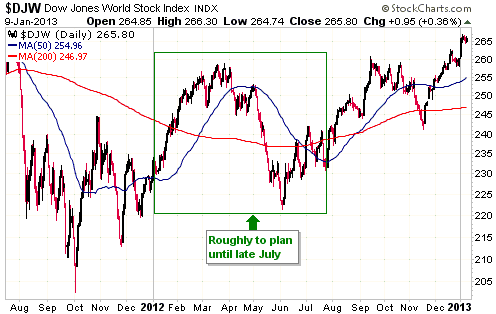
As is our wont, we were too bearish on the stock market in 2012. At
least, our concerns weren't validated by the price action. We
expected the market to hold up fairly well during the first few
months of the year and then roll over into a major downward trend,
with spreading recognition of a US recession being a primary driver
of the downward trend. The first half of 2012 went according to
plan, but the global stock market fared much better during the
second half than we thought it would. The deviation from our 'plan'
began in late July, not coincidentally around the time of ECB chief
Mario Draghi's promise that the ECB would "do whatever it takes". We
under-estimated the importance of the ECB's July-2012 shift.
Although this is the time of year when it is traditional for a
newsletter writer to express an opinion on what will likely happen
over the year ahead, right now we simply have no opinion on what the
stock market will do during 2013 and see no point in pretending
otherwise. The market is 'overbought' on a short-term basis, but
sentiment is neutral and the 'overbought' condition could be
eliminated by a routine consolidation. We think that the risk/reward
balance is skewed towards risk in the short and intermediate terms,
but a perception that risk is markedly higher than potential reward
doesn't necessarily translate into a forecast. It doesn't even
necessarily translate into a view that the market is more likely to
rise than fall. To use an analogy, we would reasonably expect to win
a round of Russian roulette, but it wouldn't make sense for us to
play because the cost of losing would be too great. We view the
current stock market situation in a similar way. Due to how the
risk/reward is skewed, the cost of being wrongly bullish would be
far greater than the cost of being wrongly bearish.
Lastly, as we've done in every yearly forecast beginning with the
2010 edition we reiterate our view that the S&P500's March-2009 low
will prove to be its ultimate bear-market bottom in nominal dollar
terms. This is due to the Fed-promoted depreciation of the US$.
Another consideration noted in previous yearly forecasts is that a
floor has effectively been placed under the US stock market's
dollar-denominated price by the virtual certainty that the Fed will
be a lot quicker to crank up the money pumps in reaction to stock
market weakness in the future than it was during 2007-2008. Based on
the Fed's actions over the past four months a rational observer
could no longer doubt that this is the case. After all, the Fed is
now introducing new money-pumping schemes for no reason other than
the high unemployment rate, as if counterfeiting money could
possibly bring about sustainable gains in employment.
The US Dollar
Most gold bulls are constantly expecting the US$ to tank, but this
expectation is unrealistic considering the dollar's fiat-currency
competition. It should always be remembered that the USD/EUR
exchange rate comprises almost 60% of the Dollar Index, which means
that a bearish view on the Dollar Index equates to a bullish view on
the euro. Based on various considerations including interest-rate
differentials, monetary-inflation differentials and sentiment, there
are times when it makes sense to be bullish on the US$ relative to
the euro and times when it makes sense to be bearish.
Here is how we stated our 2012 forecast for the euro and,
consequently, the Dollar Index (the Dollar Index effectively being
the reciprocal of the euro):
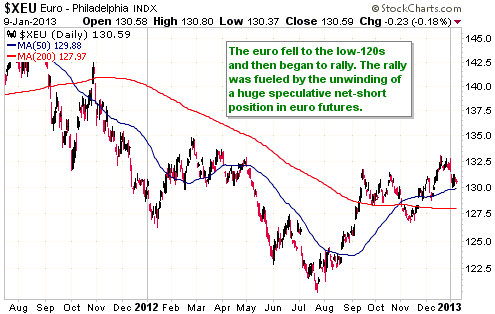
"...for 2012 we are anticipating a multi-month euro rebound,
either beginning near the current level or after a capitulation (a
final blow-off decline) that pushes the euro down to around 1.20. At
this stage there's no point thinking beyond the likely euro rebound.
Instead, we'll wait for the market to work off the massive euro
net-short position and then consider whether or not a major new euro
decline (US$ advance) is likely."
It took longer than expected for the euro to rebound and for the
euro net-short position to be worked off, but it eventually
happened. As things now stand, the euro has rebounded for about 5
months and speculators have shifted from being massively net-short
euro futures to being approximately flat.
Once a sentiment swing from an optimistic or pessimistic extreme
gets underway in the financial markets it usually doesn't end until
the opposite extreme is reached. Given that sentiment in the
currency market has shifted from an anti-euro extreme to neutral,
this probably means that the euro will gain some additional ground
before making an intermediate-term peak (a peak that holds for more
than a few months). Our best guess at this stage is that the euro
will peak at somewhere between 135 and 140 during the first half of
this year and then roll over into a major multi-quarter decline
driven by the resumption of the euro-zone's government debt crisis.
We now turn our attention to the most interesting currency of the
moment: the Yen.
In our 2012 forecast we wrote:
"At some point over the next three years the Yen is likely to
become very weak in response to huge-scale monetisation of Japanese
Government debt, but right now the supply of Yen is growing at a
much slower pace than the supply of dollars and the Fed is making
sure that the US$ has no interest rate advantage over the Yen.
Therefore, over the months ahead the Yen will probably experience
nothing more bearish than a routine correction to its up-trend.
Furthermore, the Yen could benefit from stock market weakness during
the second half of the year."
The Yen has become very weak over the past few months in response to
the ANTICIPATION of huge-scale monetisation of Japanese Government
debt. At this stage it isn't known if the anticipated monetisation
will begin in the near future, although there's a high probability
of it beginning within the coming two years. It's the logical (from
a political perspective) next step along the road to debt default.
We think the Yen is positioned similarly today to how the euro was
positioned at its low points during the first seven months of 2012.
Almost everyone is bearish for reasons that everyone is well aware
of. According to Market Vane's sentiment survey, only 19% of traders
were bullish on the Yen at the low point over the past week. By
comparison, 24% of traders were bullish on the euro when it was
bottoming in late-July of last year. It's possible that the
currency-trading community will become a little more anti-Yen before
we get a meaningful swing in the opposite direction, but there
doesn't seem to be scope for Yen sentiment to get a lot worse.
Primarily for sentiment reasons, we expect that a substantial
multi-month Yen rebound will begin by April. It should also be noted
that long-term fundamentals still favour the Yen over both the US$
and the euro, but that will change if the BOJ begins to increase the
Yen supply at a much faster pace.
Moving along, we expect that the main commodity currencies (the A$
and the C$) will be strongly influenced by the stock market during
2013 just as they were during each of the past several years. To be
a little more specific, the A$ and the C$ will be in rising trends
when the global stock market is strong and falling trends when the
global stock market is weak.
T-Bonds
Before we get to the US
Treasury Bond (T-Bond) we need to discuss Japanese Government Bonds (JGBs),
because what happens to government bonds in Japan could influence what happens
to government bonds in the US during the course of this year.
In anticipation of the Bank of Japan (BOJ) giving in to political pressure to
reduce the purchasing power of the Yen at the rate of at least 2% per year,
currency speculators have been relentlessly selling the Yen over the past two
months. The result is that the Yen has reached an 'oversold' extreme rarely seen
in a major currency. Anticipation of the BOJ becoming 'looser' has also caused
JGB yields to rise, but only by a small amount to date. As evidence we cite the
following chart, which shows an up-tick in the yield on the 10-year JGB from a
December-2012 low of 0.70% to a January-2013 high of 0.84%. This is strange,
because long-term bond yields should be more sensitive than currency exchange
rates to changes in inflation expectations. In effect, currency traders are
saying "the BOJ is going to become much more aggressive in its attempts to
depreciate the Yen", while bond traders are saying "despite all the political
rhetoric and posturing, the BOJ is going to continue doing what it has been
doing".

Chart Source: www.bloomberg.com
We see three possible outcomes with regard to the interplay between Japanese
politics and Japanese monetary policy. They are:
1. The BOJ yields to government pressure to set an "inflation" target of 2% and
then boosts the Yen supply by enough to ensure that this target is achieved or
exceeded.
2. The BOJ yields to government pressure to set an "inflation" target of 2%, but
doesn't follow through with the monetary inflation required to achieve the
"inflation" target.
3. The BOJ resists political pressure and keeps its official "inflation" target
at 1%.
Our view is that Outcome 3 is by far the least likely. Outcome 1 is almost
certain to occur within the next two years, but Outcome 2 is just as likely as
Outcome 1 during the first half of this year.
Something that makes Outcome 2 just as likely as Outcome 1 over the next 6
months is that the Quantitative Easing (QE) process is different in Japan than
it is in the US. Anyway, that's the way it seems to us, although we admit to not
being experts on the way the BOJ conducts its monetary operations. The
difference is that when the Fed does "QE" it adds to bank reserves and the
economy-wide supply of money (bank reserves aren't counted in the money supply),
whereas we get the impression that when the BOJ does "QE" it only adds to bank
reserves. Additions to bank reserves don't directly affect the purchasing power
of money.
Something else that makes Outcome 2 just as likely as Outcome 1 for at least a
couple more quarters is the devastating effect that a significantly higher rate
of "price inflation" would have on the Japanese government's financial
situation. As we stated in our 24th December commentary under the heading "The
Japanese vote for Inflationism":
"...if the BOJ inflated the Yen supply enough to cause the Yen to lose
purchasing power at the rate of at least 2% per year then long-term interest
rates would rise in Japan. This would create a big problem for Japan's
government. The Japanese government's debt is now so massive (about 230% of GDP
and rising) that more than half of its revenue goes to pay interest. And that's
with interest rates at absurdly-low levels (the 10-year Japanese government bond
yields about 0.8%). Economist Andy Xie has estimated that if the bond yield rose
to 2 percent, the interest expense of Japan's government would surpass its total
tax revenue. To put it another way, if government bond yields in Japan rose to
2% or higher then even if Japan's government were to cut all of its non-interest
expenses to zero it would still run a budget deficit due to the interest
payments on its debt.
This means that if Abe gets his way and the BOJ increases the rate of Yen
depreciation to at least 2% per year, then the day when Japan's government is
forced to default on its debt will quickly be brought much closer."
In any case, how the BOJ responds to the political pressure to inflate will
affect the T-Bond, because the absurdly-low yields on JGBs help depress the
yields on other 'safe haven' government bonds.
Before leaving Japan we present the following chart showing the yield on the
10-year JGB from February-1972 through to April-2012. We have included this
chart to make two points. First, that the secular decline in Japanese bond
yields dates back to the early 1980s, meaning that the secular bull markets in
JGBs and T-Bonds began at around the same time. Second, that the ultimate low
for the 10-year JGB yield was way back in 2003 (the May-2003 low for the 10-year
JGB yield was about 0.20% below its December-2012 low).

Chart Source:
www.gecodia.com/Japan-Government-10Y-Yields_a1305.html
The above chart shows that the JGB yield made its ultimate low and then spent
the next 9-10 years basing. This is similar to how the secular US interest-rate
decline of the 1920s-1940s came to an end. Yields on low-risk bonds reached
their ultimate bottom in the early-1940s, but a major upward trend didn't get
underway until the late-1940s. That is, the historical record suggests that
secular bond bull markets tend to end with a whimper rather than a bang.
That long-term bond bull markets have tended to end gradually rather than with
spectacular reversals is probably related to the nature of the market. Bonds are
subject to speculative buying and selling like any other investment, but first
and foremost they are purchased with the aim of earning an interest rate. As the
price of a bond advances its yield-to-maturity declines, and if the price of a
bond rises far enough then its yield-to-maturity will fall to zero. This places
a virtual lid on the price of a bond that doesn't exist for commodities,
equities or real estate. This virtual lid effectively limits the speed at which
a long-in-the-tooth bond bull market can rise and the magnitude by which it can
rise, so rather than the bull market ending with a huge upside blow-off followed
by a definitive downward reversal (as per a long-term gold bull market), it just
peters out.
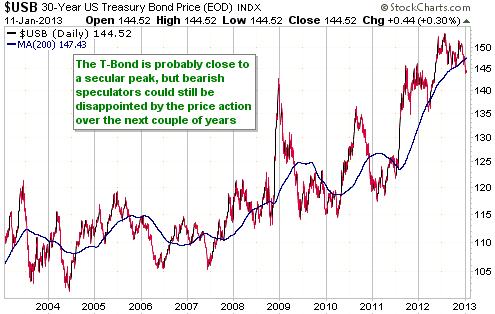
Speculators who bet against the T-Bond could therefore be in for more
disappointment than joy over the years ahead, even if a secular price peak was
recently put in place.
We think that a secular price peak is either in place or will be put in place
this year at not far above last year's high. We also think that a gradual
multi-year rolling over of the T-Bond price (a gradual turning up of the T-Bond
yield) is the most likely outcome following the secular peak, although we are
well aware of the risk that due to the extraordinary actions of the Fed it could
be different this time. It could be different because never before has the US
central bank demonstrated such steadfast commitment to crackpot theories.
After that lengthier-than-intended preamble, we now turn to our yearly T-Bond
forecast.
Our 2012 forecast was for the T-Bond market to weaken in parallel with a firm
stock market over the first few months of the year and to then strengthen as the
stock market trended downward. We thought there was a good chance of a new
all-time high being made prior to the start of a major bear market and that the
intermediate-term risk/reward was neutral.
Our 2013 forecast is similar, except that we would replace "a good chance of a
new all-time high" with "a possibility of a marginal new all-time high". The
intermediate-term risk/reward is still neutral, but only just. With the Fed
'playing fast and loose' with the US dollar and the Japanese government putting
pressure on the BOJ to do the same with the Yen, the risk of an upside breakout
in inflation expectations is increasing. However, the superficial effects of
monetary profligacy could be offset for another 12 months by the combination of
the private sector's continued de-leveraging and declining economic confidence.
Also worth noting is that the T-Bond will be supported over the months ahead by
the Fed's December-2012 promise to "purchase longer-term Treasury securities ...
at a pace of $45 billion per month." Be aware, though, that the Fed's buying
will only provide support to the T-Bond market while inflation expectations
remain in check. Once inflation expectations begin to surge, the Fed's bond
monetisation will have the opposite of the intended effect by adding fuel to the
inflation fire.
Gold
Gold's ultimate price top in nominal
dollar (or euro or some other currency) terms will be determined mostly by what
happens to the official money. For example, a forecast that the US$ gold price
will reach $10,000/oz within the next 5 years seems to be bullish, but if the US
dollar's purchasing power plunges to the extent that 5 years from now a loaf of
bread costs $50 then a rise in the gold price to $10,000/oz over this period
would constitute a substantial decline in real terms. Long-term
dollar-denominated gold price projections are therefore even less useful than
the average long-term forecast. Actually, they are completely useless.
Rather than attempt to do the impossible and accurately predict the ultimate top
in the US$ gold price by some means other than dumb luck, it makes a lot more
sense to continually weigh the evidence in real time to determine if the
long-term bull market remains intact. Along these lines, in our 29th
October-2012 commentary we described four signs that will likely be seen at
around the time of, or just prior to, gold's ultimate price top. For ease of
reference, here they are again:
1) By the time the ultimate top of gold's bull market is close at hand the
general public will have given up on the idea that returning to economic health
requires more money-printing, more government spending and more debt. The
purveyors of such economic quackery will still have their fans, but they will
most definitely be in the minority.
2) Due to gold's historical tendency to FOLLOW major changes in the monetary
situation by at least 2 years, gold probably won't reach its ultimate top until
well after the Fed stops trying to stimulate the economy using cheap credit and
money-pumping.
3) Based on the strong tendency observed under the current monetary system for
long-term bull markets in commodities, equities and real estate to go to absurd
valuation extremes and culminate in spectacular upside blow-offs during their
final 12 months, gold's long-term bull market probably won't end until gold
becomes extremely expensive following a 12-month price rise of well over 100%.
4) As a consequence of the link between long-term gold bull markets and
long-term equity bear markets, the end of the gold bull market should roughly
coincide with the end of the long-term valuation decline in the US stock market.
The broad US stock market becoming very cheap by traditional valuation standards
would therefore be a sign that the gold bull market was close to an end.
Not one of these signs has been evident during the past few years, and based on
the time it would take for them to appear it is reasonable to conclude that
gold's ultimate price top lies a minimum of two years into the future. In other
words, we currently don't perceive a realistic possibility that gold's long-term
bull market has already ended or will end this year.
Regarding the third of the above-mentioned signs of a major gold top, what would
constitute a valuation extreme for gold? After all, gold doesn't have a P/E
ratio or dividend yield.
The January-1980 peak is an example of a valuation extreme. When the gold price
rose above $800/oz in January of 1980 gold was at an all-time high and a long
way above its historical mean relative to the US stock market, the CRB Index,
the average house and the wage of the average worker. A reasonable argument can
be made that gold will exceed its real 1980 peak before the end of the current
bull market, but we would almost certainly view a rise in the gold price to near
its 1980 high in terms of inflation-adjusted (IA) dollars or the broad stock
market as a clear sign that the bull market was near its end. By our
calculations, in current dollar terms the 1980 high is about $3200/oz. The
current-dollar 1980 high will, of course, rise as the US$ is depreciated.
That's the big picture. Let's now consider what we expected the gold market to
do last year and what we expect of it to do in 2013.
Our 12-month outlook at this time last year is reflected by the following
excerpts from our 2012 Yearly Forecast:
"...we suspect that over the course of 2012 gold will be a) roughly flat in
US$ terms (up a few percent or down a few percent), b) up strongly (more than
10%) in euro terms, and c) higher relative to silver and the base metals. The
odds favour it gaining ground against oil, but oil is 2012's biggest wildcard
due to the elevated risk of large-scale military conflict in the Middle East."
"...the next upward legs (in US$ terms) in the long-term gold and silver bull
markets probably won't begin until at least the final quarter of this year. The
main reason for this belief is the extent to which the silver market became
'overbought' and 'overbullish' last April. After a commodity market's sentiment
and price action reach the sorts of extremes that occurred in the silver market
last April it usually takes at least 18 months for the conditions to be right
for the start of a new major upward trend. This doesn't mean that we expect gold
and silver to make new correction lows this year. Our favoured scenario is that
the ultimate correction lows were put in place last month [December-2011] and
that a multi-quarter period of base-building is now underway."
As it turned out, gold was up by 5%-7% in both US$ and euro terms in 2012, so we
were roughly correct about the US$ gold price and a little too optimistic about
the euro gold price. Gold was flat during 2012 relative to the base metals and
relative to silver, meaning that it didn't do as well as anticipated relative to
other metals. This is most likely because the stock market did better than
anticipated.
As expected, gold and silver spent more than half of 2012 basing without
breaking below their 2011 lows.
Before getting to our forecast for the next 12 months it's worth noting that the
US$ gold price has now risen for 12 years in a row. What are the odds of a
market rising for 13 years in a row?
To explain, we point out that the probability of 'heads' coming up 13 times in a
row in a fair coin toss is 1 in 8,192 (about 0.012%), but that the probability
of the thirteenth coin toss coming up 'heads' given that the first twelve tosses
were 'heads' is 50%. We doubt that gold will make it all the way to the end of
its long-term bull market without experiencing a single down year, but the fact
that it has just risen for 12 years in a row doesn't, by itself, make it any
more likely that 2013 will be a down year. After all, as 2013 gets underway gold
is not close to being 'overbought' on either a short or an intermediate-term
basis. Also, in inflation-adjusted dollar terms gold has been either flat or
down in 3 of the past 5 years.
Our 12-month outlook for gold and silver is more bullish this year than it was
last year. Our best guess is that gold and silver will end 2013 at least 20%
higher than they ended 2012 in terms of all the major currencies, with the price
gain driven by the combination of economic weakness and the increasingly
aggressive efforts of the world's most important central banks to counteract
this weakness by depreciating money. Note that we said "the world's most
important central banks" in the previous sentence, rather than "the Fed". This
was deliberate, as the next major up-leg in gold's bull market is just as likely
to be fueled by euro issues as by US$ issues. It could even be fueled by Yen
issues.
We don't have an opinion on the path that gold will take to get from where it is
today to the higher level that we expect it to reach by year-end. For example,
it wouldn't surprise us if there were a few more months of consolidation prior
to the start of the next major upward leg and it also wouldn't surprise us if it
turns out that the next major upward leg has already begun.

Gold Stocks
The 31st December-2012 Weekly Update contains a detailed discussion of the
"big picture" for gold stocks, in which we explained the salient differences
between the gold-stock bull market of the 1930s and the later gold-stock bull
markets (the current one and the one that extended from the early 1960s through
to 1980). Of particular significance, we pointed out that the gold mining sector
(as represented by the Barrons Gold Mining Index - BGMI) was still performing
similarly to how it performed during the 1960s-1970s bull market, both in
nominal dollar terms and relative to gold bullion. We zoomed in on the rather
extreme weakness in gold mining stocks relative to gold bullion during the 1970s
and over the past several years, explaining that "price inflation" (escalation
in the cost of building and operating a gold mine) was the main cause of this
relative weakness.
In the aforementioned commentary we stated the following thoughts regarding the
expected performance of the gold mining sector during 2013:
"When we compare the current positions of the BGMI and the BGMI/gold ratio
with their positions throughout the 1960s-1970s bull market we conclude that the
current situation is most similar to either December of 1972 or the second
quarter of 1977... If the current situation is, in fact, similar to either of
these prior times then the gold mining sector will do well in nominal dollar
terms over the next 12 months. Relative to gold, the mining stocks will do well
over the coming 12 months if the current situation is analogous to late-1972 and
poorly over the next 12 months if the current situation is analogous to Q2-1977.
We like the comparison with the 1970s because we are dealing with the same
sector responding to similar problems and opportunities, and because the bull
markets of the 1960s-1970s and 2000s-2010s have unfolded similarly to date.
However, we should always be wary when it comes to historical comparisons, and
considering the fundamental differences between the present and any earlier time
period we should now be even more wary than usual of such comparisons. In other
words, don't hang your hat on the price action over the next year mimicking
either 1973 or 1977-1978.
One plausible way that 2013's price action could deviate from the 1973 and
1977-1978 scenarios involves a decline to test the May-2012 low during the first
half of the coming year."
Due to the price action over the past two months we think there's a 50%
probability of the May-2012 low being tested during the first half of this year,
but regardless of whether or not this test occurs we expect the gold-stock
indices to finish 2013 with substantial 12-month gains in nominal dollar terms.
To be a little more specific, a test of the HUI's all-time high of 638 seems
possible this year prior to a major upside breakout in 2014. This assumes that
we are right to forecast a sizeable gain in the gold price, because even though
the average gold stock has a low valuation there is very little chance of it
achieving a meaningful price gain over the course of this year unless the
bullion price does the same. The reason is that mining costs will probably rise
again in 2013, causing profit margins to shrink unless the increase in the gold
price is greater than the increase in costs. Even with valuations at depressed
levels in the gold mining sector, it isn't reasonable to expect the investing
community's demand for gold stocks to increase in the face of shrinking
gold-mining profit margins.
As stated in our 31st December report, we continue to believe that it makes
sense to focus on the junior end of the gold mining sector. The juniors can be
adversely affected as much or more than the seniors by "price inflation" (rising
costs), but this risk is counteracted by vastly greater upside potential.
We also pointed out in our 31st December report that speculating in
exploration-stage juniors requires a different approach now than it did during
2001-2007. The reality is that buying in-ground ounces just because they happen
to be very cheap wasn't a valid approach last year and probably won't be a valid
approach this year. Obviously, if all else is equal then it is better to pay a
lower price for ounces in the ground, but all else is rarely equal. For example,
in the current environment it could (probably would) make more sense to pay
$100/oz for a stake in an undeveloped gold deposit in a good location with
above-average grade and low projected capital costs than to pay $10/oz for an
undeveloped gold deposit in a sub-par location with below-average grade and high
projected capital costs. That's why it will be important over the
months/quarters ahead to direct most of our attention and money towards two
types of gold mining stock: exploration-stage miners with low political and
permitting risk, low technical risk, good management, sizeable cash reserves and
high net present values relative to projected capex requirements, and profitable
producers with strong balance sheets and low political risk.
Industrial Commodities
The above discussions ran much longer than planned, so our 2013 forecast for
industrial commodities (the base metals and oil) will have to be brief. This is
actually appropriate, because in the absence of a war that threatens the global
supply of oil the industrial commodities can be relied upon to trend up and down
with the stock market. Since at this time we don't have an opinion on what the
stock market will do during 2013, we also don't have an opinion on what the oil
and base metals markets will do during 2013.
However, we think that the intermediate-term risk/reward is more bullish for oil
and the base metals than for the global stock market, due to the greater reward
potential of the commodities. For the base metals the greater reward potential
is mainly associated with central bank money-pumping. For the oil market it is
mainly associated with the uncomfortably-high probability of war.

|






