- Interim Update 1st April 2020
Copyright
Reminder
The commentaries that appear at TSI
may not be distributed, in full or in part, without our written permission.
In particular, please note that the posting of extracts from TSI commentaries
at other web sites or providing links to TSI commentaries at other web
sites (for example, at discussion boards) without our written permission
is prohibited.
We reserve the right to immediately
terminate the subscription of any TSI subscriber who distributes the TSI
commentaries without our written permission.
The Monthly Closing
Prices
At around this time every month
we review some of the most important (from our perspective) monthly
charts, because monthly closing prices can confirm or deny
intermediate-term trend changes. For March-2020 we'll review the monthly
closes for gold, the HUI and the S&P500 Index (SPX).
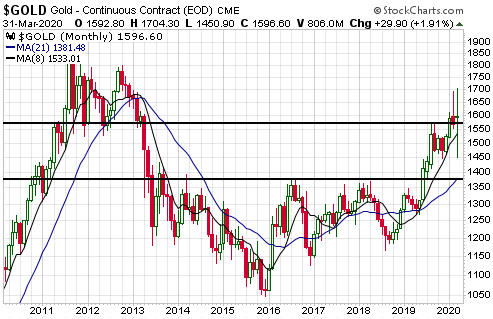
Regarding the
US$ gold price, a month ago we wrote that a top that would hold for at
least a few months had probably been set in February. As it turned out, a
marginal new high was set during March as the gold price moved through a
huge range in reaction to extraordinary events.
As illustrated by
the following monthly chart, the US$ gold price traded as high as $1704
and as low as $1450 in March before ending the month slightly above the
middle of this range. This price action is indicative of rapidly changing
opinions and more than the usual amount of disagreement among market
participants.
As stated in earlier commentaries, critical
monthly-closing support for gold's intermediate-term upward trend is
defined by the 8-month MA. That is, a monthly close below the 8-month MA
would suggest that an intermediate-term top (a top that holds for 6-12
months or longer) is in place. This MA has risen to US$1533.
The
same thing could happen in April that happened in March, that is, there
could be a marginal new high in the gold price this month, but for all
intents and purposes the February high probably will hold for at least a
few more months. Also, there's a decent chance that support at $1450 will
be breached within the next two months as part of a corrective process,
but it's likely that at some point within the next six months the gold
market will begin to discount the long-term progress-hindering effects of
the new monetary and fiscal regimes. That's when the next major gold rally
should 'kick off'.
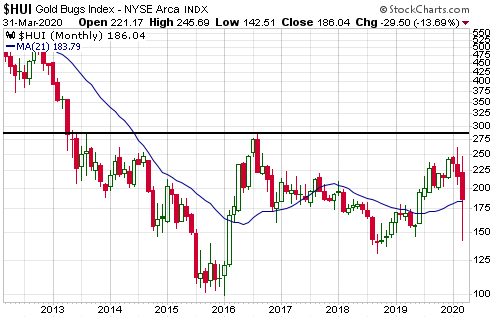
A month ago we noted that February ended up being an outside-down
month for the HUI. We weren't sure what this implied about the future,
other than a top that would hold for at least a few months was probably in
place.
During March the HUI crashed with the broad stock market.
However, it managed to end the month above its 21-month MA (the blue line
on the following chart), which is a sign of strength.
The March low
probably will be tested during April or May, but the massive shake-out of
the past month followed by 1-3 months of base building could set the stage
for a big rally during the second half of this year.
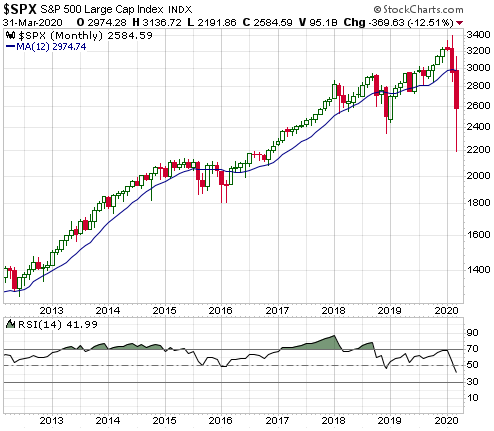
Regarding the US stock market (as represented by the SPX), a month ago
we wrote:
"...there is little doubt about the significance of
February's reversal. The SPX made a new all-time high in February and then
fell far enough to wipe out all gains achieved over the preceding four
months and end the month below its 12-month MA. This implies that either
the bull market is over or an intermediate-term correction has begun. We
think it will turn out to be the latter.
The main reason to favour
an intermediate-term correction over a bear market is that a bearish
breadth divergence did not precede the recent decline. A bear market in US
equities has never begun without a preceding bearish breadth divergence,
but there is precedence for an intermediate-term correction in the absence
of a bearish breadth divergence. The 2011 correction is an example.
Note that even if we are dealing with a correction as opposed to a
bear market, there's a decent chance that the SPX has peaked for the year."
The evidence has since shifted in favour of a bear market. A bear
market in US equities has never begun without a preceding bearish breadth
divergence, but the US government has never before forced the entire
economy into lockdown mode in response to a type of flu virus.
The
way we define the terms, the main difference between a bear market and a
severe (20%+) intermediate-term correction is time. Intermediate-term
corrections generally end within about 6 months whereas cyclical bear
markets extend for 1-3 years.
We still could be dealing with a
1987-style intermediate-term correction, but as far as the next two months
are concerned it probably doesn't matter. The reason is that in either
case the most likely short-term scenario involves a test of the March low.
US Recession
Watch
Since last November we have
assigned a probability of 80% to the US economy entering recession in 2020
and a probability of 50%-60% to a US recession starting during the first
half of 2020. This was based on three leading indicators that, taken
together, have a perfect recession-prediction record. The indicators are
the ISM New Orders Index (NOI), Real Gross Private Domestic Investment
(RGPDI) and the yield curve.
By October of last year all three of
these indicators were warning of recession, but there was still a question
of timing. The question was: Although normal lead times pointed to a
recession start in H1-2020, would the Fed's pre-emptive strike (the Fed
had never before introduced a money-pumping program with the stock market
at an all-time high and the economy still very much in the expansion
phase) delay the start of a recession by up to 12 months?
Prior to
the widespread virus-related shutdowns there was a realistic chance that
recession would be postponed by up to a few quarters, but the world
changed as soon as economic activity was severely curtailed in reaction to
the spread of COVID-19. It is now crystal clear that a US recession began
in March-2020.
Unfortunately, two of our three favourite leading
indicators of recession aren't useful as leading indicators of expansion.
Specifically, a reversal in the yield curve from flattening to steepening
warns that a recession is coming, but after the steepening trend begins it
tends to continue until well after the recession ends. Also, RGPDI tends
to commence a downward trend well before the start of a recession and then
turns upward with the economy at the end of a recession, meaning that it
tends to give a timely warning of the start but not the end of a
recession.
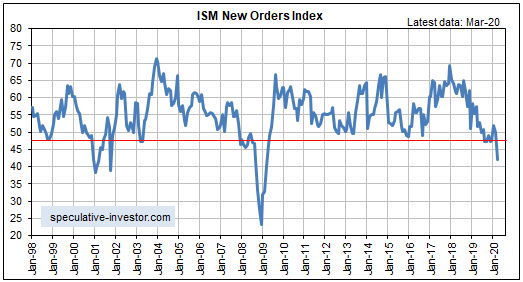
The NOI, however, should still be useful. The NOI
plunged in March (see chart below) and undoubtedly will plunge again in
April. Beyond that is anyone's guess, but the good news is that we don't
have to guess because the NOI is published monthly and should reverse
upward well before the official end date of the recession.
We think that the combination of the NOI and the stock market will
provide a reliable and timely warning that the recession is about to end.
The Stock Market
In the latest Weekly Update, we
wrote:
"We have 2800 in mind as a rebound target [for the SPX],
but the short-term risk/reward for a long position is not attractive
because the current rebound probably will be followed by a decline to test
the March low. A successful test of the low would set the stage for a
longer rebound."
2800 is still a realistic possibility for a
post-crash rebound high. In fact, a rebound could stretch as far as 2900
without changing the overall pattern. However, during both the second half
of last week and the first half of this week the SPX reversed lower after
rising to around 2640.
2640 isn't a random level. As illustrated
by the following weekly chart, it coincides with the 200-week MA. It seems
that a lot of traders are viewing the 200-week MA as an important
resistance level and are selling/shorting as it is approached.
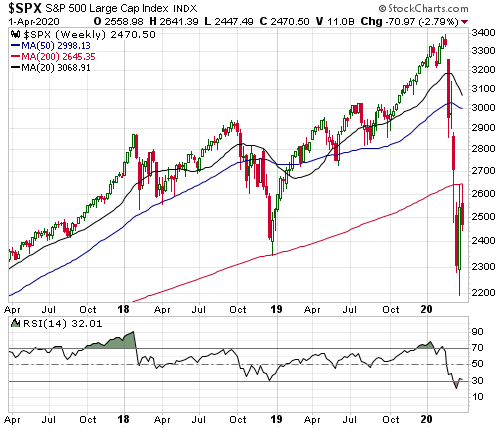
It's certainly possible that the SPX's post-crash rebound ended near
the 200-week MA in the mid-2600s and that a decline to test the March low
has begun, but, as noted above, an extension of the rebound to 2800-2900
is also a realistic possibility prior to the almost-inevitable test of the
crash low.
We don't know which of these possibilities is the more
likely. What we do know is that a rise to 2800-2900 within the next couple
of weeks would create a good set-up for a short-term bearish speculation
and that a decline to the vicinity of the March low at any time within the
next two months would create a good set-up for a short-term bullish
speculation.
Gold and the Dollar
Gold
There was a roughly $60 decline in the US$ gold price over the first three
days of this week. However, large back-and-forth swings have become
commonplace in the gold market just as they have in other markets over the
past several weeks, and, as a consequence, price moves that normally would
signal trend reversals or accelerations are not necessarily significant.
For example, this week's sharp pullback in the gold price didn't change
anything.
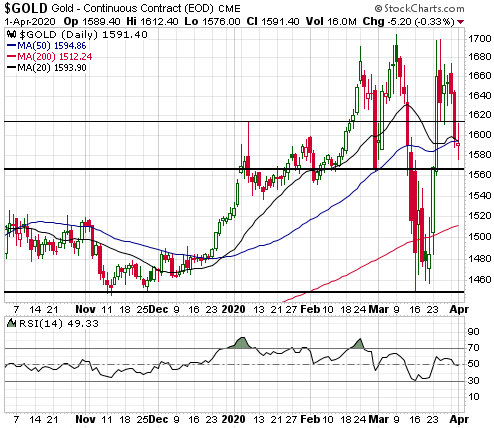
We think that gold remains in correction mode. Due to the on-going
extreme financial market volatility the correction could encompass a spike
to a new multi-year high during April, but the start of a new upward trend
probably will require sufficient price weakness to establish a
constructive sentiment backdrop.
Although we won't know for sure
until the next COT report is published at the end of this week, it looks
like the sentiment backdrop is now well on the way to becoming
constructive. We say this because Tuesday's $50 decline in the gold price
went with a sizable reduction in the gold futures open interest (OI),
suggesting that weak-handed bullish speculators are being shaken out of
the market.
At the close of trading on Tuesday 31st March the Comex
gold futures OI was 495K contracts, or about 50K contracts smaller than it
was a week earlier and about 300K contracts smaller than it was in
January. Important price lows over the past three years have coincided
with a gold futures OI of around 450K contracts, so we haven't got far to
go.
Silver
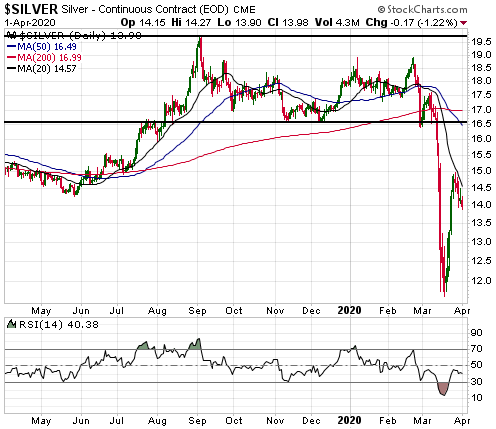
The US$ silver price made at
least a 1-week high last week. It's possible that last week's high will
turn out to be the ultimate high for the initial post-crash rebound and
that a decline to test the March low has begun. However, it's also
possible that the initial rebound will extend to around $16. Therefore,
silver is in a similar position to the S&P500 Index.
The silver
price would have to move up to US$15.50 or higher to create a good
short-term selling/hedging opportunity and down to US$12.50 or lower to
create a good short-term buying opportunity.
Gold Stocks
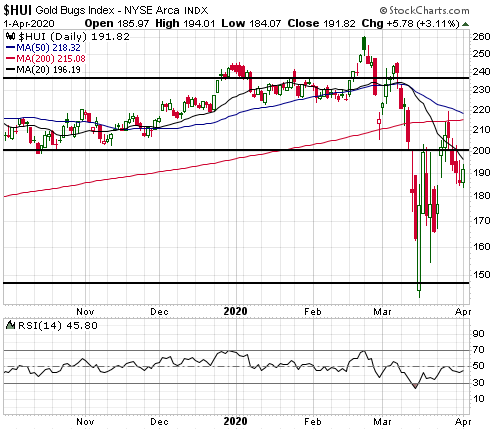
In our discussion of the HUI in
the latest Weekly Update we wrote that last week's spike above the 200-day
MA duplicated the performance of the XAU during the two weeks following
the 1987 stock market crash. We also wrote that another test of the
200-day MA could happen within the coming week or so, but unless the HUI
is able to achieve consecutive daily closes above its 200-day MA the
prudent assumption will be that the initial post-crash rebound is complete
and that a test of the crash low is coming. Therefore, near-term strength
should be viewed as a short-term selling/hedging opportunity.
There's a good chance that the crash low will be tested and a very good
chance that if it is tested the test will be successful (the March low
won't be breached). Therefore, if the HUI drops back to the 150s at some
point over the next two months you should just grit your teeth and buy
gold mining ETFs and/or stocks.
The Currency Market
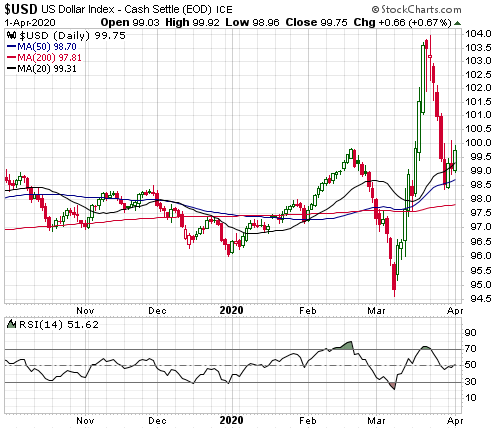
After last week's big move
to the downside, this week the Dollar Index (DX) is rebounding.
At
this time we don't have an opinion on what the DX will do in the
short-term. There just isn't enough to go on. However, as mentioned in the
latest Weekly Update it is possible that the DX made a long-term double
top during the week before last when it rocketed up to around 104.
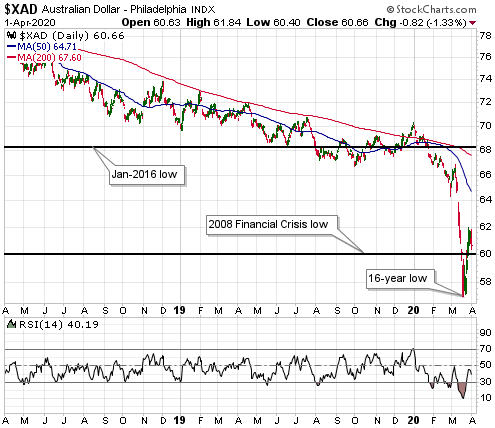
The Australian Dollar bottomed on at least a multi-week basis along
with the stock and commodity markets in mid-March. The A$'s March-2020 low
was the currency's lowest level since 2003!
As is the case with
other markets that crashed over the past two months, the A$ probably will
test its crash low within the next two months.
Updates on Stock Selections
Notes: 1) To review the complete list of current TSI stock selections, logon at
http://www.speculative-investor.com/new/market_logon.asp
and then click on "Stock Selections" in the menu. When at the Stock
Selections page, click on a stock's symbol to bring-up an archive of
our comments on the stock in question. 2) The Small Stock Watch List is
located at http://www.speculative-investor.com/new/smallstockwatch.html
Chart Sources
Charts appearing in today's commentary
are courtesy of:
https://stockcharts.com/