|
- Interim Update 1st May 2013
Copyright
Reminder
The commentaries that appear at TSI
may not be distributed, in full or in part, without our written permission.
In particular, please note that the posting of extracts from TSI commentaries
at other web sites or providing links to TSI commentaries at other web
sites (for example, at discussion boards) without our written permission
is prohibited.
We reserve the right to immediately
terminate the subscription of any TSI subscriber who distributes the TSI
commentaries without our written permission.
More
details on the US money creation process
Here is the next -- and hopefully final, for a while --
installment in our on-going effort to clarify how the Fed's QE
boosts the money supply.
One of the most important points to understand is that for every
dollar of asset monetisation carried out by the Fed, one dollar gets
added to bank reserves (NOT counted in the money supply) AND one
dollar gets added to commercial bank deposits (part of the money
supply). Another way of saying this is that the Fed's QE increases
the economy's money supply dollar for dollar, with each new dollar
being 100% backed by reserves.
Delving deeper into the mechanics of the process, what happens is
that the Fed conducts its asset purchases via Primary Dealers, the
current list of which is found at
http://www.newyorkfed.org/markets/pridealers_current.html.
Details of how the Fed interacts with Primary Dealers to expand the
money supply are contained under the heading "Bank Deposits - How
They Expand or Contract" on page 6 of the Federal Reserve document
archived
HERE*. For ease of reference, here is a relevant excerpt from
this document:
"One way the central bank can initiate...an expansion [of the
money supply] is through purchases of securities in the open market.
Payment for the securities adds to bank reserves. Such purchases
(and sales) are called "open market operations." How do open market
purchases add to bank reserves and deposits? Suppose the Federal
Reserve System, through its trading desk at the Federal Reserve Bank
of New York, buys $10,000 of Treasury bills from a dealer in U. S.
government securities. In today's world of computerized financial
transactions, the Federal Reserve Bank pays for the securities with
an "electronic" check drawn on itself. Via its "Fedwire" transfer
network, the Federal Reserve notifies the dealer's designated
bank (Bank A) that payment for the securities should be credited to
(deposited in) the dealer's account at Bank A. At the same time,
Bank A's reserve account at the Federal Reserve is credited for the
amount of the securities purchase. The Federal Reserve System
has added $10,000 of securities to its assets, which it has paid
for, in effect, by creating a liability on itself in the form of
bank reserve balances. These reserves on Bank A's books are
matched by $10,000 of the dealer's deposits that did not exist
before."
And:
"If the dealer immediately writes checks for $10,000 and all of
them are deposited in other banks, Bank A loses both deposits and
reserves and shows no net change as a result of the System's open
market purchase. However, other banks have received them. Most
likely, a part of the initial deposit will remain with Bank A, and a
part will be shifted to other banks as the dealer's checks clear. It
does not really matter where this money is at any given time. The
important fact is that these deposits do not disappear. They are in
some deposit accounts at all times. All banks together have
$10,000 of deposits and reserves that they did not have before."
[Emphasis added]
The above-referenced Fed document appears to have been prepared in
1992 and in some respects is out of date. In particular, it doesn't
incorporate the regulatory changes of the early-1990s that, via a
process called "sweeping", effectively make the traditional "money
multiplier" irrelevant by enabling any amount of reserves to support
any amount of deposits. However, the description of how the Fed's
asset monetisation expands the amount of money within the economy
(not just the amount of money held in reserve) is still accurate.
Now, the effect on the economy of the Fed's asset monetisation will
depend on what the Primary Dealers do with the new money credited to
their bank deposits. They aren't going to leave the money in
uninsured deposits earning roughly 0% interest. They are going to
invest the money somehow. Some of the new money will likely be
directed towards the purchase of bills, notes and bonds from the US
Treasury, thus making the federal government one of the first
receivers of the new money. The government will then spend the money
on whatever the government spends money on (defense contractors,
salaries of government workers, welfare payments, etc.). Some of the
new money could also be invested in equities and corporate bonds, in
which case the sellers of these equities and corporate bonds will
end up being among the first receivers of the new money. They will
then use the money to buy something else, and so on.
Some of the effects on the US economy of the large money-supply
increase brought about by the Fed** are readily apparent. For
example, the new nominal all-time high for the stock market is an
obvious effect. In general terms, however, the most obvious effect
has been to maintain the long-term downward trend in the US dollar's
purchasing power. Following the bursting of the real estate and
mortgage-financing bubbles in 2006-2007, the US economy should have
experienced a great deflation. That the great inflation has
continued with only a 1-year interruption is due to the
Fed-engineered increase in the money supply.
*Thanks to
Mike Pollaro for the link to the Fed document.
**The US money supply increased by about $3.7T from the start
of the Fed's first QE program in September of 2008 through to March
of 2013. About two-thirds of this money-supply increase was directly
due to QE.
More of the same from the Fed
If you are totally committed to the belief that
increasing the money supply and suppressing interest rates can create sustained
economic strength, then you will naturally look for explanations outside the
monetary realm when sustained economic strength fails to materialize after years
of rapidly increasing money supply and near-zero interest rates. That's what the
Fed is now doing. It will never occur to the Fed's leadership that
ultra-easy monetary policy could be one of the causes of persistent economic
weakness. Consequently, there will be nothing other than ultra-easy monetary
policy in the US until "inflation" is generally perceived to be "public enemy
no.1".
The statement released after the latest FOMC Meeting wasn't surprising in any
way. The only significant change from the preceding statement was a note that
the pace of the Fed's asset purchases could be increased or decreased in the
future as deemed necessary. It was previously assumed that the Fed's next move
would be to reduce the pace of asset purchases, but the Fed has now made it
clear that its next move could just as easily involve boosting the level of
monetary accommodation.
The Stock Market
At a superficial level the following two charts have nothing to
do with the stock market, but if we look beneath the surface we find some
relevance.
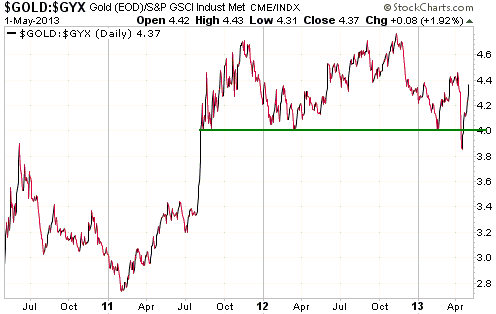
The first chart shows the gold/GYX ratio. Gold is a counter-cyclical investment,
whereas the industrial metals tend to do best when global economic growth is on
an up-swing. The gold/GYX ratio will therefore typically trend upward during
periods of weak or slowing growth and downward during periods of strong or
improving growth.
Gold/GYX began to trend upward in February, but at the beginning of April it
abruptly reversed course and during 12th-15th April it plunged to a multi-year
low. If the breakdown had been sustained it would have been a good omen for the
stock market, a growth-oriented investment. However, the breakdown proved to be
fleeting. The gold/GYX ratio has now retraced the bulk of its April-2013 plunge
and is up on a year-to-date basis.
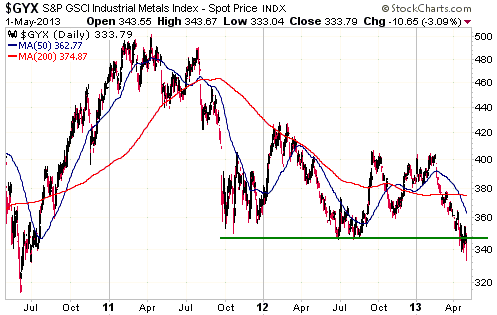
The rapid rebound in the gold/GYX ratio is partly due to gold's upward reversal
and partly due to continuing weakness in the pro-cyclical industrial metals. As
illustrated by the following chart, the Industrial Metals Index (GYX) has just
dropped to its lowest level since July of 2009.
The stock market is driven more by monetary conditions, inflation expectations
and sentiment than by economic growth, but our impression is that the
complacency now evident in the stock market is based to a large extent on the
view that the economy will avoid a recession. Evidence that challenges this view
could therefore create a problem.
The following chart compares the Russell2000 Small-Cap Index (RUT) with the
RUT/SPX ratio. The RUT has performed well since October of 2011 and hasn't yet
signaled that its upward trend has ended, but notice that the RUT/SPX ratio has
dropped sharply over the past six weeks. It did something similar in the early
stages of general shifts away from risk in 2010, 2011 and 2012.
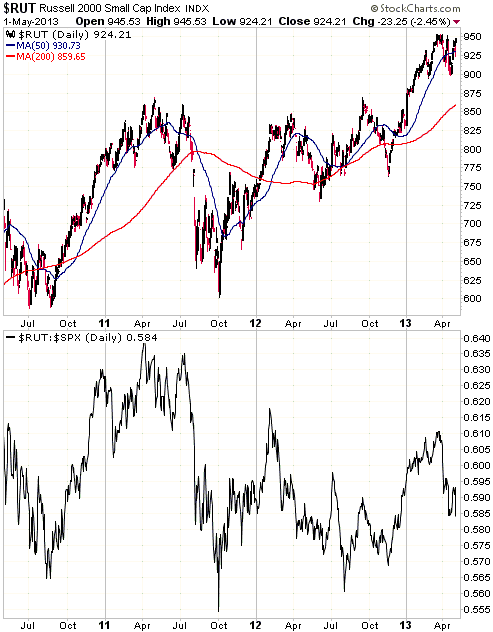
The RUT/SPX ratio, the gold/GYX ratio and the modest widening of credit spreads
over the past two months all suggest that the financial world is moving into
"risk off" mode.
Gold and the Dollar
Gold
Supply versus demand and physical versus paper
Changes in the demand for gold cannot be measured independently of price. In
fact, the only reliable way to determine whether gold demand is rising or
falling relative to gold supply is by looking at the change in price. If the
price is falling then we know, with 100% certainty, that demand is falling
relative to supply, and if the price is rising then we know, with 100%
certainty, that demand is rising relative to supply. It's that simple.
But what about the artificial creation of supply via the paper markets? Couldn't
the price of gold fall due to a large increase in the supply of "paper gold"
even while the demand for physical gold were rising relative to the supply of
physical gold?
We don't see how, because demand for physical gold cannot be satisfied by paper
gold. In any case, even if we make the tenuous assumption that an increase in
the demand for physical gold could somehow be satisfied by an increase in the
supply of "paper gold", evidence that something along these lines was taking
place would appear in the differences between the spot price and future prices
and in the differences between the near and the more distant futures contracts.
Specifically, there would be pronounced rises in the spot price relative to the
price of the nearest futures contract and in the nearby futures relative to the
more distant contracts. This evidence was conspicuous by its absence during the
April-2013 plunge in the gold (and the silver) price.
The wrongheaded idea that the total demand for physical gold was surging
relative to the total supply of physical gold during the gold-price plunge of
10th-16th April, reflecting some sort of disconnect between the physical and
paper markets, was based on evidence that the general public in many countries
was rushing out to buy gold coins and small gold bars. The sudden increase in
the public's demand for physical gold in certain forms naturally led to
temporary shortages of gold in these forms at establishments that specialise in
serving the retail crowd, but it's important to understand that these types of
sales constitute only a small part of the global market for physical gold. To
provide some context we point out that gold coin sales by the US Mint totaled
502,000 ounces over the first four months of this year and that about 40-times
this amount of physical gold changes ownership in an average trading DAY on the
LBMA. We also point out that the reduction in the amount of physical gold held
by the SPDR Gold Trust (GLD) since the beginning of this year is about 17-times
the total amount of physical gold in coin form minted in the US over the same
period.
Current Market Situation
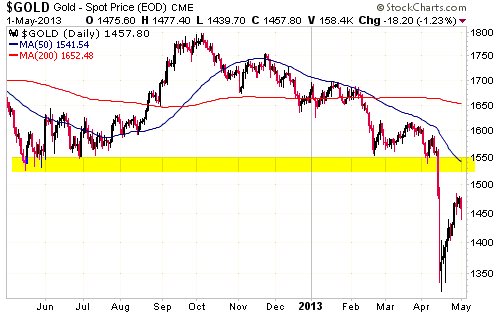
Based on the gold market's price action we can be sure that gold demand fell
relative to gold supply from 10th through to 15th of April. We can also be sure
that the sudden price reduction stimulated a sufficient increase in total
demand, either in the form of bargain hunters entering the market or
short-sellers closing out their positions, to temporarily cause demand to exceed
supply, because the price subsequently rose relentlessly from a low in the
$1320s on 15th-16th April to the $1480s late last week. The price has pulled
back from last week's high, but at this stage the magnitude of the pullback is
too small to be interpreted as anything more than a random fluctuation.
It's very unlikely that the gold price will trade significantly lower than the
April-2013 crash low within the next two months, but a continuing pullback to
the mid-$1300s to test the crash low remains a realistic possibility.
Gold Stocks
Despite the volatility caused by traders first anticipating and then reacting to
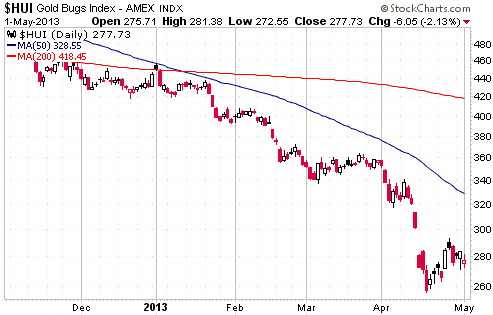
the latest FOMC statement, Wednesday 1st May was an "inside day" for the HUI. In
other words, on Wednesday the HUI traded within the preceding day's price range.
Regardless of whether or not the gold sector is still immersed in a cyclical
bear market, a 2-4 month rally probably either began in April or will begin this
month after a spike to a new low. The tendency of the gold sector to reach an
intermediate-term extreme during the month of May suggests that the HUI will
spike below its April low before commencing a multi-month rally, but the fact
that the April low was accompanied by the most 'oversold' readings of the past
13 years means that an intermediate-term extreme might already be in place.
If the HUI closes above 300 before trading below its April low then we will
assume that an intermediate-term bottom was put in place last month.
Currency Market Update
The Dollar Index has just fallen for six days in a row and has reached support
at 81.0-81.5. The most important support, however, lies at 79. A break below 79
would indicate that our currency market outlook was probably wrong.
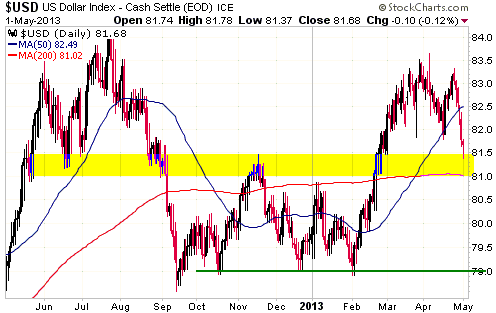
Sentiment indicators such as the COT data and Market Vane's survey suggest that
the Dollar Index's short-term downward correction has further to go, either
immediately or after pausing for a few days. However, much will depend on what
happens to stock markets in general and European bank stocks in particular.
There's a good chance that stock market weakness and heightened concerns about
the safety of Europe's banking industry will eventually fuel a sizeable rally in
the US$ relative to the euro. From our perspective the main unknown is whether
this happens over the next few months or later this year.
Due to the sentiment situation and our uncertainty regarding the timing of the
next episode of European bank-related drama, we remain short-term "neutral" on
the Dollar Index. Our intermediate-term US$ outlook has shifted to "bullish"
(from "neutral"), though, because the drama is likely to begin within the next 6
months.
Update
on Stock Selections
Notes: 1) To review the complete list of current TSI stock selections, logon at
http://www.speculative-investor.com/new/market_logon.asp
and then click on "Stock Selections" in the menu. When at the Stock
Selections page, click on a stock's symbol to bring-up an archive of
our comments on the stock in question. 2) The Small Stock Watch List is
located at http://www.speculative-investor.com/new/smallstockwatch.html
Chart Sources
Charts appearing in today's commentary
are courtesy of:
http://stockcharts.com/index.html

|









