- Interim Update 1st July 2020
Copyright
Reminder
The commentaries that appear at TSI
may not be distributed, in full or in part, without our written permission.
In particular, please note that the posting of extracts from TSI commentaries
at other web sites or providing links to TSI commentaries at other web
sites (for example, at discussion boards) without our written permission
is prohibited.
We reserve the right to immediately
terminate the subscription of any TSI subscriber who distributes the TSI
commentaries without our written permission.
No Weekly Update for
the coming week
We will be taking a short break
and therefore won't be publishing a Weekly Update for the week commencing
Monday 6th July. On the plus side, we are covering more 'stuff' in today's
report than we usually would in an Interim Update. Normal programming will
resume with next week's Interim Update.
Due to this Friday being a
public holiday in the US, we doubt that much will happen in the major
financial markets between now and the weekend (when the 6th July Weekly
Update would have been posted). However, volatility could begin to pick-up
next week.
The Policy Cliff
and the Coming Stagflation
This is from
Hedgeye's Quarterly Investment
Outlook:
"The policy cliff looms really large in the back half
of the year.
* In June you've got credit card and auto loan
forbearance ending.
* On July 1st you've got state and local
budget cuts starting.
* On July 15th you've got delayed federal
income tax check payments are due.
* On July 31st you've got
enhanced unemployment benefits rolling off.
* On September 30th
student loan forbearance programs end.
* On October 31st
mortgage forbearance programs start to roll off.
* And then
December 31st the PPP grace period ends."
The above-mentioned
dates at which support schemes end are not engraved in stone. It's likely
that some of the dates will be extended. In particular, the enhanced
unemployment benefits may well be extended beyond 31st July. However, this
is not a reason for optimism. On the contrary, the longer the
lockdown-related support programs are in place the weaker the US economy
will become. The reason is that the government's generosity is being
enabled by the Fed's money creation, but the Fed's money creation destroys
real wealth.
To explain, when money is created out of nothing and
used, for example, to pay people NOT to work or to work non-productively,
everything can seem fine for a while. The problem is that the 'economic
pie' is being made smaller, because money isn't a real resource that adds
to the economy-wide quality of life or even helps to sustain life.
Instead, money is a claim on existing resources, meaning that when more
money is created out of nothing there are more claims on the existing pile
of wealth.
More claims on the existing pile of real resources
combined with less people contributing to the pile inevitably leads to
lower quantities and higher prices for real resources. The associated
economic environment is sometimes called "stagflation" (economic
stagnation plus substantial price inflation). Thanks to the lockdowns and
the actions taken to alleviate the associated short-term pain, the US
economy is now set-up for a period of "stagflation". Furthermore,
extending the lockdown-related monetary and fiscal support programs beyond
their current expiry dates will magnify both the "stag" and the "flation".
The Monthly (and
Quarterly) Closing Prices
Today we will review monthly
charts for gold, the HUI, the S&P500 Index (SPX), the Dollar Index and the
Australian dollar, updated to the end of June-2020. As usual, we'll start
with gold.
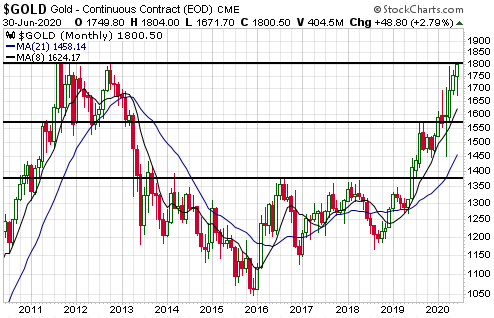
Three months ago we wrote that within the next six
months the gold market should begin to discount the long-term
progress-hindering effects of the new monetary and fiscal regimes, at
which point the next major gold rally should 'kick off'. In the meantime
we expected a significant correction.
What we got was more of a
sideways consolidation than a correction. In essence, gold spent about two
months oscillating between $1680 and $1780 before resuming its
intermediate-term upward trend.
There is long-term lateral
resistance at $1800 that is in the process of being tested and that could
cap the market for a while, after which there is resistance defined by the
all-time high in the $1920s.
Critical monthly-closing support for
gold's intermediate-term upward trend is defined by the 8-month MA (the
black line on the following chart). That is, a monthly close below the
8-month MA would indicate that a top that holds for more than a few months
is in place. This MA has risen to US$1624.
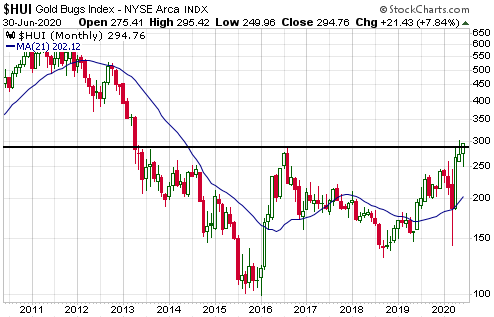
The following monthly chart shows that the HUI ended the month of
June-2020 above long-term resistance defined by its 2016 high. It was the
highest monthly close in more than seven years.
The period from
early-2013 through to the present could be viewed as a long-term base, in
which case the HUI's 30th June close above its 2016 high marks the
completion of the base. A technical analysis assumption is that the size
of the move following the completion of a basing pattern is proportional
to the depth of the base. Since the HUI almost tripled from the bottom to
the top of its base, this assumption implies an ultimate target of
800-850.
Rather than fixate on targets created by simplistic chart
measurements, we prefer to adjust positioning based on real-time analysis
of fundamentals, sentiment and price action, with fundamentals generally
taking precedence. As things currently stand, the bullish fundamentals for
gold mining suggest that the HUI will trade at a much higher level within
the coming 12 months.
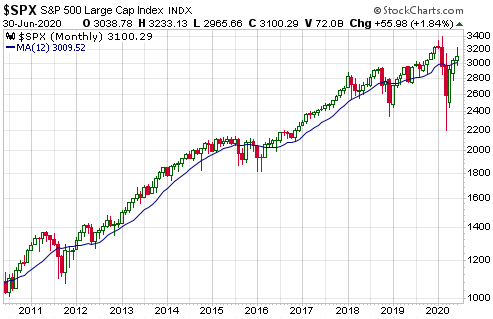
June-2020 was an up-month for the S&P500 Index (SPX), but all upward
progress occurred during the first six trading days of the month. 8th June
is the high to date for the post-crash rally.
The SPX's ability to
close above its 12-month MA in May and again in June suggests that we are
dealing with an intermediate-term bull-market correction rather than a
bear market, but there have been many unprecedented happenings over the
past four months. Therefore, it's best to keep an open mind regarding the
market's long-term trend.
We remain open-minded, but we still have
opinions. For example, we think that the March-2020 low will not be tested
over the remainder of this year or the first half of next year, but that
it will be tested in parallel with another recession during 2022.
One thing we can say for certain is that the rally from the March-2020 low
is not a new bull market. It is either the resumption of the bull market
that began in 2009 or the first big countertrend move in a new bear
market. Despite the SPX's monthly closes above its 12-month MA, we favour
the latter. However, due to the amount of monetary inflation, the bear
market -- assuming that's what we are dealing with -- is more likely to
involve a multi-year horizontal range than a major downward trend.
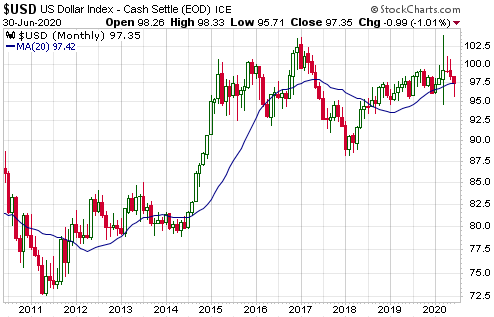
Turning to the currency market, in our previous review of monthly
charts we wrote:
"...we have been anticipating a 1-2 year
decline in the Dollar Index (DX) and at the same time acknowledging the
possibility that there will be a final 1-2 month surge prior to the start
of a longer-term decline. While we can't yet rule out a final 1-2 month
surge, it looks like the DX doubled-topped on a long-term basis at around
104 and that the anticipated 1-2 year decline has begun."
There has since been no change to our outlook. We just want to point out
that a monthly DX close below the March-2020 low would remove any
remaining doubt that a long-term top is in place.
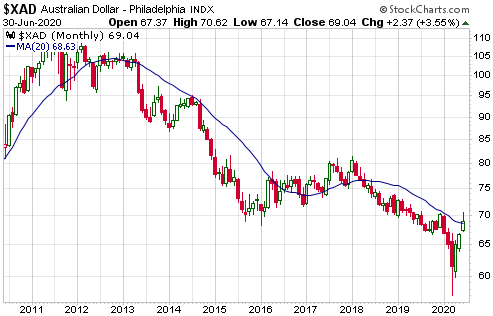
The Australian dollar (A$) has managed three big up-months since
bottoming in March-2020. There's a good chance that this currency will
experience a significant correction in parallel with the next significant
stock market decline, but we continue to think that March-2020 was the
cycle low for the A$ and that it will have an upward bias for the next 1-2
years.
By the way, the same applies to the Canadian dollar (C$).
However, the C$ is likely to underperform the A$ over the coming two
years.
The shortest US
recession ever
In our 3rd June commentary, we wrote:
"...the rebounds in
economic statistics from whatever lows are put in place during the second
quarter of 2020 probably will end with the economy at only about 80% of
what it was at the start of this year, because creating huge amounts of
money and credit out of nothing and paying people NOT to work cannot make
up for the real wealth destruction, including the permanent loss of
millions of small businesses, caused by the economic lockdowns of
March-June 2020. On the contrary, the falsification of price signals by
the Fed and the channelling of savings from the private sector to the
government will do additional structural damage to an economy that already
was weak prior to the virus-related lockdowns.
Therefore, while the
National Bureau of Economic Research (NBER), the official arbiter of US
recessions, could end up determining that the 2020 recession was over by
July or August, there will be such a large amount of 'rot' in the economic
foundations that by 2022 there probably will be another recession."
In the above-mentioned commentary we included the following picture to
illustrate our expectations regarding the US economy's performance during
2020-2022.
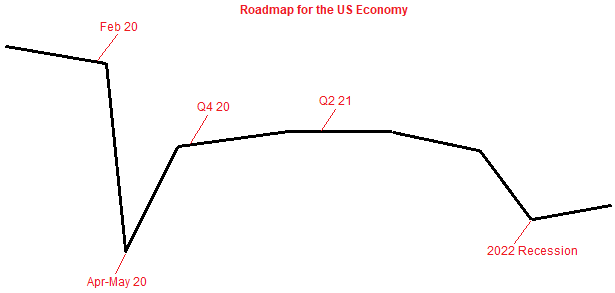
There is no change to our outlook, in that we are still looking for
the US economy to recover 80%-90% of what it lost during the lockdown
period, plateau for a few quarters and then fall back into recession
territory. However, recent economic data suggest that the 2020 recession
may be even shorter than previously anticipated.
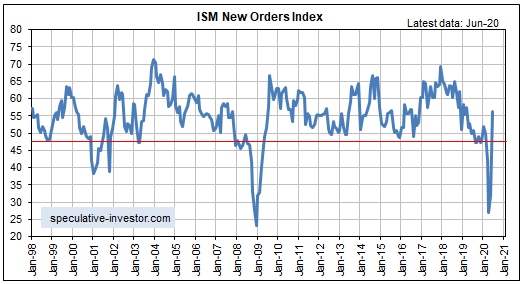
Of particular
relevance is the spectacular rise in the ISM New orders Index (NOI)
illustrated by the chart displayed below. After printing in the low-30s in
May, the NOI rocketed up to the mid-50s in June. This suggests that the
recession has ended already.
A cycle low for
industrial commodities
We think that cycle (multi-year) price lows are in place for most
industrial commodities. Here are three examples:
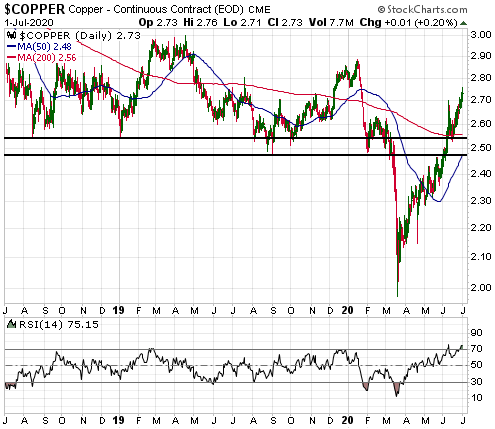
1) Due to its
decisive break above the range of support/resistance that extends from the
high-US$2.40s to the mid-$2.50s, there is little doubt that the copper
price made a cycle low in March-2020. We expect that a significant
correction in the copper market will coincide with a significant
correction in the stock market within the next two months, but as is the
case with the SPX the copper price probably won't retrace more than half
of its March-June rally.
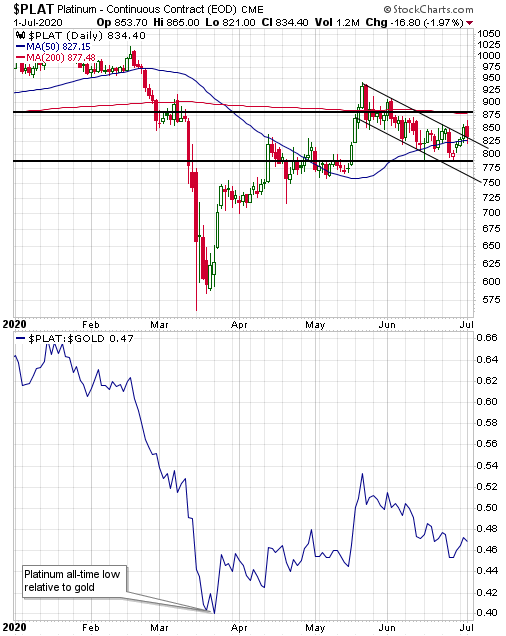
2) The platinum price bottomed in March-2020 in US$ terms and relative
to gold. We think that it is now in the early stage of a cyclical advance
driven by reduced mine supply, massive monetary inflation and the metal's
low relative valuation. Also, it may have just completed a short-term
correction.
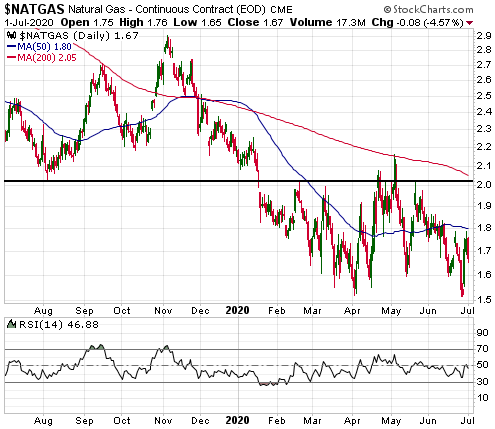
3) Due to a temporary supply glut, Natural Gas (NG) has been a
laggard. However, it reversed upward this week after testing its April
low, so it may have just set a cycle low via a double bottom.
The Stock Market
Current Market Situation
A reason for the stock market's recent resilience in the face of a
dismal economic backdrop could be that the bear case is too obvious. Most
professional traders/investors would be well aware that stock indices
generally are very high relative to the earnings that will be generated by
the component companies over the coming year or two, regardless of whether
or not the government and the Fed extend their support programs. As a
consequence, it's possible that many traders have been too eager to bet
against the market and have been forced to 'cover' on a regular basis.
Another reason for the resilience is that a large proportion of the
trading that takes place these days is price and value insensitive. For
example, a lot of trading decisions are made by computer programs based on
price patterns. For another example, ETFs are a big part of the market and
the traders/investors who buy these funds often don't even consider the
valuations of the underlying stocks.
Whatever the reason for it,
the US stock market is showing remarkable resilience given the obvious
risks and the extremely optimistic expectations built into current prices.
That being said, most US stock indices stopped rising more than three
weeks ago. Here are some examples:
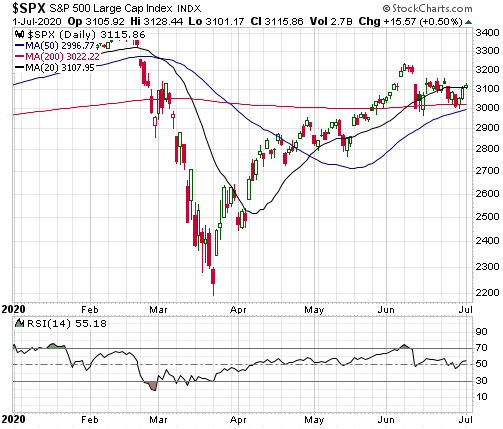
The SPX peaked in early-June and
has since traded in a 5% range bounded on the lower side by its 200-day
MA.
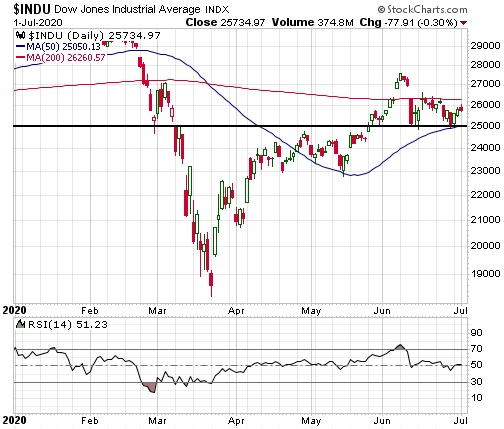
The Dow Industrials Index peaked in early-June and has since traded in
a 5% range bounded on the lower side by lateral support at 25000 and on
the upper side by its 200-day MA.
The Dow Transportation Average has traded similarly to the Dow
Industrials Average, although it has been slightly weaker.
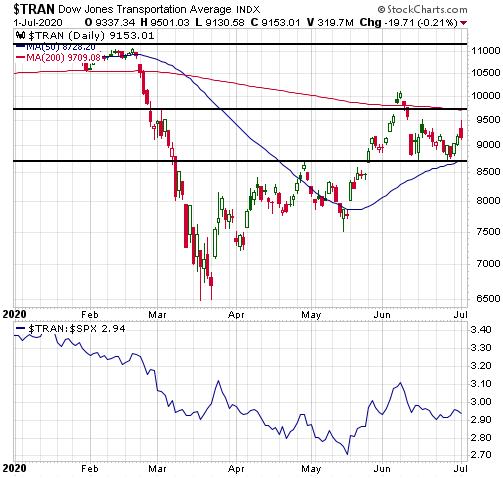
The price patterns that have formed since early-June could be routine
multi-week consolidations or the beginnings of sizable corrections. We
favour the latter possibility, but note that moves to new post-crash highs
during the first half of July would only add to the short-term risk.
Tesla (TSLA) Comment
Apparently, Tesla has
just overtaken Toyota as the world's most valuable car manufacturer. This
is more than a little strange, given that Toyota is making cars at the
rate of around 9 million per year and is consistently profitable whereas
Tesla is making cars at the rate of around 0.5 million per year and is not
consistently profitable.
We have traded TSLA put options profitably
on two occasions over the past three years and held the view that the
company was on a long and winding road to bankruptcy, but most of the time
we have been satisfied to watch the Elon Musk show from the sidelines.
There have been so many true believers in the company and the stock that
even at the company's financial low points a bearish bet was just as risky
as a bullish bet.
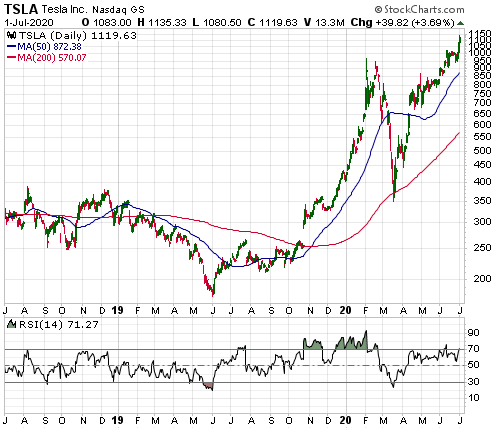
As evidenced by the following chart, currently
the stock price is stretched to the upside (to put it mildly). This opens
up the potential for a sizable correction within the next couple of months
almost regardless of what the company achieves/reports, but we will
continue to watch the show from the sidelines.
TSLA's incredibly high valuation greatly reduces the risk of
bankruptcy, because it means that the company has access to very cheap
equity financing (the higher the valuation of new equity, the better it is
for the company issuing the equity). Musk took advantage of the high
valuation early this year by issuing billions of dollars of new equity and
may well do the same in the near future.
Although we don't have any
direct financial interest at the moment in Tesla's success or failure, we
hope that it succeeds. This is because we are bullish on the trend towards
vehicle electrification and because Tesla is still the technological
leader of this trend. Also, Tesla stands a good chance of being the first
company to solve the autonomous vehicle (AV) problem. Right now there is
no such thing as a self-driving car for all situations, but by virtue of
its huge data-collection advantage (every Tesla vehicle on the road is
continuously providing data to the company) it's possible that Tesla will
build the first genuine AV within the next few years.
Gold and the Dollar
Gold
In
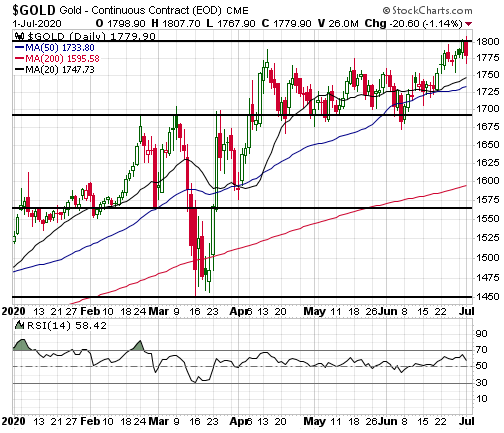
the latest Weekly Update we noted that the US$ gold price was bumping up
against long-term resistance near $1800. This suggested that there could
be a few days to a few weeks of back-and-forth trading in the $1750-$1800
range, even if the longer-term upward trend had resumed (as thought
likely).
Resistance near $1800 was tested, and held, on both
Tuesday and Wednesday of this week. Also, Wednesday was an outside-down
day for gold, meaning that the price closed lower after trading outside
the range of the preceding day. This is not significant by itself, but it
would become significant if the gold price were to end Thursday's US
trading session (the final trading session of the holiday-shortened week)
below $1753. The reason is that a Thursday (2nd July) close below $1753
would create an outside-down week, and an outside-down week at this time
would warn that the 'corrective' period had not ended.
As long as
the gold price avoids a weekly close below $1753, nothing has changed. In
other words, it will be reasonable to assume that the longer-term upward
trend has resumed, but that there could be up to a few weeks of
back-and-forth trading in the $1750-$1800 range before resistance at $1800
is decisively breached.
Gold Stocks
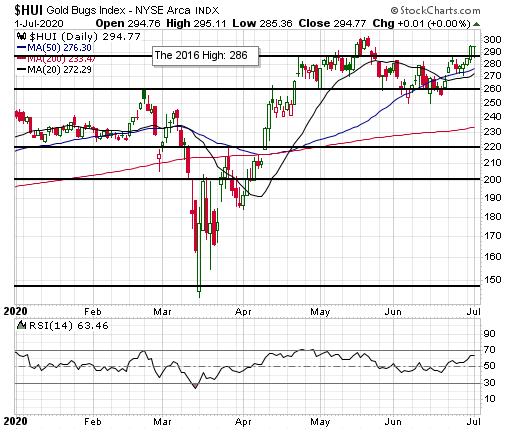
The HUI closed above long-term
resistance at 286 (the 2016 high) on Tuesday of this week and despite a
pullback in the bullion price held the breakout on Wednesday. As mentioned
earlier in today's report, this could be the completion of a huge base
that projects much higher prices over the coming year or two.
Such
a move (much higher prices over the coming year or two) would mesh with
the current fundamental backdrop and our assessment of how the fundamental
backdrop will evolve. In particular, while the fundamentals could begin to
favour the industrial metals over gold within the next few months, we
expect that gold will continue to trend upward in terms of depreciating
dollars and that gold mining will remain a popular sector.
We mentioned in the latest Weekly Update that being near multi-year
highs makes the gold mining sector acutely vulnerable to substantial
weakness in the broad market. We also mentioned that as long as the
fundamental backdrop remains bullish for gold, which it would during a
period characterised by a rapid shift away from risk, the gold mining
sector should bounce back very quickly from a broad-based stock market
decline. Consequently, a sell-off in the gold mining sector that occurred
in sympathy with a plunge in the broad market would create excellent
opportunities to buy gold mining stocks/ETFs for both short-term and
intermediate-term trades.
The Currency Market
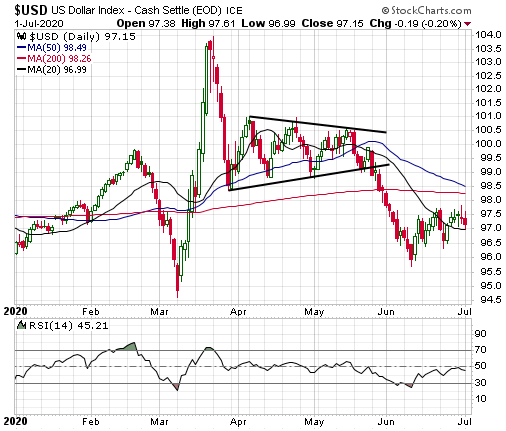
The Dollar Index (DX) has consolidated since hitting a 2-month low on
10th June.
As mentioned a week ago, the DX has short-term upside
potential to around 98.5 and short-term downside potential to around 94.5
(the March-2020 low). It's likely that the March-2020 low will be breached
before year-end, but not until the final quarter. In the meantime we are
looking for a choppy market, with multi-week periods dominated by risk-off
sentiment giving the DX a boost and multi-week periods dominated by
risk-on sentiment pushing the DX downward.
Note that the DX's
recent rebound coincided with a modicum of weakness in the stock market,
that is, with a minor shift away from risk.
Updates on Stock Selections
Notes: 1) To review the complete list of current TSI stock selections, logon at
http://www.speculative-investor.com/new/market_logon.asp
and then click on "Stock Selections" in the menu. When at the Stock
Selections page, click on a stock's symbol to bring-up an archive of
our comments on the stock in question. 2) The Small Stock Watch List is
located at http://www.speculative-investor.com/new/smallstockwatch.html
 Recent
company news/developments:
Recent
company news/developments:
[Note: AISC = All-In Sustaining
Cost, boepd = barrels of oil equivalent per day, dmt = dry metric tonnes,
CIL = Carbon In Leach, E&P = Exploration and Production, EBITDA = Earnings
Before Interest, Tax, Depreciation and Amortisation (a measure of cash
flow), EV = Enterprise Value or Electric Vehicle, FS = Feasibility Study,
FY = Financial Year, IRR = Internal Rate of Return, ISR = In-Situ
Recovery, JV = Joint Venture, MD&A = Management Discussion and Analysis,
M&I = Measured and Indicated, MLP = Master Limited Partnership, NAV = Net
Asset Value, NPV(X%) = Net Present Value using a discount rate of X%, NSR
= Net Smelter Return or Net Smelter Royalty, O&G = Oil and Gas, P&P =
Proven and Probable, PEA = Preliminary Economic Assessment, PFS =
Pre-Feasibility Study]
*Alkane Resources (ALK.AX)
advised that its research and development partner, ZironTech, has
successfully produced a titanium metal alloy with its patented reduction
process at the JV's commercial pilot plant in South Korea. The patented
method of metal production uses 45% less power than current industry
methods.
This is good news for the soon-to-be-spun-out Australian
Strategic Materials (ASM) and its Dubbo Specialty Metals project. The
Dubbo project won't produce titanium, but the patented method could be
applied to all of its products and would reduce operating costs by a
significant amount.
*Peyto Exploration and
Development (PEY.TO) updated the market regarding the status of
its operations, debt and capital spending. Overall, the update was
positive. The most important points were:
1. PEY and its lenders
have agreed to reduce the amount available under the company's revolving
credit facility from $1.3B to $950M, thus reducing the cost of the
unutilised credit. At 31st March the company had drawn $715M on this
facility, so the reduction in the size of the facility still leaves it
with access to more than $200M of additional credit if needed.
2.
PEY's debt-to-EBITDA covenants have been made less stringent, thus
providing the company with greater financial 'breathing room' during the
current difficult period for the Canadian O&G industry. In exchange,
PEY.TO has agreed to pay a higher interest rate.
3. The company has
improved its capital efficiency. This means that whereas it will require
$200M-$250M of capital spending to achieve average production of 78,500
boe/d in 2020, it will require capital spending of only $180M and $165M,
respectively, to maintain this production rate in 2021 and 2022.
4.
The capital spending savings will be put towards either increasing
production or reducing debt, depending on commodity prices at the time.
If more evidence emerges over the weeks ahead that the natural gas
price has 'doubled bottomed', then PEY should begin to trade in a more
bullish manner. The stock has been in correction mode since its strong
post-crash rebound peaked in early-May.
*Sabina Gold
and Silver (SBB.TO) reported that it has received the final
operational approval for the placement of the tailings into the Back River
project's proposed tailings storage facility. This means that SBB is now
in possession of all major authorisations for not only the construction,
but also the operations of the Back River Project.
This news was
very much expected and therefore didn't move the stock price, but it does
highlight SBB's potential as a takeover candidate. The most likely
acquirers are Agnico Eagle, B2 Gold and Shandong Gold.
Chart Sources
Charts appearing in today's commentary
are courtesy of:
https://stockcharts.com/