|
- Interim Update
1st October 2014
Copyright
Reminder
The commentaries that appear at TSI
may not be distributed, in full or in part, without our written permission.
In particular, please note that the posting of extracts from TSI commentaries
at other web sites or providing links to TSI commentaries at other web
sites (for example, at discussion boards) without our written permission
is prohibited.
We reserve the right to immediately
terminate the subscription of any TSI subscriber who distributes the TSI
commentaries without our written permission.
Something we didn't know
In his "Up and Down Wall Street" column in the 29th September
edition of Barrons magazine, Randall Forsyth discusses Bill Gross's
resignation from PIMCO, the gargantuan asset management firm founded
by Gross more than four decades ago. In the course of this
discussion Forsyth stated a fact that stunned us. Here's the
relevant excerpt from the Barrons article:
"Gross' exit roiled the prices of Pimco closed-end funds,
especially those that trade at egregious premiums to their net asset
values (which Barron's has pointed out several times over the past
couple of years).
Prominent among those hit was Pimco High Income (PHK), which plunged
6% Friday. Prior to that, it had closed at a massive 46.1% premium
to NAV, according to cefconnect.com. Shareholders' willingness to
pay $146 for $100 in assets may relate to their being managed by one
William H. Gross or to the fund's 11.75% distribution rate.
Similarly, Pimco Corporate & Income Opportunity (PTY) fell 6.6%
Friday; as of Thursday, it had commanded a 17.2% premium while
yielding 8.48%."
A fund that invests in high-yield (meaning: high-risk) corporate
bonds trading at a 46% premium to net asset value (NAV)? That's a
mindboggling fact that we were not aware of.
Even after its recent drubbing, PHK still trades at a premium to NAV
of around 40%. This is both absurd and symptomatic of the desperate
chase for yield in a world where central banks have eliminated any
opportunity for bond and other fixed-income investors to make a real
return by investing prudently.
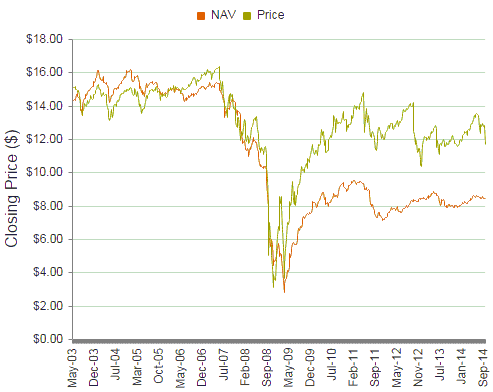
We can't claim that PHK's ridiculous premium is a bell-ringing sign
of a top, because the following chart from cefconnect.com shows that
the premium has been ridiculous for years. However, it's worth
noting that near the crescendo of the 2008 financial crisis PHK
traded at a discount to its NAV. Assuming the fund survives there's
a good chance that at some point in the future it will again trade
at a discount. That future point will be near the end of the next
crisis or equity bear market.
The Stock Market
Prior to the past few days, Hong Kong's Hang Seng Index (HSI)
appeared to be immersed in a routine correction. As part of this correction it
was testing July's break above long-term resistance, which was all perfectly
normal. However, it has just accelerated downward and has fallen far enough to
suggest that the July breakout was false.
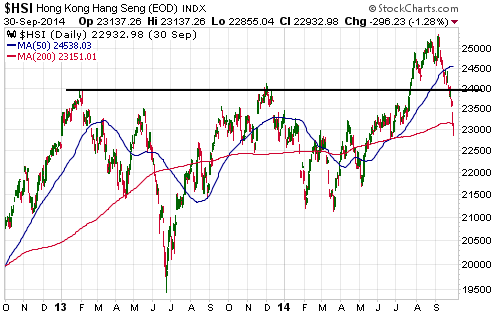
The HSI's downward acceleration was largely a reaction to increasing political
instability in Hong Kong, with
police
using tear gas and pepper spray as part of the government's efforts to end a
peaceful street protest.
Tens of thousands of HK residents have taken to the streets with the goal of
reversing a trend towards more rigid control of HK by China's Communist Party.
In particular, the protestors want the resignation of the current
Communist-Party-appointed chief executive and for the people of HK to have a say
in the Region's future political leadership.
There's a risk that the HK protests will escalate and prompt a heavy-handed
response from China. The stock market is trying to discount this risk.
That being said, the recent weakness in HK's stock market is not solely related
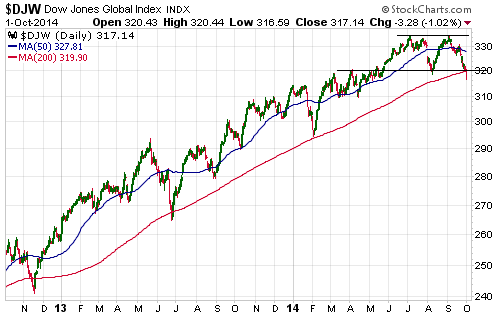
to HK's political situation. It is also part of a global stock market trend. As
illustrated by the following daily chart, this global trend in equities has just
pushed the Dow Jones World Index below significant support to its lowest level
in more than four months.
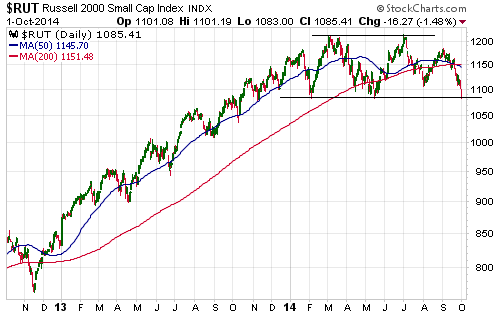
In the US, the Russell2000 SmallCap Index (RUT), the weakest of the high-profile
US stock indices, made a new daily-closing low for the year on Wednesday 1st
October, although the following chart shows that a decisive downside breakout
hasn't yet happened. The RUT is now short-term 'oversold', but it's a good bet
that a decisive downside breakout will happen during the first half of October.
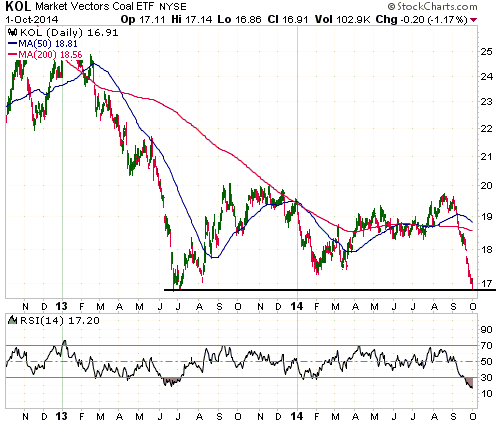
It's lastly worth pointing out that, like many other commodity-related equity
sectors, the coal sector tanked over the past month. As a result, the Market
Vectors Coal ETF (KOL) is extremely 'oversold' and is testing major support
defined by last year's low.
Incredibly, just six weeks ago KOL appeared to be preparing to break out to the
upside from its 15-month range.
Gold and the Dollar
Precious Metals
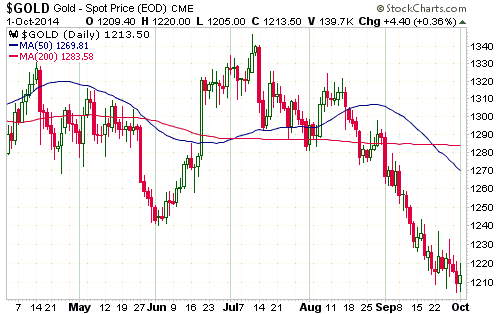
Considering the goings-on in the commodity and currency markets, the gold market
continues to demonstrate remarkable resilience. The gold market hasn't yet
signaled a short-term bottom, but it has managed to remain above last week's low
($1206) on a daily closing basis.
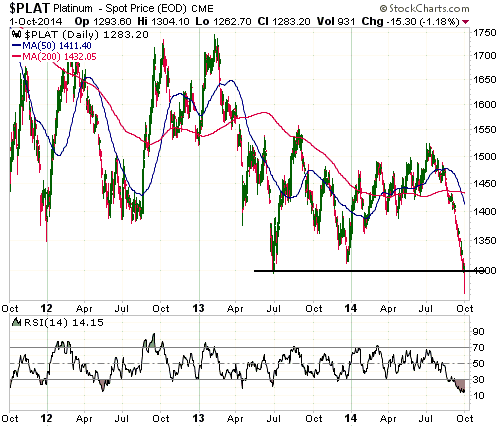
While gold was refusing to buckle under the pressure over the past two trading
days, silver closed at a new multi-year low and the waterfall decline in the
platinum market became even steeper. Platinum ended last week at major support
and at a rare 'oversold' extreme, paving the way for a rebound to soon begin.
However, support gave way and set in motion another wave of speculative selling.
Needless to say, platinum is now even more 'oversold'.
The panic selling evident in the price action of platinum and several other
commodities creates the potential for strong rebounds, most likely in parallel
with a downward correction in the Dollar Index. The question is: Will the
commodities that have recently been clobbered in response to strength in the US$
be able to manage anything more than 1-2 month counter-trend rebounds if the US$
is still in the early part of a major advance? The answer is: Probably not.
Gold Stocks
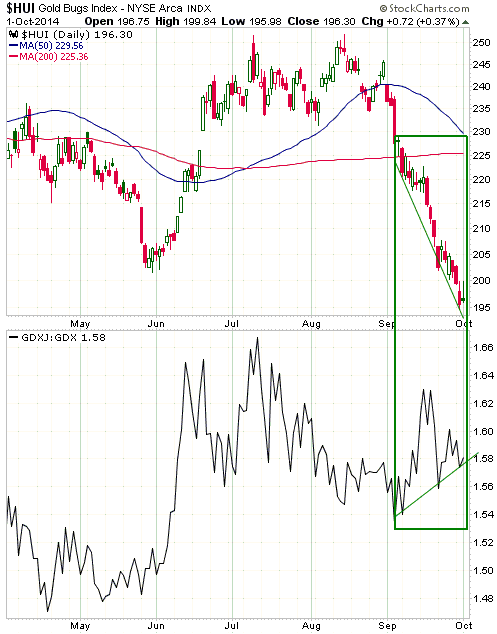
The following daily chart shows that the HUI made a new multi-month low during
the first half of this week, while the GDXJ/GDX ratio remains above its
early-September and mid-September lows. This divergence makes the recent market
action look more like what happened to the gold-mining sector during April-May
of this year than what happened during any part of last year, although the HUI's
decline since the early-September beginning of the current bullish divergence is
greater than its decline during the April-May bullish divergence.
Divergences never matter until they do, and the gold sector's bullish divergence
obviously hasn't done anything for us yet. It is important, though, because it
increases the probability that the current decline is part of a drawn-out basing
pattern.
The Currency Market
The ECB's Monetary Machinations
The ECB recently launched a two-pronged attack aimed at boosting bank lending to
the private sector. The first prong was the TLTRO (Targeted Longer Term
Refinancing Operation), which got underway on 18th September. The second prong
was the ABS (Asset Backed Security) and Covered Bond Purchase Program, the
details of which will be announced a few hours after this commentary is
published. Will these schemes be successful?
That depends on what constitutes success. The schemes cannot possibly foster
economic progress, because creating money and credit out of nothing distorts
price signals, redistributes wealth from savers to speculators and generally
makes the economy less efficient. So, if success is defined as bringing about a
stronger economy then failure is guaranteed. However, if success is defined as
increasing the size of the ECB's balance sheet by 1 trillion euros and adding 1
trillion euros to the money supply, then the schemes will probably, but not
necessarily, be successful.
The challenge faced by the ECB as it tries to prod the commercial banks into
lending more money to the private sector is the dearth of lending opportunities
open to the banks. Due to the after-effects of the credit bubble that blew-up in
2008 and the ensuing years during which wealth was siphoned out of the real
economy to prevent the holders of government bonds from suffering any losses
(part of what we referred to back in 2010 as "the no bondholder left behind
policy"), the euro-zone's pool of willing and qualified private-sector borrowers
has experienced severe shrinkage.
The new ABS purchase program is supposed to encourage the commercial banks to be
more aggressive in their search for lending opportunities, in that the ECB is
effectively saying "if you securitise it, we will buy it". In other words, the
ECB is effectively saying to the banks: "If you make new loans and package the
loans into a security that can be sold, then you will definitely have a buyer
for the security at an attractive price. You will therefore be able to shift the
risk from your balance sheet to our balance sheet." The extent to which the
commercial banks will take advantage of this 'generous' offer is unknown.
The new ABS purchase program appears to have a better chance than the TLTRO of
promoting increased bank lending to the private sector. The reason is that the
ABS program enables banks to shift the risk of loan default to someone else (to
the ECB and ultimately to tax-payers throughout the euro-zone), whereas the
TLTRO is supposed to encourage banks to add risk to their own balance sheets.
The TLTRO could still work, though, because the senior managements of banks are
often guided by the same type of short-term focus as most politicians. Just like
the average politician is focused on doing/saying whatever it takes to win the
next election, we get the impression that the average bank CEO is focused on
doing whatever it takes to make the next quarterly and annual earnings reports
look good.
Some analysts and commentators are concerned that the ECB's new money-and-credit
creation schemes won't do enough to bring about the "inflation" that --
according to their crackpot theories -- the euro-zone needs. Therefore, they
believe that the ECB should resort to Fed-style QE (outright large-scale
monetisation of government bonds). This prompts us to address the question: Why
hasn't the ECB resorted to Fed-style QE? After all, it is blatantly obvious that
Mario Draghi is as ignorant about economics as his Federal Reserve counterpart.
It's first worth noting that the ECB does not appear to be facing a legal
obstacle to the sort of QE programs implemented by the Fed. The ECB is legally
prohibited from buying government bonds directly from any euro-zone government,
but it is able to buy government bonds in the secondary market. In this respect
it is in the same boat as the Fed. Like the ECB, the Fed is legally prohibited
from buying US Treasury bonds directly from the US government, but it can buy as
many Treasury bonds as it wants from Primary Dealers.
Rather than being legally constrained, the ECB appears to be politically
constrained. Whereas some euro-zone governments and national central banks would
be in favour of a full-blown QE program, other euro-zone governments and central
banks, most notably the German government and the Bundesbank, would be very much
against it. That's why the ECB is coming up with half-measures. At this stage
Draghi and Co. can't get approval for the large-scale monetisation of government
bonds, but they can get approval for a monetisation program that will supposedly
result in additional credit to private businesses.
Lastly, if the ECB is determined to add 1 trillion euros to its balance sheet
and the money supply over the coming 12 months then it will almost certainly
find a way of doing so. If the ABS purchase program and the TLTRO don't do the
trick, then some other method will be concocted.
Current Market Situation
The Dollar Index confirmed its breakout on the monthly chart by holding its
ground over the first two trading days of this week (the last two days of the
month and the quarter). The implication of this breakout is that substantial
additional gains are likely over the coming 12 months, but the following
paragraph from our latest Weekly Update remains applicable:
"Even if the Dollar Index is in the early part of a major rally that will
extend well into next year, it is probably not far from the highest level it
will reach this year. By the same token, the euro is probably not far from its
ultimate 2014 low. In other words, the recent short-term trends probably won't
extend much further. Instead, 1-2 month trends in the opposite directions should
soon begin."
Updates
on Stock Selections
Notes: 1) To review the complete list of current TSI stock selections, logon at
http://www.speculative-investor.com/new/market_logon.asp
and then click on "Stock Selections" in the menu. When at the Stock
Selections page, click on a stock's symbol to bring-up an archive of
our comments on the stock in question. 2) The Small Stock Watch List is
located at http://www.speculative-investor.com/new/smallstockwatch.html
Chart Sources
Charts appearing in today's commentary
are courtesy of:
http://stockcharts.com/index.html

|









