|
- Interim Update 1st December 2010
Copyright
Reminder
The commentaries that appear at TSI
may not be distributed, in full or in part, without our written permission.
In particular, please note that the posting of extracts from TSI commentaries
at other web sites or providing links to TSI commentaries at other web
sites (for example, at discussion boards) without our written permission
is prohibited.
We reserve the right to immediately
terminate the subscription of any TSI subscriber who distributes the TSI
commentaries without our written permission.
Stealing pension funds to reduce budget deficits and bail out bondholders
1. The Bloomberg article linked HERE
explains that Hungary is giving its citizens an ultimatum: move your
private-pension fund assets to the state or lose your state pension.
According to the article, Hungarian Prime Minister Viktor Orban "plans
to use pension funds to pay current government pensions and reduce debt
as he seeks to cut the budget deficit to less than the EU limit of 3
percent of gross domestic product next year from a targeted 3.8 percent
this year".
2. European Union nations agreed on Sunday to give euro67.5 billion
($89.4 billion) in bailout loans to Ireland's government, partly to
help it support insolvent banks and partly to shore-up the government's
own finances. Interestingly, although not surprisingly given what has
happened over the past 2.5 years, there is no intention to make senior
bondholders take any losses on the loans they made to Ireland's
debt-crippled banks. In other words, public funds are again being
mustered to prevent bank bondholders from suffering any adverse
consequences. Also of interest is that one of the conditions attached
to receipt of the bailout funds is that Ireland's government must
deploy its pension reserves to cover current expenditures.
The above examples demonstrate that when 'push comes to shove',
governments will use the financial resources of government-run and
privately-run pension plans to fulfill their own payment obligations.
This is an argument for getting money out of officially-sanctioned
pension plans. Investors need to weigh the immediate tax-related costs
of getting their money out of these plans against the risk of 100% loss
in the future due to government theft.
China's bubble and its commodity-related effects
The
most vociferous commodity bulls tend to be China bulls, and rightly so
given that the price gains achieved across the industrial commodity
complex over the past 12 months can only be justified by making the
assumption that China will continue its rapid growth. China's
importance to the commodity world stems from the fact that the bulk of
its growth involves fixed-asset investment, which means that the growth
is commodity-intensive. The risk to the bullish case is that a
substantial chunk of this growth in fixed-asset investment is linked to
a building boom that, to put it mildly, does not appear to be
sustainable. To put it more bluntly, China's current building boom
ranks with the construction of Qin Shi Huang's tomb* as one of
history's all-time great examples of mal-investment.
One of the most prominent bears on China is Jim Chanos, a hedge fund
manager who became well known about 10 years ago after making a large
bearish bet against a highly regarded company (Enron) that he correctly
identified as a giant scam. Chanos lays out his reasons for being
bearish on China -- and, by extension, on commodities such as iron-ore
that rely heavily on Chinese demand -- in the interview posted HERE.
One of the key points is that a lot of the residential and commercial
buildings that have been constructed in China over the past few years
remain empty, and yet new buildings continue to go up at a frenetic
pace. There appears to be a complete absence of traditional
return-on-investment considerations, especially in the residential
property market, in that investors often have no intention of
generating any rental income from the houses and apartments they
purchase. Renting is thought to be pointless, because even if a tenant
could be found the yield would be so low that it wouldn't be worth the
trouble. Instead, the plan in very many cases is simply to buy a
property, hold onto it for a few years, and then sell it for a large
profit. In other words, in China today the "greater fool theory" is
being put into practice on a phenomenal scale.
Monetary inflation is invariably one of the driving forces behind a
major investment bubble, the reason being that a steep multi-year
upward trend in prices could never occur within an important sector of
the economy (such as real estate) without a veritable flood of new
money. The new money and its price-related effects don't spread evenly
over the economy; rather, some prices always rise faster than others,
which can set in motion a self-reinforcing feedback loop (an increase
in price attracts investment/speculation that leads to an additional
increase in price, etc.) that eventually reaches bubble proportions. If
the money-supply growth that supports the bubble then slows or stops,
the bubble bursts and the consequences of years of poor resource
allocation come to the fore. Alternatively, if the monetary authorities
decide to keep the money supply growing rapidly in an effort to
indefinitely postpone the 'day of reckoning', the eventual result will
be hyperinflation.
China has possibly now reached a critical juncture where the monetary
authorities are forced to make a choice between keeping the fixed-asset
investment bubble going and thus risking hyperinflation, or addressing
the mushrooming inflationary pressure by slowing/stopping the monetary
expansion. The choice is being forced upon them at this time by sharp
rises in food prices and the social unrest that such price rises foment
in a country where a large section of the population spends about half
its income on food. We suspect that they will try to avoid
hyperinflation and will, instead, attempt to gradually deflate the
fixed-asset investment bubble.
The thing is, bubbles never deflate gradually. This is why we remain
concerned about downside risk in the industrial commodities whose
supply/demand equations have come to be dominated by Chinese demand.
The commodities that would be most adversely affected by the bursting
of the China bubble and the consequent reduction in Chinese commodity
consumption are the industrial metals. Oil also looks vulnerable to us,
but uranium does not because we expect that China's plans to increase
its nuclear power generation capacity will remain in place almost
regardless of what happens in the real estate market. We doubt that
gold would be adversely affected beyond short-term knee-jerk reactions,
because gold is mostly held for wealth-preservation purposes and
therefore tends to fare relatively well when economic problems abound.
*In the third
century BC, about 700,000 workers laboured for almost 4 decades to
build the final resting place of Qin Shi Huang, China's first emperor.
The work included the sculpting of the famous Terracotta Army of Xi'an.
The Stock Market
Prior
to Wednesday, the S&P500 Index had spent about two weeks moving
back and forth within a 25-point range. It broke out of that range to
the upside on Wednesday 2nd December, which probably means that a test
of resistance in the 1220s will soon occur. In fact, the price action
suggests that the market is headed to a new high for the year.
If the SPX breaks to a new high for the year we will be interested to
see if it is confirmed by Hong Kong's Hang Seng Index (HSI). A failure
by the HSI to confirm a new 52-week high in the SPX would be a bearish
divergence.
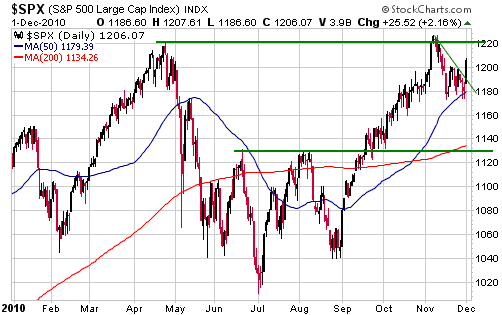
We downgraded our
short-term stock market outlook to bearish in the latest Weekly Update,
but the market action suggests that we were premature in doing so. For
example, if a new downward trend had begun then the S&P500 would
probably have moved well below its 50-day moving average before
experiencing a strong rebound, but on Wednesday it rebounded strongly
from just above this moving average. Also, the silver/gold ratio, which
generally trends with the stock market, managed to recoup all of last
week's losses and move to a new 52-week high during the first half of
this week.
We are going to quickly correct our mistake and return our short-term
stock market outlook to "neutral" pending additional evidence of a
downward trend reversal, such as a daily S&P500 close below 1170.
The industrial metals and oil are trending with the stock market, so
our short-term views on these commodities are also going back to
"neutral".
Gold and
the Dollar
Gold
There were two significant price-related developments in the gold
market over the past three trading days, the first being the move to a
new high by the euro-denominated gold price (gold/euro) as illustrated
by the following daily chart.
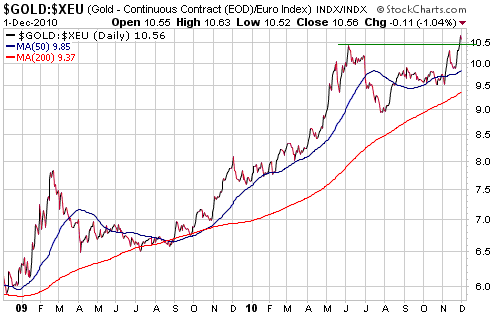
Upside breakouts in
gold/euro tend to be followed by upside breakouts in the
US$-denominated gold price, so gold/euro's performance over the past
few days suggests that the US$ gold price hasn't yet reached a
meaningful peak. Also, if gold/euro's correction has ended without a
test of the 200-day moving average -- as currently seems to be the case
-- then the potential now exists for a 1-2 month upside blow-off in the
gold market.
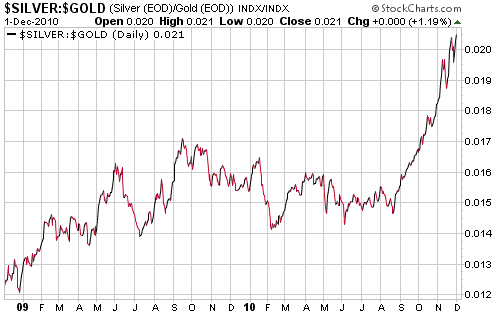
The other significant development over the first three days of this
week was the move by the silver/gold ratio to a new 52-week high. A
daily chart of this ratio is displayed below.
The silver/gold ratio's performance suggests that new highs lie in the near future for both gold and silver.
Gold Stocks
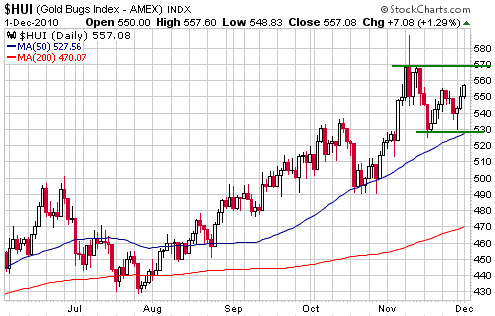
In the Weekly Update we said that a re-test of HUI support in the 520s
was likely. The re-test was accomplished immediately, via a quick drop
to 530 on Monday morning. The HUI then reversed upward and had made its
way back to the mid-550s by Wednesday's close.
It's quite possible that Monday's downward spike was 'all she wrote'
and that the next rally leg has begun. In fact, this is the most likely
scenario, although it won't be confirmed until the HUI closes above 570.
A daily close by the HUI below its November pullback low (525) would
now be more bearish than it would have been if it had occurred during
the first half of this week, so a close below 525 could be used as a
'stop' on short-term trading positions.
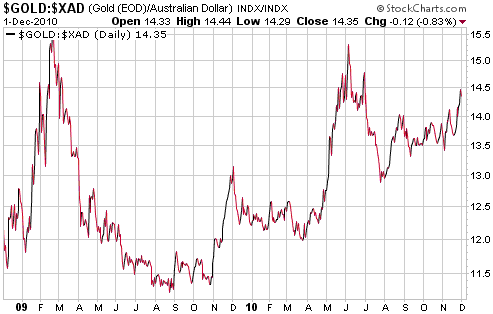
The stocks of gold
mining companies that generate a significant proportion of their
production in Australia have tended to fare relatively poorly over the
past few months. The reason is illustrated by the following daily
chart, which shows that the A$-denominated gold price (gold/A$) has
been consolidating since reaching a peak in early June. In fact,
gold/A$ has been consolidating on a longer-term basis in that the
June-2010 peak was a test of the February-2009 peak.
Gold/A$ and the stocks of Australia-based gold miners have the potential to make catch-up moves over the next few months.
Currency Market Update
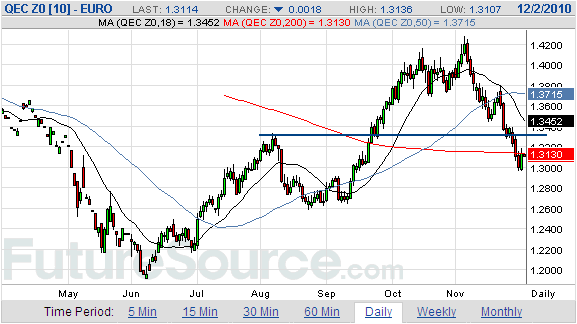
The euro continued its decline during the first two days of this week,
causing sentiment towards this currency to become overly extended to
the bearish side. In particular, Market Vane reported that the euro's
bullish percentage dropped to 35 on Tuesday, which was only 7 points
above the 2-year low reached in early June (when the euro traded below
1.20 and appeared to be on its way to 1.10). The euro has a lot of
additional downside potential, but it would be strange for sentiment to
become any more bearish at this stage of the decline. It is therefore
reasonable to assume that Wednesday's bounce was the start of a
multi-week rebound.
Update
on Stock Selections
(Notes: 1) To review the complete list of current TSI stock selections, logon at http://www.speculative-investor.com/new/market_logon.asp
and then click on "Stock Selections" in the menu. When at the Stock
Selections page, click on a stock's symbol to bring-up an archive of
our comments on the stock in question. 2) The Small Stock Watch List is
located at http://www.speculative-investor.com/new/smallstockwatch.html)
 Uranium Stocks Uranium Stocks
It's amazing how quickly the uranium sector of the stock market has
gone from the 'doghouse' to the 'penthouse'. Four months ago there was
almost no interest in these stocks and they were languishing near
52-week lows, but in the short intervening period they've risen so much
that it's now difficult to find value. In fact, although the current
leg of the gold bull market is 2 years old and the current leg of the
uranium bull market is only 4 months old, we can find a lot more value
within the ranks of junior gold stocks than junior uranium stocks.
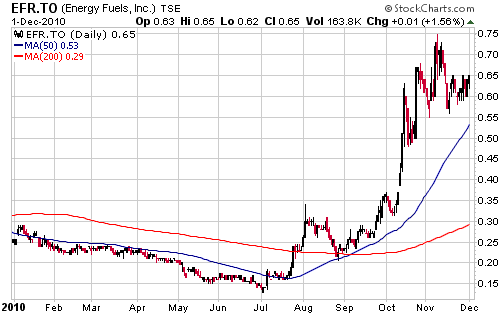
Considering that it is one of the very few juniors with a realistic
chance of getting into production within the next two years, we
continue to like Energy Fuels (TSX: EFR). A decision on whether or not
EFR's proposed uranium mill can proceed to construction is due within
the next 6 weeks. The mill will be located in Colorado and will
initially be fed by ore mined at the Utah-located Energy Queen and
Whirlwind mines. Refer to the map at http://www.energyfuels.com/projects/properties-map.html
for details. EFR's current in-ground U3O8 resource is around 11.5M
pounds, and based on Wednesday's closing price of C$0.65 its market cap
is about C$65M.
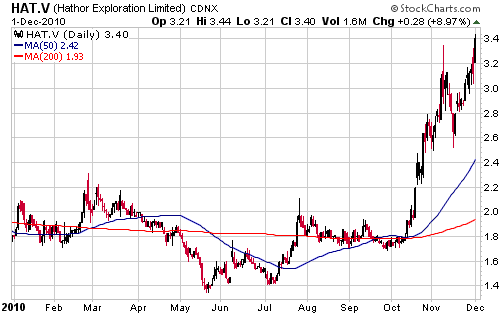
Hathor Exploration
(TSXV: HAT), UEX Corp. (TSX: UEX) and Uranerz Energy (TSX and AMEX:
URZ) are three other uranium stocks that interest us, although each of
them is too high to buy at this time. If uranium-related optimism
continues to build then it is certainly possible that they will move a
lot higher before experiencing substantial corrections, but we
generally prefer to risk missing out on further gains than to chase
over-priced stocks. There will always be other opportunities.
In brief, here's why each of the above-mentioned stocks interests us:
1. HAT owns 90% of the Roughrider deposit in the Athabasca Basin of
Saskatchewan (a region that accounts for more than 20% of global
uranium production), and this deposit contains a very high-grade --
and, therefore, potentially very valuable -- uranium resource. The
total NI-43-101 in-ground resource at Roughrider is presently estimated
to be 27.8M pounds, 24.2M pounds of which has an average U3O8 grade of
11.7% (by way of comparison, most uranium deposits owned by junior
mining companies have average grades of less than 0.5% U3O8). With a
fully diluted share count of 117M and an enterprise value of C$380M at
Wednesday's closing price of C$3.40, this means that HAT is being
valued by the market at around C$15/pound. This is comparatively high,
although a premium is warranted due to the quality of the resource.
HAT will probably have to pull back to the low-C$2 area to become a
member of the TSI Stocks List, but we might take an initial position
for our own account at a higher price.
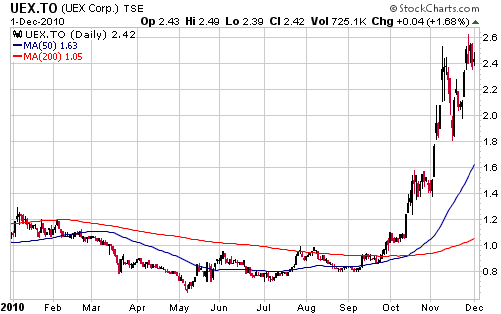
2. UEX controls a
large (82M-pound) in-ground resource across two projects in the
Athabasca Basin -- the Hidden Bay project, which is 100% owned by UEX,
and the Shea Creek project, which is 49% owned by UEX and 51% owned by
Areva. UEX is a takeover candidate, with Areva and Cameco being the
most likely acquirers (Cameco owns 22% of UEX).
UEX has a fully diluted share count of 219M and ended Wednesday's
trading session at C$2.42/share, which means that its in-ground
resources are presently being valued by the market at around
C$6.30/pound.
3. Like EFR, URZ is
one of a very small number of junior uranium miners that stands a good
chance of actually producing uranium. The plan is that the uranium will
be extracted from the ground using the ISR (In Situ Recovery) method.
URZ has about 19M pounds of low-grade in-ground uranium across several
projects in the Powder River Basin of Wyoming. With a fully diluted
share count of 77M, $20M of cash in the bank and a stock price of
C$3.70 at Wednesday's close, this means that the market is presently
valuing URZ's resources at around C$14/pound. This appears to be
unreasonably high given the low grade of the resources, although some
premium is probably warranted due to the near-term production potential.
Note that if EFR's resources were being accorded the same valuation as
URZ's then EFR would now be trading at around C$1.60/share.

New selection: Resolute Mining options (ASX: RSGO). Recent price: A$0.67
RSG is expected to produce 380K ounces of gold in 2011 from operations
in Africa and Australia. It no longer has any hedge liability and has
the lowest valuation amongst the >200K-oz/yr producers that we
track. It is also a takeover candidate, with Endeavour Mining (TSX:
EDV) being the most likely acquirer (RSG's West African assets would
mesh with EDV's current assets and stated plans). It is a member of the
TSI Stocks List and, in our opinion, a buy near its current price of
A$1.27.
RSG offers considerable leverage to changes in the gold price, but
adventurous types wanting even more leverage should consider buying the
RSG company options that trade in Australia under the symbol RSGO
(note: the options issued by Australian companies are the same as the
warrants issued by Canadian companies). These options have an expiry
date of 31st December 2011, an exercise price of A$0.60 and a current
market price of 0.67. Therefore, although they have a little more than
one year of time before expiry, their current market price includes no
time premium (the current option price of 0.67 is equivalent to the
stock price (1.27) minus the option's exercise price (0.60)).
With the stock price in the 1.20s and the option price in the 0.60s,
buying the options is roughly equivalent to buying the stock with 2x
leverage. Leverage, of course, works both ways.
We considered recommending the RSG options during earlier corrections
in RSG's stock price, but they weren't liquid enough (their trading
volume was too low and their buy-sell spread was too wide). However,
there now appears to be reasonable liquidity in that 500,000 options
traded on Wednesday 1st Dec and another 400,000 traded today on the
Australian market. This liquidity, along with the recent pullback in
the underlying stock, has prompted us to add RSGO to the TSI List at
A$0.67 (the closing bid-ask spread in Australia today was 0.66-0.675).
Chart Sources
Charts appearing in today's commentary
are courtesy of:
http://stockcharts.com/index.html
http://www.futuresource.com/

|