|
- Interim Update 2nd March 2011
Copyright
Reminder
The commentaries that appear at TSI
may not be distributed, in full or in part, without our written permission.
In particular, please note that the posting of extracts from TSI commentaries
at other web sites or providing links to TSI commentaries at other web
sites (for example, at discussion boards) without our written permission
is prohibited.
We reserve the right to immediately
terminate the subscription of any TSI subscriber who distributes the TSI
commentaries without our written permission.
Don't fight the Fed?
"Don't
fight the Fed" is an adage that's always worth remembering; however,
this adage shouldn't be applied to all of the Fed's endeavours because
the Fed is powerful in some areas and impotent in others. For example,
the Fed can ALWAYS depreciate the US dollar -- that is, it can always
cause dollar-denominated prices to rise -- if it chooses to do so, but
it can't create real economic growth or sustainable employment (despite
the fact that achieving "full employment" is part of the Fed's official
mandate). Furthermore, although the Fed can always bring about a rise
in prices by inflating the currency supply, it can't control which
prices rise the most in response to its monetary inflation. In fact,
the price-related effects of the Fed's inflation will often be the
opposite of what the Fed intends.
Given that the Fed is always capable of creating inflation (in all
meanings of the term), it is important not to bet on deflation at those
times when the Fed is going 'full steam ahead' along the inflation
path. Putting it another way, it doesn't make sense for investors to
worry about deflation as long as the Fed is aggressively trying to
promote inflation. By the same token, investors should generally become
more concerned about the potential for deflation at those times when
the Fed's top priority is to temporarily curtail the inflation.
Whereas it generally won't make sense to bet against the Fed's power to
inflate, it will always make sense to bet against the Fed's ability to
bring about real economic progress. This is because the Fed's
manipulations of interest rates and money supply make the economy less
efficient than it would be in the absence of these manipulations. It is
also appropriate to bet against the Fed's ability to smooth-out the
business cycle, because the central bank is one of the two main causes
of large swings in the overall economy (fractional reserve banking
being the other).
Summing up, the old adage "don't fight the Fed" always applies when it
comes to inflation/deflation and never applies when it comes to real
economic progress or economic stability.
The Stock Market
The
stock indices that we are watching most closely at the moment are the
NASDAQ100 and Russell2000 Indices in the US and the Hang Seng Index in
Hong Kong. Unlike the Dow Transportation Average, these indices aren't
directly affected by what's happening in the Middle East.
The Hang Seng Index stopped rising last November, but needs to close
below 22,500 to signal that the price action of the past few months is
more likely a topping pattern than a consolidation pattern. The
NASDAQ100 and Russell2000 Indices pulled back to their respective
50-day moving averages in February, which is not sufficient to indicate
that tops of even short-term significance are in place. To signal that
tops of at least short-term significance were put in place last month
these indices need to close below their February lows.
Based on the new high reached this week by the 10-day moving average of
the OEX put/call ratio, professional money managers remain far more
concerned than usual about the risk of a stock market decline. They
have been concerned for a while and nothing bad has happened, but you
can also play Russian Roulette for a while without anything bad
happening.
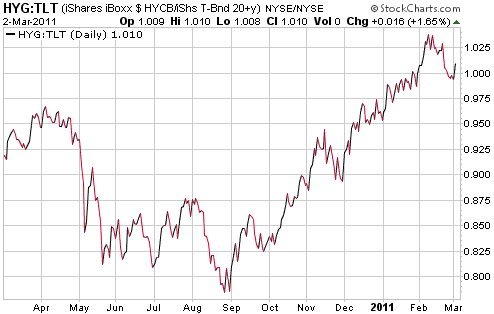
The following chart of the HYG/TLT ratio encapsulates the current
situation quite well. It reveals a relentless advance since late August
-- indicating a general narrowing of credit spreads as the demand for
high-risk debt increased relative to the demand for low-risk debt --
with just minor pullbacks along the way. This ratio is likely to peak
at the same time as, or prior to, an important peak in the US stock
market.
Gold and
the Dollar
Gold
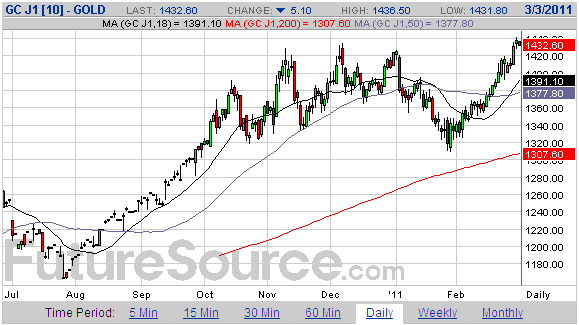
The following daily chart shows that the nearest gold futures contract
made a marginal new high this week. The breakout will probably become
more decisive within the next few weeks, but before that happens there
could be a $40-$60 pullback.
Interestingly, Market
Vane's bullish percentage for gold was at 78% on Tuesday, which is low
for a market on the verge of breaking out to a new all-time high. In
other words, sentiment towards gold remains constructive. However,
Market Vane's bullish percentage for silver is into the 90s, which is
what you'd expect for a commodity market that was approaching a major
peak. We wouldn't bet against the silver market at this time, but we
doubt that the current speculative fervour surrounding this metal will
last longer than a few more weeks.
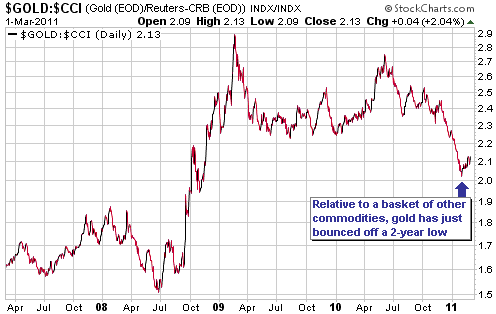
While gold has just made a new high in US$ terms, relative to other
commodities the situation could hardly be more different. Specifically,
the following chart shows that relative to the basket of commodities
represented by the CCI (the Continuous Commodity Index), gold has just
bounced off a 2-year LOW. This indicates that the global growth theme
remains dominant and that the goings-on in the Middle East have not yet
prompted a meaningful 'flight to safety'.
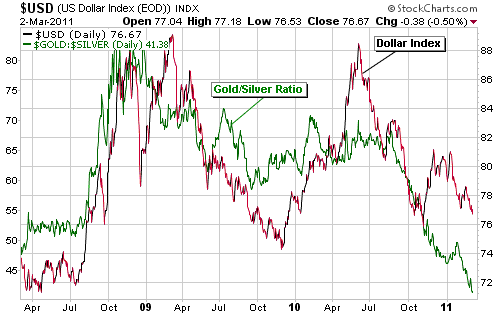
Gold's weakness
relative to silver over the past several months is related to the
global growth theme (increasing economic confidence and the general
shift away from safety) and the resultant weakness in the US dollar. As
evidence we present the following chart, which shows that the
gold/silver ratio has trended in the same direction as the Dollar Index
over the past three years.
Our expectation is
that three major changes will happen at approximately the same time:
gold will begin trending upward against most other commodities
(including silver), the US$ will begin trending upward against most
other currencies, and the the major stock markets of the world will
begin trending downward.
Gold Stocks
Gold Stocks versus Gold Bullion
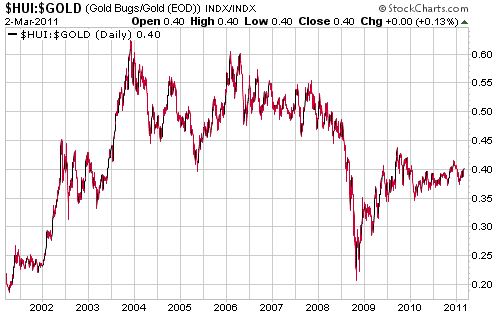
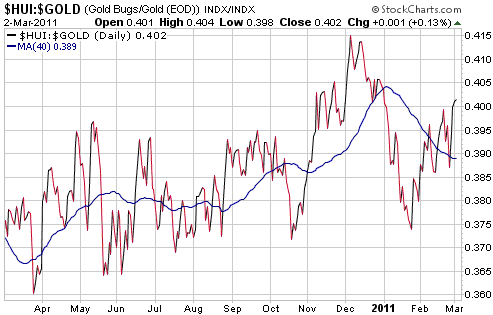
Have gold stocks, as a group, recently been diverging bearishly from gold bullion?
The answer is no. As evidenced by the first of the following charts of
the HUI/gold ratio, on a very short-term basis the gold stocks have
been strengthening relative to the metal. Also, the HUI/gold ratio
bottomed slightly in advance of gold bullion in late January, thus
creating a minor bullish divergence.
However, our second
HUI/gold chart shows that on a long-term basis the gold stocks have
been weakening relative to the metal. Specifically, the HUI/gold ratio
peaked near the end of 2003 and has since made a series of declining
tops. You'd be hard-pressed to make the case that HUI/gold's post-2003
series of declining tops constituted a bearish divergence, though,
given that it occurred in parallel with a 250% increase in the gold
price.
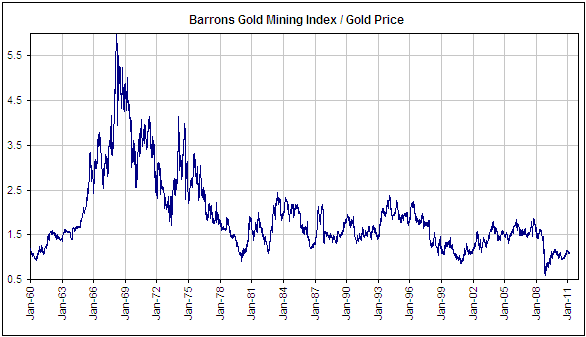
If we take an
ultra-long-term view, which is what we've done with the following chart
of the BGMI/gold ratio (the Barrons Gold Mining Index relative to
gold), we see that gold stocks, as a group, have been declining
relative to gold bullion since 1968. We don't think that this long-term
trend is about to change, although there is some potential for gold
stocks to outperform the bullion over the coming 1-2 years.
As we've explained
many times in TSI commentaries over the years, despite popular opinion
to the contrary the stocks of major gold producers do NOT provide
leveraged exposure to gains in the gold price over the long term. There
are a number of reasons for this, the main one being mine depletion. In
effect, gold producers have to invest a lot of money every year just to
stand still (that is, just to prevent their in-ground resources from
shrinking). Over the long haul the cumulative cost of this continual
investment usually offsets any benefit achieved from a higher gold
price.
The upshot is that the best way to obtain long-term exposure to gold is
to buy...gold. The major gold stocks make good intermediate-term trades
when they become extremely depressed relative to gold bullion, as was
the case in Q4-2008, but in general they shouldn't be held as long-term
investments.
Other than those times when the major gold stocks are extremely
depressed relative to gold bullion, speculators looking for
gold-related leverage should be able to find it at the junior end of
the gold sector.
Current Market Situation
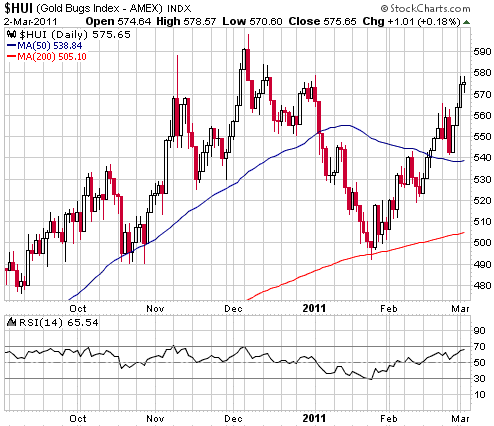
The HUI has broken above resistance at 555-560 and is now approaching
its all-time high. Support during a routine 'retracement' of the recent
rally would likely be found in the vicinity of the 50-day moving
average. This moving average is presently at 538, but it has begun to
rise and will probably move into the 540s over the days ahead.
As we noted at the
time, the HUI's decline to around 500 in late January created a good
short-term buying opportunity. At that time the short-term risk/reward
was very attractive because the downside risk was minimal and the
situation was such that even a counter-trend rebound would result in
decent gains over the ensuing weeks. The short-term risk/reward still
looks OK, but it is nowhere near as attractive as it was in late
January. This is mainly because the downside risk is significantly
greater now than it was back then.
Some individual gold stocks are at levels where new buying could be
appropriate, but on a very short-term sector-wide basis the current
situation should be viewed as a selling opportunity. In our opinion,
the most dependable way to outperform the market involves scaling in on
weakness and scaling out on strength.
Currency Market Update
The Dollar Index has broken below its early-February low. Also, it has
either broken below its 3-year trend line or is very close to doing so.
It will be interesting to see if the (potential) break below the 3-year
trend line is confirmed on a weekly closing basis. If it is, it won't
necessarily mean that there is a lot of additional downside in store
for the US$, but it will probably mean that a new multi-month bottoming
process will occur before the US$ begins its next intermediate-term
rally.
Update
on Stock Selections
(Notes: 1) To review the complete list of current TSI stock selections, logon at http://www.speculative-investor.com/new/market_logon.asp
and then click on "Stock Selections" in the menu. When at the Stock
Selections page, click on a stock's symbol to bring-up an archive of
our comments on the stock in question. 2) The Small Stock Watch List is
located at http://www.speculative-investor.com/new/smallstockwatch.html)
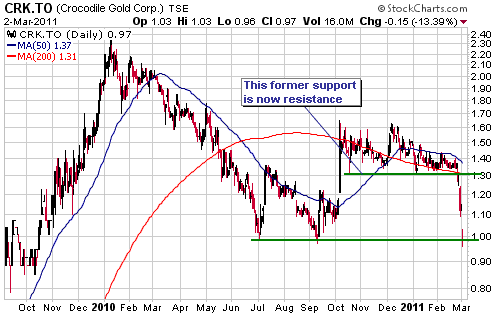
 Crocodile Gold (TSX: CRK). Shares: 321M issued, 400M fully diluted (incl 93M-share Mar-2011 financing). Recent price: C$0.97 Crocodile Gold (TSX: CRK). Shares: 321M issued, 400M fully diluted (incl 93M-share Mar-2011 financing). Recent price: C$0.97
CRK, a junior gold producer that operates mines in Australia's Northern
Territory, became the latest in a rather long line of gold producers to
disappoint on the operational front when it announced on Monday that
its 2011 production will be around 90K ounces. This compares to the
120K ounces that we were anticipating.
Record-high rainfall over the past two months is the main reason that
CRK's 2011 production will be lower than previously forecast. Other
mining companies in the region have been similarly affected by the
extraordinarily wet conditions.
Although the market's reaction to the lowered 2011 production forecast
was predictably negative, we don't see it as a big issue. CRK's
management obviously can't control the weather, and the plan to ramp up
to a production rate of 200K ounces in 2012 still appears to be
achievable. Monday's news therefore didn't have a significant adverse
effect on our valuation of the stock.
As far as the stock's valuation is concerned, Tuesday's news was more
negative than Monday's. On Tuesday the company announced a 93M-share
financing at the extremely low price of C$1.05/share. And as if to rub
salt into the wounds of existing shareholders, the company announced
that participants in the equity financing will receive half of a 5-year
C$2.25 warrant with each new share they buy.
When a company issues new equity at a large discount to the underlying
value of the existing equity, the existing equity is de-valued. By way
of explanation, consider the hypothetical case of a company that has
$200M of assets and 100M shares on issue, meaning that each share is
worth $2.00. If this company raises $50M by issuing 50M new shares at
$1.00/share, the total value of assets will rise to $250M and the total
share count will rise to 150M. Therefore, as a result of this financing
the value of our hypothetical company's shares will fall from $2.00
($200M/100M) to $1.67 ($250M/150M).
Note that it will sometimes make sense for a company to issue new
equity at a large discount to full value. One example is when there is
a feasible plan to use the money to fund an expansion that should
ultimately add more value per share than is subtracted by the stock
dilution. Another example is when the additional equity reduces risk by
enough to offset the reduction in the per-share upside potential.
The proceeds of CRK's equity financing will be used to fund production
growth, but it couldn't have been timed worse. In our opinion, it has
reduced the current per-share valuation by about 15%. Moreover, the
warrants could effectively put a long-term cap on the stock at
C$2.25-C$2.50.
It probably doesn't make sense to exit CRK right now because the
market's reaction to the bad news has pushed the stock price a long way
below our reduced estimate of current value (our per-share valuation
has dropped from $2.00-$2.20 to around $1.70 due to this week's
developments). However, we wouldn't do any new buying at this time,
unless we could do so via the private placement (and thus get the free
5-year warrants). The reason we wouldn't be eager to buy this weakness
is that the combination of the production news and the large equity
financing makes it likely that CRK will be 'dead money' for at least
the next 6 months.
General
Exploration-stage gold stocks have historically had more upside
potential and more downside risk than the stocks of gold producers, but
based on what has happened over the past 12 months -- producers have
been regularly missing their own production forecasts and getting
clobbered by the stock market in response -- it seems that the
explorers now have more upside potential and LESS downside risk than
the producers. We are referring, in particular, to the
exploration-stage miners that have already discovered substantial
in-ground resources but are still a long way from entering the mine
construction phase -- stocks such as BAT.V, CFO.V, KGN, PVG.TO, SBB.TO
and THM. At some point the market will begin to reward current
production, but at the moment it is a lot easier to make money amongst
the pure explorers.
Of the stocks mentioned above, CFO.V and KGN are probably the best
candidates for new buying at this time. THM would be suitable for new
buying at around US$9.00 and would be a strong buy if it were to drop
back to the low-US$8 area. BAT.V, PVG.TO and SBB.TO are too
'overbought' for new buying right now, although they are obviously in
demand and could therefore become even more 'overbought' before
substantial corrections get underway.
Chart Sources
Charts appearing in today's commentary
are courtesy of:
http://stockcharts.com/index.html
http://www.futuresource.com/

|