|
- Interim Update 2nd May 2012
Copyright
Reminder
The commentaries that appear at TSI
may not be distributed, in full or in part, without our written permission.
In particular, please note that the posting of extracts from TSI commentaries
at other web sites or providing links to TSI commentaries at other web
sites (for example, at discussion boards) without our written permission
is prohibited.
We reserve the right to immediately
terminate the subscription of any TSI subscriber who distributes the TSI
commentaries without our written permission.
The Stock Market
ISM Index better than expected
Going into this week there was a risk that optimistic sentiment in the US stock market would be dented by a worse-than-expected ISM Index on Tuesday and/or a worse-than-expected monthly employment report on Friday. Risk associated with the ISM Index didn't materialise as the numbers turned out to be a little better than expected.
As discussed in the WSJ blog linked HERE, the
latest ISM numbers (the results of a national survey of purchasing managers) were at odds with almost all of the regional surveys. The regional surveys weakened across the board in April and in some cases the weakness was considerable.
The ISM numbers remain noncommittal, having neither confirmed nor denied the recession argument. That being said, Tuesday's better-than-expected data removed one immediate-term threat.
Current Market Situation
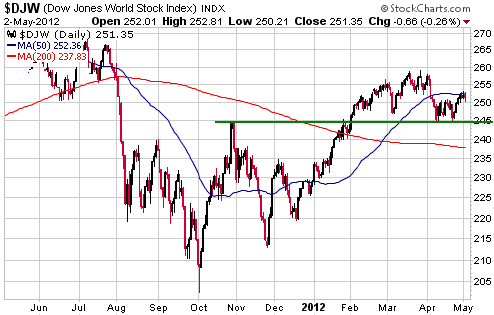
With reference to the following daily chart, the Dow Jones World Index (DJW) would have to close below 240 to provide the first piece of price-related evidence that an intermediate-term peak is in place. The S&P500 Index (SPX) is much farther above equivalent support, so the DJW is likely to be the first of these indices to signal an intermediate-term peak.
Gold and the Dollar
Gold and Silver
Who/what determines the gold price?
A gold mining company has more than enough cash to cover its expenses over the coming 12 months, so rather than swap all of its gold production for cash it decides to retain 20,000 ounces. That is, it decides to hold a portion of its liquid assets in gold rather than cash. Separately, an investor who plans to sell 20,000 ounces of gold changes his plans after listening to a speech by Ben Bernanke. The speech convinces the investor that the Fed is either deliberately or unwittingly charting a course that will simultaneously weaken the US economy and obliterate the purchasing power of the US$, thus increasing the desirability of owning gold. However, for the purposes of this discussion the investor's reasoning is immaterial. The point is that he decides to hold onto his 20,000 ounces of gold. The question now before us is: Which has the greater effect on the gold market -- the mining company's decision to withhold 20,000 ounces of its new production or the investor's decision not to sell 20,000 ounces of his existing gold?
The answer is that both decisions have exactly the same effect. In each case we are talking about a 20,000-ounce increase in gold demand (or a 20,000-ounce decrease in supply coming onto the market, whichever way you want to look at it). By the same token, one investor's decision not to sell a certain quantity of gold would have the same effect on the gold market as another investor's decision to buy the same quantity of gold. Again, we are talking about the same change in gold demand.
It is true that prices are set "at the margin", meaning that with supply and demand in balance a 20,000-ounce change in either supply or demand could affect the gold price. However, it is unrealistic to posit a scenario in which the global gold market is perfectly balanced and then a single investor or gold miner comes along and disrupts the balance via a small addition to supply or demand. The fact is that the gold market is large, very liquid and continuously adjusting in response to the decisions of millions of people throughout the world. These people (the owners of gold and the potential future owners of gold) exercise demand for the total aboveground gold stock, the size of which is estimated to be about 150,000 tonnes (4.6 BILLION ounces). Gold mining companies collectively add about 2,500 tonnes to this aboveground stock each year, which amounts to less than 2% of the total supply.
In the gold market, "the margin" is the net result at any point in time of the buy/sell decisions of all participants in the market, with any particular "margin" only existing for an instant. For example, there were innumerable changes in "the margin" in just the time it took us to type the preceding sentence. Furthermore, "the margin" can be influenced as much by decisions NOT to buy/sell as by decisions to buy/sell. If, for example, all the current holders of gold decided not to sell then the gold price would quickly move much higher.
In the hypothetical example outlined in the first paragraph, the actions of the investor and the gold mining company had the same effect on the gold price. However, it is clear from the relative sizes of annual mine supply and the total aboveground gold supply that gold mining companies, as a group, have almost no influence on the price of gold. Even a 30% change in mine supply would be trivial in the grand scheme of things. It is equally clear that the owners and potential future owners of the existing aboveground gold supply, as a group, totally dominate the gold market. This group covers the gamut of gold investors and includes Indian farmers, US hedge fund managers, Arab oil sheiks, European bankers, Chinese businessmen, and average working individuals throughout the world. In other words, the gold market's ever-changing "margin" is dominated by gold investors.
In summary, with their decisions to buy, not to buy, sell and not to sell, gold investors determine the price at which the total demand for gold is temporarily in balance with the total aboveground gold supply.
Current Market Situation
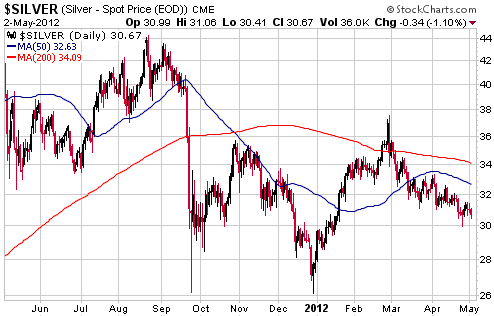
By the way that gold and silver mining stocks have been trading you'd be forgiven for concluding that the prices of gold and silver bullion must have tanked over the past several weeks, but the fact is that gold and silver have done very little since the second week of March. Gold has traded sideways in a narrow range and silver has drifted with a slight downward bias.
Both gold and silver have been trading as if they were immersed in routine consolidations. If this interpretation of the price action is correct then the next moves of significance ($100-$200 for gold, $5-$10 for silver) will be to the upside.
The following daily chart shows the performance of silver.
Gold Stocks
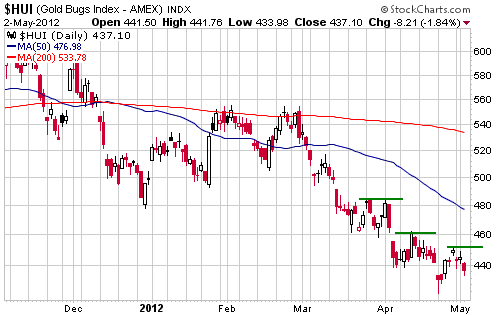
The HUI's price action over the past two months has involved the following repeating sequence:
1. Plunge to a new low
2. Bounce
3. Consolidate for a few days
4. Return to Step 1.
The most recent "Step 2" bounce ended last Friday at 452. This means that a daily close above 452 would break the sequence. Moreover, such a change in the pattern would be a clear sign that a low is in place.
Although it doesn't feel like it, times like these are when the seeds of profits are sown. Opportunities to harvest the profits will come in the future. Exactly when in the future is indeterminable, but very likely within the next six months.
Currency Market Update
At the end of last week the Dollar Index was slightly 'oversold' (on a short-term basis) and at minor support. It therefore isn't surprising that it rebounded over the first three days of this week.
This week's rebound hasn't changed anything. At this stage it hasn't even been strong enough to push the Dollar Index above its 50-day moving average.
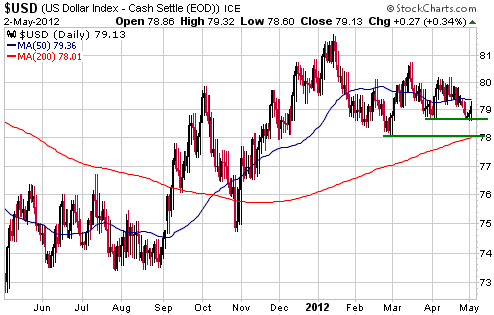
We remain short-term neutral on the Dollar Index, although if we were forced to pick a side we'd choose "bearish". The main thing that prevents us from downgrading our short-term outlook immediately is the risk that the stock market's correction isn't complete. If the recent strength in the stock market turns out to be a counter-trend rebound that does no more than test the high then we will possibly soon get a 'flight to safety' that quickly adds 2-3 points to the Dollar Index.
A general rule to bear in mind
Any newsletter writer or Western analyst who claims to have the 'inside dope' on what China's government plans to do is either a nutcase or a charlatan.
Update
on Stock Selections
Notes: 1) To review the complete list of current TSI stock selections, logon at
http://www.speculative-investor.com/new/market_logon.asp
and then click on "Stock Selections" in the menu. When at the Stock
Selections page, click on a stock's symbol to bring-up an archive of
our comments on the stock in question. 2) The Small Stock Watch List is
located at http://www.speculative-investor.com/new/smallstockwatch.html
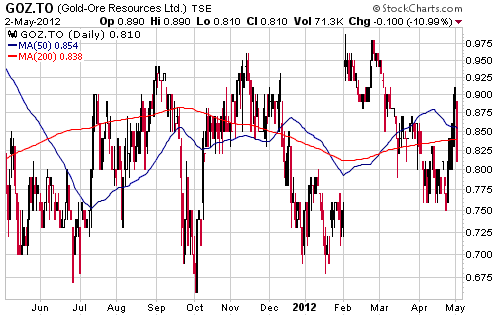
 Gold-Ore Resources (TSX: GOZ). Recent price: C$0.81 Gold-Ore Resources (TSX: GOZ). Recent price: C$0.81
The merger of GOZ and Elgin Mining (TSX: ELG) was approved by the shareholders of both companies on Monday 30th April and is now complete. GOZ will be de-listed on 4th May and former GOZ shareholders will receive one ELG share and half an ELG 2-year C$1.30 warrant for each of their GOZ shares. Consequently, ELG will replace GOZ in the TSI Stocks List and the ELG warrants (ELG.WT) will be added to the TSI Stocks List.
We consider ELG/GOZ shares to be strong candidates for new buying at around C$0.80.
Also, the soon-to-be-listed (on 3rd May) ELG warrants would be an interesting speculation at the right price. At the current ELG share price of C$0.80, fair value for the warrants would be around C$0.09. This means that at the current share price, the "right price" for the warrants would be C$0.09 or lower. We understand that the warrants will initially trade on the TSXV and then switch to the TSX on 4th May.
Pretium Resources (TSX and NYSE: PVG). Shares: 88M issued, 95M fully diluted. Recent price: C$15.28
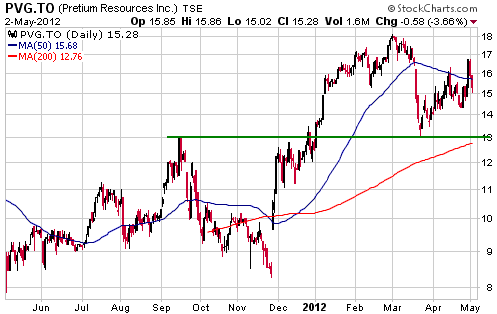
For anyone who has been speculating on the 'long side', almost nothing has worked in the gold sector over the past two months. One of the few things that did work was buying PVG shares after they dropped to the C$13-C$14 'buy zone'.
Due to a barrage of positive company-specific developments, PVG shares held up well under the pressure stemming from the relentless sector-wide slide of the past two months. The only meaningful weakness occurred in mid March when a wave of selling was set in motion by a news release advising that the company would be issuing more shares at some future time. This selling created an opportunity to buy PVG near intermediate-term support at C$13.00.
It is possible that the press release issued by PVG after the close of trading on Wednesday 2nd May combined with the dismal overall market for gold mining stocks will lead to another opportunity to buy PVG shares near support at C$13. We are referring to the announcement that PVG has arranged to sell about $60M of new shares.
There is no guarantee that PVG will drop back as far as support in the low-C$13 area. There is also no guarantee that support at C$13 will hold if tested. It isn't reasonable to expect any guarantees, but it is reasonable to attempt to do most of your buying when prices are fundamentally and technically stretched to the downside.
Buy PVG shares if presented with the opportunity to do so in the low-C$13 area.
Rio Novo Gold (TSX: RN). Recent price: C$0.38. Shares: 113M
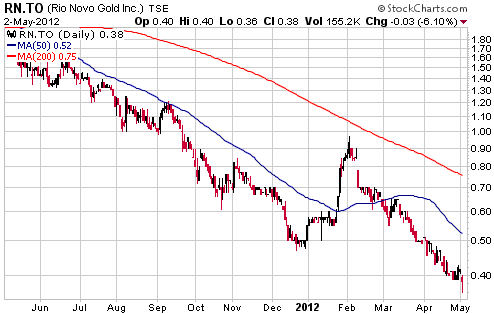
We traded RN very successfully during December-January, but our second attempt to trade this stock has been a dismal failure to date. The only significant news issued by the company since we re-entered the stock at C$0.63 in late February was positive, but RN has been a victim of the relentless sector-wide downward trend that has drastically reduced the market capitalisations of most exploration-stage gold mining stocks.
RN has about C$0.25/share in cash, which means that its gold projects in Brazil and Colombia -- two of the best countries in which to do business in South America -- are being assigned very little value. These projects currently have a combined total of about 2.2M ounces of in-ground gold. Also, one of the projects has an estimated NPV of $106M at $1350/oz for gold (rising to more than $200M at the current gold price).
Is it possible that RN's market cap will decline to the point where its gold mining assets are being valued at zero? Well, it is unlikely, but it is certainly possible. Stranger things have happened in the stock market.
Like many other exploration-stage juniors, RN has been sold down to the point where the potential reward is several times the remaining downside risk. It could possibly get even cheaper, but speculators who methodically pick away at these beaten down stocks with solid balance sheets and interesting metal deposits should end up with large profits.
Jaguar Mining (NYSE and TSX: JAG). Shares: 84M issued, 88M fully diluted. Recent price: US$2.50
The following weekly chart shows that JAG, a Brazil-based junior gold miner, is probably about to achieve its 11th down week in succession. JAG is a poorly managed company that has consistently missed its own production forecasts, but by late March the stock market had discounted the poor operational performance and the latest missed forecasts. It seems that the accelerated slide since then can mostly be put down to the general capitulation of gold-stock investors.
Despite its ultra-depressed price, JAG still wouldn't be near the top of our shopping list if we were building-up long-term positions in gold stocks. The reason is that almost everything in the gold sector is ultra-depressed right now -- well managed and poorly managed companies alike. That being said, JAG should bounce back very strongly once the sector-wide trend reverses course, so it will make a good short-term trade for anyone who can get the timing right.
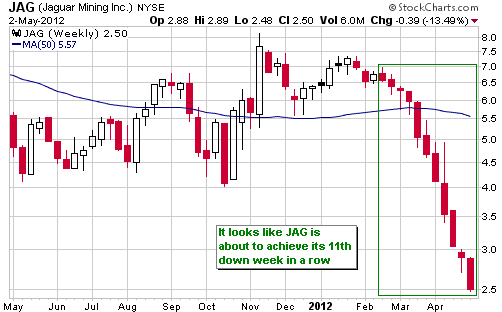
Chart Sources
Charts appearing in today's commentary
are courtesy of:
http://stockcharts.com/index.html

|









