|
- Interim Update 2nd June 2010
Copyright
Reminder
The commentaries that appear at TSI
may not be distributed, in full or in part, without our written permission.
In particular, please note that the posting of extracts from TSI commentaries
at other web sites or providing links to TSI commentaries at other web
sites (for example, at discussion boards) without our written permission
is prohibited.
We reserve the right to immediately
terminate the subscription of any TSI subscriber who distributes the TSI
commentaries without our written permission.
Two articles that suggest gold is headed much higher
There
are two articles in the 31st May edition of Barrons magazine that point
to a much higher gold price over the years ahead. The first of these
articles is an interview with Ray Dalio entitled "Set Aside Fears of
Inflation -- Just For Now".
Ray Dalio is the chief investment officer for Bridgwater Associates, a
firm that manages about $75B on behalf of governments, central banks,
pension funds and endowments, so his opinions carry some weight. His
views are decidedly gold-bullish, not because he is bullish on gold but
because he unequivocally concurs with the Keynesian (read: wrongheaded)
policies implemented by governments and central banks in response to
the financial crisis. Specifically, coming through loud and clear in
the article is Dalio's belief that central banks can help the economy
by creating money out of nothing (counterfeiting). For example, he says:
"There is a lot of
criticism about saving financial institutions and running a big budget
deficit, but if the government didn't do those things we would be in a
terrible situation. It will be impossible to stimulate that way in the
future because politically it is untenable. That's a risk because,
between now and 2012, the economy will probably go down again, and it
will be important for monetary policy and fiscal policy to be able to
be stimulative, and for the Federal Reserve to be able to purchase
assets again."
And:
"The English also have
way too much debt, but they have [an advantage over the euro zone in
that they have] an independent currency and can print money and avert a
debt crisis. Debtors with no ability to print money are the ones in
trouble."
Moreover, near the end of the article he dispenses with the idea that
the large-scale printing of money will lead to an "inflation" problem,
as follows:
"The depreciation of the
major currencies and the printing of money will not cause a significant
general level of inflation anytime soon.
The printing of money
will offset the deflation that is coming from the weak demand for goods
and services due to weak credit growth. For example, in March of 1933
the U.S. printed a whole lot of money, and that had the effect of
converting deflation into modest inflation, but not a high rate of
inflation.... My point is, in developed countries there is too much of
most things at the moment, and that's creating a deflationary
environment. There is too much manufacturing capacity. There is too
much labor. There is too much housing stock. As Europe's economy
weakens and its debt crisis worsens, the printing of money does not
mean that it will produce an accelerating inflation because
simultaneously there is also less being purchased, and the surpluses
are already causing deflationary pressures. That is why, contrary to
almost everybody's belief, I believe the bonds in countries that can
print money will be good investments."
To summarise Dalio's view: Central bank money creation will put a floor
under the economy, and as far as the general price level is concerned
it really doesn't matter how much new money is created as long as there
is an output gap.
If highly respected and influential money managers such as Ray Dalio
believe that monetary inflation is the way to go then we are a long way
from the point where the political tide shifts against attempts to
'inflate away the debt'. This suggests that there will be a lot more
inflation in the future and that a much higher gold price lies in store.
The second of the two Barrons articles is entitled "Gold: The Ultimate
Fiat Currency". This article makes the correct point that people tend
to chase performance, which results in investments becoming extremely
popular after they cease to offer any value. Unfortunately, that's the
only correct point in an article riddled with misunderstandings and
logical errors. We'll only deal with a few of the
errors/misunderstandings.
Richard Wiggins, the article's author, argues that gold has become too
popular, the implication being that it is now over-owned and therefore
at risk of experiencing a large price decline. We agree that gold is a
lot more popular today than it was five years ago, but very few members
of the investing public currently have significant exposure to gold. To
quote Marc Faber:
"Let me shed some light
on...[the argument that gold is over-owned]. Every year I attend
numerous investment seminars, corporate meetings, and conferences. I
frequently ask who among the audience owns some gold. Usually a maximum
of between 3% and 5% of the participants own some gold or other
precious metals. ...In fact, given all the money printing that is going
on around the world I was rather shocked that when I attended recently
five different conferences and group meetings with investors I consider
to be "sophisticated", prudent, and "intelligent", hardly anyone among
them owned any physical gold or silver (usually among 200 people maybe
3 people)."
After wrongly asserting that gold is "over-owned", Wiggins continues:
"The big argument for
gold is that all of the money that the Federal Reserve is printing --
18 years of easy money -- will come back to haunt us at some time when
inflation comes roaring back. Yet if today's investors are worried
about U.S. inflation, they can go out and sell T-bonds, or buy the euro
or another currency and earn interest while they're doing it. Investors
afraid of 1970s-style inflation also should be buying Treasury
inflation-protected securities."
We agree that a short position in T-Bonds should do well over the next
few years, but there are four reasons why a short T-Bond position is
not a good substitute for an investment in gold bullion. First, a short
position in anything should never be considered an investment. Second,
you only need to look at what happened over the past decade to realise
that declining confidence in government-controlled money can be
accompanied by positive returns for both gold and T-Bonds. Third, by
monetising T-Bonds the Fed could ensure that the government bond market
failed to reflect the "inflation" threat for an inconveniently long
time (inconvenient, that is, for anyone attempting to protect
themselves from "inflation" via a T-Bond short position). Fourth,
mathematics favours 'longs' over 'shorts', in that the maximum
potential gain on a non-leveraged short position is 100% whereas the
maximum potential gain on a non-leveraged long position is unlimited.
Regarding the idea that inflation-fearing investors should buy
inflation-protected securities, we'll simply note that these securities
only protect against the effects of inflation that the government
admits to.
Regarding the idea that investors buy the euro as a hedge against US$ inflation: He can't be serious!
The article ends as follows:
"Only 15% of gold is used
as a monetary metal; the rest of it is used as a commercial metal, and
that use, particularly as a corrosion-resistant electrical conductor
for semiconductors, is declining. Regrettably, it is a soft,
semi-useless metal with very few industrial applications.
Gold is just another fiat
currency. The only reason gold is valuable is that we believe it is
valuable. Ultimately, this gold bubble ends in tears. When and how far
gold's price will decline is anyone's guess, but a smart bet is "sooner
rather than later.""
He may as well have held up a sign that reads:
"I am totally
clueless about gold supply and demand, and I don't know the meaning of
the term "fiat currency". Also, it has never occurred to me that the
only reason ANYTHING is valuable is because we believe it is valuable."
In conclusion, the first of the above-mentioned Barrons articles is
gold-bullish because it reflects a belief that a lot more monetary
inflation will be needed to support the economy in the future, while
the second is gold-bullish because it reflects gross misunderstandings
of gold, money, and what a real "gold bubble" would look like. Such
misunderstandings are usually prevalent in the early or middle stages
of bull markets, but never near the ends of bull markets. When we get
to the stage where the gold bull market is almost complete, almost
everyone will understand why the price is rising.
"Austrian"-oriented investment advisors
In
last week's Interim Update we said we aimed to put together a
short-list of professional managers/advisors who a) have good track
records over the past 5 years, and b) understand that the attempted
solutions to the system's current problems will lead to more and bigger
problems. After tapping the TSI readership and a couple of other
sources, we came up with two lists -- a list of investment
advisors/managers and a list of investment funds. Refer to http://www.speculative-investor.com/new/advisors_managers.html.
The Stock Market
The Shanghai Stock Casino
An article posted at Seeking Alpha
on 1st June does a good job of explaining the three main forces that
drive prices in all stock markets (speculation, arbitrage, and value
investing), and why the performance of the Shanghai stock market says
almost nothing about the long-term growth prospects of China's economy.
Here are the concluding paragraphs:
"A market driven almost
exclusively by speculators, and with little to no participation by
fundamental or value investors, is not a market that pays much
attention to long-term growth prospects. It is driven largely by fads,
technical factors, liquidity shifts, and government signaling.
So what does this year's
crash in the Shanghai stock market tell us? It might be saying
something about the impact of the European crisis on export earnings.
It might suggest that liquidity in the system is being driven into real
estate rather than into stocks. It may reflect contagion and
nervousness about the fall of stock markets abroad.
But we should be cautious
about reading too much into it. In fact attempts by Beijing to hammer
down real estate bubbles in the primary cities without addressing
underlying liquidity expansion may simply push asset price bubbles
elsewhere, and this could easily cause a surge in the Shanghai stock
markets. But this should not then be interpreted as signaling a surge
in the economy.
Shanghai's markets will
go up and down, but they are not driven by investor evaluation of
long-term growth prospects. China does not yet posses the tools to make
such evaluation useful, so be careful about reading too much into the
stock market numbers."
Investors and analysts should be careful about reading too much into
China's stock market numbers, and should be even more careful about
reading too much into the GDP-growth numbers reported by the Chinese
Government. China's GDP numbers -- which many people cite to justify
bullish forecasts for industrial commodities -- are completely
fabricated.
China's economy is probably now in a downturn, but it is really just a
coincidence that the stock market is in a funk. At some point over the
next few months it is certainly possible that the government will
'manufacture' a new upward trend, regardless of what the economy
happens to be doing at the time.
By the way, stock markets in the so-called "developed world" have
become far more speculative over the past 15 years. Rather than
discounting long-term growth prospects, in a similar vein to China's
market they are now driven to a large degree by government policy
shifts and central bank machinations.
Current Market Situation
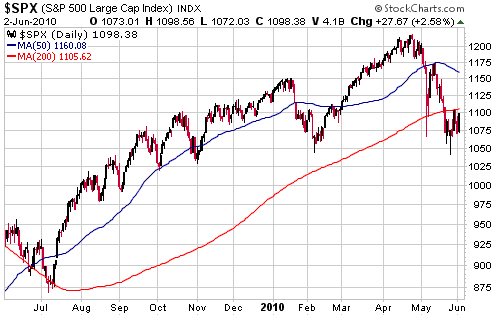
There is nothing new for us to say about the broad stock market. As
discussed in the latest Weekly Update, the 50-day moving average looks
like a reasonable upside target for the rebound that began last
Tuesday. The following chart shows that the S&P500's 50-day moving
average is at 1160 and falling.
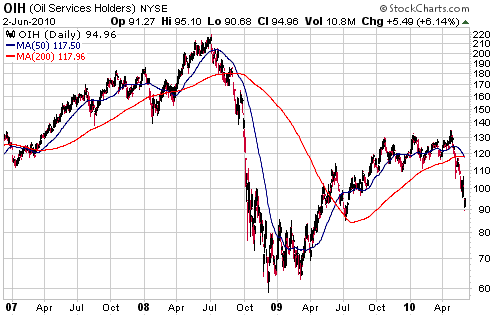
The beaten-down oil
services sector of the stock market, as represented on the following
chart of the Oil Services Holders ETF (OIH), is worthy of comment at
this time. The OIH has tanked over the past few weeks as the stock
market has discounted the short-term costs and the longer-term
implications of the BP disaster.
Apart from the
environment and the companies that are directly involved with the
failed rig that is now pumping millions of barrels of oil into the
ocean, the offshore drilling industry will be the biggest loser as a
result of the disaster. Amongst the biggest winners will be onshore
drilling companies (PDS, for example) and companies involved with the
production of oil from Canada's tar sands (SU, for example). On a
longer-term basis the uranium sector could also benefit.
Due to our overall market outlook we don't think that this is a good
time to be buying the potential winners from the BP disaster, but we
expect that a good buying opportunity will arrive by October.
Gold and
the Dollar
Gold
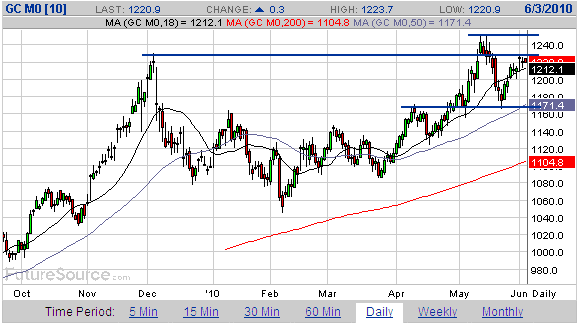
Nothing of significance happened in the gold market during the first
half of this week, but the current situation is interesting
nonetheless. It is interesting because the US$ gold price is either
very close to (within $20 of) a short-term peak, or about to break out
to the upside. Something similar can be said about the euro-denominated
gold price because gold/euro has moved back to last month's all-time
high.
Gold has no chart-based resistance above $1250, so coming up with a
target following a sustained break above $1250 would involve pure
guesswork. On the other hand, IF a short-term peak is now being put in
place then $1080-$1120 is a likely downside target-range and major
support at $1000 probably defines the maximum downside potential.
We are operating
under the assumption that a short-term peak is close at hand, which
means that we are maintaining a large cash reserve and looking for
opportunities to accumulate some insurance in the form of put options.
If this assumption is proven wrong then we will most likely increase
our exposure to junior gold and silver stocks.
Platinum
Gold and platinum have trended in the same directions more often than
not over the past 40 years, but their supply/demand characteristics
could hardly be more different. Whereas gold's price trend is dominated
by changes in investment demand, which are, in turn, driven by changes
in the general level of investor confidence in banks, governments and
the financial system, platinum's price trend is dominated by changes in
mine supply and car production.
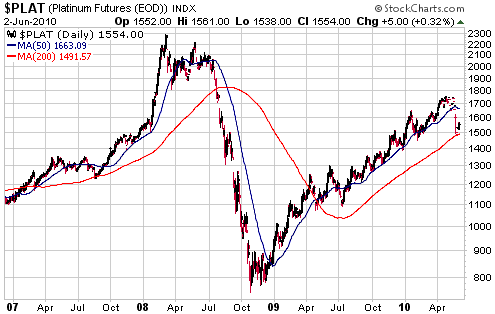
The following chart shows that there was a huge near-vertical rise in
the platinum price in early 2008. This price rise was caused by the --
temporary, as it turned out -- crimping of South Africa's mine
production due to the inability of ESKOM to provide adequate electrical
power to the mines. It is quite possible that this supply-shock-related
upside blow-off created a secular price peak.
The platinum price crashed during the second half of 2008 and then
rebounded strongly from late 2008 through to early April of this year.
The crash and the subsequent rebound tracked changes in economic growth
expectations.
Economic growth expectations probably began a new downward trend last
month due to the triumph of reality over stimulus-induced hope, in
which case there is a lot of downside risk in the platinum price.
Gold Stocks
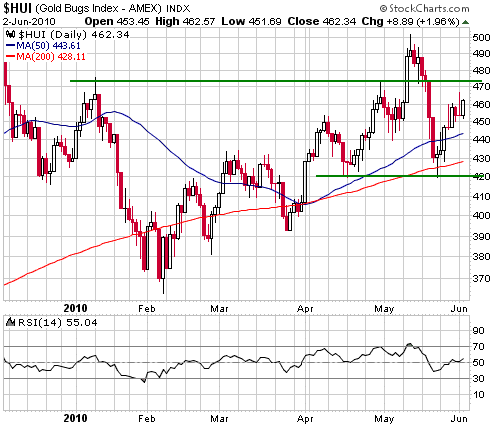
The HUI has been drifting lower relative to gold bullion since last
September. The most likely outcome is that this downward drift will
continue until around October of this year, at which point the stocks
should begin to strengthen relative to the bullion. However, if gold
bullion makes a sustained break to a new high in the near future then
the gold-stock indices will probably enjoy some immediate
out-performance as stock market participants hurriedly discount
substantially greater gold-mining profit margins. This is not our
favoured near-term outcome, but it can't yet be ruled out.
On a short-term basis the HUI is in a similar position to the June gold
futures contract in that it has risen to just below significant
resistance. Either a short-term top will be put in place within a few
percent of Wednesday's closing price, or an upside breakout will soon
occur. We are operating under the assumption that it will be the former.
Speculators looking
for ways to hedge long-term exposure to gold and silver stocks could
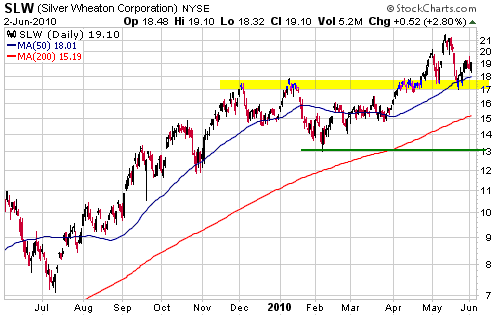
consider purchasing December-2009 put options on Silver Wheaton (SLW)
with the stock in the US$19-$20 range. SLW is possibly now working on
the "right shoulder" of a "head-and-shoulders" topping pattern.
Support lies at US$17 and then at US$13.
Currency Market Update
A slow week so far in the currency market, which makes a nice change.
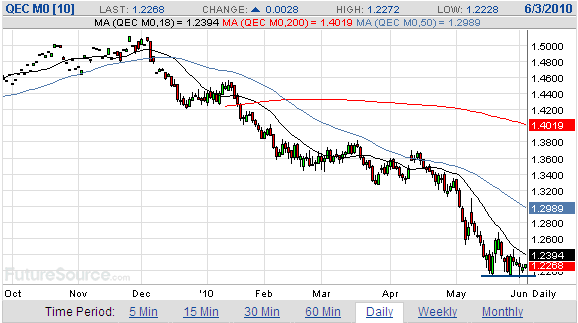
The June euro has again tested its low (see chart below), but on a
daily closing basis there has been almost no movement.
We continue to anticipate a 1-2 month bear-market rebound in the euro,
with maximum upside to the low-1.30s and likely upside to the
high-1.20s.
Update
on Stock Selections
(Notes: 1) To review the complete list of current TSI stock selections, logon at http://www.speculative-investor.com/new/market_logon.asp
and then click on "Stock Selections" in the menu. When at the Stock
Selections page, click on a stock's symbol to bring-up an archive of
our comments on the stock in question. 2) The Small Stock Watch List is
located at http://www.speculative-investor.com/new/smallstockwatch.html)
 Cardero Resource (TSX: CDU, AMEX: CDY). Shares: 59M. Recent price: US$1.04 Cardero Resource (TSX: CDU, AMEX: CDY). Shares: 59M. Recent price: US$1.04
CDY is an exploration-stage metal miner with several projects in South
America and Mexico. The main metals covered by these projects are iron,
copper and gold.
The company has been exploring for metals and making metals-related
investments for a long time, and yet it managed to sneak through the
entire resource bull market of the past decade without creating any
shareholder value. That's a remarkable achievement and suggestive of a
management deficiency. Sometimes, however, poor management can lead to
assets being priced at large discounts to fair value, and, therefore,
to buying opportunities. In CDY's case, there is now such a total lack
of confidence in management's ability to create shareholder wealth that
the stock market is assigning a large NEGATIVE value to the company's
exploration-stage assets.
Our statement that the stock market is assigning a negative value to CDY's projects is based on the following simple arithmetic:
The company has working capital (in this case, cash minus the tax
liability associated with an asset sale) of C$62M and investments
(shares in other resource companies) worth around C$32M, meaning that
it has net-cash plus investments of around C$94M. This works out to
about US$1.50 per share, or 33% less than the current stock price. In
other words, at the current stock price you get cash + investments at a
33% discount to current market value and you get the exploration-stage
projects for free. Furthermore, the most significant of CDY's
investments is its 3.5M-share stake in International Tower Hill Mines
(AMEX: THM), a junior gold mining company that does appear to be well
managed.
We aren't going to add CDY to the TSI Stocks List, but it warrants inclusion in the TSI Small Stocks Watch List.
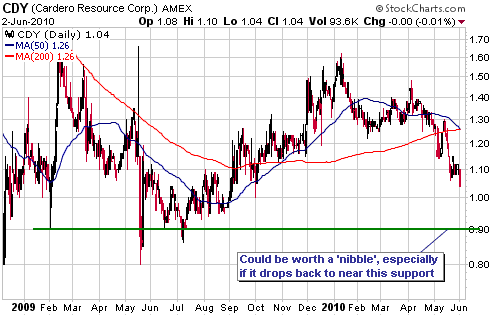
Chart Sources
Charts appearing in today's commentary
are courtesy of:
http://stockcharts.com/index.html
http://www.futuresource.com/

|