|
- Interim Update 2nd November 2011
Copyright
Reminder
The commentaries that appear at TSI
may not be distributed, in full or in part, without our written permission.
In particular, please note that the posting of extracts from TSI commentaries
at other web sites or providing links to TSI commentaries at other web
sites (for example, at discussion boards) without our written permission
is prohibited.
We reserve the right to immediately
terminate the subscription of any TSI subscriber who distributes the TSI
commentaries without our written permission.
Unintended Consequences
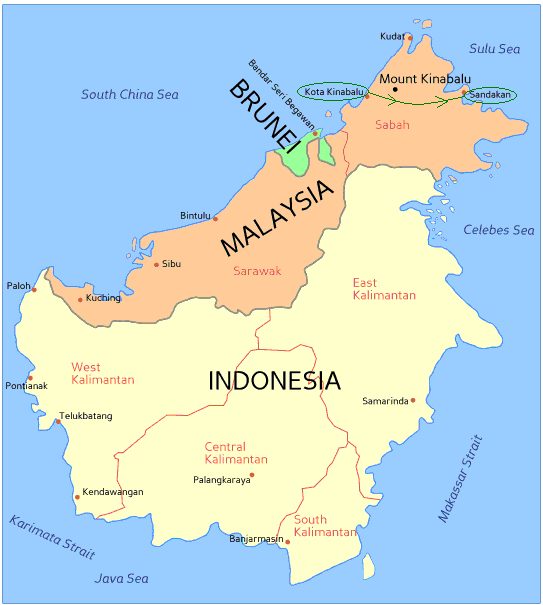
Last week we drove from Kota Kinabalu (our base) on the north-west coast of Borneo to Sandakan on the north-east coast of Borneo. It's a 330km journey that, due to the nature of the roads and the preponderance of slow-moving trucks along the way, takes 6-7 hours. The route we took is marked in green on the following map of Borneo.
The first half of the journey to Sandakan primarily consisted of mountainous terrain covered by rainforest. It was definitely scenic. The second half of the journey couldn't be described as scenic in the traditional sense, but it was certainly interesting. It consisted of plantation after plantation of oil palms. The photo linked
HERE
shows the type of scenery we saw.
Oil palm plantations produce the fruit that gets turned into palm oil, which is one of the world's most important commodities. It's likely that at least 10% of the products at your local supermarket contain palm oil.
As well as being a component of many food products and a vital source of nutrition throughout the world, palm oil is increasingly being used in the production of biofuel. However, this is only because governments are setting targets for biofuel production and consumption. For example, the US government has arbitrarily decided that the US economy should be producing 36 billion gallons per year of biofuel by 2020, and both the UK and the EU have targeted 10% for biofuel's proportion of transport fuel.
The main reason that governments are incentivising/mandating the increased use of biofuel is the hobgoblin formerly known as "global warming" and now known as "climate change" or "climate disruption". The goal is to cause less CO2 from being spewed into the atmosphere.
Putting aside for the moment the conspicuous lack of legitimate evidence that human-generated changes in CO2 levels are significant contributors to climate change, government promotion of increased biofuel production is a classic example of the unintended bad consequences of interventionist policy. The most obvious unintended consequence is that the large-scale use of food as fuel leads to much higher food prices and, therefore, to more people going hungry. A less obvious unintended consequence is increased deforestation as the rising price of palm oil (see chart below) stemming in part from the unnatural push towards biofuel prompts a natural market response in the form of more oil palm plantations.
What happens when you obliterate a hectare of rainforest to make way for oil palms? It is estimated that you release 500-900 tonnes of CO2 into the atmosphere. And what is the estimated reduction in CO2 emissions from replacing fossil fuel with the biofuel generated from one hectare of oil palms? About 6 tonnes per year. That is, using palm oil as a fuel dramatically INCREASES the amount of carbon spewed into the atmosphere.
In other words, even if there is an element of truth to the claims that human-generated CO2 emissions are contributing in a meaningful way to "climate change", there is no justification for the regulations requiring the greater use of biofuels. These regulations are unusual in that all of their consequences are negative. With most government economic interventions there will be superficial short-term positives that will be more than offset by indirect and longer-term negatives, but the regulations requiring the greater use of biofuels don't even have superficial short-term positives.
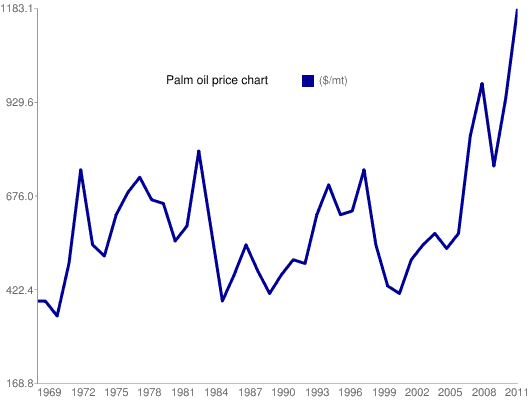
Chart Source: http://www.mongabay.com/images/commodities/charts/palm_oil.html More
weather extremes on the way
For those who want to understand the drivers of the weather and the causes of weather extremes, the
Browning Newsletter is very good. The November issue of this newsletter explains that the Central Pacific Ocean began to cool down a couple of months ago, creating the phenomenon called "La Nina". The air/weather pattern associated with "La Nina" (and "El Nino", the name given to a warming of the Central Pacific Ocean) is called the "Southern Oscillation".
It isn't yet known if this year's La Nina will be moderate or strong, but according to the Browning Newsletter two other events are likely to ensure that the overall effect is strong even if the La Nina itself is only moderate. The first is that the Northern Pacific is undergoing a cool phase of the Pacific Decadal Oscillation (PDO). The PDO will magnify the weather impact of La Nina. The other event is "volcano weather", meaning increased winter cooling in the Northern Hemisphere due to the effects of two Arctic volcano explosions this year.
Browning expects the combination of the developing La Nina, the negative Pacific Decadal Oscillation and volcanic eruptions in the polar air mass to have the following effects:
- Colder than normal weather in the northern states of the US, heavy precipitation in the Pacific Northwest and drought in Texas and the South.
- A very cold mid-winter in Southeast Canada, the Midwest and Eastern US.
- Many of the same problems as last winter.
- Flooding in Southeast Asia (already happening in Thailand).
- Heavy rains in Indonesia, Malaysia and the Philippines later this year.
- A very cold winter in Asia and strong dry season monsoons in Northern and Central China.
The likelihood of extreme weather over the next few months in important grain-producing regions creates a speculative opportunity. Specifically, there is significant risk that weather-related supply disruptions will lead to price surges in the grain and bean markets at some point over the next few months, so a good argument can be made for obtaining some 'long side' exposure to these markets.
Unfortunately, we don't know of an ideal way of obtaining the aforementioned exposure via the stock market. In most respects the iPath Grains ETN (JJG) is an ideal vehicle in that it is designed to track an index of corn, soybean and wheat prices. However, as is the case with all ETNs there is credit risk associated with JJG (JJG shares are unsecured debt instruments issued by Barclays Bank) and in the current environment we aren't keen to expose ourselves to such risk. The PowerShares DB Agriculture Fund (DBA) is an ETF and therefore doesn't have credit risk (an ETF is backed by the assets it holds rather than by a financial institution), but it provides exposure to many different agricultural commodities and we'd prefer that our exposure were focused on grains.
If we had to choose between JJG and DBA we'd opt for DBA, even though it appears to have less weather-related upside potential. This is because DBA doesn't come with credit risk.The Stock Market
Review
Below is an excerpt from the 3rd October Weekly Update, with new comments shown in square brackets.
"We suspect that the US stock market commenced a 1-3 year downward trend in May of this year. We also suspect that this bearish trend will a) contain no 2008-style crashes, b) contain enough rallies that money-making will prove to be almost as difficult for the 'shorts' as for the 'longs', and c) end with the senior stock indices above their March-2009 lows.
[This continues to be our intermediate-term outlook]. That's our best guess as to what the future holds in store, but there is no good reason for us to bet on this scenario or any other scenario. Instead, we will place our bets based on real-time analysis. "
"Our real-time analysis tells us that the early-August low occurred in parallel with a sentiment extreme and stands a good chance of having marked this year's 'internal' low for the market (the point when the greatest number of individual stocks reached new 52-week lows).
[The number of individual stocks hitting new 52-week lows ended up breaching its August extreme on 4th October, while other measures of 'internal' strength diverged in a bullish manner.] However, it also indicates that at least two of the senior stock indices (the S&P500 and the Dow Industrials) will probably break below their August lows in the near future. [The S&P500 and the Dow Industrials broke below their August lows over the ensuing two days, while the NASDAQ100, the last of the three senior US stock indices, made a higher low.]"
As we now know, the market bottomed on 4th October. The 4th October low will probably hold for at least three months and will possibly hold for more than 6 months, but there are fundamental and technical reasons to expect that the senior US stock indices will eventually drop to much lower levels. The main fundamental reason to expect declines to new multi-year lows is that next year's earnings are likely to be a long way below current estimates due to the effects of a global economic slowdown. The main technical reason to expect new lows relates to the pattern that has -- in one way or another -- been followed by secular equity bear markets throughout history. This pattern suggests that the current secular bear market will experience at least one more multi-year decline before it culminates, and that the rampant optimism generated by "QE2" set the stage for such a decline.
That being said, there are two things in the bulls' favor (there are always other valid points of view). First, the US monetary backdrop remains supportive and should ensure that the next major low is well above the last major low (March-2009) in nominal dollar terms. Second, while the US stock market appears to have completed only the first leg of a new cyclical bear market, some European bourses have reached bear-ending extremes.
Current Market Situation
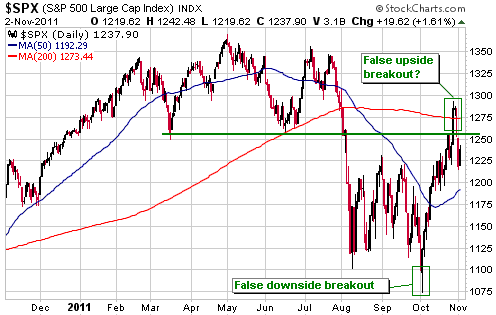
The S&P500 surprised us last week by breaking above resistance in the 1250s. This breakout was a disproportionately large reaction to news out of Europe that didn't appear to be all that bullish.
Due to the price action of the past three trading days, it is beginning to look like last week's upside breakout was false. A daily close below Tuesday's intra-day low of 1215 would leave little doubt that last week's upside breakout was, indeed, false.
Note that as far as price signals go, false upside breakouts are more reliably bearish than downside breakouts. By the same token, false downside breakouts are more reliably bullish than upside breakouts.
Interestingly, the following chart shows that the Russell2000 Index (RUT) did not confirm last week's upside breakout by the SPX.
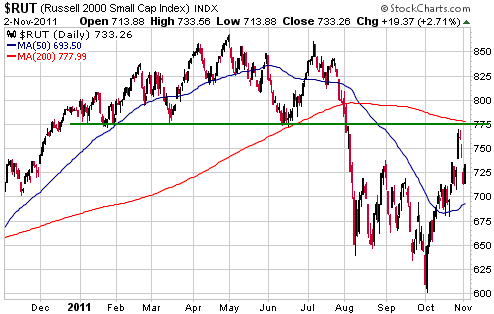
The US stock market's short-term risk/reward remains skewed towards risk.
Gold and the Dollar
Gold
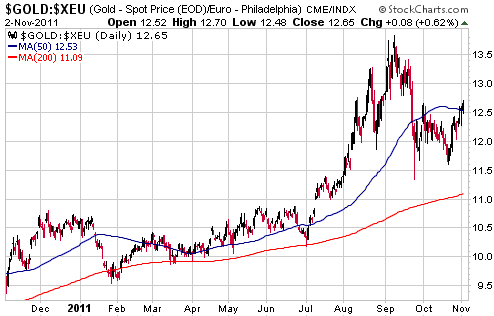
A daily chart of the euro-denominated gold price (gold/euro) is displayed below.
Based on the performance record of the past 10 years, gold/euro is likely to spend the next several months trading between 1150 and 1350. However, while it is very unlikely that the bottom of the aforementioned range will be decisively breached, there is a significant risk that a panicked flight away from the euro at some point over the next few months will push the euro-denominated gold price to new highs.
In other words, gold/euro will probably be range-bound over the next several months, but if there is a breakout from the range it will very likely be to the upside.
Gold Stocks
At the end of last week the HUI wasn't particularly 'overbought', but it had risen for 6 days in succession and was therefore due for some sort of consolidation. Also, it had finished the week at resistance in the low-580s. While not necessarily predictable, the sharp pullback over the first 1.5 trading days of this week was therefore not surprising.
The price action over the first three days of this week was bullish in that Tuesday morning's plunge generated sufficient new buying to erase the losses that had occurred since the start of the week. The HUI is again challenging resistance in the low-580s.
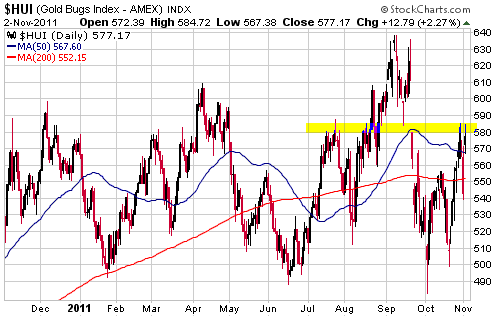
The historical record of October lows tells us that the HUI will probably trade above 600 and will possibly test its September high before year-end. Note, though, that a daily close below Tuesday's intra-day low of 540 would be a big deviation from the expected pattern. In other words, for the anticipated scenario to remain intact the HUI should hold above 540 on a daily closing basis from here on.
Currency Market Update
At best, last week's 'euro fix' was only ever going to buy some time. This is because it didn't actually fix anything. However, it doesn't even appear to have bought any time. Based on the price action in various markets over the past few days, it seems to have done nothing except increase volatility and uncertainty.
In the latest Weekly Update we said: "...we aren't sure whether the ECB will mark down, by 50%, the value of the Greek government debt it holds on its balance sheet. It seems to us that doing so would be problematical because it would wipe out a large percentage of the ECB's capital, but that not doing so would be absurd given that the private banks are being forced to do the mark-down."
We now know that the ECB does not intend to mark down the value of its 'investment' in Greek government debt, which is absurd on a number of levels. First, the private banks have been forced to accept a 50% reduction in value. Second, the actual value of the debt is a lot less than 50% of the value at which it is included on the ECB's balance sheet. Third, by refusing to accept a substantial loss on its ill-conceived purchases of Greek government debt securities, the ECB ensures that the total amount of Greek government debt will not be reduced by anywhere near enough to make the debt load manageable. Fourth, telling the Greek people that they have to pay more taxes and endure more "austerity" to make the ECB whole on its bond speculations is an invitation to rebel against last week's deal.
The Greek populace has rebelled against last week's deal, prompting the Greek Prime Minister to call for a referendum to decide whether or not the deal will be accepted. The referendum is scheduled to happen on 4th December.
In addition to the ECB's intransigence and the upcoming referendum, there is the problem that last week's 'euro fix' defined the Greek government's debt default in a way that would not trigger Credit Default Swaps (bond insurance). If Credit Default Swaps can be rendered ineffective via this type of government-sponsored chicanery, then they serve no purpose. And if Credit Default Swaps cannot be used to hedge the risk of owning euro-zone government bonds, then owning euro-zone government bonds is riskier than most investors previously thought.
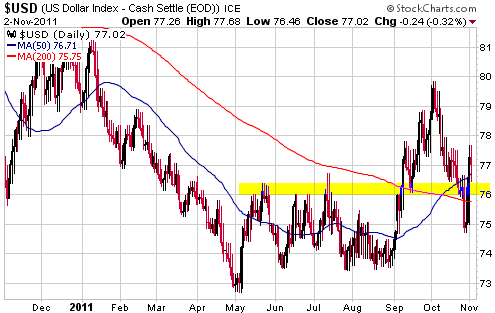
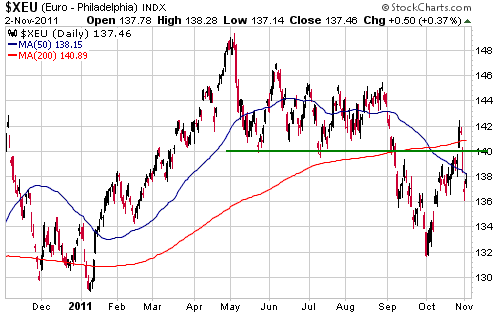
Daily charts of the Dollar Index and the euro are shown below. The optimism generated by last week's 'fix' broke the dollar below support at 76 and broke the euro above resistance at 140, but this week's realism has more than offset the moves caused by last week's optimism.
We remain bullish on the US$ relative to the euro.
Update
on Stock Selections
Notes: 1) To review the complete list of current TSI stock selections, logon at
http://www.speculative-investor.com/new/market_logon.asp
and then click on "Stock Selections" in the menu. When at the Stock
Selections page, click on a stock's symbol to bring-up an archive of
our comments on the stock in question. 2) The Small Stock Watch List is
located at http://www.speculative-investor.com/new/smallstockwatch.html
 Catalpa Resource (ASX: CAH). Shares: 588M issued, 604M fully diluted. Recent price: A$1.66 Catalpa Resource (ASX: CAH). Shares: 588M issued, 604M fully diluted. Recent price: A$1.66
CAH has completed its merger with Conquest Mining and its purchase of two operating mines from Newcrest. Effective 8th November, its name will change to Evolution Mining and its stock symbol will be change to EVN.
The new company will have four operating gold mines and one development-stage gold mine in Australia. It will have current production of around 330K ounces/year and its production run-rate is expected to increase to 450K ounces/year during the first half of the 2013 financial year (the second half of 2012 calendar year). It has a total in-ground gold resource of 7M ounces (5.6M ounces M&I plus 1.4M ounces Inferred).
As previously advised, we have a valuation-based target of A$2.50 in mind for
CAH/EVN.
Chart Sources
Charts appearing in today's commentary
are courtesy of:
http://stockcharts.com/index.html

|









