|
- Interim Update 3rd April 2013
Copyright
Reminder
The commentaries that appear at TSI
may not be distributed, in full or in part, without our written permission.
In particular, please note that the posting of extracts from TSI commentaries
at other web sites or providing links to TSI commentaries at other web
sites (for example, at discussion boards) without our written permission
is prohibited.
We reserve the right to immediately
terminate the subscription of any TSI subscriber who distributes the TSI
commentaries without our written permission.
Deflation or Hyperinflation?
Inflation-deflation debates often involve arguing over which is
more likely: deflation or hyperinflation. Since both deflation and
hyperinflation are extremely unlikely over what most people would
consider to be a normal investment timeframe, these debates are
effectively arguments about which of two remote possibilities is the
least remote. The more useful debate would start with the question:
Deflation or more of the same (plenty of inflation, but not
hyperinflation)?
Framing the inflation-deflation debate as deflation versus
hyperinflation is done more often by 'deflationists' (people who
expect deflation) than 'inflationists' (people who expect
inflation). It's a type of "straw man" argument, in that it
misrepresents a forecast for more inflation as a forecast for
hyperinflation in order to make the forecast easier to discredit.
After all, it is difficult to argue that more inflation is unlikely
in the US when the US has experienced inflation and nothing but
inflation since 1933. It is much easier to argue that hyperinflation
is unlikely, because hyperinflation would require a dramatic shift
in both monetary policy and mass psychology.
To be fair, we'll note that some inflationists have made the mistake
of arguing that hyperinflation is not only a long-term
inevitability, but likely to happen in the near future. For example,
some inflationists have shown charts of what happened in Germany
during the early-1920s and implied that something similar was a
realistic possibility for the US within the coming year or two. In
doing so they gave the deflationists a helping hand, because a bad
argument in favour of an idea can be more damaging to the
credibility of the idea than a good argument against it.
The deflationists point at the forecasters of near-term US
hyperinflation and exclaim: "The Fed has printed heaps of money, but
there is no sign of the hyperinflation you've been predicting. You
have obviously been wrong!" These are true words, but, as mentioned
above, deflationists often distort the truth by insinuating that ALL
inflationists have been predicting imminent hyperinflation.
Unfortunately, while the deflationists are generally quick to take
the hyperinflation forecasters to task, they are generally slow to
explain why their own forecasts have been completely wrong. We want
the deflationists who told us, back in 2008-2009, that the Fed would
be powerless to prevent deflation, to explain why there has been so
much inflation -- regardless of how the word "inflation" is defined
-- in the US over the past four years.
As far as we can tell, the deflation theory that became very popular
a few years ago was largely based on the fact that the amount of
debt was huge relative to the amount of money. It wasn't a good
theory then and it is not a good theory now, because it
confuses/conflates money and debt. Back in late-2008 and early-2009
you needed to understand the difference between money and debt to
know why there would be no deflation in the US if the Fed continued
the aggressive money-creation program that began in September of
2008, but as time went by it became increasingly obvious just by
observing price changes that there was something fatally wrong with
the popular deflation theory. The question that deflationists need
to answer now is: with the theory that the Fed either couldn't or
wouldn't create inflation having been thoroughly debunked by events,
what is the basis of your current deflation forecast?
Our view is that the US will eventually experience hyperinflation,
but there is not a realistic chance of it happening within the next
two years (and there is no point looking further ahead than two
years). This has been our view since the inauguration of the TSI
subscription service more than 12 years ago. While deflation has a
better chance than hyperinflation of happening within the next two
years, its probability is also extremely low.
Over the next two years there is likely to be no deflation and no
hyperinflation, just more inflation of both the monetary kind and
the price kind. There is also likely to be another deflation scare,
which we define as a period when rapid monetary inflation occurs in
parallel with rising irrational fear of deflation.
The
7-Year Cycle
We don't put a lot of emphasis on cycles, but we
also don't completely ignore them. In looking backwards and forwards from the
1987 stock market crash, we recently noticed a 7-year cycle of major turning
points and/or financial crises. We aren't claiming that this is an important new
discovery, as we are sure that many other people will have previously identified
the same cycle.
The cycle begins in 1966, which is when the secular bull market in US equities
that started in the 1940s peaked in real terms.
The 7-year anniversary of the 1966 stock market peak occurred in 1973, which is
when the US stock market successfully tested its 1966 nominal peak and embarked
on a huge 2-year decline. 1973 also ushered in the first oil crisis and one of
the worst recessions of the past 100 years.
7 years later, in 1980, some of the biggest trends of the preceding 10-15 years,
most notably the long-term bull markets in gold and commodities, came to an end.
The next occurrence of the 7-year cycle was 1987, the year of a spectacular
global stock market crash.
Rather than a single dramatic event or turning point, there were a few
developments at the 1994 cycle anniversary that when taken together can aptly be
described as "major". Specifically, in 1994 there was a) an economic/currency
crisis in Mexico that affected markets around the world, b) the Orange County
bankruptcy in the US, c) the biggest decline of the past 20 years in the US
Treasury Bond market, and d) a stock market correction in the US that resulted
in the most bearish sentiment (as measured by Investors Intelligence) of the
past 30 years.
The last two anniversaries of the 7-year cycle were the fateful years of 2001
and 2008. All of our readers will remember that 2001 was the year of the most
important terrorist attack ever on US soil and a dramatic stock market collapse,
and that 2008 was the year of a global financial crisis and one of the worst
stock market declines in history.
The 7-year cycle next comes into play in 2015. One possibility is that 2015 will
be marked by another global financial crisis and a major peak in the gold
market.
The Stock Market
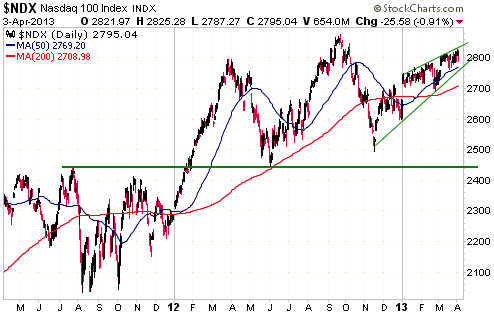
Superficially, nothing bearish appears to be happening in the US
stock market. For example, the S&P500 Index made a new 5-year high on Tuesday of
this week before pulling back on Wednesday, and the NASDAQ100 Index (NDX)
remains near the top of the "rising wedge" that has defined its progress for the
past few months. The NDX still needs to close below 2700 to clearly signal a
trend change from up to down, although we would now interpret a daily close
below 2750 as an early warning that the trend had changed.
If the NDX signals a trend change in the near future, a likely 1-3 month
downside target will be intermediate-term support at 2450.
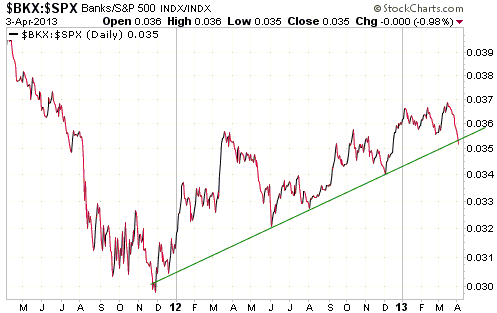
Beneath the surface, however, the recent price action has a bearish tinge. As
examples of what we are talking about, we point to the following daily charts of
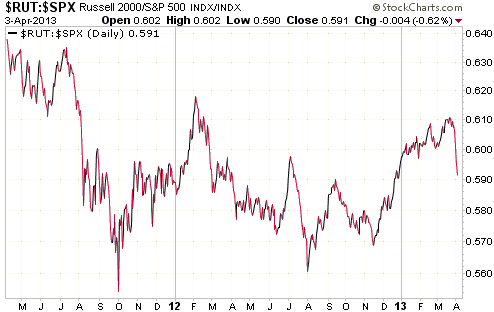
the BKX/SPX ratio (major bank stocks versus large-cap stocks) and the RUT/SPX
ratio (small-cap stocks versus large-cap stocks).
The BKX/SPX ratio dropped sharply over the past several days and ended
Wednesday's session at a new low for the year. This could be significant. If it
is significant it should soon be confirmed by strength in the gold market (the
lengthy correction in the gold market that began during the final few months of
2011 is linked to the lengthy recovery in the BKX/SPX ratio). To put it another
way, if gold doesn't soon begin to rally then the recent sharp drop in the BKX/SPX
ratio is probably just a routine pullback within the context of a continuing
intermediate-term advance.
The RUT/SPX ratio has also dropped sharply to a new low for the year. Over the
past few years this ratio has a) usually trended in the same direction as the
broad stock market and b) tended to lead the broad stock market at
intermediate-term peaks.
Gold and the Dollar
Gold and Silver
The minimum that gold needed to do to signal that a bottom had been put in place
in early March was achieve a daily close above short-term resistance at $1625.
It turned down before being able to do so and has just dropped to a new low for
the year.
Major support lies in the $1520s and $1530s.

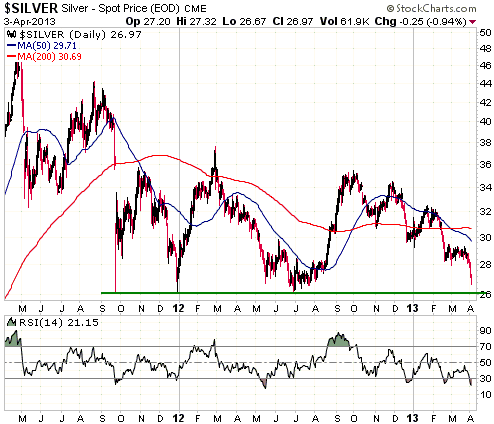
Silver is now testing major support at $26-$27. We don't know for sure that this
support will hold. Nobody does. There is definitely a risk that the support will
be breached, but a breach of support won't imply that the price is headed a lot
lower.
We think that silver is a strong buy in the $26-$27 range, but buyers should not
assume that the ultimate bottom will occur within this range. Such an assumption
would likely lead to excessive risk-taking. The $26-$27 range is simply a very
good place to do some buying.
Not every useful indicator will signal "buy" near an important price low or
"sell" near an important price high. For example, some indicators of sentiment
and momentum suggested that the early-March price lows for gold and silver would
turn out to be important, but one indicator that didn't move into the 'buy zone'
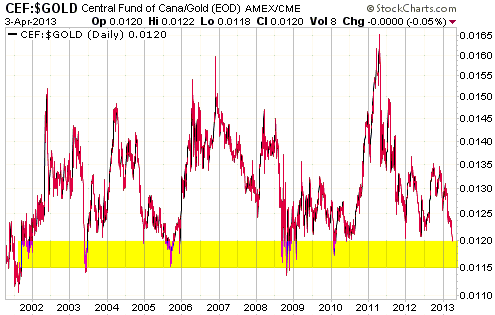
early last month was the CEF/gold ratio.
The CEF/gold ratio is similar to the silver/gold ratio in that CEF is a mutual
fund that holds gold and silver in roughly equal dollar amounts. However, CEF/gold
has an additional sentiment component due to the fact that CEF trades at a
variable premium to its net asset value (NAV) depending on the public's
enthusiasm for precious metals. When the public is very optimistic about the
prospects of gold and silver it often bids up the CEF unit price to the point
where the fund trades at a premium of 10% or more to its NAV. On the other hand,
when the public has minimal interest in owning gold and silver the CEF premium
will usually drop to 3% or lower.
At yesterday's closing prices for gold, silver and CEF units, CEF was trading at
a small discount (negative premium) to its NAV. Along with the recent weakness
in silver relative to gold, the decline into negative territory by CEF's premium
has enabled the CEF/gold ratio to drop into the 'buy zone' for the first time
since early 2010. The 'buy zone' we are referring to is the yellow shaded area
on the following chart. Note that reaching the bottom of the 'buy zone' would
require a further decline of about 5% in CEF relative to gold.
The CEF/gold ratio's current level is another piece of evidence that the
precious-metal trends of the past 18 months are almost over.
Gold Stocks
When the gold-stock indices and ETFs rebounded for a few weeks without mustering
enough strength to exceed any meaningful resistance they left open the
possibility that the March low wasn't the final low. It obviously wasn't the
final low.
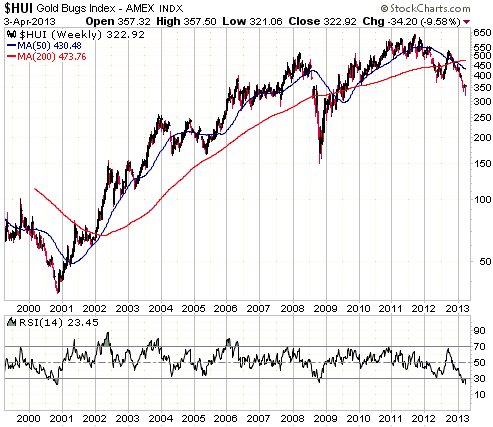
The following weekly chart of the HUI should be of interest to anyone still
capable of looking at the down-in-the-dumps gold sector with objectivity. Of
particular interest is the RSI shown at the bottom of the chart.
The HUI's weekly RSI has dropped below 30 on only two occasions since the
beginning of the long-term bull market in late-2000. The first occasion was the
crescendo of the 2008 crash. The second occasion was February of this year. The
second occasion is on-going, in that the HUI's weekly RSI remains well below 30.
A difference between the October-2008 RSI extreme and the present RSI extreme is
that the 2008 extreme ended less than three weeks after it began, whereas the
current extreme has already lasted six weeks. To find something similar to the
current situation we now have to go back to late-2000 -- to the final phase of
the secular bear market. During September-November of 2000 the HUI's weekly RSI
stayed below 30 for six weeks and bottomed at 22.3. The current level of the
weekly RSI is 23.5. This is the lowest level since November of 2000.
The point is that we are not near the beginning or the middle of something. We
are near the end of something.
On a different matter, beware of companies that combine gold and a base metal to
arrive at a gold-equivalent amount or combine silver and a base metal to come up
with a silver-equivalent amount. It is perfectly acceptable to combine gold and
silver in a resource calculation or a production calculation to arrive at either
a gold-equivalent or a silver-equivalent amount, but due to their very different
attributes and market valuations it is not acceptable to lump base metals in
with gold or silver when doing these calculations. The reason that some
companies do lump the metals together is to make a mineral deposit look more
lucrative than is actually the case. It's a trick.
Update
on Stock Selections
Notes: 1) To review the complete list of current TSI stock selections, logon at
http://www.speculative-investor.com/new/market_logon.asp
and then click on "Stock Selections" in the menu. When at the Stock
Selections page, click on a stock's symbol to bring-up an archive of
our comments on the stock in question. 2) The Small Stock Watch List is
located at http://www.speculative-investor.com/new/smallstockwatch.html
Chart Sources
Charts appearing in today's commentary
are courtesy of:
http://stockcharts.com/index.html

|









