|
- Interim Update 3rd August 2011
Copyright
Reminder
The commentaries that appear at TSI
may not be distributed, in full or in part, without our written permission.
In particular, please note that the posting of extracts from TSI commentaries
at other web sites or providing links to TSI commentaries at other web
sites (for example, at discussion boards) without our written permission
is prohibited.
We reserve the right to immediately
terminate the subscription of any TSI subscriber who distributes the TSI
commentaries without our written permission.
The
Debt Deal
As expected, a deal was done to allow the US debt ceiling to be raised again. Even if a deal hadn't been done, there was no chance that the US government would directly default on its existing debt this year.
It seemed, last week, that the financial markets were a little worried that the US government was about to get serious about reining-in its spending. Less government spending would likely mean less monetary inflation, and less monetary inflation would likely lead to lower asset prices. As it turned out they needn't have worried, because the agreed cuts are trivial and almost nothing is scheduled to happen on the cost-cutting front until after 2014. To be more specific, the deal involves the cutting of about $2T in government expenses, but the planned cuts are spread over 10 years and are back-end loaded. Moreover, the agreement to cut future costs is non-binding. As other commentators have noted, this almost certainly means that the current deficit-reduction plans will 'go out the window' in response to future economic weakness.
This deal simply allows both sides of the debate to claim that their efforts have prompted a big step in the direction of fiscal prudence, while circumventing the need to make any tough decisions over the next two years. The word "charade" springs to mind.
Even though it would likely be trivial in the grand scheme of things, we guessed that a deal to raise the debt ceiling would lead to a significant rebound in the stock market and a concurrent pullback in the safe-haven trades (the T-Bond and gold markets). Monday's trading session began along these lines with the stock indices rallying and the bond and gold markets declining, but the debt-deal enthusiasm quickly evaporated. The ISM Manufacturing Index coming in at its lowest level in 2 years certainly didn't help. In this case we therefore appear to have under-estimated the rationality of the financial markets. Commodities:
an important top or just a correction?
The way we've drawn the lines on the following daily chart of the Continuous Commodity Index (CCI), the decline that has unfolded over the past few months looks similar to the correction that occurred during the first half of last year. If this interpretation is valid then almost all of the CCI's downside was out of the way at the June low and another strong multi-month rally will soon begin.
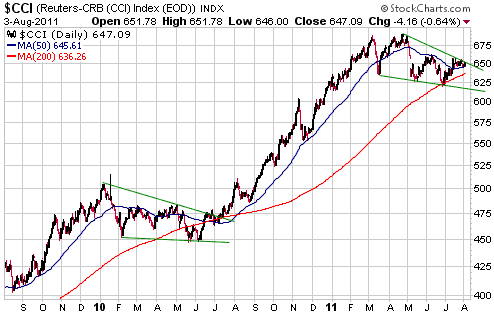
The CCI's price action favours the above interpretation. The problem we have is that this interpretation runs counter to our expectations for the stock and currency markets. Specifically, if the CCI is correcting ahead of an advance to new highs then we are too bearish on the stock market and too bullish on the US$.
Based on our other market views and our bearish outlook for global economic growth, it would make more sense if the CCI were in the process of completing an important top. A decline to 600 or lower would indicate that an important top had been put in place.
The market action over the next month will hopefully add some clarity.Reading
TSI reports on a Smart Phone
According to subscriber feedback, the TSI market updates are currently not smart-phone friendly. This is not something we plan on changing in the near future, but there is an interim solution/workaround.
If it is important to you to be able to read the TSI reports on a smart-phone, please let us know by email.The Stock Market
As has been the case since February, the US stock market is being pulled in different directions by powerful countervailing forces. It is being pulled downward by evidence that the US economy is in recession and global economic growth is slowing, and it is being elevated by rapid money-supply growth. It is reasonable to characterise the situation as a battle between lower-than-expected real earnings and currency depreciation.
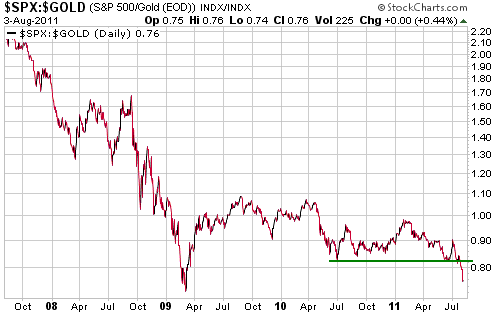
At this stage, monetary inflation has prevented the S&P500 Index from breaking out to a new low for the year in nominal dollar terms, but the following chart shows that it has clearly broken down in gold terms. Over the past 10 years, downside breakouts in the SPX/gold ratio similar to the one that has just occurred have always been followed by substantial additional weakness over the ensuing 6 months. Note, though, that a rebound over the next few weeks to 'test' the breakout would not be surprising.
Despite the rapid rate of monetary inflation (the True Money Supply aggregate is up by around 11% over the past 12 months), the senior US stock indices will probably break out to the downside within the next 6 weeks. However, with the Dow Industrials Index having just completed an unusually long run of 8 consecutive down days (Tuesday was the 8th lower close in a row), an intervening 1-2 week rebound is likely. Our guess is that this rebound will do no more than retrace about half of the recent decline. As an aside, a counter-trend rebound in the stock market over the next couple of weeks would likely coincide with a counter-trend pullback in the T-Bond market.
A likely scenario entails the stock market rebounding into mid August and then resuming its decline. A rebound over the next couple of weeks followed by a decline that takes out this week's low would set the stage for an ugly September.
Here are pictures of the current market situation:
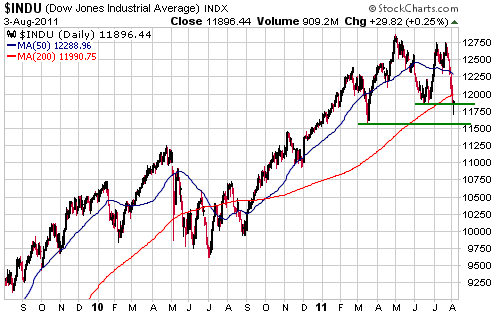
1) The Dow Industrials Index spiked below support defined by its June low on Wednesday, but managed to close above this support. A normal counter-trend rebound would take it up to around 12,250.
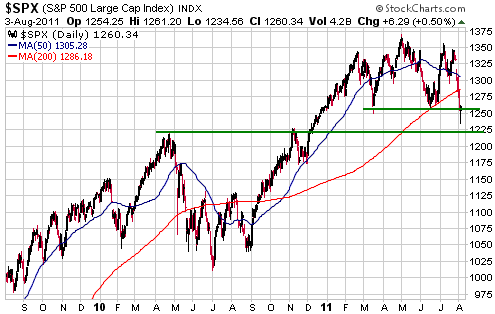
2) The S&P500 spiked to a new low for the year on Wednesday, but managed to close above support in the 1250s. A normal counter-trend rebound would take it up to around 1295.
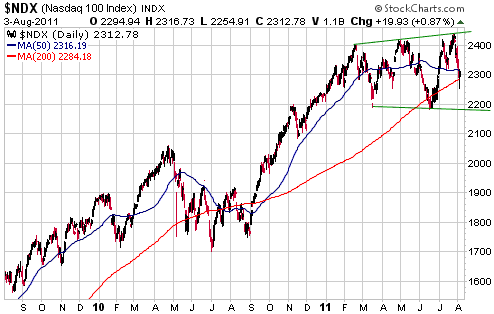
3) The tech-heavy NASDAQ100 Index (NDX) has been relatively strong since mid June and, unlike the Dow and the S&P500, is still above its 200-day moving average. The bearish interpretation is that the NDX is tracing out a "broadening top".
A market-wide rebound over the next couple of weeks could lead to the NDX testing, or even marginally exceeding, the multi-year peak reached last month.
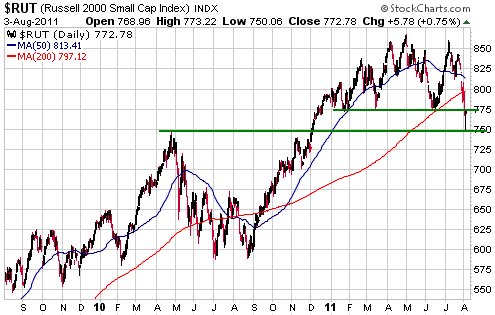
4) The Russell2000 Small Cap Index (RUT) broke below intermediate-term support at 775 on Tuesday. On Wednesday it spiked down to longer-term support at 750.
The RUT has generated an obvious bearish signal this week, but obvious bearish signals are not reliable when they are preceded by steep declines. We suspect that this week's bearish signal points to significantly lower prices over the next two months, but not the next two weeks.
A normal counter-trend rebound would take the RUT up to 800-810.
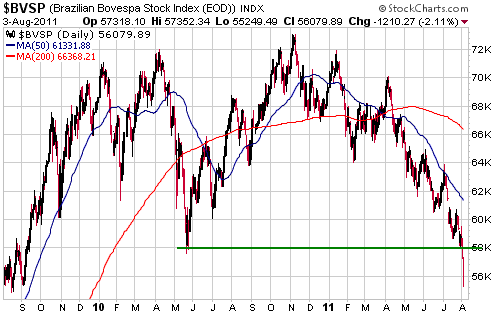
5) The Brazilian economy appears to be in much better shape than the US economy, but the Brazilian stock market has been much weaker than the US stock market over the past 9 months. The difference in stock market performance is largely due to the difference in monetary backdrop, with the US stock market being propped up by a weak currency and ultra-accommodative monetary policy and Brazil's stock market being pushed downward by a strong currency and relatively tight monetary policy.
Brazil's Bovespa Index has just broken below last year's low and ended Wednesday's session near a 2-year low. This now qualifies as a cyclical bear market, but it is also now very 'oversold' and will probably soon enjoy a decent rebound.
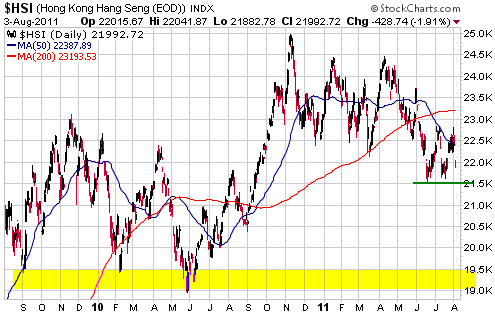
6) Like Brazil's stock market, Hong Kong's stock market has been trending lower since last November. Major support at 19000-19500 is a realistic 3-month target.
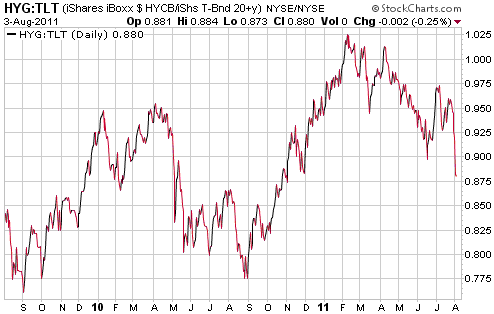
7) The HYG/TLT ratio broke to a new low for the year this week, which is another way of saying that credit spreads have continued to widen and just made new highs for the year. This is indicative of a general shift away from risk, as also evidenced by the strength in gold and T-Bonds.
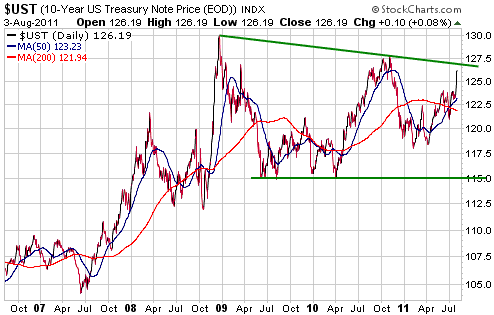
8) Stepping back, we see that their recent surge has taken 10-year T-Note futures up to near the top of the pattern that has formed over the past 2.5 years. This could be a major topping pattern, or it could be a multi-year consolidation within a long-term bull market. Whether it's the former or the latter, the move up to near trend-line resistance sets the stage for a short-term decline.
We'll end this section with a warning: Although a rebound is the most likely outcome as far as the next two weeks are concerned, the combination of general nervousness and the stock indices hovering just above important support levels means that there is a risk of a rapid decline. In other words, don't attempt to trade a near-term bounce.
Gold and the Dollar
Gold
Regarding the US$ gold price, there isn't much we can say that we haven't said in the past two commentaries. The only new development of note is that the debt-ceiling agreement failed to interrupt any short-term trends, including gold's short-term advance.
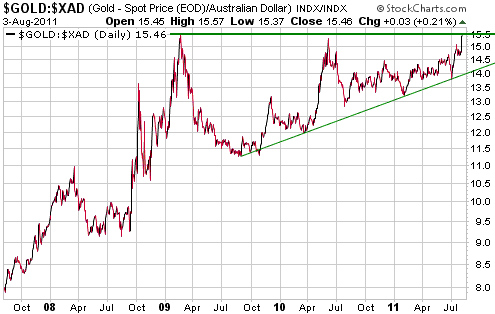
In terms of the Australian Dollar, gold is now in a very interesting position. As illustrated below, the A$-denominated gold price (gold/A$) has been consolidating for about 2.5 years and has just moved up to the top of its multi-year range. This probably means that gold/A$ is finally about to break into new-high territory, which would obviously be a very positive turn of events for gold mining companies that produce most of their gold in Australia.
A break above resistance at A$1550/oz would create a measured chart-based target of A$1950.
Gold Stocks
Here's how we described the two most plausible HUI scenarios in the latest Weekly Update:
"If the July rally from 490 to 590 was the first leg of a new intermediate-term upward trend, then the current decline will probably end within about three percent of Friday's closing price and the next rally should take the HUI to a new all-time high. However, if the intermediate-term correction that began last December is still in progress then the short-term upside from here is probably limited to the 570s, versus downside risk to as low as 400 (450 would be the most plausible downside target following a break below support at 490, but 400 would not be out of the question). Due to gold's move to new highs the former scenario is the more likely of the two, but the downside risk is significant."
The HUI rebounded to as high as 570 during the first three days of this week, which means that this week's action has so far been consistent with both of the above-described scenarios. To put it another way, this week's action has not provided us with any new information.
The bearish scenario involves interpreting the HUI's chart pattern as a "head and shoulders" top with a "neckline" at 490. Looking at the chart displayed below, it's not hard to understand how this interpretation could be favoured by some 'technical analysts'. However, most "head and shoulders" patterns don't turn out the way the textbooks say they are supposed to turn out. Markets just aren't that simple.
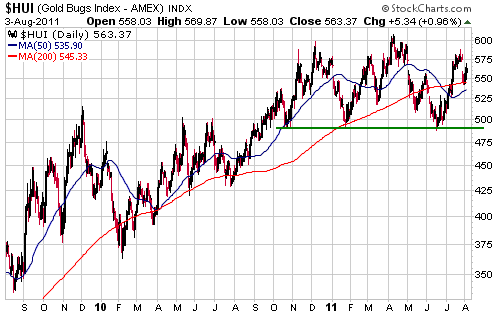
To completely negate the "head and shoulders" top possibility the HUI would have to close above its April high.
Currency Market Update
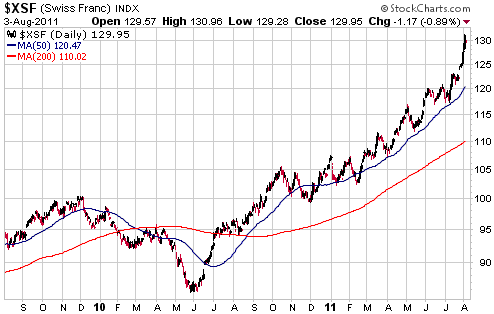
It's very unusual for a major currency to 'go parabolic', but the following chart shows that the Swiss Franc has done exactly that. Moreover, the rapid advance has caused Market Vane's bullish consensus for the Swiss Franc to rise to a mind-boggling 97%. This is the same extreme that occurred in the silver market during the second half of April -- towards the end of that market's parabolic advance and just prior to its crash.
The conditions are in place for a substantial decline in the Swiss Franc.
Update
on Stock Selections
Notes: 1) To review the complete list of current TSI stock selections, logon at
http://www.speculative-investor.com/new/market_logon.asp
and then click on "Stock Selections" in the menu. When at the Stock
Selections page, click on a stock's symbol to bring-up an archive of
our comments on the stock in question. 2) The Small Stock Watch List is
located at http://www.speculative-investor.com/new/smallstockwatch.html
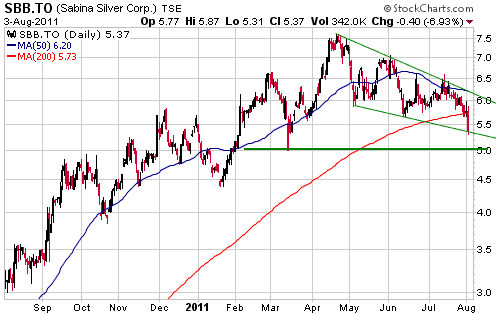
 Sabina Gold and Silver (TSX: SBB). Shares: 154M issued, 166M fully diluted. Recent price: C$5.37 Sabina Gold and Silver (TSX: SBB). Shares: 154M issued, 166M fully diluted. Recent price: C$5.37
In June we mentioned that a decline to around C$5.00 would create a new buying opportunity in SBB shares. We are almost there.
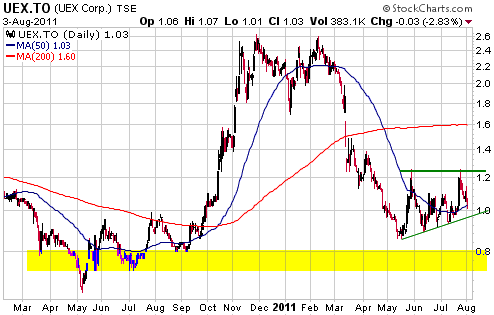
UEX Corp. (TSX: UEX). Shares: 203M issued, 219M fully diluted. Recent price: C$1.03
There is still plenty of uncertainty regarding the long-term effects of the Fukushima disaster on uranium demand. At this stage it looks like the disaster will result in less uranium being consumed in Europe and Japan, but will not significantly alter the uranium-consumption growth trends in China, India and Russia. If this proves to be the case there should be considerable upward pressure on the uranium price over the next few years, the reason being that the bulk of the growth in uranium demand was always going to come from China, India and Russia.
Of the three uranium-mining stocks in the TSI List, Hathor (TSX: HAT) offers the most certainty (HAT's stock price will very likely be higher 12 months from now, almost regardless of what happens to the price of uranium); Energy Fuels (TSX: EFR) offers the most upside potential and the most leverage to the uranium price; and UEX (TSX: UEX) is the best buy at this time. UEX is currently a better buy than HAT thanks to the large price gains achieved by HAT over the past few months, and it is currently a better buy than EFR due to the latter's legal issues. There's a very high probability that the legal challenge to EFR's Pinon Ridge uranium mill will fail, but until it has officially failed it will weigh on EFR's performance.
UEX is a logical takeover target, with Cameco and Areva being potential acquirers. Cameco currently owns 22% of UEX and has projects adjacent to UEX's Hidden Bay project. Areva is UEX's JV partner at the Shea Creek project.
Clifton Star Resources (TSXV: CFO). Shares: 36M issued, 40M fully diluted. Recent price: C$2.90
CFO remains "halted". The company has submitted all the documents it was asked to submit and is now awaiting a response from the BC Securities Commission.
Chart Sources
Charts appearing in today's commentary
are courtesy of:
http://stockcharts.com/index.html

|









