|
- Interim Update
3rd September 2014
Copyright
Reminder
The commentaries that appear at TSI
may not be distributed, in full or in part, without our written permission.
In particular, please note that the posting of extracts from TSI commentaries
at other web sites or providing links to TSI commentaries at other web
sites (for example, at discussion boards) without our written permission
is prohibited.
We reserve the right to immediately
terminate the subscription of any TSI subscriber who distributes the TSI
commentaries without our written permission.
The US
manufacturing sector stays strong
The Institute of Supply Management
(ISM) issued its monthly report on the US manufacturing sector on
Tuesday 2nd September. This report is the most useful coincident
indicator of US economic performance.
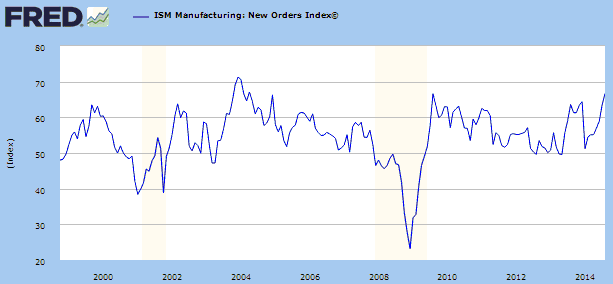
The latest report showed that the strengthening trend of the past
several months continued in August. Of particular relevance, it
showed that the New Orders Index, a chart of which is included
below, rose to a 10-year high. This means that the US economy is
still in the boom phase of the boom/bust cycle caused by monetary
inflation and interest-rate manipulation. The boom could end at any
time, but it hasn't ended yet.
This Friday we get the next installment of the monthly US Employment
Report. The Employment Report is one of the most useless indicators
of economic performance, but it often causes significant knee-jerk
reactions in the financial markets due to its apparent influence on
the Fed.
The Global Boom/Bust Indicator
The gold market is generally weak relative to the
industrial metals markets during the boom phase of the inflation-fueled,
central-bank-sponsored boom/bust cycle and strong relative to the industrial
metals markets during the bust phase of the cycle. In other words, the gold/GYX
ratio (gold relative to the Industrial Metals Index) tends to fall during the
booms, which are periods when economic confidence rises while mal-investment
sets the stage for an economic contraction, and rise during the busts, which are
periods when the mistakes of the past become obvious. This is due to gold's
historical role as a store of purchasing power and a hedge against uncertainty.
By shading the bust periods in grey, we've indicated the global booms and busts
on the following chart of the gold/GYX ratio. During the 16-year period covered
by the chart there have been three busts: the recession of 2001-2002 that
followed the bursting of the NASDAQ bubble, the global financial crisis and
"great recession" of 2007-2009, and the euro-zone sovereign debt and banking
crisis of 2011-2012.
The booms tend to fall apart more quickly than they build up, so the rising
trends in the gold/GYX ratio tend to be shorter and steeper than the falling
trends.
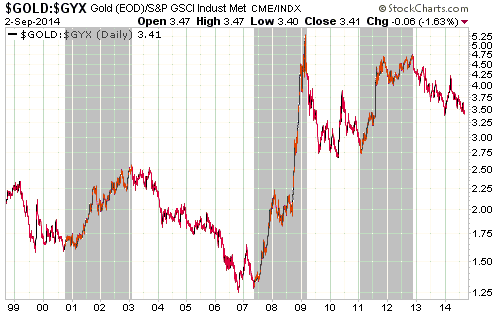
Gold/GYX's current situation looks most similar to Q2-2007. At that time the
ratio tested its late-2006 bottom and then reversed upward, marking the end of
the boom that began in 2003. However, gold will soon have to start strengthening
relative to industrial metals such as copper in order for the 2007 similarity to
be maintained. If this doesn't happen and the gold/GYX ratio breaks decisively
below its December-2013 bottom, it will indicate that the boom is going to
extend into 2015.
We stress that gold's relationship to the boom/bust cycle is primarily about its
performance relative to other commodities, especially the industrial metals. It
is not about gold's performance in US$ terms. For example, from mid-2005 through
to mid-2006 gold performed poorly relative to the industrial metals, but this
was a good time to be long gold and a very good time to be long gold stocks.
It's just that the industrial metals handily outperformed gold during this
period, which makes sense considering the global economic and financial-market
backdrop at the time. For another example, from May through November of 2008
gold performed extremely well relative to the industrial metals. This makes
sense considering the global economic and financial-market backdrop of the
period, but it was a bad time to be long gold and a very bad time to be long
gold stocks.A few
words about frustration
In general, frustration is a feeling that can
arise when things don't turn out as well as expected or planned. It can be
combated by changing one's expectations and can often be avoided altogether by
accepting, ahead of time, the very real possibility that plans will not come to
fruition and expectations will not be met.
In the financial markets, frustration is usually the result of being emotionally
and/or financially committed to a particular short-term outcome. It can
therefore be avoided by not being emotionally or financially committed to any
particular short-term outcome. Accept the reality that your favoured scenario
might not happen, and consider, ahead of time, what you will do when a market
behaves in a way that foils your best-laid plans.
If you are a short-term trader, then any significant deviation from plan should
probably be viewed as a signal to retreat to the sidelines and regroup. If you
are a long-term trader or investor, then it is probably best to remain focused
on the long-term considerations that informed your trading/investing decision
and to never have any expectations as to what the market will do over the weeks
immediately ahead. However, even long-term traders/investors should acknowledge
the possibility that they will be proven wrong and should structure their
portfolios in such a way that being wrong about any particular idea or strategy
won't be financially devastating.The Stock Market
The S&P500 Index (SPX) continues to trade sideways around the
magical 2000 level. Specifically, on each of the past 7 trading days the SPX
closed at 2000 +/- 3 points. A sharp move is likely to begin within the coming
few days and the direction will most likely be down, but the possibility of an
upside blow-off cannot be ruled out.
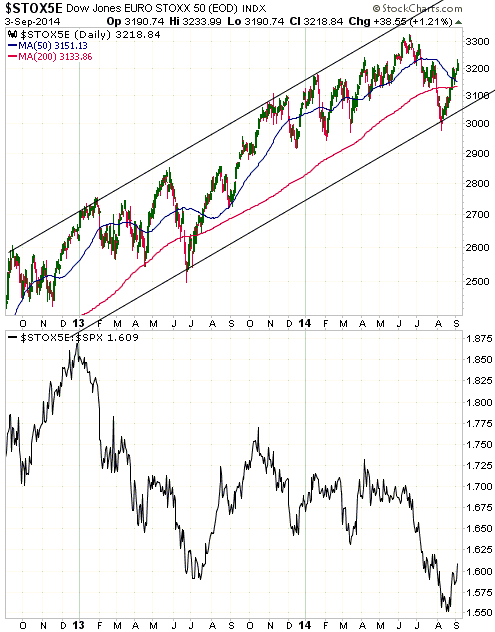
Meanwhile, back in Europe, more evidence has emerged that the EURO STOXX 50
Index (STOX5E) has completed a downward correction of similar size and duration
to the downturn that occurred during May-July of last year. We first mentioned
the likelihood that the STOX5E had completed a downward correction in the 25th
August Weekly Update.
The evidence we are referring to is illustrated by the following chart. The top
section of this chart shows that the STOX5E has clearly moved above its 200-day
and 50-day MAs, and the bottom section shows that the STOX5E/SPX ratio has
reversed course on at least a short-term basis.
Note that it isn't just the STOX5E that the SPX has begun to underperform. There
are signs that the relatively expensive US stock market has begun to
underperform on a global basis.
Gold and the Dollar
Gold
Last week's price action ushered-in the possibility that the gold price would
drop to the bottom of its short-term channel this week. As illustrated by the
daily chart included below, a drop to the channel bottom has just occurred.
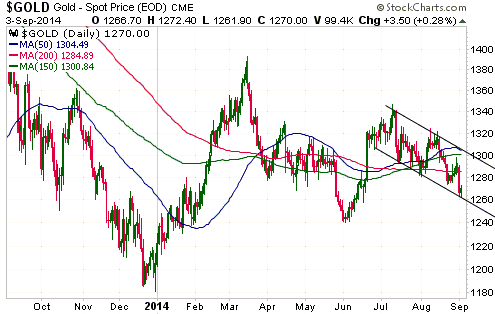
Our view is unchanged. We think that the slow
two-steps-down-followed-by-one-step-up decline that began in early-July is a
correction to the rally that began in early-June, and that everything that has
happened over the past 9 months is part of a long-term basing pattern at the
beginning of a new cyclical bull market. However, for our interpretation of the
short-term price action to remain plausible, the gold price will have to begin
rallying soon (by early next week at the latest).
The biggest short-term threat to gold is the potential for upward acceleration
in the US stock market, which would most likely occur as part of a final upside
blow-off. An upside blow-off in the US stock market over the weeks ahead is not
a high-probability outcome, but it has a realistic chance.
Gold Stocks
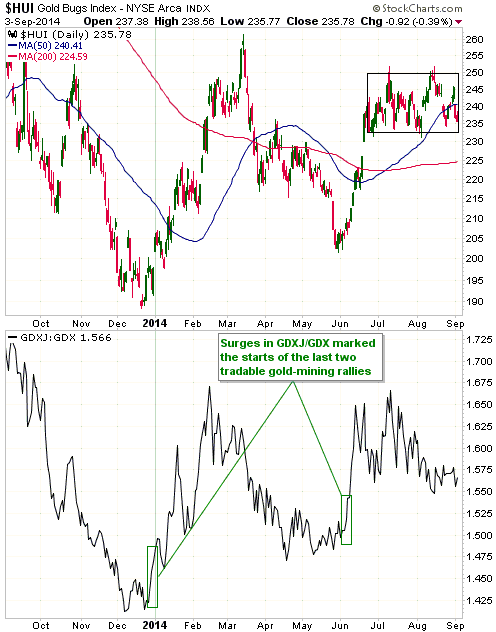
The HUI went down with gold during the first half of the trading week but
remains within the bounds of the rectangle in which it has oscillated since
late-June. Refer to the top section of the following daily chart for details. A
break below the bottom of this rectangle would suggest a downside target of
215-220, whereas a break above the top of this rectangle would confirm that the
oscillations of the past 2 months constituted a mid-trend consolidation and
suggest that the HUI was on its way to 300. We have been expecting and continue
to expect an upside breakout from the rectangle, but the risk of a downside
breakout has risen due to the fact that we are now into September with no sign
of the expected rally.
The GDXJ/GDX ratio has been the best indicator of the gold-mining sector's
short-term situation. As noted on the bottom section of the following chart, an
upward surge in this ratio marked the start of the last two tradable gold-mining
rallies. There's a high probability that it will also mark the start of the next
rally, so any strength in the HUI will be suspect if it isn't accompanied by
material strength in the juniors (as represented by GDXJ) relative to the
seniors (as represented by GDX).
The Currency Market
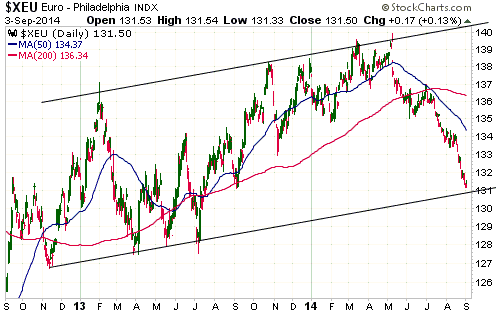
There's a high probability that the euro is close to a short-term bottom. This
is due to a) the extent to which it is oversold (as measured by momentum
indicators and distance below the 200-day MA), b) the huge speculative net-short
position in euro futures, c) the close proximity of the current price to the
bottom of the 2-year price channel (see chart below), d) the recent upward
reversal in European equities relative to US equities, and e) the recent upward
reversal in an index representing European bank stocks. The ECB meeting later
today (Thursday 4th September) could be the catalyst for a modicum of additional
downside, because there is much anticipation that new 'stimulative' measures
will be introduced at this meeting. However, an upward reversal is likely within
the next few days almost regardless of what the ECB announces.
Also, the ingredients are in place for an intermediate-term bottom in the euro.
Updates
on Stock Selections
Notes: 1) To review the complete list of current TSI stock selections, logon at
http://www.speculative-investor.com/new/market_logon.asp
and then click on "Stock Selections" in the menu. When at the Stock
Selections page, click on a stock's symbol to bring-up an archive of
our comments on the stock in question. 2) The Small Stock Watch List is
located at http://www.speculative-investor.com/new/smallstockwatch.html
Chart Sources
Charts appearing in today's commentary
are courtesy of:
http://stockcharts.com/index.html
http://research.stlouisfed.org/

|









