|
- Interim Update 3rd October 2012
Copyright
Reminder
The commentaries that appear at TSI
may not be distributed, in full or in part, without our written permission.
In particular, please note that the posting of extracts from TSI commentaries
at other web sites or providing links to TSI commentaries at other web
sites (for example, at discussion boards) without our written permission
is prohibited.
We reserve the right to immediately
terminate the subscription of any TSI subscriber who distributes the TSI
commentaries without our written permission.
China's
Boom-Bust Cycle
Once there has been sufficient monetary inflation to create an
economic boom, a bust is inevitable. The only question then facing
the central bank is: do we stop the inflation immediately and
therefore experience a bust sooner, or do we keep the inflation
going for a while and experience a more severe bust later? In other
words, there is simply no way to avoid a bust once an
inflation-fueled boom has been fomented. You either deal with the
consequences of the inflation in the short-term or you postpone the
pain at the cost of greater damage to the economy. The greatest
long-term damage would be done by attempting to maintain a
high-enough rate of monetary inflation to postpone the bust
indefinitely. This path leads to the complete destruction of the
currency and an economic bust of biblical proportions, which is why
it is seldom followed. Seldom, but unfortunately not never.
An inflation-fueled boom began in China in 2004-2005. Consequently,
China is headed for an economic bust. No ifs, buts or maybes. The
only question relates to timing. There is evidence to indicate that
a bust commenced about 18 months ago, but the evidence is not yet
conclusive. Aside from the signs that China's economy has almost
ground to a halt, evidence pointing to a bust having already begun
is found in the following chart.
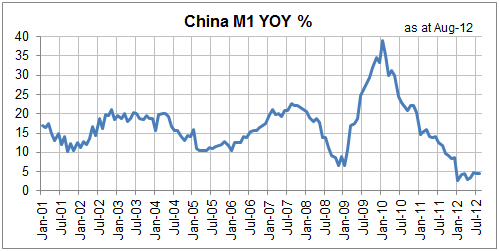
The chart shows that the year-over-year (YOY) growth rate of China's
M1 money supply has been trending downward since peaking at 35%-40%
in early 2010. By early 2012 it had fallen to a 12-year low of
around 3% and in August of 2012 (the latest month for which there is
money-supply data) it was hovering just above its 12-year low. The
chart suggests that China's monetary authorities have decided to
'bite the bullet' and suffer a bust now rather than do even more
damage and suffer a far more severe bust later. However, the chart
also suggests that China's monetary authorities decided to 'bite the
bullet' and suffer a bust during 2008 (note the downward trend in
the M1 growth rate during 2008), but then chickened out and breathed
new life into the boom via a huge injection of money. It is
therefore fair to say that the verdict isn't yet in. It looks like
China's inflation-fueled boom-bust cycle has entered the bust phase,
but there is still a chance that the old boom's life will be
prolonged by another large and damaging injection of monetary
heroin. After all, we are talking about a country where the annual
money-supply growth rate can be quickly increased from 5% to 20% via
a command from the central government to the banking system. There
was an unusually large increase in new loans outstanding within
China's banking system in August, so perhaps the command has already
gone out.
It makes sense to be long-term bearish on China's economy based on
the reality that if the boom hasn't already turned to bust, it is
living on borrowed time. It also makes sense not to under-estimate
the ability of China's government to temporarily re-energise the
boom via money pumping and directed bank lending.
Deflating the emerging markets bubble
The article posted
HERE is a good companion to our above discussion on China. The article makes
an attempt to explain why the rapid growth over the past several years of China,
India and Brazil, the most important Emerging Market Economies (EMEs), was never
going to be sustainable. It leaves out some salient arguments, but is otherwise
spot on. Here is an excerpt:
"Monetary easing in the US had a direct impact on monetary policy in emerging
markets. It works by weakening the US dollar which puts upward pressure on EMEs'
currencies. These nations' central banks try to maintain a peg (implicit or
explicit) to the dollar to defend their exports' competitiveness. To do so the
central banks must buy dollars and sell ("print") their domestic currency. That
ends up boosting foreign reserves and increasing the monetary base, creating an
extremely easy domestic monetary policy.
Such accommodative policy combined with infrastructure and other government
spending generated unsustainable growth that is currently being reversed."
Hindsight Bias
After a big market move we sometimes get emails
from people who claim to have known that the move was going to happen. Yeah,
right. If you truly believe that you KNOW exactly what's going to transpire in
the market you trade then you are a financial accident waiting to happen.
Most people are realistic enough to acknowledge the uncertainty of the future in
real time; it's just that after the event they remember themselves being far
more certain than was actually the case. Putting it another way, they suspect
that Event X is going to happen, and when Event X does happen they go from "I
think it is probably going to happen" to "I knew it was going to happen, I just
knew it!" This is called hindsight bias.
When considering whether a previous buy, sell or take-no-action decision was
correct, don't just take into account the end result (the profit, the loss, or
the opportunity foregone). Also take into account what could reasonably have
been known at the time the decision was made. The fact is that ill-conceived
trades will sometimes turn out to be profitable and well-thought-out trades will
sometimes end in losses due to turns of events that could not reasonably have
been anticipated at the time the trade was entered. For example, if you sell or
pass on buying a stock that subsequently rockets higher in response to a
takeover bid, you didn't make a bad decision if there was no good reason at the
time to anticipate a takeover and there were good reasons at the time to believe
that the reward/risk ratio wasn't high enough to warrant buying/holding.
However, you possibly did make a bad decision if you overlooked evidence that
you should have seen.The Stock Market
Q3 earnings season is about to begin. So far, more than 80% of
Q3 earnings pre-announcements for S&P500 companies have been negative, which is
more than double the normal rate. From a "glass half full" perspective this
could mean that a poor quarterly earnings situation is factored into current
stock prices, thus insulating the market from near-term bad news on the earnings
front. While this is certainly possible, the market's price action and valuation
don't suggest that bad news has been discounted to a meaningful degree.
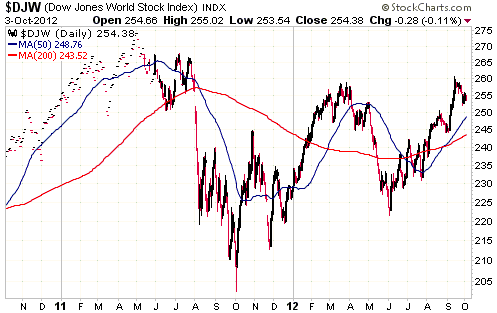
The Dow Jones World Stock Index (DJW) made a new high for the year on 14th
September, the day after the Fed's QE3 announcement. It has since pulled back,
but at this stage there is nothing in the price action to suggest that the
decline from the 14th September peak is anything more than a minor correction.
We don't think there's much additional upside potential, but our guess is that
the DJW will make another move to a new high for the year before starting an
intermediate-term decline.
Gold and the Dollar
Gold
The US$ gold price made a marginal new intra-day high for the move early this
week, but there was no follow-through. It has essentially traded sideways since
the day of the "QE3" surge.
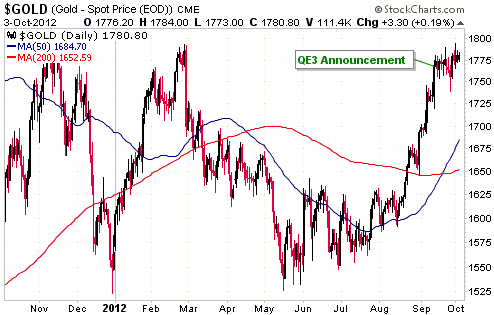
A pullback to near the 50-day moving average is needed to create a new
short-term buying opportunity, but before this happens there could be a break
above resistance at $1800 and a jump to as high as $1850. A lot will depend on
the monthly US employment report scheduled to be released on Friday morning. If
this report reflects further deterioration of the labour market then the QE
beneficiaries will probably get another boost, sending gold, the chief
beneficiary of the Fed's QE, to a new multi-month high.
Gold Stocks
Two of the things that short-term HUI corrections almost always accomplish
before they come to an end, are:
1) A price decline to near the 50-day moving average
2) A decline by the daily RSI(14), a short-term momentum indicator, to between
40 and 50.
The following chart therefore suggests that if a short-term correction has
begun, it is not yet close to being complete. The 50-day MA continues to rise
and is now in the low-460s, but this is still about 8% below Wednesday's closing
price. And while the daily RSI(14) has dropped back from the extreme high
reached 2-3 weeks ago and is no longer registering 'overbought', it is still
well above the 40-50 range that will likely be probed prior to the correction's
end.
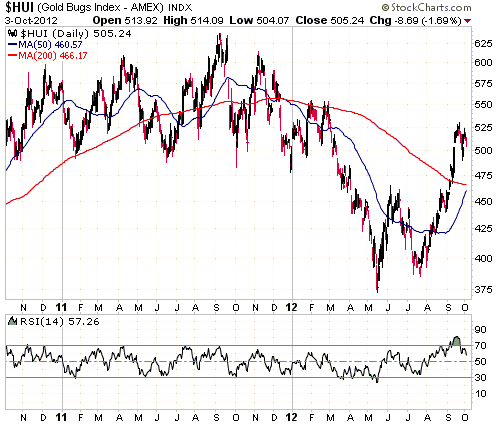
If the HUI reverses upward and breaks out to a new multi-month high over the
days immediately ahead (not likely, but possible), it won't mean that the
correction has ended earlier than expected. It will mean that it hasn't yet
started. In this case the expected correction would likely get underway after
the HUI had tested resistance at 550.
Currency Market Update
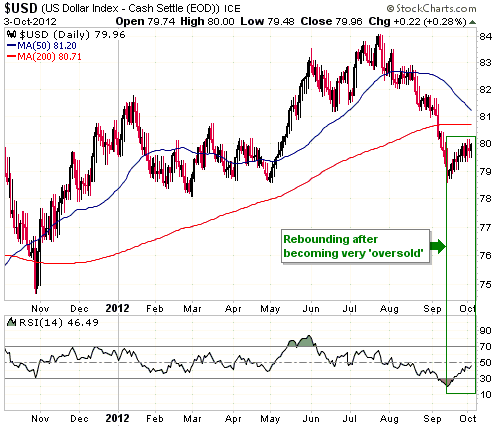
The Dollar Index continues to consolidate with an upward bias after reaching an
'oversold' extreme about three weeks ago. We suspect that the current rebound
will be followed by a decline to a new multi-month low.
The big news of the past week was the collapse in Iran's currency, known as the
rial. In early 2011 it took 10,000 rials to buy one US$. Last week it took
24,000 rials to buy one US$, meaning that the rial had lost about 58% of its
value relative to the US$ over the space of only 18 months. However, on Tuesday
of this week it took 35,500 rials to buy one US$, meaning that the rial had lost
an additional one-third of its value in just one week.
The totally unethical economic sanctions imposed on Iran by the US government
and its partners in crime are partly to blame for the currency collapse and the
violent protests that have begun to erupt in the streets of Tehran in reaction
to skyrocketing prices, but in order for Iran's money to behave in this way its
own government must have massively inflated the money supply. We doubt that
there are any reliable records regarding the extent to which the supply of rials
has expanded, but it's crystal clear that dramatic expansion has occurred.
Iran is going to experience a great deal of economic and political instability
over the months ahead. Whether this leads to regime change is anyone's guess.
Moreover, if major political change does occur it won't necessarily be positive
from the perspective of Western governments. The change could, for example,
involve the elimination of any semblance of democracy (Iran currently has a
democratically elected president) and the assertion of stricter control by the
country's religious leadership.
Update
on Stock Selections
Notes: 1) To review the complete list of current TSI stock selections, logon at
http://www.speculative-investor.com/new/market_logon.asp
and then click on "Stock Selections" in the menu. When at the Stock
Selections page, click on a stock's symbol to bring-up an archive of
our comments on the stock in question. 2) The Small Stock Watch List is
located at http://www.speculative-investor.com/new/smallstockwatch.html
 Midway
Gold (NYSE and TSXV: MDW). Shares: 128M issued, 143M fully diluted. Recent
price: US$1.58 Midway
Gold (NYSE and TSXV: MDW). Shares: 128M issued, 143M fully diluted. Recent
price: US$1.58
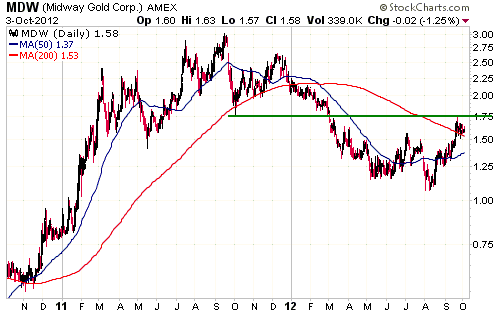
MDW has stakes in three Nevada-based development-stage gold projects: the Pan
and Gold Rock projects, which MDW owns and operates, and the Spring Valley
project, which is a joint venture with Barrick Gold (Barrick is the operator and
has the option to earn 70%).
We were prompted to check out MDW by the fact that Golden Predator (GPD.TO), a
recent addition to the TSI Stocks List, owns 4% gross production royalties on
the Pan and Gold Rock projects. In our efforts to determine the value of these
royalties it occurred to us that MDW would be a reasonable speculation in its
own right. At this stage we prefer to gain indirect exposure to MDW's projects
via GPD, but MDW offers good value and the advantage of an NYSE listing.
Of MDW's projects, Pan is the most advanced. First production is scheduled for
2014 and the average production rate is currently designed to be
81K-ounces/year, although there is potential to increase the rate to
150K-ounces/year. The mine plan is simple, in that we are dealing with an oxide
gold deposit that can be mined via open pit and heap leach. At a gold price of
$1725/oz the project's NPV(5%) is estimated to be $290M, or about $2.00 per
fully diluted MDW share.
Assuming a gold price of $1700/oz, at Pan's design production rate of 81K-oz/yr
the 4% gross production royalty owned by GPD would generate annual revenue of
$5.5M. This implies a value for the royalty of about $55M (using a 10-times
revenue multiple, which is lower than the revenue multiple that most gold
royalty companies now trade at) after production begins in 2014, assuming a gold
price of $1700 and not allowing for any future expansion.
Gold Rock is similar to Pan, although it is at an earlier stage of development
(initial production is scheduled for 2016) and could end up being slightly
larger. Annual gold production is expected to be 80K-100K ounces.
If we take the bottom of the above-mentioned range and make the same assumptions
we made when assessing the future value of the Pan royalty, we arrive at the
same potential value of $55M for GPD's Gold Rock royalty.
Further to the above, if MDW is successful in its endeavours then at a gold
price of $1700/oz the value of GPD's royalties on MDW's projects will likely be
worth at least $110M within three years. This equates to about $0.76 per GPD
share, or roughly double the current GPD stock price. None of this potential
value appears to be factored in at this time, which means that success by MDW
could translate into a 200% gain in GPD's stock price within three years. Note
that success, here, is simply defined as bringing the projects into production
roughly in accordance with the present schedule. Any cost blow-outs suffered by
MDW won't affect GPD because GPD's royalties are based on gross production.
Alternatively, if MDW turns out to be a total failure then GPD's shareholders
will lose a lot of upside potential but could still do OK as a result of GPD's
Yukon-based projects. This is why we prefer to gain exposure to MDW via GPD.
It is worth mentioning that in addition to the Pan and Gold Rock projects, MDW
has a stake in the Spring Valley project. MDW's stake will probably end up at
either 30% or 25%, with Barrick Gold owning the rest. However, due to Spring
Valley's size (the total in-ground resource is presently 4.2M ounces of gold)
this 25%-30% stake could generate similar production for MDW as its 100% stakes
in the Pan and Gold Rock projects.
MDW's current market cap is around $200M and the company has about $15M of
working capital to fund its development activities over the next several months.
It has three solid projects in a good location (Nevada), two of which are
100%-owned and one of which is a JV with the world's largest gold mining
company. While we don't intend to add it to the TSI List in the near future (for
the reason stated above), it would be a reasonable addition to a gold stock
portfolio. A good place for new buying would be within a few cents of the 50-day
moving average (around US$1.40).
Keegan Resources (TSX: KGN, NYSE: KGN). Shares: 76M issued, 83M
fully diluted. Recent price: US$3.20
Our most recent mention of KGN was in the 10th September Weekly
Update. At that time it was priced at US$4.15 and was short-term
'overbought'. It has since pulled back a long way, for no
fundamental reason we are aware of. It is now short-term 'oversold'.
KGN's current market cap is around $250M. This is moderately high
considering the size, location (Ghana) and development stage of its
flagship Esaase project, but it is offset by the company's $185M of
cash. Due to its large cash position KGN's enterprise value is only
about $65M, which is low.
KGN is a good candidate for new buying in the low-US$3 area.
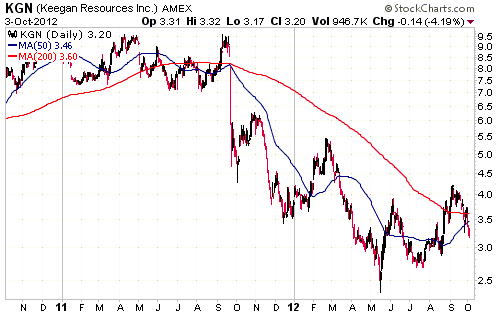
Chart Sources
Charts appearing in today's commentary
are courtesy of:
http://stockcharts.com/index.html

|









