|
- Interim Update
4th March 2015
Copyright
Reminder
The commentaries that appear at TSI
may not be distributed, in full or in part, without our written permission.
In particular, please note that the posting of extracts from TSI commentaries
at other web sites or providing links to TSI commentaries at other web
sites (for example, at discussion boards) without our written permission
is prohibited.
We reserve the right to immediately
terminate the subscription of any TSI subscriber who distributes the TSI
commentaries without our written permission.
Why the
Fed pays interest on bank reserves
The Fed's reason for paying interest on bank reserves has been
addressed in previous TSI commentaries, but it's an important issue
and worthy of additional commentary space. That's especially so
because there is so much confusion surrounding the issue. In
particular, the actual reason for the interest payments is at odds
with the beliefs/assumptions of many journalists, newsletter writers
and other commentators on financial matters.
Before getting to the real reason we'll deal with the two most
common false beliefs. The first of these is that the Fed started
paying interest on bank reserves to prevent the commercial banks
from rapidly expanding their loan books in reaction to the
Fed-generated ballooning of reserves from Q4-2008 onwards. The
second is that the main purpose of the interest payments is to
provide financial support to the banks.
There is no truth to the first belief, because the interest payments
on reserves have no effect on either the ability or the willingness
of banks to make loans. The facts are that a) reserves cannot be
loaned into the economy, b) there has been no relationship between
US bank reserves and US bank lending for decades, and c) even if the
amount of bank lending were influenced by the level of reserves as
wrongly explained in outdated economics textbooks, an increase in a
bank's lending would not affect the amount of interest earned by the
bank on its reserves. This last point is due to the fact that an
increase in a bank's loan book could shift reserves from the
"excess" to the "required" category, but wouldn't affect its total
reserves. The Fed, however, pays interest on ALL reserves, not just
"excess" reserves.
There is some truth to the second belief in that the payment of
interest on reserves does provide some additional income to the
banks. However, even with today's massive reserve levels the
financial impact on the banks is trivial (at the current interest
rate we are talking about $6B/year of reserve-related interest
payments across the entire banking industry, which is a veritable
drop in the ocean).
The real reason that the Fed began paying interest on bank reserves
in late-2008 was to enable it to maintain control of the Fed Funds
Rate (the overnight interest rate on reserves in the inter-bank
market and the primary rate targeted by Fed monetary policy) while
it pumped huge volumes of dollars into the economy and into the
reserve accounts of banks.
To further explain, prior to the extraordinary measures taken by the
Fed in late-2008 in reaction to the global financial crisis, the Fed
Funds Rate (FFR) could be adjusted by making small changes to
reserves. However, after the Fed began pumping hundreds of billions
of dollars of reserves into the banks, the central bank was in
danger of losing its ability to control the FFR. With the commercial
banks inundated with reserves and with plans in place for additional
rapid monetary expansion, it became clear to the Fed that even
maintaining an extremely low FFR of 0.25% was going to be
impossible. Furthermore, the Fed was thinking ahead to the time when
it would have to start hiking the FFR. With reserve levels way in
excess of what they needed to be to set the FFR at 0.25%, even the
superficially minor task of pushing the FFR back up to 0.50% would,
under the Fed's traditional way of operating, necessitate a
large-enough contraction of bank reserves and the money supply to
bring about another financial crisis.
Think of it this way: In October of 2008 the FFR was at 1% and the
total level of US bank reserves was $315B. This suggests that $315B
was consistent with an FFR of 1%. Today, the total level of bank
reserves is about $2.5T. The implication is that to get the FFR back
up to 1% the Fed would have to remove about $2.2T of covered money
($2.2T of money 'backed' by $2.2T of bank reserves) from the US
economy, but there is no way that it could remove that amount
without crashing the financial markets and the economy. Actually, we
doubt that it could even remove a quarter of that sum without
precipitating a stock market collapse and a severe recession.
This problem was obvious to Bernanke, and his solution was to pay
interest on reserves. With this new tool in its kit the Fed gained
the ability to set the FFR at whatever level it wanted without
adjusting bank reserves and the economy-wide money supply. For
example, if the Fed decides in the future that it wants the FFR at
1%, it could achieve this target by simply changing the interest
rate on reserves to 1% while leaving reserve and money-supply
quantities untouched.
A likely ramification of the Fed's ability to control the FFR via
the interest rate on bank reserves is that the Fed's balance sheet
has reached a permanently high plateau. There will be no traditional
tightening of monetary policy in the foreseeable future.
Industrial Metals Update
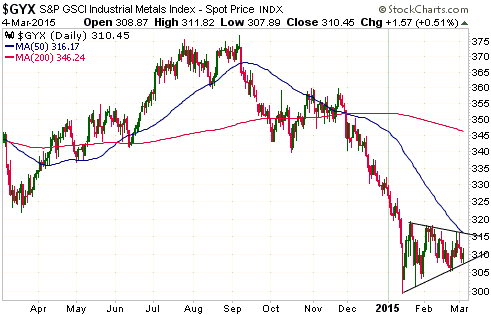
Since making a short-term low about 2 months ago
the Industrial Metals Index (GYX) has been oscillating within a contracting
range. This price action could be part of an intermediate-term bottoming pattern
or a consolidation within a continuing intermediate-term decline. It's more
likely to be the latter.
 The Stock Market
Europe
European equities have been very strong since early January. In the cases of the
EURO STOXX 50 Index, Germany's DAX Index and France's CAC40 Index, this strength
resulted in breakouts to new multi-year highs (a new all-time high in the case
of the DAX). However, in some of the 'peripheral' markets the strength resulted
in a test of last year's high, but no breakout to new highs, yet. Daily charts
of Italy's MIB index and Spain's IBEX Index, the two best examples, are
displayed below.
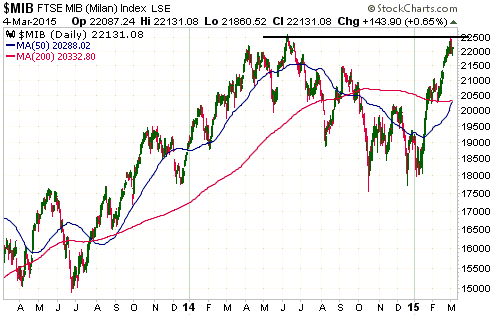
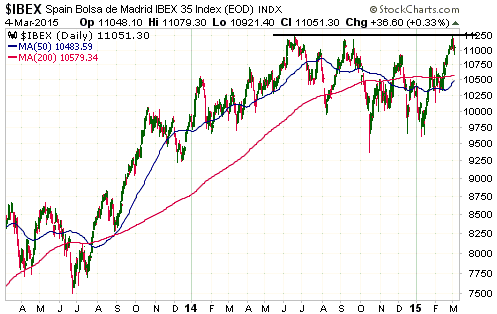
Our guess is that the MIB and the IBEX will make sustained upside breakouts
within the next few months, but not within the next few weeks. Given that
European equities have risen strongly over the past two months in response to
more rapid monetary inflation and in anticipation of the new ECB money-pumping
program that's due to start this month, the stage is set for the start of the
ECB's new program to mark a short-term price top. This would be a typical "buy
the rumour, sell the fact" scenario.
The World
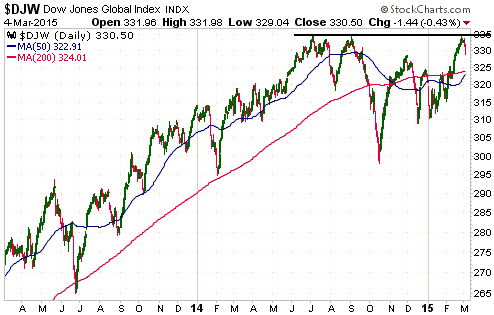
The Dow Jones Global Index (DJW) is in a similar position to the two European
indices shown above. It is also in a similar position to the NYSE Composite
Index. We suspect that an intermediate-term peak is in place for the DJW or will
be put in place via an upward spike to a marginal new high within the next few
trading days.
As far as we can tell, only the US stock market is at a dangerously high
valuation. In fact, by some measures the US stock market is more expensive than
it has ever been, because, unlike in March-2000 when the average valuation was
at an extraordinary height due to the stratospheric valuations of a fairly small
number of large-cap tech stocks, the valuation of the average stock is much
higher today. However, many of the markets that aren't over-valued have extreme
short-term vulnerability. This is due to the fact that they have fully
discounted a lot of good news on the monetary front and, in some cases, are
precariously poised near important resistance levels.
Gold and the Dollar
Gold
With gold's correction having done as much as it needed to do (in US$ terms),
this was a likely week for a short-term bottom in the US$ gold price. There is
still a chance that a multi-week rally will begin before the end of this week,
with Thursday's ECB meeting or Friday's US employment report acting as the
catalyst, but with the HUI having just broken below its 50-day MA there is now a
higher probability that the correction will extend into next week.
The monthly US employment report has almost no value as an economic indicator,
but the Fed focuses on it so the markets focus on it. After all, nothing matters
in the financial markets anymore except for the machinations of the monetary
politburo, genuine price discovery having been eradicated many years ago.
According to Bloomberg, the average expectation is that the US economy added
230K jobs in February. Due to reduced activity in the oil industry and related
businesses there is scope for a big negative surprise in the February data, but
that's definitely not something we would bet on.
In any case, the only useful information associated with the employment numbers
is how the markets react to them. For example, in gold's case a downward spike
followed by an upward reversal in reaction to a strong employment report would
be bullish, while an upward spike followed by a downward reversal in reaction to
a weak employment report would be bearish.
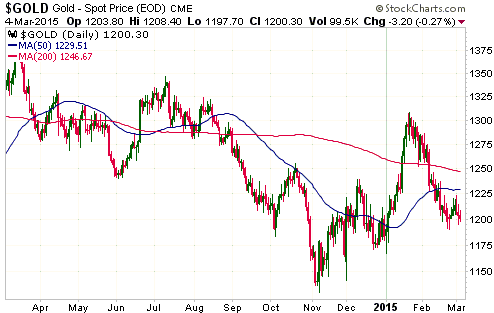
2015 will probably turn out to be a decent year for gold as an investment.
However, it's important not to have high expectations with regard to gold's
likely performance over the remainder of this year's first half. A multi-week
rally will probably soon begin, but with the true fundamentals still no better
than 'mixed' a sustained break above $1300 is probably not going to happen
during the first half. Also, when the S&P500 Index made a new all-time high last
month it meant that the US$ gold price would probably have to test last year's
low before commencing a major advance.
Gold Stocks
The HUI held support at 180 'by the skin of its teeth' on Wednesday. However,
the first of the following daily charts shows that it broke below its 50-day MA,
which it shouldn't have done as part of a routine short-term correction. Also,
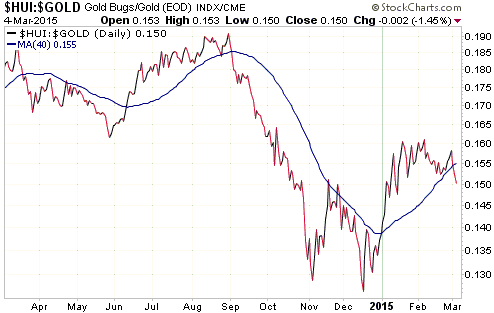
the second of the following daily charts shows that after holding up well over
the preceding few weeks, the HUI/gold ratio dropped quite sharply this week.
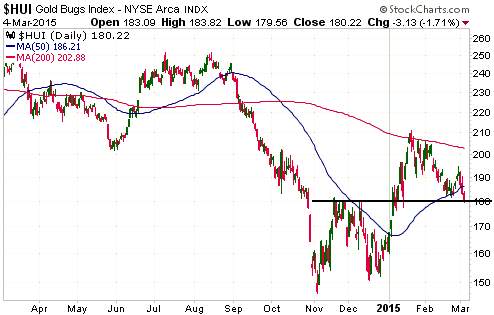
When the HUI quickly rose to its 200-day MA in January, a pullback to support at
180 and/or the 50-day MA became likely. It was a predictable outcome. With the
HUI having just broken below its 50-day MA while barely remaining above 180, a
high-confidence short-term prediction is not possible. What we can say is that
IF 180 continues to hold on a daily-closing basis then the next multi-week rally
should result in a new 2015 high for the HUI even if gold bullion fails to move
back above $1300. However, we do not have an opinion on whether 180 will hold.
If the HUI closes below 180 then the next multi-week rally will probably end at
a lower high for the year.
The Currency Market
David Stockman noted
earlier this week that $2T of European government bonds are now trading at
negative yields. As Bloomberg further noted, 88 of 346 European sovereign debt
issues tracked in its index are now trading at negative yields. As recently as 2
years ago no rational person would have believed this to be possible, but here
we are. Furthermore, within the next two weeks the ECB is expected to begin a
new bond monetisation program that will have the direct effect of putting
additional downward pressure on euro-zone bond yields. More details about the
new bond monetisation program are likely to be announced at the conclusion of
the 5th March ECB meeting (later today, that is).
While the ECB's new money-pumping program will have the direct effect of putting
additional downward pressure on bond yields, an indirect effect could be an
increase in inflation expectations of sufficient magnitude to more than offset
this downward pressure. In fact, this is what we think will happen. We think
that the start of the ECB's new bond monetisation program will roughly coincide
with an intermediate-term bottom for interest rates in the euro-zone. This would
be similar to what happened following the kick-offs to the massive bond-buying
programs implemented by the Fed over the past several years.
The start of the ECB's new pro-inflation program is also likely to coincide with
an important turning point in the currency market -- a turn from down to up in
the euro and from up to down in the Dollar Index.
Updates
on Stock Selections
Notes: 1) To review the complete list of current TSI stock selections, logon at
http://www.speculative-investor.com/new/market_logon.asp
and then click on "Stock Selections" in the menu. When at the Stock
Selections page, click on a stock's symbol to bring-up an archive of
our comments on the stock in question. 2) The Small Stock Watch List is
located at http://www.speculative-investor.com/new/smallstockwatch.html
 Note
on Dragon Mining (DRA.AX) Note
on Dragon Mining (DRA.AX)
DRA trades on the Australian stock market. It is a former member of the TSI
Stocks List and a current member of the TSI Small Stocks Watch List.
In the 25th January Interim Update we pointed out that, like Dalradian Resources
(DNA.TO), DRA benefits from the strong rise in the euro-denominated gold price.
Furthermore, we noted that DRA's benefit from gold/euro's strong rise was more
direct and immediate than DNA's, because whereas DNA is an exploration-stage
miner with a project in the euro-zone DRA is a current producer with projects in
the euro-zone and Sweden (the Swedish Krona has been even weaker than the euro,
meaning that gold/Krona has been even stronger than gold/euro).
Despite the fact that DRA.AX stands to benefit more than most junior gold miners
from the changes in the gold and currency markets that have taken place over the
past several months, prior to this week it hadn't rebounded far from its low and
was trading well below its working capital (meaning: the market was valuing
DRA's cash-flow-positive gold-producing assets at less than zero). However,
prompted by the release of financial statements and drilling results on Monday
2nd March, the market has begun to pay a little more attention to DRA.
DRA earned a profit of A$7.8M in 2014 and should definitely be profitable at the
higher euro-denominated gold price of today, and yet at the beginning of this
week it was trading at a discount of more than 50% to its working capital. To be
more specific, the financial statements issued on Monday showed that DRA had no
long-term debt and about A$0.26/share of working capital, and yet the market
price of the shares began the week at only A$0.10. Who claimed that the stock
market is efficient?
The stock quickly gained 60%-80% of market value in response to the information
released on Monday, but at A$0.16-A$0.18 it is still being priced at a sizable
discount to the company's working capital.
We have no current intention of returning DRA to the TSI Stocks List, though,
because it remains very illiquid and therefore very difficult to trade. The fact
that the stock price gained 70% on Monday in response to only $25,000 of buying
is indicative of the lack of liquidity.
Chart Sources
Charts appearing in today's commentary
are courtesy of:
http://stockcharts.com/index.html

|









