|
- Interim Update 4th April 2012
Copyright
Reminder
The commentaries that appear at TSI
may not be distributed, in full or in part, without our written permission.
In particular, please note that the posting of extracts from TSI commentaries
at other web sites or providing links to TSI commentaries at other web
sites (for example, at discussion boards) without our written permission
is prohibited.
We reserve the right to immediately
terminate the subscription of any TSI subscriber who distributes the TSI
commentaries without our written permission.
TSI Schedule
Change
Due to Easter, school holidays and visiting relatives, there won't be a Weekly Market Update this coming Sunday (8th April) or the Sunday after (15th April). We will, however, post an Interim Update at the usual time on Thursday 12th April. Commodities
Trend?
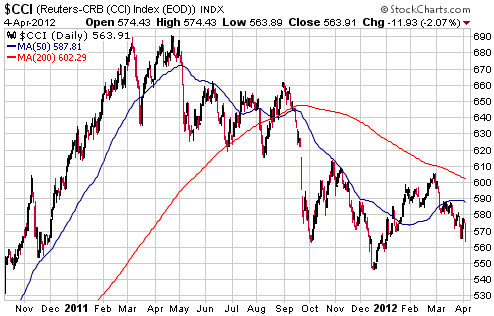
As evidenced by the following chart, the Continuous Commodity Index
(CCI) was in a downward trend from late April through to mid December of last year. That's a fact. The CCI then trended upward from mid December through to late February. That's another fact. As to whether the decline from the late February peak is a pullback within the context of an upward trend or the first leg of a new downward trend, that's a matter of opinion.
Our best guess is that the CCI's 2011 peak will not be exceeded, or even seriously challenged, this year. However, we won't be surprised if the CCI exceeds its late February peak within the next two months, thus confirming that the March decline was a pullback within the context of an upward trend.
The Stock Market
Presidential Cycle Update
We last mentioned the US stock market's 4-year Presidential Cycle (PC) in our 28th December 2011 commentary. At that time we noted that the PC Model (a stock market model based on the S&P500's average performance during all Presidential Cycles from 1928 through to 2008) predicted a 'choppy' first half and a very strong second half for 2012, the fourth year of the current PC. A graphical representation is displayed below. We questioned whether this model should be heeded when deciding what to do in 2012, and then answered the question in the negative. Our reasoning was:
"The fundamental basis for the PC Model no longer exists. The Model was often a useful guide in the distant past because the President would attempt to get restrictive policies out of the way during the first half of his 4-year term and implement stimulative policies -- to create the illusion of prosperity during the quarters leading up to the next election -- during his term's second half. Nowadays, however, there is non-stop 'stimulus' and the rate at which stimulus is administered tends to be ramped up and down on an ad hoc basis in reaction to events that policy-makers never see coming.
The ad hoc acceleration/deceleration of monetary and/or fiscal stimulus is why the stock market diverged bullishly from the PC Model in 2010 and bearishly from the PC Model in 2011. Specifically, the unplanned "QE2" program caused the market to turn higher prematurely (well in advance of the PC Model) in 2010, and the removal of artificial support caused the market to under-perform the PC Model throughout the bulk of 2011.
Also worth noting is that the fourth year was a huge outlier in two of the past three Presidential Cycles (we are referring to the years 2000 and 2008). Anyone who bought aggressively in mid-2000 or mid-2008 in anticipation of the strong second-half rally predicted by the PC Model would have been financially clobbered."
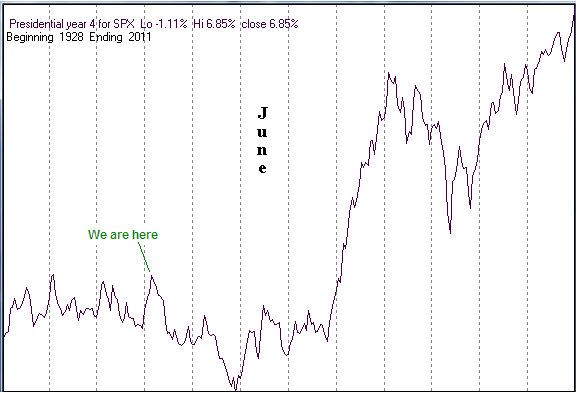
Chart Source: Mike Burk at http://alphaim.net/signup.html
The PC Model predicts an early-April high followed by a downward correction to a late-May low. A significant April correction is a likely prospect, but not because of the PC. The fact is that the market did much better than predicted by the Model during the first quarter and is now dangerously extended to the upside, especially considering the economic backdrop. This creates the potential for a meaningful decline.
Our expectation has been, and is, that the market's performance during the second half of this year will be very different to the performance predicted by the PC Model. Rather than accelerating upward as per an average 4th year, we expect the market to lose ground.
Current Market Situation
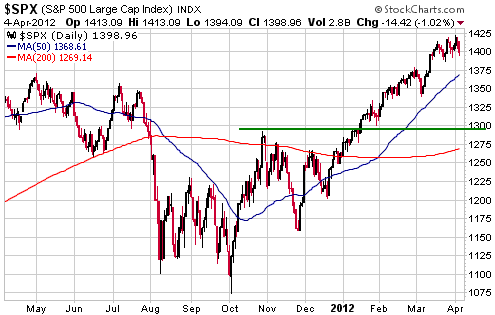
One possibility is that the US stock market is now immersed in a 2-4 week correction that will be followed by a rise to a new high for the year. Although we are bearish, we consider this to be the possible outcome with the highest probability.
The reason we are bearish has to do with a 4-letter word: risk. Although this week's decline is probably part of a routine correction with maximum downside on the S&P500 to around 1300, there is a significant risk that a much larger and longer decline has begun. Furthermore, if an intermediate-term decline has not already begun, there's a good chance that it will begin within the next few months.
Gold and the Dollar
Gold
Gold to peak at $27,493 in September-2014!!!
If we published an article with the above title we would get a huge number of page views. However, any article that claims to predict the exact level and/or time of the ultimate gold peak or any other financial market turning point is not worth reading.
A lot of people like to be told what's going to happen in the future, which is why gurus who make very specific forecasts about how the markets are going to perform over the years ahead sometimes attract a lot of followers. In addition, the more dramatic the specific forecast, the more attention and the more followers the self-appointed guru is likely to attract. For example, a forecast that the Dow is going to rise 5% between now and the end of 2013 is very specific, but is way too boring to provoke much interest. On the other hand, a forecast that involves a 50% move in the Dow -- up or down, it doesn't matter -- by the end of 2013 will potentially provoke considerable interest. There is consequently an incentive for a financial-markets forecaster to be outlandish.
The incentive to make very specific and dramatic forecasts doesn't just come from the fact that such forecasts are capable of generating a lot of publicity and business (book/newsletter sales, speaking engagements) for the forecaster. It also comes from the fact that a career can be built on just one dramatic forecast that happens to pan out. For example, Robert Prechter still gets introduced in interviews and promoted as someone who correctly predicted the 1987 stock market crash. That he hasn't guessed right since then doesn't seem to matter.
Commentators on the financial markets will make correct 'calls' from time to time and will often give themselves a public pat on the back for having been so prescient, but this is similar to patting oneself on the back for the prescience demonstrated by correctly calling a coin toss. Keep in mind that nobody KNOWS the future and that a lot of correct forecasts are just lucky guesses. Also keep in mind that successful investing and financial-market speculating do not rely on knowing the future; they rely on being able to accurately assess PRESENT conditions. They also rely on risk management, which should, in turn, be based on the realisation that at any given time there are numerous possible futures.
Current Market Situation
Entering this week gold hadn't done anything to confirm that a correction low was in place, leaving open the possibility that a final spike to a new low for the move lay in store. A (likely) final spike to a new low occurred on Wednesday.
There is still no confirmation that a low is in place, but note that clear-cut evidence that an important turning point has occurred usually only comes well after the turning point (after the price has moved much higher or lower). Doing the right thing in the investment world often involves buying when there is no evidence that the price has bottomed and selling when there is no evidence that the price has peaked. Risk can be managed by gradually increasing or reducing exposure, as opposed to shifting between 100%-in to 100%-out based on some view of the future that could turn out to be wrong.
We recently turned short-term bullish on gold on the basis that the maximum short-term downside risk was defined by support at $1550-$1600. We remain short-term bullish, as the price action over the intervening period has done nothing other than reduce the downside risk by about $40/oz.
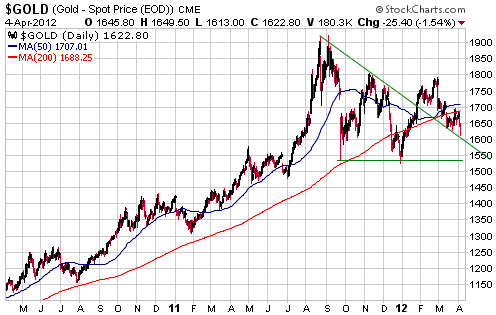
The catalyst for the quick decline in the gold price during Tuesday-Wednesday of this week was the release of the latest FOMC meeting minutes. These minutes convinced traders that there would be no more monetary stimulus from the Fed anytime soon, which prompted the speculative selling of gold futures.
We don't know why anyone in their right mind would have been expecting additional "QE" from the Fed during the first half of this year, but a significant number of traders apparently were. As far as what to expect from the Fed during the second half of this year and beyond, you won't find clues in FOMC minutes or in anything said by the Fed chairman or one of the Fed governors. The reason is that the Fed has no idea what it will do in the future.
The Fed will continue to do what it always does, which is react counter-productively to backward-looking economic data and the performances of the financial markets. This means that there will be more "QE" (or monetary stimulus under another name) after the stock market tanks or the backward-looking data leave no doubt that the US economy is in recession, but not before.
By the way, with or without additional monetary stimulus measures in the short-term, US monetary conditions remain ultra-easy. The gold market is being tossed around by changing sentiment, but the US monetary fundamentals remain unequivocally gold-bullish.
Gold Stocks
In the HUI discussion in the latest Weekly Update, we wrote:
"A short-term bottom might have been put in place last week, but the price action hasn't yet confirmed it. A bottom for the HUI would be signaled by either a sharp intra-day plunge and upward reversal or two large up-days. As long as the HUI 'chops' back and forth within a horizontal range, as it did last week, the potential for a final cleansing plunge will remain."
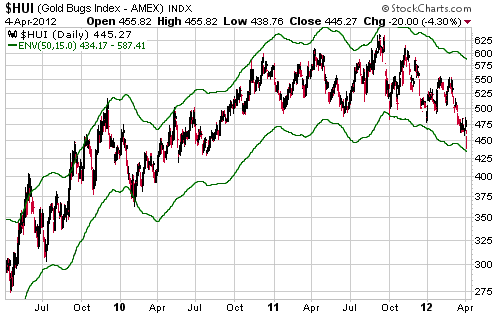
A final cleansing plunge appears to have begun on Tuesday of this week. It might not be complete, but note that Wednesday's intra-day low of 438 was close to the bottom of the moving-average (MA) envelope shown on the following daily chart. This was the likely target IF short-term support in the 460s was breached. Also, we thought that the bottom of the MA envelope defined the maximum short-term downside risk.
Perhaps the "cleansing plunge" will continue on Thursday of this week and/or during the first half of next week, but it should soon run its course.
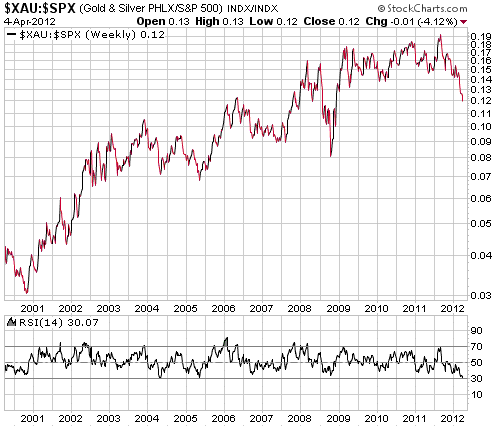
The gold sector is not only at an 'oversold' extreme in nominal dollar terms, it is also at an 'oversold' extreme relative to the broad stock market. As evidenced by the following chart, as a result of the additional relative weakness in the gold sector over the past few days the XAU/SPX ratio's weekly RSI is now as low as it was at the May-2004 and May-2005 bottoms. In other words, the XAU/SPX ratio's weekly RSI is now testing a 12-year low.
Further to the above, if you have a sizeable cash reserve then this is an excellent time to be putting part of it to work in the gold sector. That's exactly what we are doing.
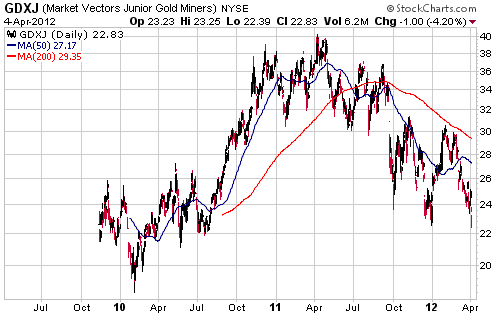
If you want to trade the coming rebound in junior gold/silver stocks and liquidity is one of your biggest concerns, then GDXJ (the Market Vectors Junior Gold Miners ETF) could be your vehicle of choice. About $80M of GDXJ shares change hands on an average trading day and buy-sell spreads are always low, so getting in and out is never difficult with this ETF.
GDXJ briefly traded below its December-2011 intra-day low on Wednesday, but ended the day slightly above this low. Considering the gold price, it offers better value today than at any other time during its 2.5-year existence.
Currency Market Update
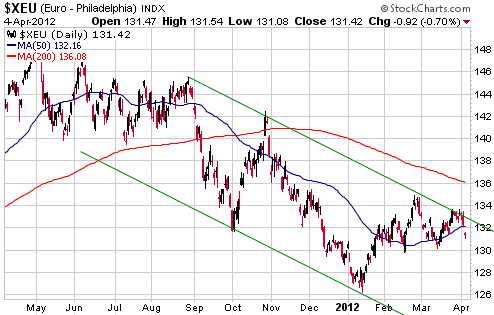
Minor weakness in the stock market over the past two trading days led to minor weakness in the euro. This was 'par for the course'. If the stock market's decline develops into something more serious than a routine consolidation then the euro will probably drop to a new 52-week low, but it is far more likely that the euro will take care of some unfinished business on the upside before resuming its longer-term bear market.
It won't surprise us if the euro pulls back as far as the high-120s before re-entering its short-term upward trend.
Update
on Stock Selections
Notes: 1) To review the complete list of current TSI stock selections, logon at
http://www.speculative-investor.com/new/market_logon.asp
and then click on "Stock Selections" in the menu. When at the Stock
Selections page, click on a stock's symbol to bring-up an archive of
our comments on the stock in question. 2) The Small Stock Watch List is
located at http://www.speculative-investor.com/new/smallstockwatch.html
 Norton Gold Fields (ASX: NGF). Recent price: A$0.24 Norton Gold Fields (ASX: NGF). Recent price: A$0.24
NGF is an Australian junior gold producer and a member of the TSI Small Stocks Watch List
(SSWL).
NGF announced on Tuesday that it had received a takeover bid from Zijin Mining, a Chinese mining company. The conditional bid is valued at A$0.27/share.
The Zijin bid is low relative to NGF's underlying value but represents a healthy premium of about 40% to the pre-bid stock price. A competing bid is possible but not probable given that Zijin already owns about 17% of NGF. Zijin's ownership stake (and the potential for that stake to be expanded) was part of why we became interested in NGF.
In the absence of a superior bid, we suggest that NGF shareholders accept the Zijin offer. This would free-up funds that could be redeployed elsewhere.
We have removed NGF from the SSWL.
Keegan Resources (TSX: KGN, AMEX: KGN). Shares: 75M issued, 81M fully diluted. Recent price: C$3.35
KGN's Esaase gold project is estimated to have a Net Present Value (NPV) of about $700M at a gold price of around $1500/oz. However, at Wednesday's intra-day low of C$3.15 the company's market cap was only slightly higher than its cash-in-the-bank. This means that sellers of the stock near Wednesday's low were effectively giving the project away.
At Wednesday's closing price of $3.35 the project is only being valued by the market at about $60M, after accounting for the company's cash. This is still extraordinarily low.
KGN is an obvious candidate for new buying near its current price, although it is fair to say that right now we are spoiled for choice as far as buying opportunities in the gold sector are concerned.
Rio Novo Gold (TSX: RN). Recent price: C$0.46
RN announced the results of the Preliminary Economic Assessment (PEA) for its Brazil-based Almas gold project after the close of trading on Tuesday. The project has been estimated to have an NPV and IRR of $106M and 24.5%, resp., at a gold price of $1350/oz (the NPV rises to $200M at the current gold price.). Production is expected to be 60K-75K ounces/year and the cost to build the mine is estimated to be $95M.
RN has moved this project directly to the feasibility stage and expects to have a completed Definitive Feasibility Study in July of this year.
In a stronger market environment the above-mentioned PEA would probably have given RN's stock price a hefty boost. In the current environment, however, it generated no interest.
RN is one of many reasonable candidates for new buying, but be aware that this stock has recently become very illiquid.
Chart Sources
Charts appearing in today's commentary
are courtesy of:
http://stockcharts.com/index.html

|









