|
- Interim Update
4th June 2014
Copyright
Reminder
The commentaries that appear at TSI
may not be distributed, in full or in part, without our written permission.
In particular, please note that the posting of extracts from TSI commentaries
at other web sites or providing links to TSI commentaries at other web
sites (for example, at discussion boards) without our written permission
is prohibited.
We reserve the right to immediately
terminate the subscription of any TSI subscriber who distributes the TSI
commentaries without our written permission.
The Stock Market
The slow grind continues. There were periods in the past when
prices were changing so quickly that a twice-per-week commentary frequency
seemed insufficient, but when financial-market volatility is as low as it has
been over the past three months it feels like once per week would be more than
enough.
Could the glacial market action continue for another 2-3 months, proving the
short-term bears wrong and at the same time doing very little to increase the
wealth of the bulls? It's a possibility, as that type of performance would be
counter to the expectations of the greatest number of market participants.
However, it's more likely that we will get some fireworks within the next couple
of months.
Regarding the US stock market's price action over the first three trading days
of this week, the only change worth mentioning is that the NDX made a marginal
new high for the year. As noted in the latest Weekly Update, this doesn't affect
our assessment that a top of at least intermediate-term significance is close at
hand, but it does usher in the possibility that the overall topping process will
last a few more months. A multi-month extension to the overall topping process
would likely entail a sharp 10%+ decline within the next two months followed by
a rally to test the June-2014 high during September-October.
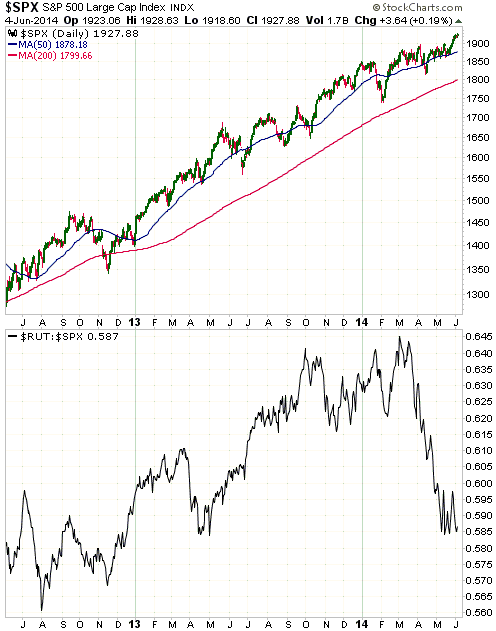
Turning to the charts, first up we are showing the divergence between the S&P500
Large-Cap Index (SPX) and the RUT/SPX ratio (small-cap stocks relative to
large-cap stocks). Notice that the SPX and the RUT/SPX ratio were trending
upward together until March, at which point RUT/SPX began to trend downward
while the SPX stayed on its upward path.
Small-cap stocks, as a group, are now so 'oversold' relative to the SPX that we
won't be surprised if the next multi-week decline in the SPX is accompanied by
relative strength in the small-caps.
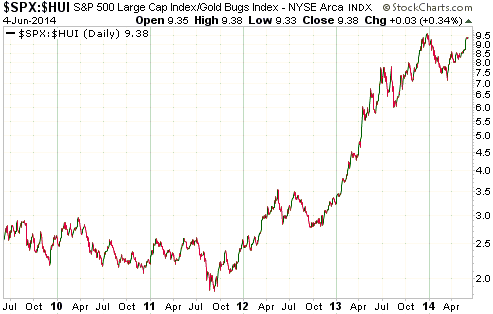
Our second chart shows the SPX/HUI ratio (large-cap US stocks relative to the
gold-mining sector). This ratio has risen to test its December-2013 blow-off
top.
We expect the test to be successful.
Gold and the Dollar
Gold
A dose of realism regarding gold's valuation
Some gold-market analysts come up with a theoretical value for an ounce of gold
by dividing the US Monetary Base (MB) or some other US monetary aggregate by the
quantity of US government gold reserves. Valuing gold in this way is completely
nonsensical, but it has the advantage of arriving at a very high dollar figure.
How high depends on the monetary aggregate of choice. For example, if we start
with the assumption that the true value of gold can be determined by dividing
the current US Monetary Base of around $3.9T by the 262M ounces of official US
gold reserves then we end up with around $15,000 per ounce. The problem is that
the starting assumption is illogical. There is simply no good reason that the
current market price or the current value of gold should be determined in this
way.
The ridiculousness of the above gold valuation methodology is apparent if we
consider what would happen if the US government sold 90% of its gold reserves
while nothing else changed. This action would undoubtedly reduce the price of
gold, but the same calculation that previously resulted in a $15,000/oz
theoretical valuation would now result in a $150,000/oz theoretical valuation.
Another path that we can take to reveal the absurdity of using the method
outlined above is to show what it would mean for gold's value relative to the
values of other commodities, on the basis that regardless of what is happening
to the US dollar the price of gold should bear some resemblance to the prices of
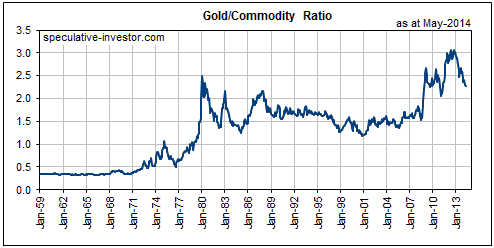
other real things. The following chart of the gold/commodity ratio (the gold
price divided by the Continuous Commodity Index) is the first step along this
path.
The chart shows that the gold/commodity ratio is in a very long-term upward
trend. This very long-term upward trend, which is a natural consequence of the
Fed's destructive policies, involved an advance during the 1970s, a choppy
downward drift during 1980-2000, an advance during 2001-2011 and a sharp
pullback during 2012-2013. As an aside, the directions and magnitudes of these
long-term relative moves in gold and commodities make sense considering what was
happening throughout the major financial markets at the time.
The next step is to look at the effect that a sudden increase in the gold price
to $15000/oz would have on the gold/commodity. The following chart illustrates
the effect.
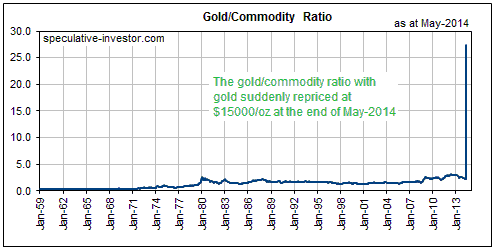
If the gold price were $15000/oz today then gold would be more than 10-times as
expensive relative to other valuable commodities as it was at its January-1980
blow-off peak. Does anyone truly believe that such a valuation would be
reasonable?
The gold market doesn't really have its own fundamentals, in that changes in the
investment/speculative demand for gold are almost totally driven by what's
happening to other markets and confidence in the monetary system. Based on these
influences that are external to the gold market an ounce of gold will sometimes
be relatively expensive and sometimes be relatively cheap, but there is no good
reason to expect that gold's price will ever become completely divorced from the
prices of commodities, assets and labour. A gold price of $15000/oz today would
not only make gold almost 10-times more expensive than it has ever been relative
to a basket of other valuable commodities, it would also make gold almost
10-times more expensive than it has ever been relative to the median US house
and the median US wage.
Based on its value relative to other 'things', gold was dirt cheap at its
1999-2001 price low. It was expensive at its 2011 price peak, although taking
into account the monetary and financial-market backdrops of the respective
periods it wasn't anywhere near as expensive as it was at the January-1980 price
peak. Considering the current monetary and financial-market backdrop we think
that gold is now fairly-valued to slightly under-valued, but we expect it to
become a lot more expensive over the years ahead as the negative consequences of
central-bank interventions in the US and Europe become increasingly obvious.
Current Market Situation
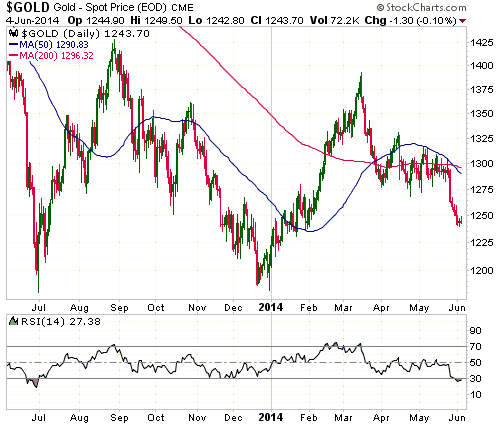
Gold is very 'oversold' on a short-term basis and will probably soon rebound,
perhaps following a spike down to $1230 (+/- a few dollars). It needs to get
back above $1280 to confirm that the short-term trend has reversed.
The gold price usually bounces around in reaction to the monthly US Employment
Report, the next iteration of which will be released prior to the start of US
trading this Friday. However, as important as the employment news can sometimes
seem, we aren't aware of one of these reports ever altering the price trend of
any market. All they usually do is create some intra-day volatility.
The US employment numbers that get published this Friday will probably show some
strength, leading to a knee-jerk negative reaction in the gold market. However,
regardless of whether the initial reaction is to the upside or the downside, the
only useful information will be contained in what happens after the initial
reaction.
Gold Stocks
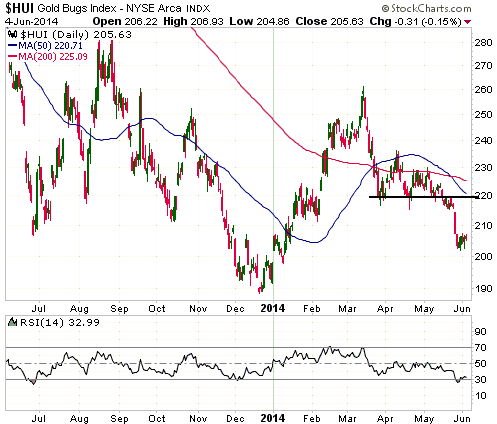
The HUI drifted sideways over the first three days of this week. This means that
it hasn't signaled an end to its short-term downward trend, although historical
comparisons and the extent to which it is 'oversold' indicate that the
short-term downward trend should be almost over.
We haven't attempted to prove that this is actually the case, but we get the
impression that the average gold-mining stock has recently done better than
gold-mining stock indices such as the HUI and the XAU. The price charts of many
of the gold stocks that we follow certainly look more bullish than the charts of
the HUI and the XAU.
The Currency Market
A few hours after this TSI commentary is posted, the greatly anticipated ECB
Meeting will end and the ECB's new 'unconventional' pro-inflation measures will
be announced.
The situation in which the ECB now finds itself is another example of one
intervention by a government or central bank leading to an unforeseen (by
policymakers) problem that creates the need for another intervention.
Specifically, during 2011-2012 the ECB's actions were dedicated to suppressing
interest rates on the debt securities issued by peripheral governments such as
the government of Spain, partly by inducing commercial banks to invest in these
securities. This particular ECB goal was achieved, but increasing the demand for
government debt had the effect of reducing the demand for private debt. Bank
lending to private individuals and businesses has contracted in the euro-zone.
In other words, the ECB paved the way for the parasitic sector to get easier and
less-costly access to credit and at the same time made it more difficult for the
productive sector to get access to credit. Brilliant. To address this problem,
it is widely expected that the ECB will now take steps to induce more lending to
private businesses, such as charging banks (via a negative deposit rate) to
deposit money with the ECB. This, of course, will have negative consequences
that will 'justify' even more stupidity down the track.
The euro is 'oversold' and is likely to soon rebound almost regardless of the
news over the next couple of days.
Updates
on Stock Selections
Notes: 1) To review the complete list of current TSI stock selections, logon at
http://www.speculative-investor.com/new/market_logon.asp
and then click on "Stock Selections" in the menu. When at the Stock
Selections page, click on a stock's symbol to bring-up an archive of
our comments on the stock in question. 2) The Small Stock Watch List is
located at http://www.speculative-investor.com/new/smallstockwatch.html
 In
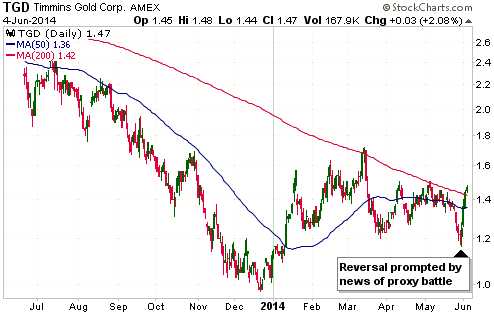
last week's Interim Update and the latest Weekly Update we said that Timmins
Gold (TGD) would be added to the TSI List if it traded at US$1.10. In the
absence of company-specific news there was a good chance that it would trade in
the US$1.00-$1.10 range in response to sector-wide lethargy, but, unfortunately,
there was news early this week that greatly reduced the probability of our
suggested buy price being reached. We are referring to the
proxy battle launched by Sentry Investments, TGD's largest shareholder.
Although this news didn't alter TGD's value in any way, it shone a light on the
value offered by the shares and prompted some speculation. In
last week's Interim Update and the latest Weekly Update we said that Timmins
Gold (TGD) would be added to the TSI List if it traded at US$1.10. In the
absence of company-specific news there was a good chance that it would trade in
the US$1.00-$1.10 range in response to sector-wide lethargy, but, unfortunately,
there was news early this week that greatly reduced the probability of our
suggested buy price being reached. We are referring to the
proxy battle launched by Sentry Investments, TGD's largest shareholder.
Although this news didn't alter TGD's value in any way, it shone a light on the
value offered by the shares and prompted some speculation.
There isn't a good reason to pay up for anything in the current market for
gold-mining stocks, because if one opportunity gets away there will be plenty of
others. Our intentions regarding TGD are therefore unchanged at this time,
although we could decide to 'pull the trigger' at a higher price after it
becomes clear that the sector-wide correction is over.
As widely anticipated, B2Gold (BTG) has arranged to buy Papillon
Resources (PIR.AX) in order to obtain PIR's development-stage Fekola
gold project in Mali, West Africa. This doesn't directly affect any
members of the TSI Stocks List, but it highlights the value offered
by some TSI stocks that also have development-stage gold projects in
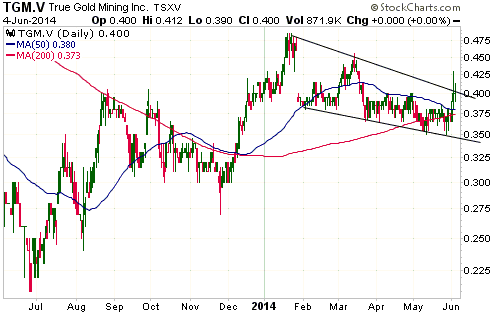
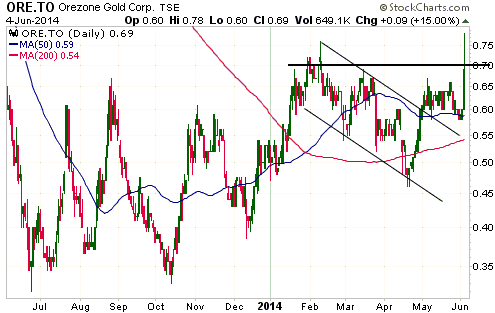
West Africa. Examples are True Gold (TGM.V) and Orezone Gold (ORE.V).
TGM's stock was strong in the immediate aftermath of the Papillon
takeover news and is now close to breaking upward from its
multi-month consolidation pattern. ORE's stock rose sharply on the
following day, although this was due to an ORE press release
regarding improved economics for its gold project rather than a
delayed reaction to the Papillon news.
Elgin Mining (ELG.TO), a former TSI Stock (ELG exited the TSI List
back in February of 2013), is being bought by Mandalay Resources (MND.V)
in a part-cash/part-stock deal valued at C$0.37/share. We still have
a small ELG position in our own account that we intend to sell at
C$0.37 in order to raise some cash for use elsewhere.
At the close of trading on Wednesday 4th June, ELG was trading at a
roughly 10% discount to the MND bid. This creates an opportunity to
make a nearly-risk-free 10% profit by purchasing ELG at C$0.33 or
lower and simultaneously selling MND at C$0.88 or higher, although
due to insufficient liquidity it might not be possible to implement
this arbitrage.
Chart Sources
Charts appearing in today's commentary
are courtesy of:
http://stockcharts.com/index.html

|









