- Interim Update 4th November 2020
Copyright
Reminder
The commentaries that appear at TSI
may not be distributed, in full or in part, without our written permission.
In particular, please note that the posting of extracts from TSI commentaries
at other web sites or providing links to TSI commentaries at other web
sites (for example, at discussion boards) without our written permission
is prohibited.
We reserve the right to immediately
terminate the subscription of any TSI subscriber who distributes the TSI
commentaries without our written permission.
US Election Outcome
At the time of writing the
outcome of this week's US elections is largely 'up in the air'. One thing
we know for sure is that there wasn't the "blue wave" that many pollsters
were predicting.
At this stage there remains an uncomfortably high
risk that the Presidential election result will be uncertain for a few
months due to disputes that lead to recounts. However, the
highest-probability outcome right now appears to be our "Scenario 4",
which is that Biden wins the Presidency and the Republicans retain control
of the Senate. Here's how we summarised the Scenario 4 market/economic
implications in the latest Weekly Update:
"Apart from Scenario
5) [a disputed result], this would be the most bearish short-term outcome
for the stock market and the economy due to the relative austerity that
would be forced on the government by the Senate. For the same reason, on a
short-term basis it would be the most bullish outcome for the US$ and the
most bearish outcome for industrial commodities.
Due to the
restraints imposed by the Senate in such a government configuration, on a
long-term basis this would be the second-most bullish -- or, to put it
more aptly, the second-least bearish -- outcome for the US economy and the
US stock market's real performance. Also, it would be the most bullish
outcome for the US$, although a long-term weakening trend for the US$
still would be likely."
There's no point writing much more
until there is greater certainty regarding the election outcome.
The FOMC Meeting
The FOMC Meeting that began on
Wednesday and will end later today (Thursday) has been overshadowed -- to
put it mildly -- by the US elections. The Fed's post-meeting statement
probably won't contain any significant changes, but it's likely that Fed
Chairman Powell will make 'dovish' noises in his post-meeting press
conference. In particular, Powell can be relied on to emphasise the Fed's
plan to keep monetary conditions very loose for the foreseeable future.
The Fed's on-going monetary accommodation will have a much greater
effect on GDP growth and prices throughout the economy if it is
accompanied by aggressive fiscal stimulus. The reason is that the way
things currently work, the Fed can make a lot of money available to the
financial markets but it relies on the government and/or the commercial
banks to get that money into the 'real' economy.
US Recession/Recovery Watch
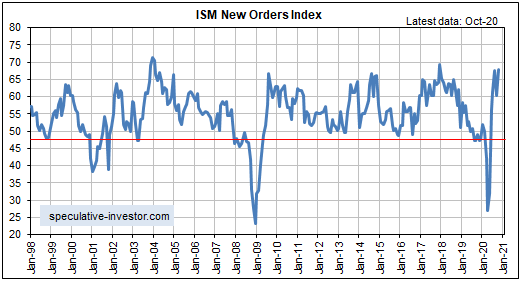
Four months ago we wrote that the spectacular rise in the ISM New Orders
Index (NOI) suggested that the 2020 US recession ended in June, a view
that was reiterated in each of the past three months. The latest data (for
October) were published on Monday of this week and are consistent with
this view.
The following monthly chart shows that NOI made a new
multi-year high in October and is at its third highest level of the past
20 years. This implies that the economy continues to recover from the
devastation caused by the government-imposed lockdowns earlier in the
year. Keep in mind, however, that a complete recovery is not possible due
to the damage to the production structure that resulted from the lockdowns
and the massive monetary/fiscal stimulus programs that were implemented to
reduce short-term pain. These programs boosted economic activity and
should continue to do so for a few more quarters, but they are sowing the
seeds of major economic weakness in years to come.
As was the case a month earlier, the latest ISM report on US
manufacturing contains evidence that inflationary pressures are building.
Specifically, the report mentions that prices are increasing, customers'
inventories are too low (although raw materials inventories have begun to
grow), and supplier deliveries are slowing.
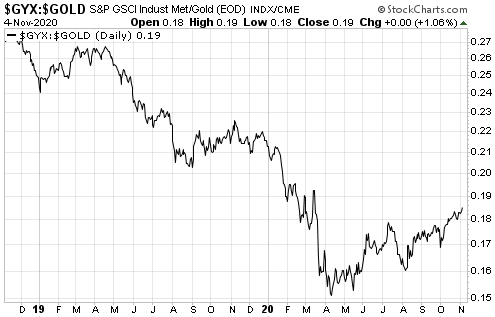
The recent performance
of the ISM NOI is bullish for industrial commodities and bearish for gold
and T-Bonds, which is consistent with our view that the industrial metals
will continue to outperform gold over the coming 6-12 months. As
illustrated by the following chart, relative to gold the Industrial Metals
Index (GYX) has been strengthening since April and just hit a 7-month
high.
The Stock Market
The rally that we thought had a
good chance of getting underway after the election began on the day before
the election. We are sceptical about the sustainability of the rally, but
a lot will depend on the removal of uncertainty regarding the identity of
the next President.
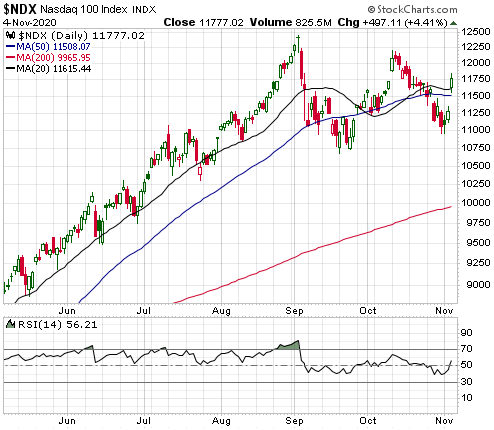
The mega-cap tech stocks represented by the
NASDAQ100 Index (NDX) were the big initial beneficiaries of the election.
As illustrated below, the NDX gained 4.4% on Wednesday 4th November.
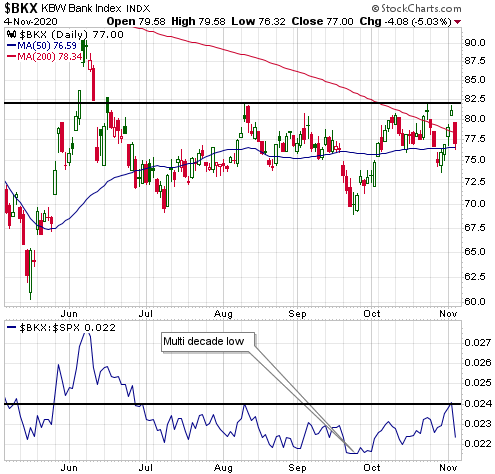
The biggest initial loser was the banking sector. Both the Bank Index
(BKX) and the BKX/SPX ratio rose sharply over the first two days of this
week and ended Tuesday's session at important lateral resistance levels,
meaning that they were poised for upside breakouts prior to any voting
results being published. This price action could have been due to
anticipation of a Trump victory, but whatever was being anticipated
clearly didn't happen because the BKX plunged in dollar terms and relative
to the SPX in response to the new information that became available on
Wednesday.
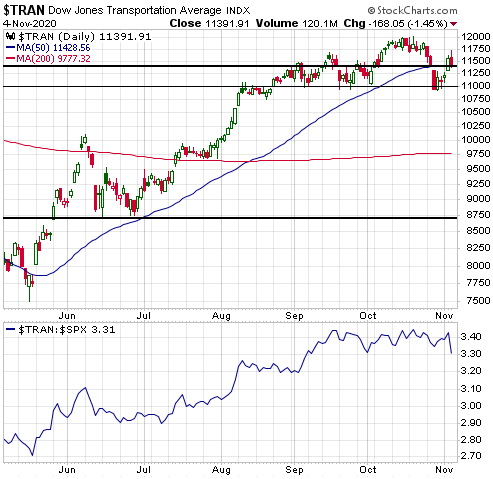
The transportation sector was also a loser in response to the initial
voting results. The Dow Transportation Average (TRAN) could be tracing out
a multi-month topping pattern.
It's possible that the US stock market has commenced a multi-week
post-election rally in line with the 1980 Model. If so then some stock
indices, including the SPX, the NDX and the NYSE Composite Index (NYA),
should trade above their September-October highs within the coming month.
However, if we get the "Scenario 4" election outcome then there would be a
high risk of the rally ending sooner/lower.
In our opinion, the
short-term risk/reward is neutral at best.
Gold and the Dollar
Gold
The
gold market was relatively calm over the first three days of this week in
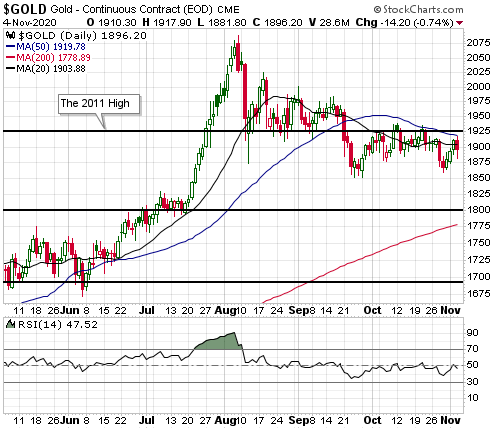
response to the US political news. As illustrated by the following daily
chart, the US$ gold price rebounded to the 50-day MA and then pulled back.
This leaves the chart pattern essentially unchanged since the end of last
week and leaves the door open to a correction-ending decline to $1800 or
lower.
The fundamental backdrop remains bullish for gold, but this could
change due to the reactions of the credit, equity and currency markets to
the election news.
Gold Stocks
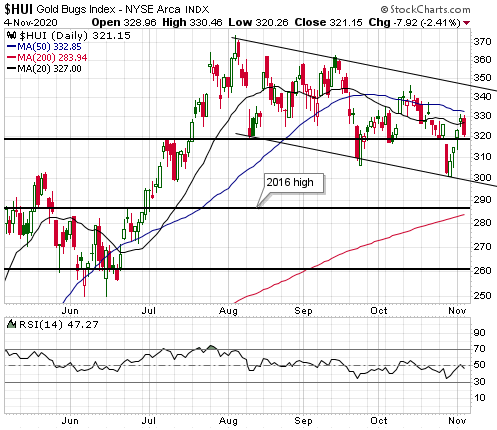
The HUI
gained 10% during the four trading days prior to Wednesday 4th November
and then pulled back on Wednesday. It possibly has just made the third in
a sequence of declining tops since the early-August peak.
The HUI/gold ratio tested its 40-day MA on Tuesday and then pulled
back on Wednesday.
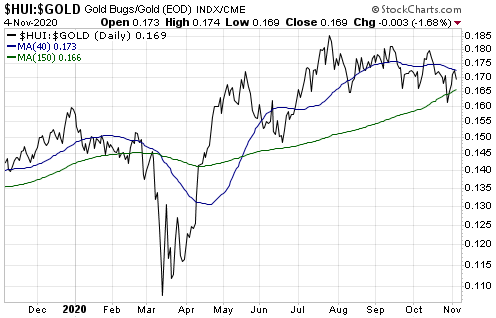
There is no evidence in the above charts that the multi-month
correction is over, so the prudent assumption is that it's not over.
A daily close by the HUI/gold ratio above its 40-day MA would be
preliminary evidence that the correction is over. Stronger evidence would
be a daily close by the HUI/gold ratio above its 40-day MA in addition to
a daily close by the HUI above its October high (347).
As things
stand today, a correction-ending decline that pushes the HUI down at least
as far as the 280s and possibly as far as 260 is the most likely near-term
outcome. That would, we think, set the stage for a 3-6 month rally to well
above the August high.
The Currency Market
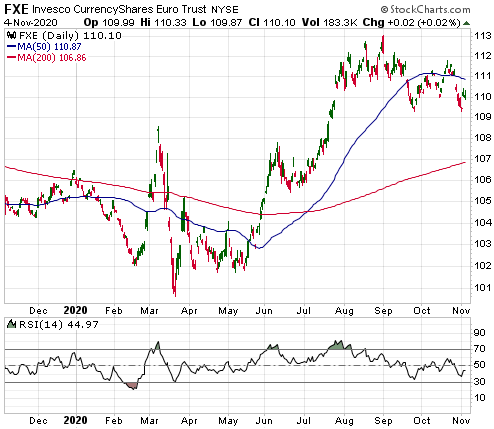
Like gold, the euro remains in correction mode. As illustrated below, the
CurrencyShares Euro Trust (FXE), an NYSE-traded ETF that tracks the euro
relative to the US$, peaked on the first trading day of September. It
declined to an initial bottom on 25th September, rebounded to a lower high
and then dropped to test its September low. Note that the 25th September
intra-day low and the 2nd November intra-day low were identical at 109.32.
Breaking below 109.32 would suggest that FXE was on its way to
106-108, which is our target for a correction low.
Updates on Stock Selections
Notes: To review the complete list of current TSI stock selections, logon at
http://www.speculative-investor.com/new/market_logon.asp
and then click on "Stock Selections" in the menu. When at the Stock
Selections page, click on a stock's symbol to bring-up an archive of
our comments on the stock in question.
 Revisiting
Goldmoney Inc. (XAU.TO). Shares: 78M issued, 79M fully diluted. Recent
price: C$2.18
Revisiting
Goldmoney Inc. (XAU.TO). Shares: 78M issued, 79M fully diluted. Recent
price: C$2.18
Goldmoney (XAU.TO) originally was called
BitGold and first began trading on the stock market in 2015. We wrote
about the company four times at the TSI Blog during 2015-2016 (HERE,
HERE,
HERE, and
HERE). The general theme of these writeups was: The company has a
great product, but the stock is wildly overpriced.
Here's how we
summed up the Goldmoney business in the last of the above-linked blog
posts:
"From the perspective of a Goldmoney user, the business
is great. Customers can store gold, use gold as a medium of exchange and
even take delivery of physical gold in manageable quantities, all at a low
(or no) cost. From the perspective of a Goldmoney shareholder, however,
the business is not so great. Of particular significance, unlike a mutual
fund that charges a fee based on AUM (Assets Under Management), Goldmoney
charges nothing to store its customers' assets (gold bullion). This means
that the larger the amount of Goldmoney's AUM, the greater the net cost to
the owners of the business (Goldmoney's shareholders).
It's
important that under the current fee structure, Goldmoney will generally
lose money on customers who use the service primarily for store-of-value
purposes. This is where PayPal has a big advantage over Goldmoney. Nobody
views their PayPal account as a long-term store of value. Instead, they
view it as short-term parking for money to be spent, and when the money is
spent PayPal usually gets a commission. This results in PayPal being very
profitable, with earnings of US$1.2B (US$1.00/share) in 2015. Many of
Goldmoney's customers, however, view the service as a convenient way to
store their physical gold. They don't want to spend their gold, they want
to save it.
Based on what I've seen to date I continue to believe
that Goldmoney offers a great product, but is operating an inherently
low-margin business deserving of a low valuation. Use the service, but
don't buy the stock."
Since 2016 the company has grown a lot,
mainly by acquiring similar or related businesses. Most importantly, it
has modified its business model and now generates revenue/earnings from
precious metals storage and lending. The fee structure is outlined
HERE.
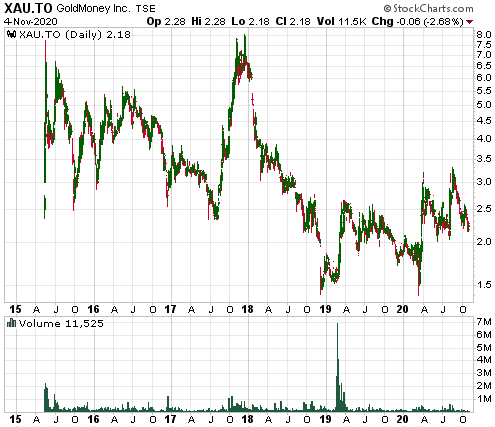
Over the same period the share price has trended down from highs of
C$8.00 in 2015 and 2017 to a current level of C$2.18. Incredibly, the
fundamental value of an XAU share is higher today with the stock trading
near C$2 than it was in 2015-2017 when speculative fervour briefly caused
the shares to trade as high as C$8.
Goldmoney Inc. now owns/operates two precious metals businesses called
Goldmoney.com and Schiff Gold. Revenue for these businesses is earned as a
weight of precious metal each time a client buys, sells, exchanges, takes
delivery or stores precious metals through one of these businesses. Also,
Goldmoney owns 37% of a jewellery manufacturer called Mene Inc. (MENE.V)
and earns interest (in precious metals form) through the lending of
precious metals to Mene. Lastly, Goldmoney owns/operates a company called
Lend & Borrow Trust (LBT) that generates income by making fiat currency
loans that are fully secured by precious metals.
The bulk of XAU's
earnings is in the form of precious metals that accumulate on the balance
sheet. Furthermore, balance sheet assets not allocated to current working
capital, investments and intangible assets are used to purchase and hold
physical precious metals, the idea being that XAU's holdings of gold,
silver, platinum and palladium ounces will grow steadily over time.
With a Goldmoney account it is easy to buy and sell physical precious
metals (PMs) at very competitive bid-ask spreads, with the PMs stored in
secure vaults on an allocated basis (each client has ownership of specific
pieces of metal). Also, it is possible to take delivery of your metal.
Therefore, it could make sense to build up direct ownership of PMs via a
Goldmoney.com account.
Alternatively, as long as the shares are
purchased when they are trading near book value (BV), owning XAU shares is
a reasonable way to build up indirect ownership of PMs. Owning the shares
has the added advantage that if the company is well-managed then the
amount of physical metal per share will increase over time.
The
current BV is C$2.28/share including goodwill and C$1.79/share excluding
goodwill. We think the latter number is the more relevant and therefore
that the shares would be very attractive for long-term investment purposes
at around C$1.80. However, the current premium to the C$1.79/share BV is
not excessive, so if you are interested in XAU then it could make sense to
take an initial position near the current market price of C$2.18.
We will add XAU to the TSI Stocks List as a long-term position if it drops
to around C$1.80.
Chart Sources
Charts appearing in today's commentary
are courtesy of:
https://stockcharts.com/