|
- 04 December, 2002
Overview
From the latest Weekly Update: "It
would make the most sense, based on the current fundamental backdrop, if
gold stocks held support and began to rally, thus signaling the end of
the Dollar's counter-trend rebound and projecting an upside breakout by
the CRB Index and a downside breakout by bonds. But whatever happens we
expect gold stocks to provide the early warning signal because gold is
likely to move in advance of breakouts in the CRB Index and the Dollar,
and gold stocks are likely to move in advance of gold."
The action so far this week has been
almost perfect with gold stocks having begun to rally and the US$ showing
signs of rolling over. The strength in gold and gold stocks also provides
some confirmation of the recent downturn in the US stock market.
Where's
the deflation?
WIf we define deflation correctly,
that is, if we define it as a decrease in the total supply of money and
credit, then there clearly isn't any deflation. The total US money supply
has been growing at a rapid rate for several years and has risen by around
7% over the past 12 months. There is, though, a legitimate concern that
the massive debt burdens being carried by US consumers and corporations,
plus the huge over-capacity in some sectors of the economy (the telecommunications
industry being a prime example), plus the wobbling economic recovery, will
lead to more defaults and bankruptcies. Contrary to popular opinion a debt
default doesn't result in a decrease in the supply of money (when someone
defaults on a debt the lender's net worth takes a hit, but the money that
was originally loaned still exists somewhere in the economy). However,
if defaults are widespread and sizeable then the ability and the desire
of lenders to make additional loans will diminish. As such, widespread
debt defaults will likely, at some point in the future, lead to less lending/borrowing
and therefore slower money supply growth (or perhaps even money supply
contraction, that is, genuine deflation). But, it is blatantly obvious
that we haven't yet reached that point because the total supply of US dollars
grew at an annualised rate of 26% over the most recent 6-week period. Furthermore,
with the Fed having recently proclaimed its willingness to monetise anything
and everything in order to devalue the dollar by increasing its supply
should prices start to fall, the possibility of the US experiencing deflation
at any time over the next 12 months is remote. Actually, there isn't much
chance that the US will experience deflation between now and when
inflation is perceived to be an enormous problem (once the
financial markets start to discount a high US$ inflation rate the Fed will
no longer be free to inflate to its heart's content).
Even if we define deflation incorrectly,
that is, even if we accept the government-sponsored definition that deflation
is a reduction in the price of some arbitrarily-selected hedonically-adjusted
basket of goods and services, there still isn't any deflation. The CPI
has risen at an annualised rate of 2.7% since the beginning of this year
and is likely to finish the year with a gain of around 3%. Of course, if
we remove some of the more troublesome items (the ones that have gone up
in price the most) from our basket of goods and services, as is the common
ploy, we would end up with a lower positive number (in the same way that
the S&P500 Index would be lower if we decided to omit some of the best-performing
stocks from its calculation). But where's the logic in that?
Prices have risen this year, but what
about next year? Well, according to the Future Inflation Gauge calculated
by the Economic Cycle Research Institute (http://www.speculative-investor.com/FIG_fed.htm)
next year's increase in the CPI is going to be greater than this year's.
So, where's the deflation?
The Fed, by the way, has recently signaled
its intention to fight a fall in prices, not its intention to fight deflation.
An effect of deflation is lower prices, but prices can fall for reasons
other than deflation. For example, becoming more productive or importing
more cheap products from China would put downward pressure on prices, but
these price suppressants have nothing to do with deflation. However, regardless
of what causes prices to fall (assuming they fall at all, which
we seriously doubt), the Fed has threatened to offset any fall in
the general price level by depreciating the US$. This is not an empty threat
since the Fed has the power to make the US$ so worthless that it ceases
to circulate as currency. Clearly, the Fed will want to stop the devaluation
well before the US$ becomes completely worthless.
With the Fed having recently come out
so strongly against deflation and reminded us of its enormous power in
the field of currency depreciation, when the effects of inflation become
more obvious (as they no doubt will over the coming 12 months) will the
Fed be congratulated for having saved us from the deflation bogey? Will
Alan Greenspan receive a medal of honor, to go with his knighthood, as
a tribute to his courageous efforts in what will almost certainly appear
to be a very successful war against deflation? If so, it really would be
a public relations coup on his part because the leader of a major central
bank has never before been commended for destroying the purchasing power
of the national currency.
Finally, the Fed's threat to devalue
the dollar might not be an empty one, but its threat to peg long-term interest
rates at artificially-low levels is (in recent speeches both Fed Governor
Bernanke and Fed Chairman Greenspan have mentioned the possibility of the
Fed buying whatever amount of long-term debt it needed to buy to keep long-term
interest rates at some pre-determined low level). If the US$ was being
devalued and the Fed had committed to keep the yields on 10-year bonds
from rising above, say, 2%, who else besides the Fed would be a buyer of
bonds? Anyone who bought bonds under such circumstances would be accepting
a guaranteed loss, in real terms. If the Fed decided to peg long-term interest
rates well below levels that would otherwise be set by the market then
there would be a mass exodus from the US credit markets and a collapse
in the US dollar's exchange rate. Unless, of course, all the other major
central banks were implementing a similar strategy in which case there
would be panic buying of gold and other hard assets.
The US
Stock Market
Current Market Situation
From the latest Weekly Update: "One
thing we will be watching closely is how sentiment indicators respond to
a pullback. If this rally is going to extend into January then any modest
pullback during the first half of December should be greeted with a sharp
increase in fear."
The current pullback, although only
a few days old, is already generating considerable fear judging by the
behaviour of put/call ratios, volatility indices and the Arms Index. For
example, the equity put/call ratio was around 0.8 on each of the past 2
days (a high level indicative of fear) and on Wednesday the volume of QQQ
put options traded was the highest we can ever recall seeing. Also, the
NASDAQ Arms Index was 3.98 on Wednesday, an extremely high level suggestive
of panic selling. The fact that these signs of fear are appearing with
the indices so close to their highs is bullish. It also shows how nervous
traders are with regard to the geopolitical situation (there is clearly
a lot of concern that a war against Iraq is imminent).
One possibility is that the rally that
began on 10th October is close to a peak, but that an extended period of
back-and-forth trading action will occur before the stock indices decline
in earnest. If the story did unfold in this manner it would be similar
to what happened between December 2001 and March 2002.
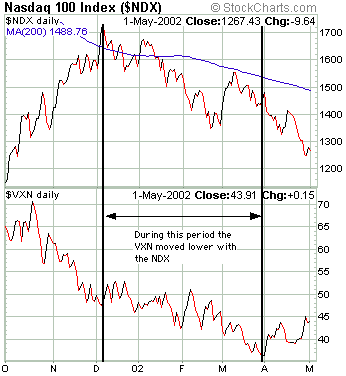
Below is a chart showing the NASDAQ100
Index (NDX) and the NASDAQ100 Volatility Index (VXN) between October-2001
and April-2002. Notice that the NDX peaked in early-December of 2001 when
the VXN was around 50. Over the next few months the NDX drifted lower while
the VXN also moved lower. Normally, a falling NDX would be accompanied
by a rising VXN because falling prices usually generate fear. The fact
that the level of fear, as represented by the VXN, dissipated during the
first quarter of 2002 even as the NDX trended lower was something we identified
at the time as being a very bearish omen for the market. The reduction
in volatility during this period probably resulted from the greater strength
being shown by some of the other major stock indices, such as the Dow Industrials,
and a steady flow of good economic news.
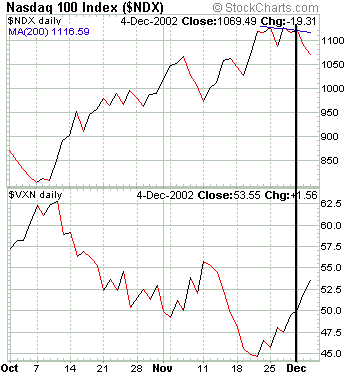
Below is a chart showing the NDX and
the VXN since the beginning of October this year. As was the case last
year, the NDX peaked in early-December with the VXN at around the 50 level.
Notice, though, that the VXN has moved up sharply over the past 2 weeks
while the NDX has suffered only a modest decline. With the VXN rising at
a faster rate than the NDX is falling it is unlikely that a major decline
is about to occur.
Just because sentiment is quickly turning
bearish doesn't mean the market won't experience a sharp fall over the
next few weeks. In fact, the strength in gold stocks over the past 2 trading
days has increased the probability that we will see a sharp move lower.
It does, however, mean that we are most likely not in the early stages
of a decline that will extend for several months and that we will, therefore,
need to be on guard for an opportunity to make an early exit from the bearish
positions previously recommended.
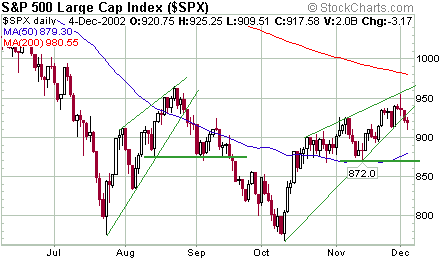
Lastly, below is a chart of the S&P500
Index on which we've drawn lines to indicate some emerging similarities
between the current market action and the July-September market action.
The S&P500 has broken below trend-line support, but until proven otherwise
this decline should be considered as being a correction within a continuing
uptrend. A close below the November low (872) would prove it to be otherwise.
Gold and
the Dollar
Gold Stocks
We spend more time looking at charts
of the HUI than at charts of the XAU because the XAU is dominated by the
stocks of heavily-hedged gold mining companies and therefore tends to be
a poorer representation of the real trend in the gold sector. However,
right now we are going to focus on the XAU because the XAU is currently
much closer to achieving an important upside breakout than is the HUI.
The below chart of the XAU shows that
a very bullish setup has developed. Firstly, the XAU has broken decisively
above the short-term downtrend that began in early-November. Secondly,
the rally over the past few days clearly defines the late-November low
as the third low in a sequence of ascending lows. This is a pattern that
is followed, more often than not, by an upward surge. Thirdly, the index
closed right at its intermediate-term downtrend line on Wednesday. Therefore,
any further strength from here will result in an upside breakout that should,
in turn, be followed by a substantial up-move. Sometimes a market will
set itself up to make a large move in one direction or another, but nothing
will actually happen. So, until the intermediate-term downtrend line is
broken the setup is simply that - a setup.

The bullish setup discussed above will
remain in place unless the XAU falls below last week's low (around 61).
A pullback beginning now and lasting a few days would not be a concern
provided that last week's low is not breached.
In last week's Interim Update we said:
"With the major gold stocks and the gold stock indices so close to important
support, now is a good time to be doing some buying. This is not because
the risk is low, but because the close proximity to support allows risk
to be well managed using sell stops. At the same time, the potential rewards
are great if support does hold. For example, a reasonable approach would
be to buy HMY at around Wednesday's closing price of $12.47 and set a sell-stop
at $11.95. If the stop is hit then the loss on the trade would be about
4%, but if support holds then the percentage gains could be substantial."
Although HMY has gained about $2 over
the past few days, for anyone who buys now the potential for large gains
still exists if gold stocks do break their intermediate-term downtrends.
This risk, however, is now significantly greater than it was at this time
last week. This is because prices have moved up quite sharply but major
support remains at around the same levels. So, whereas a trader who bought
HMY last week would have known that he/she had made a wrong move if the
stock had subsequently declined by only 4%, it would now take a 17% decline
(based on Wednesday's closing price) to confirm the 'wrongness' of the
trade.
In general, when you get the opportunity
to buy in a bull market near major support you should always take that
opportunity. In most cases the support will hold and in those cases when
it doesn't you will usually be able to exit with a small loss. Doing so,
however, requires both conviction and discipline - conviction in the major
trend and discipline to override the fear that most of us feel when we
buy an investment at a time when that investment is unloved. It always
feels much easier to buy after prices have been rising for a while and
bullish sentiment is prevalent, but the natural desire to run with the
herd will, if not curbed, result in losses over the long-term.
Any new buying at this time should
be focussed on the junior gold stocks. Some examples are:
Cumberland Resources (TSX: CBD) at
around C$2.00. The CBD stock price has recently been under pressure because
it is in the process of issuing 2.5M new shares. The new equity issue should
be completed this month.
American Bonanza (TSX: BZA) at C$0.17
or lower.
Red Back Mining (ASX: RBK). At current
prices (RBK is trading at A$0.30 as we write) RBK is our favourite amongst
the Australian gold stocks. The market is presently valuing RBK's gold
resources at around US$8/ounce.
The Dollar
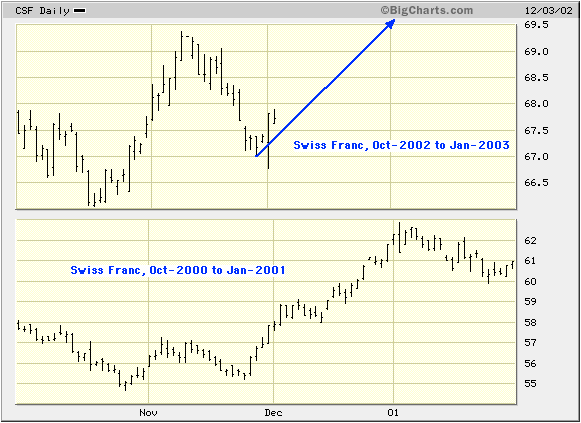
Below is a chart comparing Swiss Franc
futures from 1st October 2000 to 31st January 2001 with the Swiss Franc
since 1st October of this year. In 2000 the SF bottomed towards the end
of October, rallied to a short-term peak during the first half of November,
fell to a higher low towards the end of November, then surged to a peak
in early January. This year the SF bottomed towards the end of October,
rallied to a short-term peak during the first half of November, and appears
to have made a higher low towards the end of November. If the similarities
continue the SF will now surge to an important peak in early January. We
give this comparison some credence because, as discussed above, gold stocks
look set to move sharply higher over the coming month.
Below is a long-term chart of Yen futures
(the line on the chart rises when the Yen strengthens against the US$).
Since making a blow-off peak in 1995 the Yen has consolidated in the form
of a huge contracting triangle. Our view at the start of this year was
that 2002 would be an 'up' year for the Yen but that the Yen would eventually
move much lower. In other words, we thought that this year's rally would
be a counter-trend move within a long-term bear market. A break above the
post-1995 downtrend shown on this chart would, however, force us to change
our long-term view on the Yen relative to the US$.
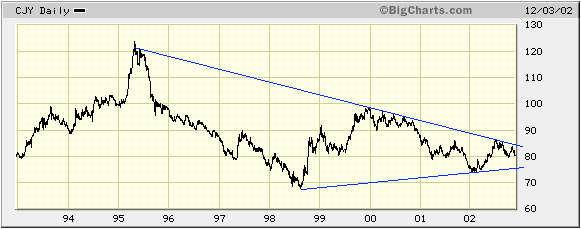
The Yen must break out, one way or
the other, within the next 12 months. If it breaks up then this would suggest
that the US Fed was going to outdo the Bank of Japan in the inflation race.
An upside breakout on the above chart would therefore not be indicative
of Yen strength but would, instead, imply that the Yen was going to be
less weak than the US$. Both currencies would likely fall relative
to gold, but the Yen would fall at a slower rate than the US$.
The current situation really is absurd.
We've recently had the Fed threatening to perpetrate a massive devaluation
of the US$ and earlier this week we had a senior Japanese monetary official
talking about the need for the Yen to move much lower. At this stage the
market is more inclined to believe the Japanese than the Americans (the
market has more faith in Japan's commitment to a weaker Yen than in the
US' commitment to a weaker Dollar). This is probably because most people
are far more bullish on the US economy than on the Japanese economy and
because it is difficult to believe that the exchange rate policy that has
served the US so well over the past 7 years is now being discarded. However,
beliefs might change over the next 6 months.
Update
on Stock Selections
Chesapeake Energy (CHK) dropped by
almost 5% on Wednesday after the company announced a major acquisition
of additional gas reserves and production. When the announcement was made
the market anticipated that CHK would need to issue more equity and/or
debt to fund the acquisition. This proved to be a correct assessment because
after the close of trading CHK reported that it was going to issue 20M
new shares and $150M in new debt.
Anyone planning to buy CHK should wait
until the market has digested this latest news. A drop to around $6 (a
level where there was a lot of insider buying in September) would present
another good opportunity for investors to buy CHK, although we doubt that
it will fall that far. Note that the acquisition announced yesterday increases
CHK's leverage to the natural gas price and the leverage in its balance
sheet, meaning that the stock now has greater upside and downside risk.
Chart Sources
Charts used in today's commentary were
taken from the following web sites:
http://stockcharts.com/index.html
http://www.decisionpoint.com/
http://bigcharts.marketwatch.com/

|









