|
- 05 February, 2003
Why people
fail to make money in bull markets
The average stock market investor conspires
with his/her inner self to avoid making much money in a bull market. Here
are some of the ways people manage to trip themselves up.
1. Trying to get rich quick
Very few people who set out to get
rich quick in the stock market actually become rich and the small minority
that do succeed do so purely as a result of chance (and will therefore
probably not keep their riches for long). This is because trying to get
rich quickly causes people to take on too much risk, either via excessive
leverage or by investing too much money in one particular trade/investment.
In other words, people who are in a hurry to make a lot of money tend not
to do a good job of managing risk.
Managing risk involves focusing more
on the potential downside of a trade/investment than the potential upside
and having an objective method to limit draw-downs in the value of your
portfolio. If you do not do a good job of managing risk you will almost
certainly lose money over the long-term even if probability is on your
side, that is, even if you are buying during a bull market. For example,
if you continually bet everything you have on a trade in which the probability
of success is 90% you will eventually lose everything. Sure, you will most
likely look like a genius for a while, but the one out of every ten trades
that happens to be a 'loser' will wipe you out.
2. Watching stock prices too closely
The people who make the most money
in a major bull market are the ones who don't pay much attention to the
daily, weekly, or even monthly price fluctuations. The best course of action
for most people is to keep the big picture in mind at all times, observe
the short-term volatility with detached amusement, and take advantage of
the periodic buying opportunities that occur when those who are influenced
by the short-term swings in the market 'puke up' their shares.
We get the impression that a lot of
people these days - people who are not professional stock traders - follow
the hour-by-hour or even the minute-by-minute price fluctuations of the
stocks they own. But by doing so these people are only increasing the probability
that they will make a buy/sell decision based on an emotional reaction
to a price change, that is, they are increasing the probability of failure.
3. Trend-following
The 'investing public' is, by nature,
a trend follower. By this we mean that it typically does most of its buying
after prices have already gone up a lot and ends up doing the bulk of its
selling after prices have already fallen by a long way. This is, of course,
the opposite of what it should do.
Peter Lynch, one of the most successful
mutual fund managers of all time, has said that the majority of people
who invested in his fund didn't make money even though the fund's average
annual return over many years was excellent. This is because people would
often buy into the fund after a period during which large returns had been
achieved and then sell after the fund had experienced a brief period of
poor performance.
Further to the above, all the talk
during the 1990s equity bull market about the public 'buying the dips'
was rubbish. Most of the public's money went into the market during those
periods when prices were at their least attractive levels, for example,
during the first quarter of 2000.
In a bull market, buying the dips is
the right approach. It is, however, difficult to do because it involves
going against the trend-following urges that are inherent in most
of us. Correspondingly, waiting for prices to move substantially higher
(when everything appears to be rosy) before buying is an ill-conceived
approach that will result in losses, or mediocre gains at best, even in
a bull market. During a secular bull market prices will continue to make
higher-highs so those who prefer to buy when everything looks rosy might
still be fortunate enough to get bailed out by the longer-term trend. But,
the greatest gains will be achieved by those investors who have enough
understanding of the big picture and enough courage to fade the periodic
sharp sell-offs that happen during bull markets.
The US
Stock Market
Current Market Situation
From a short-term perspective stock
market sentiment is very fearful right now. For example, the equity put/call
ratio was greater than 1 on both Monday and Wednesday of this week, despite
the fact that the market did not suffer a large loss on either day (the
market actually rose on Monday). This is unusual (an equity put/call ratio
of greater than 1 will typically only occur after the market has plunged
for several days in a row). However, a major rally can't occur because
everyone is still 'long' and mutual fund cash levels are very low (they
are now down to 4.4%). That is, there is no buying power waiting to be
released. It appears that the only fear in the market greater than the
fear of losing money in the next major decline is the fear of missing the
next bull market.
Regardless of the 'oversold' extremes
being seen in some of the sentiment indicators, we think the next sharp
move in the market will be to the downside. This is based on our interpretation
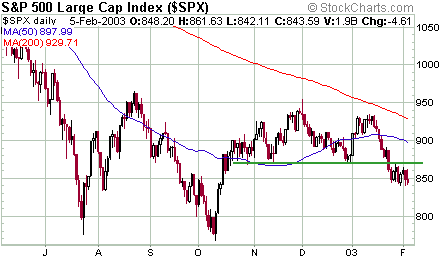
of price action. For example, after breaking below support at 870 the S&P500
has traded sideways (see chart below). Whenever a market declines sharply
over a few weeks and then enters a sideways consolidation, the next big
move is usually to the downside.
Also, on Tuesday the NASDAQ Composite
finally closed below support defined by its November pullback low. It tried
to move back above this support (now resistance) on Wednesday but was unable
to do so.
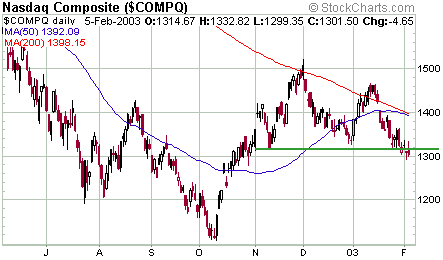
Both the S&P500 Index and the NASDAQ
Composite Index appear to be on their way to last October's lows.
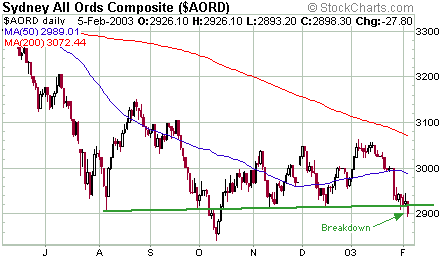
By the way, the Australian stock market
broke below important support on Tuesday (see chart below) and followed
up that breakdown with another 30-point fall today (not shown on the chart).
After today's fall the Aussie market is now precariously positioned within
a few points of its October low. In fact, most of the major stock markets
of the world are currently poised at, or just above, their respective lows
from last October. New bear market lows are likely to occur this month.
Gold and
the Dollar
Gold versus Gold Stocks
Most gold stock investors (including
us) have been surprised by the lack of response of gold stock prices to
the recent surge in the gold price. Actually, what has really surprised
us wasn't the general lack of response by the gold stocks, but the lack
of response by the stocks of those companies that had good leverage to
the spot gold price and were reasonably valued prior to the run-up in the
gold price. Prior to the recent gold rally the stocks of some of the popular
large and mid-size North American gold producers (e.g., Goldcorp, Agnico
Eagle, Glamis Gold and Meridian Gold) were priced as though gold were already
trading at $450. It is therefore not difficult to explain why these stocks
wouldn't rocket higher in response to the gold price moving from $330 to
$380. However, in many cases the major gold producers with the greatest
leverage to the spot gold price have under-performed over the past 2 months.
Also, there has been minimal speculation in the shares of the junior gold
companies, the area of the market where the greatest leverage and the best
value can be found. Many of the juniors we follow have done very well over
the past 2 months, but nowhere near as well as we would have expected given
the performance of the gold price.
To gain some perspective on what is
happening let's now take a look at some charts showing the performance
of gold stocks relative to the gold price over different time frames.
The first chart shows the performance
of the AMEX Gold BUGS Index (HUI) relative to the gold price (London PM
Fix) since the beginning of 2002. Over this period the percentage gain
in the prices of unhedged gold stocks (as represented by the HUI) was more
than three times larger than the percentage gain in the gold price, so
gold stocks behaved exactly as they should have behaved. That is, they
behaved like leveraged plays on the gold price.
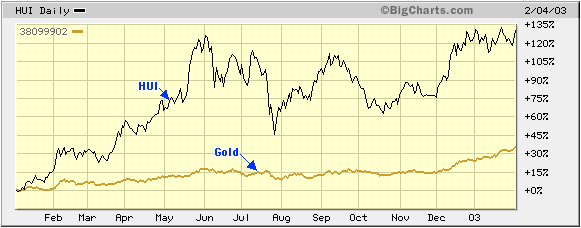
The next chart compares the performances
of the HUI and the gold price since the beginning of December last year.
Over this period the HUI out-performed the metal, but the out-performance
was clearly nowhere near as pronounced as it was over the past 13 months.
Furthermore, the last 10% gain in the gold price did not result in any
increase in the HUI.
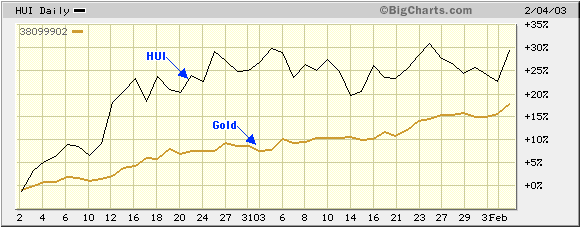
The above charts show that the leverage
being offered by gold stocks has reduced over the past few months. This,
of course, is something most gold stock investors would already be aware
of. This reduction in leverage over the recent past is at least partly
explained by the huge gains achieved by some gold stocks during the first
half of last year.
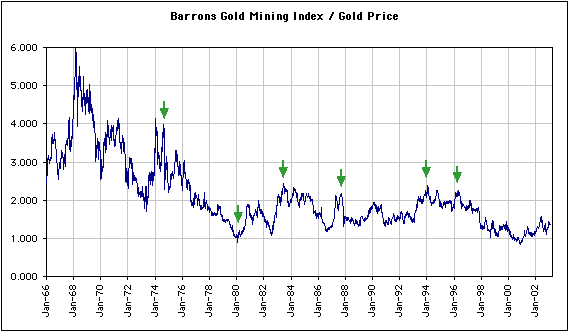
The final chart shows the ratio of
the Barrons Gold Mining Index (BGMI) and the gold price since January-1966
(the Barrons data is compliments of www.sharelynx.net and Mark L). This
chart illustrates that a) the long-term peak in the prices of gold stocks
relative to the gold price was achieved way back in 1968, b) the BGMI/gold
ratio trended lower throughout the gold bull market of the 1970s and bottomed
at the same time that the gold price was peaking in January of 1980, and
c) the BGMI/gold ratio has moved sideways since 1980.
The downtrend in the prices of gold
stocks relative to the gold price during the 1970s seems counter-intuitive
at first blush, but is simply a function of the massive rally in gold stocks
that occurred during the 1960s while the gold price was fixed at US$35/ounce.
Clearly, during the 1960s the financial markets began to discount the breaking
of the official gold-US$ link and the ensuing monetary chaos. Gold stocks
did extremely well during the 1970s, but they under-performed the gold
price because at least part of the eventual gains in the gold price had
already been factored into gold stock prices before the gold bull was unleashed.
On a much smaller scale a similar thing happened during the first half
of last year.
The green arrows on the above chart
point to the times that intermediate-term rallies in the gold price reached
a peak. It can be seen that all intermediate-term gold rallies, with the
exception of the 1977-1980 rally, ended following a surge in the prices
of gold stocks relative to the price of gold. Even during 1971-1975, when
gold stock prices were in a long-term downtrend relative to the gold price,
there was a sharp move higher in the BGMI/gold ratio before an intermediate-term
peak was reached.
The fact that the latest gold rally
hasn't yet resulted in a surge in the HUI relative to the gold price indicates
to us that we have not yet reached an intermediate-term peak. If the HUI
continues to be held back by the extremely high valuations of some of its
components then we would still expect to see rampant speculation in the
junior gold stocks before an important peak is reached, but speculation
in the juniors has been restrained up until now.
So, why have those stocks that are
reasonably valued and offer good leverage to the spot gold price not moved
much higher during the recent gold rally? The only explanation that really
makes sense to us is that many owners of gold stocks are fearful of a sharp
correction in the gold price and are constantly trying to sidestep such
a correction. The way the gold price has moved higher ? in almost a straight
line with no significant 'backing and filling' along the way ? would tend
to feed such fears because straight-line moves are rarely sustainable.
Excessive short-selling of gold shares
does not, by the way, appear to be a factor in the sluggish performance
of the gold sector. For example, below we list 10 of the largest (by market
cap) gold stocks and the change in the short interest for each stock during
the month of January. The total combined change in short interest across
these 10 stocks during January was -1.4M, that is, short-sellers were net
buyers
of gold stocks during January.
|
Stock Symbol
|
Change in Short Interest
|
ABX
AEM
AU
DROOY
GG
GLG
HMY
MDG
NEM
PDG
|
-0.8
0.0
0.0
0.0
0.8
0.7
-0.5
-1.0
-1.7
1.1
|
Current Market Situation
In the latest Weekly Update we mentioned
that the premium to its net asset value at which the Central Fund of Canada
(CEF) was trading was high, but at 21% it was still below where it was
when the gold price was peaking last May. However, on 4th February the
premium rose to 30.4%, well above the peak reached last May.
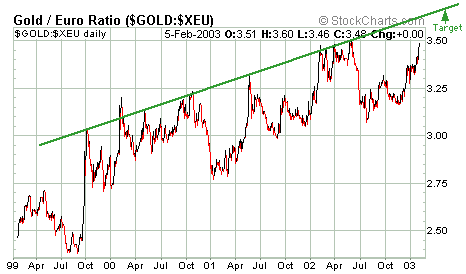
Below is a chart of the gold price
in terms of the euro. Yesterday's closing price for gold was still about
10-15 euros below the trend-line at which every significant gold rally
of the past 3 years has peaked, but during Asian trading on Wednesday the
price did move up to near the trend-line (gold briefly traded as high as
US$390, corresponding to about 360 euros, on Wednesday).
In the latest Weekly Update we cautioned
against doing any significant new buying in gold stocks because the risk/reward
ratio was no longer particularly attractive. This advice is even more applicable
now because, further to the above, the level of risk in the gold market
has just moved up a couple of notches. However, unless you have attempted
to leverage your gold stock gains by buying on margin or you have all of
your money invested in gold stocks (that is, you have no significant cash
position), this is not the time to be doing much selling. We might get
a sharp pullback in both the metal and the gold stocks, but as discussed
above the absence of a surge in gold stock prices over the past month suggests
that gold has not yet reached an intermediate-term peak. Furthermore, the
junior gold stocks we are interested in are still priced as though gold
were trading in the $325-$340 range, so there is no significant valuation
risk in these stocks.
If you have been trying to leverage
your gains in gold stocks by, for example, buying on margin, then you are
asking for trouble and should de-leverage immediately. Note that
this would be our advice even if we thought the gold price was going to
rise by $100 over the coming week.
For the newcomers who don't yet have
much exposure to the gold sector or, for that matter, anyone who doesn't
have much exposure to junior gold stocks, look for opportunities to buy
several of the high-potential juniors on weakness. For example, here are
a few suggestions with indicative buy levels:
Desert Sun Mining (TSXV: DSM) below
C$1.00
American Bonanza (TSXV: BZA) below
C$0.30
Red Back Mining (ASX: RBK) below A$0.38
Cumberland Resources (TSX: CBD) at
around C$2.60
Richmont Mines (AMEX: RIC) below US$3.60
Golden Star Resources (AMEX: GSS)
at around US$1.75
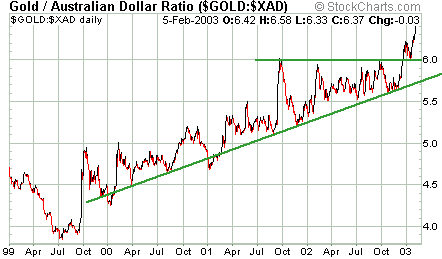
Gold is trending higher in terms of
all the major fiat currencies (with the possible exception of the Swiss
Franc). For example, below is a chart of the A$ gold price showing the
nice uptrend that began more than 3 years ago. The only problem with this
chart is that the current price is well above the long-term uptrend-line.
A better time to buy would be after the price has pulled back to near the
trend-line.
In last week's Interim Update we canceled
the short-term bearish view on the US$ that we'd maintained since 24th
January last year. There is a reasonable chance that the Dollar Index will
drop to the mid or even the low 90s at some point over the coming 2 months,
but the Dollar's short-term upside and downside risks are now close enough
to being in balance that holding a neutral view seems appropriate.
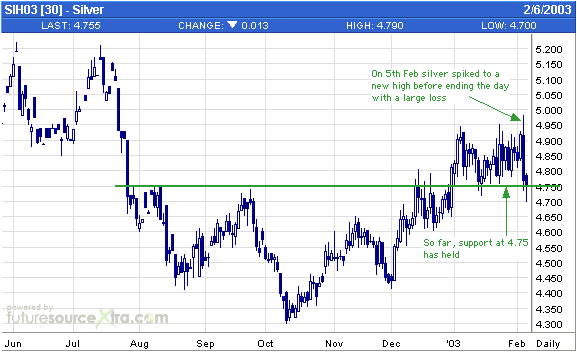
Below is a daily chart of March silver
futures. Once again silver has dropped to test critical support at around
4.75. It traded as low as 4.70 earlier today (the chart shows the drop
to 4.70), but at the time of writing it had recovered to around 4.76.
Update
on Stock Selections
 On
5th February Western Copper began trading on the AMEX under the symbol
WTZ. Also, if approved by shareholders at a meeting on 20th March the company
will change its name to Western Silver. We expect Western to ultimately
move much higher and from a technical perspective the stock looks quite
good, but it appears to be fully valued at around C$4.20 based on the current
silver price. On
5th February Western Copper began trading on the AMEX under the symbol
WTZ. Also, if approved by shareholders at a meeting on 20th March the company
will change its name to Western Silver. We expect Western to ultimately
move much higher and from a technical perspective the stock looks quite
good, but it appears to be fully valued at around C$4.20 based on the current
silver price.
We've
previously mentioned Wheaton River (AMEX: WHT, TSX: WRM) as a potential
future addition to the TSI Stocks List, but in the 27th January Weekly
Update said we'd wait until after the recent large acquisition and private
placement were complete before re-assessing the stock.
It looks like the recently announced
purchase by WRM of a 25% stake in the Alumbrera copper/gold mine in Argentina
and 100% of the Peak gold mine in Australia is going to proceed because
BHP is not going to exercise its pre-emptive right to buy the Alumbrera
stake being sold by Rio Tinto. Also, details have now been released regarding
the private placement of new shares being done by WRM to finance the acquisition.
After completion of the deal we calculate that Wheaton will have annual
revenue of around US$227M, based on current metals prices, with the following
split: 55% gold, 31% copper, 14% silver. It will have about 450M shares
outstanding, so assuming a stock price of US$1.00 it will be trading at
around 2-times annual sales. This is low for a gold producer (in the current
market) and high for a producer of industrial metals.
The huge private placement (230M new
shares will be issued) is probably going to keep pressure on WRM for a
while, but since we will be looking to increase our exposure to industrial
metals over the next few months it is a stock we'll keep on our radar screen.
There
are three tech/internet stocks (AVNX, CPTH and SPLN) that have been in
the TSI Stocks List for around 2 years but that we no longer follow closely.
We will therefore realise the large losses on these stocks (they will be
transferred from the Stocks List to the Historical Performance table).
MIM
Holdings (ASX: MIM) was stopped out earlier this week for a profit of 32%.
We will re-enter MIM if presented with a good opportunity (for example,
during a period of severe stock market weakness) over the next several
weeks.
Canyon
Resources (AMEX: CAU) is suitable for a small speculation below
US$1.30. As discussed previously, CAU is a gold company but buying CAU
is not a play on the gold price it is a play on the outcome of a court
case. If CAU eventually wins its legal battle with the State of Montana
and is permitted to proceed with development of the 10M ounce McDonald
deposit the CAU stock price would move to at least US$10 and perhaps as
high as $20.
Chart Sources
Charts appearing in today's commentary
are courtesy of:
http://stockcharts.com/index.html
http://bigcharts.marketwatch.com/
http://www.futuresource.com/

|









