- Interim Update 5th August 2020
Copyright
Reminder
The commentaries that appear at TSI
may not be distributed, in full or in part, without our written permission.
In particular, please note that the posting of extracts from TSI commentaries
at other web sites or providing links to TSI commentaries at other web
sites (for example, at discussion boards) without our written permission
is prohibited.
We reserve the right to immediately
terminate the subscription of any TSI subscriber who distributes the TSI
commentaries without our written permission.
An update on the
shortest US recession ever
Two months ago we wrote that the
National Bureau of Economic Research (NBER), the official arbiter of US
recessions, could determine that the 2020 recession was over by July,
making it the shortest US recession ever. We also wrote that there was so
much 'rot' in the economic foundations that the US economy would recover
only 80%-90% of what it lost during the first half of this year before
turning back down. A month ago we reiterated this view, adding: "...recent
economic data suggest that the 2020 recession may be even shorter than
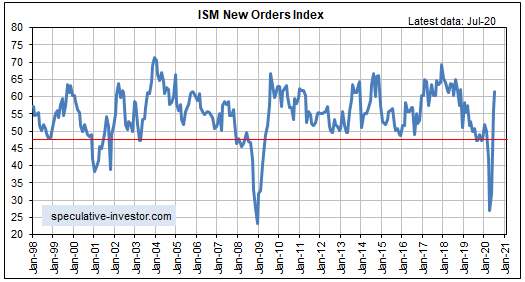
previously anticipated. Of particular relevance is the spectacular rise in
the ISM New Orders Index (NOI) illustrated by the chart displayed below.
After printing in the low-30s in May, the NOI rocketed up to the mid-50s
in June. This suggests that the recession has ended already."
The latest NOI was published on Monday of this week and provides more
evidence that the recession ended in June. As shown below, it continued
its rapid rise in July and has reached its highest level since
September-2018.
The US economy will continue to be propped up over the remainder of
this year by the Fed's money creation and the government's
deficit-spending, and we expect that it will be supported during at least
the first half of next year by a massive government-debt-financed
infrastructure spending program. From a policy-making perspective, the big
challenge will arrive after the consequences of having gone 'whole hog'
MMT start to include rapidly rising prices for the staples of life. This
will be the point when it becomes clear to the Fed's management that
"inflation" is a problem and that creating money out of nothing is no
longer providing even a short-term, superficial benefit.
Once the
aforementioned point is reached, creating more money achieves nothing
other than a higher cost of living (a lower standard of living for the
average person) and a general reduction in confidence. Unfortunately, the
way things are going the point could be reached as soon as the first half
of next year.
Global Monetary
Inflation Roundup
There was a veritable explosion
in monetary inflation rates throughout much of the world during March-June
of this year (June being the latest month for which there is complete
data). Displayed below are monthly charts that tell an important part of
the story.
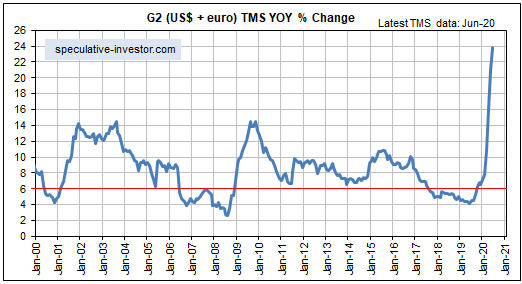
The first chart shows the combination of US and
euro-zone money supply that we call G2 True Money Supply (TMS). G2 TMS is
growing at a much faster pace than it ever has before, due more to what's
happening in the US than what's happening in the euro-zone (at 12.8%, the
euro-zone monetary inflation rate is only slightly more than one-third the
US monetary inflation rate). This currently is putting upward pressure on
both equity and commodity prices, but after bond yields commence rising
trends the upward pressure should shift such that it is more focused on
the commodity markets.
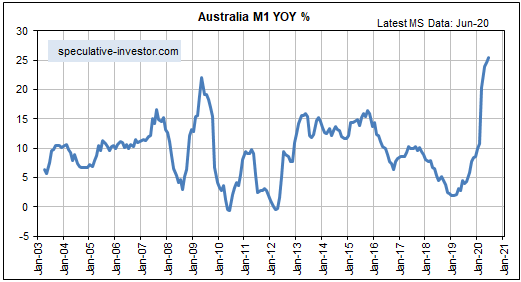
The year-over-year rate of growth in Australia's M1 money supply (in
this case a reasonable proxy for TMS) rocketed to 24% as part of the
immediate reaction to the "coronacrisis" and has since risen to around
25%. We have mentioned previously that this is not bearish for the A$
relative to other currencies, because the A$'s exchange rate is influenced
to a far greater extent by the commodity markets than by the local
monetary inflation rate. Due to the emerging multi-year bullish trend in
commodity prices, the A$ is set to become a lot stronger over the coming
1-2 years relative to most other currencies. However, the money-supply
surge suggests that the local prices of goods, services and assets will go
up a lot over the next few years.
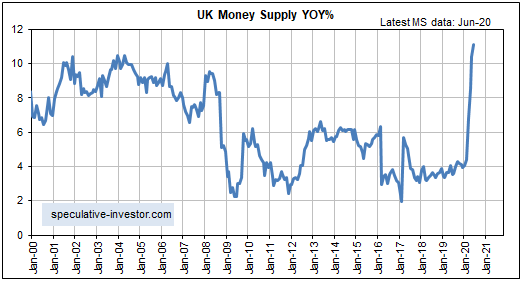
In monetary inflation terms the UK has followed the same path as many
other developed countries/regions over the past year, with a gradual
upturn during 2019 and a moon-shot over the past few months. But as is the
case with the euro-zone, the UK monetary inflation rate is only about
one-third the US monetary inflation rate.
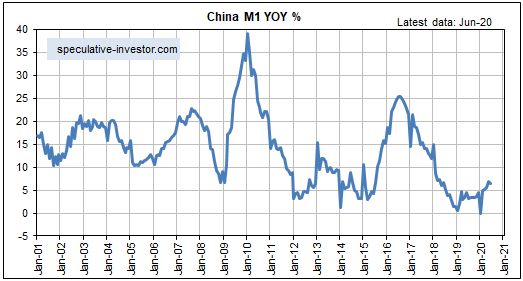
Lastly, it currently seems that whereas the US policy-making clique is
going further down the monetary rabbit-hole with each crisis, China's
equivalent is doing the opposite. As illustrated below, the year-over-year
rate of growth in China's M1 money supply hit a multi-decade low in
January of this year and remains within the bottom quintile of its
long-term range.
This could allow China's economy to emerge from
the current downturn in relatively good shape.
It is appropriate to end this section with the following excerpt from
Keynes' 1919 book "The Economic Consequences of the Peace".
"Lenin
is said to have declared that the best way to destroy the Capitalist
System was to debauch the currency. By a continuing process of inflation,
governments can confiscate, secretly and unobserved, an important part of
the wealth of their citizens. By this method they not only confiscate, but
they confiscate arbitrarily; and, while the process impoverishes many, it
actually enriches some. The sight of this arbitrary rearrangement of
riches strikes not only at security but [also] at confidence in the equity
of the existing distribution of wealth.
Those to whom the system
brings windfalls, beyond their deserts and even beyond their expectations
or desires, become "profiteers," who are the object of the hatred of the
bourgeoisie, whom the inflationism has impoverished, not less than of the
proletariat. As the inflation proceeds and the real value of the currency
fluctuates wildly from month to month, all permanent relations between
debtors and creditors, which form the ultimate foundation of capitalism,
become so utterly disordered as to be almost meaningless; and the process
of wealth-getting degenerates into a gamble and a lottery.
Lenin
was certainly right. There is no subtler, no surer means of overturning
the existing basis of society than to debauch the currency. The process
engages all the hidden forces of economic law on the side of destruction,
and does it in a manner which not one man in a million is able to
diagnose."
Commodities
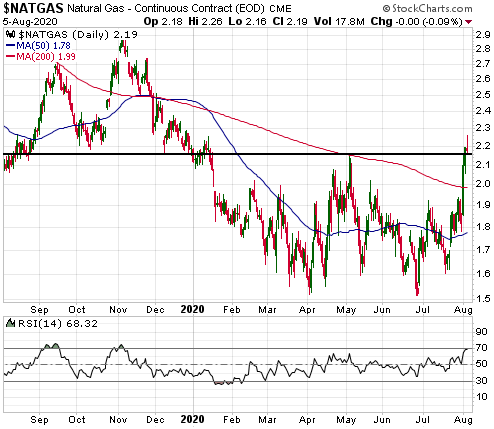
Natural Gas is close to confirming its double bottom
In the 1st July and 8th July Interim Updates we noted that the natural
gas (NG) price (basis: the continuous US futures contract) had reversed
upward after testing its April low, providing us with preliminary evidence
that a cycle low had been set via a double bottom. In our 8th July report
we wrote that a weekly close above the early-May high would be definitive
evidence that a cycle low was in place.
The following chart shows
that during the first half of this week there was sufficient strength in
the NG market to enable the continuous US NG futures contract to achieve a
daily close above is May high. If the gains hold through the end of the
week then we will have definitive evidence of a cycle low.
Peyto Exploration and Development (PEY.TO), a TSI stock selection, is
our preferred way to obtain intermediate-to-long-term exposure to NG. The
TSI List also contains Petrus Resources (PRQ.TO), which is a
high-risk/high-reward NG-related speculation, and Enable Midstream (ENBL),
which is a relatively low-risk NG-related play that offers a good income
yield. It could make sense for risk tolerant speculators to buy some PRQ
shares near the current price of C$0.14.
Industrial metals
are going to get a lot more expensive
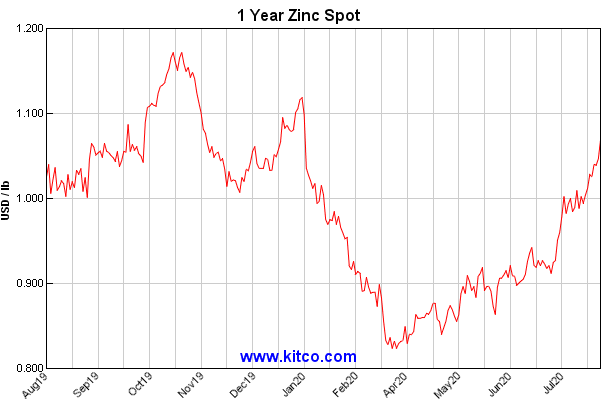
One by one,
commodity markets are signalling major upward reversals. Among the
industrial metals, first we had copper and now we have zinc showing signs
of life.
The zinc price hit a 4-year low in March and is now at a
6-month high.
The TSI List is a little overweight zinc-related plays. At the moment,
TSI stocks ADT.AX, NCZ.AX and TK.V all have zinc as their primary metal
exposure. ADT has already experienced a big upward re-rating in the stock
market and is a hold at its current price pending the release of the PFS
for its Vares project, but NCZ and TK are still candidates for new buying.
The Stock Market
The financial markets are
beginning to discount what's commonly called "stagflation". This has been
happening to some extent since April, but the discounting process appears
to be picking up steam. This is very much in line with our outlook,
although it could be happening faster than expected.
We had thought
that a definitive shift towards an environment involving slow/no economic
growth and rapidly rising commodity prices would wait until late this
year, with a pre-election correction involving US$ strength and
commodity-price weakness. While this remains our base-case scenario, it's
possible that enough speculators/investors can see what's coming that the
financial markets are leading the economic data by several months.
In the US stock market the important indices have been making small daily
moves with an upward bias for a few weeks now, which implies that
volatility has collapsed. This tells us nothing about the future, but it
does mean that at the close of trading on 5th August there was no evidence
that a correction had begun. Once a correction does begin, volatility will
pick up in a big way.
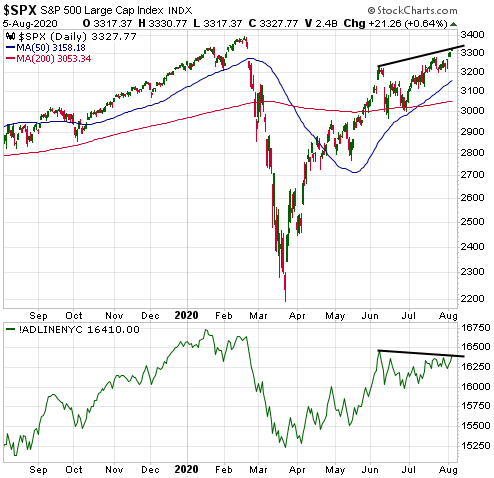
The first of the following daily charts shows
that the S&P500 Index (SPX) is getting close to its February-2020 all-time
high. It also shows that the bearish divergence between the SPX and the
NYSE Advance-Decline Line (ADL) remains in place, but note that it would
take only a small amount of strength from here to push the ADL above its
June high and remove the divergence.
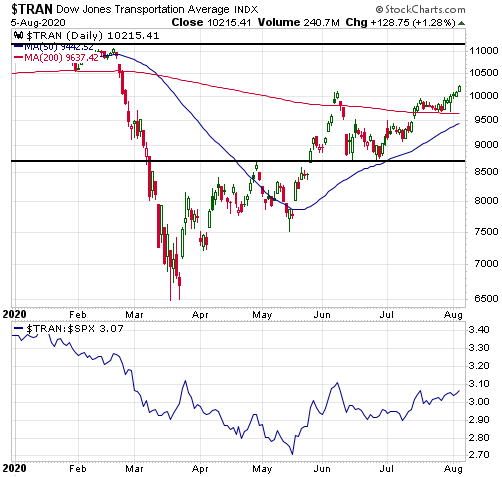
The second chart shows that
the Dow Transportation Average (TRAN), one of the biggest laggards of the
past year, has moved above its June-2020 high but is still about 10% below
its early-2020 high.
The SPX's short-term risk/reward remains lousy. It could chop around
at a high level for at least a few more weeks in response to an
intra-market rotation that favours one group of stocks one day and another
group the next (similar to what has been happening over the past few
weeks), but the other side of the equation is the risk of a quick 10%+
correction.
Gold and the Dollar
Gold
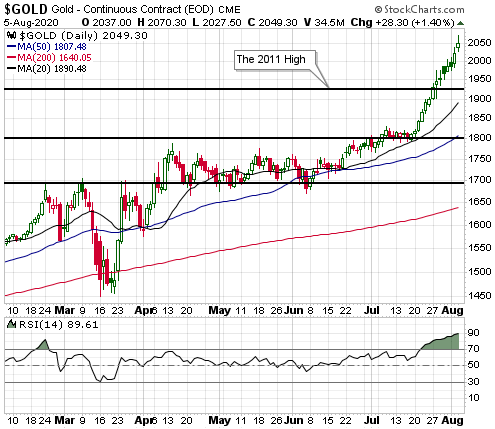
The
rise in the US$ gold price over the past 3 weeks doesn't have the look of
an upside blow-off, in that there have been no large single-day gains.
However, the relentless nature of the recent rise (the December gold
futures contract closed higher on 13 or the past 14 days and the sole down
day was only a $10 drop) has pushed the daily RSI(14) to its highest level
in more than 20 years.
The 14-day ramp to the upside added US$250
to the price and left the 2011 high in the dust.
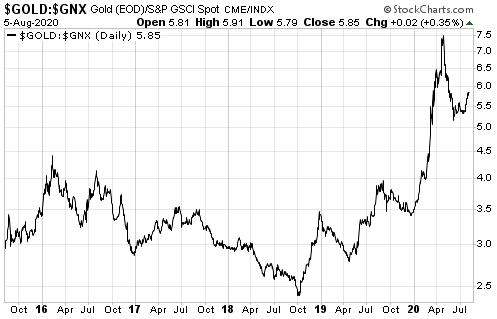
The post-April rise in the gold price is first and foremost about
currency depreciation. We know this because of the way the gold/commodity
ratio has performed.
The following chart shows that relative to the
S&P Spot Commodity Index (GNX), the gold price peaked in April and the
recent 14-day surge looks like a countertrend bounce. The implication is
that the entire commodity world has begun to discount the effects of using
a massive increase in the supply of money to counteract a massive
government-enforced decline in the production of real things. Naturally,
the 'real things' end up becoming a lot more expensive.
We continue to expect that the current short-term upward trend in the
US$ gold price will end by early September at the latest.
Silver
We suspected that the spectacular price action of
Tuesday 28th July created a multi-month price top for silver at $26.27.
This suspicion was wrong, however, because on Wednesday 5th August the
silver price made a new multi-year high and thus extended its short-term
upward trend.
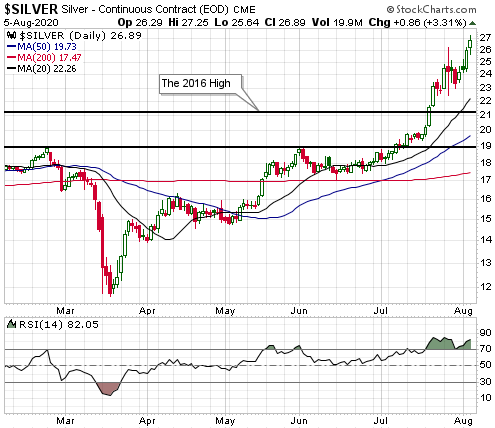
We are back to looking for a dramatic reversal day or a large
single-day decline to mark the top for the current silver rally.
Gold Stocks
From the latest Weekly Update:
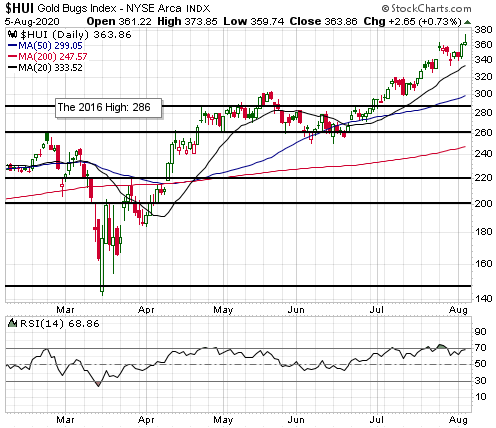
"If the HUI stays below last Monday's high for another 1-2 weeks and
also holds above its 20-day MA on a daily closing basis then the stage
will be set for a final surge to an early-September high, whereas a new
high as soon as this week would tip the scales in favour of an August top.
Also, note that a daily close below the 20-day MA at any time from here on
would be an early warning sign that a multi-month top was in place."
The price action over the past three days was a little confusing.
Despite the continuing ramp-up in the US$ gold price the HUI has been
unable to close above its 27th July intra-day high, but the HUI did trade
above its 27th July high on Wednesday 5th August. Therefore, it's not
certain if Wednesday's price action set a new high for the move.
In
any case, from here on it will be reasonable to assume that the short-term
upward trend is intact until the HUI ends a day below its 20-day MA. This
moving average currently is at 333 and is rising at the rate of about 3
points per day.
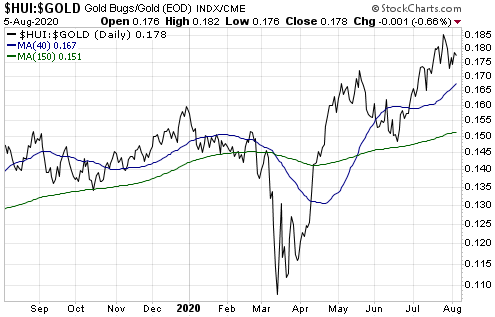
With reference to the following daily chart, note that the peak to
date for the HUI/gold ratio was set on 27th July. The recent weakness in
the HUI/gold ratio counts as only a minor divergence/non-confirmation at
this stage, but if it persists for another 1-2 weeks it will be important.
The Currency Market
The Dollar Index (DX)
declined over the first three days of this week. In doing so it has made a
new closing low for the year, but it is yet to close below or even trade
below last week's intra-day low. Therefore, it remains possible that a
short-term upward trend commenced last week. To eliminate this possibility
and extend the short-term downward trend the DX must close below 92.52.
Regardless of whether a rebound got underway last Friday following the
spike down to around 92.5 or instead gets underway at some point over the
next few weeks, there is now sufficient fuel in the form of anti-US$
speculations to push the DX up to resistance at around 98 within the next
two months. A rebound of that magnitude would have major consequences for
everything that has been going up in price in response to the weakening
dollar.
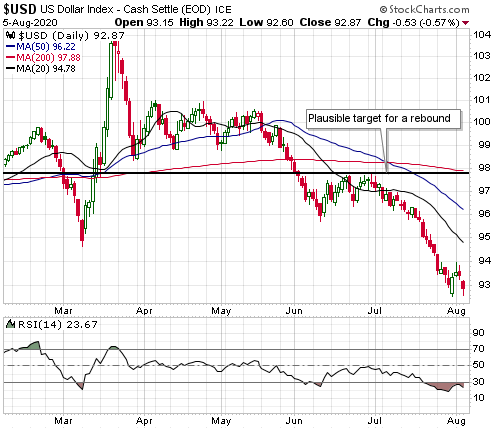
We emphasise that even a 5-point rally from here in the DX would be a
countertrend move within the context of a longer-term decline. This means
that short-term US$ strength should be welcomed as an opportunity to
increase exposure to commodities -- the asset class that should benefit
the most from US$ weakness over the coming year.
Also, we point
out that while a strong US$ rebound lasting 1-2 months probably will begin
soon, there is a risk that we will get nothing more than a 1-2 week bounce
in the US$ before its downward trend resumes. In this case there could be
premature blow-offs to the upside in commodities such as copper and oil.
This is why core commodity-related exposure should be kept in place and
not exited in anticipation of a short-term correction.
Updates on Stock Selections
Notes: 1) To review the complete list of current TSI stock selections, logon at
http://www.speculative-investor.com/new/market_logon.asp
and then click on "Stock Selections" in the menu. When at the Stock
Selections page, click on a stock's symbol to bring-up an archive of
our comments on the stock in question. 2) The Small Stock Watch List is
located at http://www.speculative-investor.com/new/smallstockwatch.html
Chart Sources
Charts appearing in today's commentary
are courtesy of:
https://stockcharts.com/
http://www.kitcometals.com/