|
- Interim Update 5th September 2012
Copyright
Reminder
The commentaries that appear at TSI
may not be distributed, in full or in part, without our written permission.
In particular, please note that the posting of extracts from TSI commentaries
at other web sites or providing links to TSI commentaries at other web
sites (for example, at discussion boards) without our written permission
is prohibited.
We reserve the right to immediately
terminate the subscription of any TSI subscriber who distributes the TSI
commentaries without our written permission.
More
evidence of a US recession
The latest ISM (Institute of Supply Management) report on US
manufacturing was published on Tuesday. The headline index was
marginally below 50 for the third month in a row, indicating modest
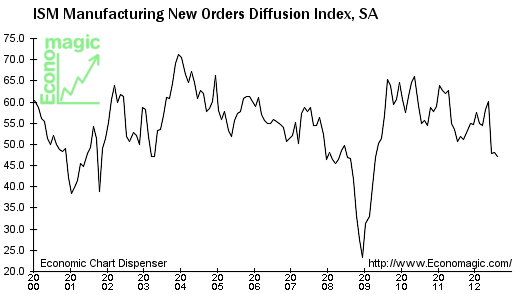
contraction. More importantly, the "New Orders" component of the
report, a chart of which is presented below, fell to the lowest
level since April of 2009. This is important because the "New
Orders" sub-index tends to lead the headline index.
Overall, the data published by the ISM earlier this week constitutes
more evidence that the US economy is in recession.
The monthly ISM report is a better economic indicator than the
monthly employment report, but the monthly employment report usually
has a bigger immediate effect on the financial markets. The next
monthly employment report is due to be published this Friday and
could have an outsized effect on the markets as a consequence of
Bernanke having zoomed in on the jobs situation in his recent
Jackson Hole speech. In particular, a very weak report would lead to
heightened speculation about a new inflation program whereas an
unexpectedly strong report would lead to the rapid unwinding of "QE"
bets.
The US jobs market is weak, but the monthly data is not always an
accurate reflection of reality. It's therefore anyone's guess as to
what the US government will report on Friday.
The
irrelevance of currency reserves, re-visited
Our 13th August commentary at TSI contained a
discussion titled "The Irrelevance of Currency Reserves", which was subsequently
posted as a standalone
free
article. We didn't receive any response from TSI subscribers to the original
piece, but received more than the usual amount of negative feedback from
non-subscribers after the piece was posted as a free article. The negative
feedback was generally more of a visceral reaction to the article's provocative
opening paragraph* than logical counter-argument, but it has prompted us to
write some additional words on the topic. Here we go.
We'll begin with the US$. The only official US currency reserve of note is gold
bullion, but changes in the amount of gold bullion held by the US Treasury/Fed
can't explain any of the large moves in the US dollar's foreign exchange value
or purchasing power over the past 30 years. The reason is that the gold reserve
hasn't changed. The US officially held about 260M ounces of gold 30 years ago
and holds the same amount today. The market value of the official US gold
reserve is a lot more today than it was in 2000, but since the US$ is worth a
lot less in both purchasing power and foreign exchange terms today than it was
in 2000 you would have difficulty showing how the increase in the market value
of the US foreign currency reserve has added value to the US dollar.
Moving along to the major "commodity currencies" -- the Australian and Canadian
dollars. The A$ and the C$ have been relatively strong currencies over the past
10 years, but this strength cannot be explained by reference to the reserves
held by the respective central bank. Specifically, the Bank of Canada holds FX
reserves amounting to only about 6% of C$ supply and the Reserve Bank of
Australia (RBA) holds FX reserves amounting to only about 3.5% of A$ supply.
Furthermore, the RBA dumped two-thirds of Australia's gold bullion reserves, the
country's most important "reserve asset", in the late 1990s -- a few years prior
to the start of a long-term bullish trend in the A$'s foreign exchange value.
The ECB has FX reserves amounting to about 14% of euro supply. This is a lot
compared to the reserves supposedly backing the A$ and the C$, but we see no
evidence that these reserves are influencing investment demand for euros. They
certainly aren't influencing the supply of euros. Something that influences
neither supply nor demand cannot possibly influence price.
In the currency world there are a lot of special cases, because governments and
central banks regularly try to gain trade advantages or cover up the bad effects
of earlier policies by manipulating exchange rates. The Swiss Franc (SF) is one
of these special cases. Switzerland began the last decade with a large gold
reserve (about 2500 tonnes), and yet the SF was a weak currency at the time. The
Swiss National Bank (SNB) then embarked on a gold sales program that led to a
60% reduction in the quantity of Switzerland's official gold over the course of
the decade, and yet the SF transformed into a strong currency. At a superficial
level it could therefore appear as if the reduction in the SNB's gold reserve
caused the strength in the SF's exchange rate, in that an inverse correlation is
apparent if a 13-year chart of the SF's gold reserve is placed below a chart of
the SF/US$ exchange rate. However, correlation does not imply causation. Under
the current monetary system a change in official reserves doesn't cause a
currency to become stronger or weaker. Instead, the change in reserves is
generally an effect of some other change. We'll return to this point in a
moment, but we'll first note that by August of last year the SF had become so
strong that the SNB decided to act aggressively to reduce the currency's
relative value. It did this by substantially BOOSTING foreign exchange reserves.
Specifically, the SNB weakened the SF by adding a large quantity of euros to its
FX reserve in exchange for newly-created SFs. Adding reserves as part of a
program to WEAKEN the currency is common practice among central banks, although
it usually takes place gradually over years rather than in one fell swoop.
China's currency (the Renminbi or Yuan) is another special case, because the
Yuan's exchange rate is fixed. However, the management of the Yuan's FX value
provides us with a good example of how exchange rates often correlate with
reserves and how a superficial analysis of the relationship between reserves and
relative currency value could confuse cause with effect. Very briefly, China's
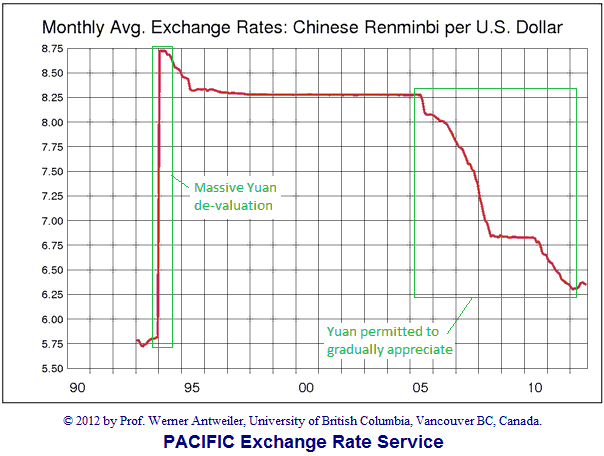
government massively devalued the Yuan in 1994 -- from around 5.8 Yuan per US$
to well over 8 Yuan per US$. Refer to the following monthly chart for details.
For many years the rate was fixed at around 8.25, but because this rate greatly
under-valued their currency the Chinese monetary authorities had to relentlessly
buy US dollars using newly-created Yuan in order to keep supply and demand in
balance at the artificial rate. In 2005 the government of China began to allow a
little more flexibility in the exchange rate, which paved the way for the Yuan
to gradually strengthen against the US$. The Yuan remained under-valued for
several more years, though, which meant that the People's Bank of China had to
continue using new Yuan (money created out of nothing) to purchase US dollars to
maintain the artificial rate. In other words, China's massive accumulation of
US$ reserves was part of a scheme to keep the Yuan at an artificially low level.
Rather than being a cause of strength, the build-up of reserves was an effect of
trying to make the currency weaker than it would otherwise have been.
The Chinese case is special due to the fixed exchange rate, but under the
current monetary regime a large build-up of international currency reserves in a
country often goes hand-in-hand with an effort by that country's central bank to
reduce its currency's exchange value. This happens because many central bankers
and politicians operate under the wrongheaded notion that the exporting sector
of the economy takes precedence and must be protected. When a country's money
continues to strengthen relative to the money used by its trading partners, a
point will eventually be reached when that country's exporters scream for help.
They demand that something be done to reduce the relative value of the money in
which their products are priced. The central bank typically responds by creating
new units of money that are exchanged for the international currency against
which depreciation, or a slower pace of appreciation, is desired. The result is
a larger pile of international currency reserves and a higher rate of local
monetary inflation. The higher rate of monetary inflation will lead to inflation
problems down the track, but it takes a good economist to see the long-term
effects of a policy and good economists are rarely attracted to central banking
and government.
As a final point of discussion (for now), what about the case of a government
borrowing in US dollars and then running out of dollars and being forced to
default? Examples over the past 30 years include Argentina and Mexico. Was an
insufficient international currency reserve the problem in these cases?
Again, only at the most superficial level. At the most superficial level, every
government and every private entity that has ever defaulted on its debt has done
so due to insufficient money. It could be said, for instance, that the recent
financial troubles of Greece's government are due to the government having an
inadequate supply of euros. This is obviously true as far as it goes, in that if
the Greek government suddenly found an extra 100 billion euros in its coffers it
wouldn't have a short-term financial problem. However, an inadequate supply of
euros is obviously not the source of the Greek government's current dilemma. The
real problem is excessive borrowing. Regardless of how much money any government
or private entity begins with, if they borrow money at a fast enough pace for
long enough they will eventually end up in the position of having to default on
their debt. If they have borrowed in a currency they can't print, then they must
default directly. If they have borrowed in a currency they can print, then they
have the option of defaulting indirectly via inflation.
Summing up, with most of the major currencies it's easy to make the case that
currency reserves haven't affected currency value. This is because there has
been almost no change in reserves and/or because reserves and currency value
have trended in opposite directions. But with the junior currencies it is
sometimes more difficult to make the case, because there have been large changes
in reserves and at a superficial level it can be hard to differentiate cause
from effect. Consequently, we will possibly return to this topic in the next few
weeks via a case study of a junior (or at least non-major) currency that has
undergone large changes in reserves and exchange rate over the past 10 years.
The Brazilian Real would be a good choice for this analysis.
*This is what we wrote: "The reserves held by a central
bank have no influence on the associated currency's purchasing power and very
little influence on its exchange rate. Today's currencies are not 'backed' by
central bank reserves. The reserves are holdovers from a previous monetary
system and are anachronistic under today's system."
The Stock Market
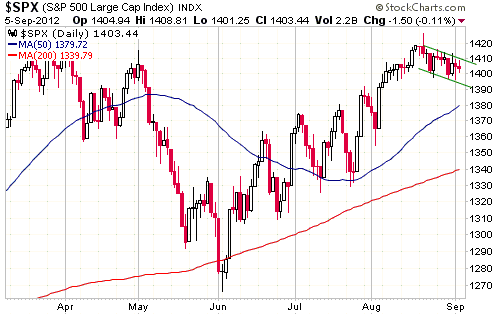
The S&P500 Index (SPX) has spent the past 12 trading days
immersed in what looks, on the following daily chart, like a routine 2-3 week
consolidation. However, charts are often deceptive so it could actually be a
topping pattern. The reaction to the 6th September ECB meeting could tell us
whether it's a topping pattern or a consolidation. If the SPX breaks to new
multi-month highs in reaction to the ECB meeting then the pattern of the past
2-3 weeks was obviously a consolidation. Alternatively, a daily close below 1390
would shift the odds in favour of a top.
If the SPX does break out to the upside within the next few days we will be more
alert than usual to the potential for a breakout failure. A sustained advance
following a break to new highs is unlikely.
Gold and the Dollar
Gold and Silver
The gold and silver markets are now 'overbought' on short-term basis with silver
being the more extended to the upside, but neither market has done anything to
suggest that its upward trend has ended. Consequently, there could be additional
gains over the days immediately ahead. A lot will depend on the actions (if any)
agreed at today's ECB meeting and the actions (again, if any) agreed at next
week's FOMC meeting.
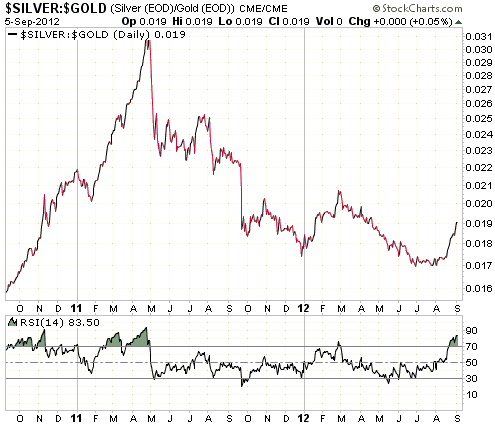
Due to silver's recent strength relative to gold, the silver/gold ratio has
rebounded strongly. This has caused the RSI shown at the bottom of the following
chart to rise well into 'overbought' territory, which is simply a sign to be
cautious. This is not the time to be doing any new buying of silver or to be
favouring silver over gold.
Under the right financial/monetary conditions, silver can rally in dollar terms
and relative to gold for many months after the silver/gold ratio becomes
short-term 'overbought'. However, we don't think that current monetary/financial
conditions are conducive to such an outcome. We should know a lot more by the
end of next week, but right now the odds appear to be in favour of monetary
conditions becoming a little tighter before they become significantly looser.
So, we should be cautious unless the senior central banks change the monetary
backdrop by throwing caution to the wind.
Gold Stocks
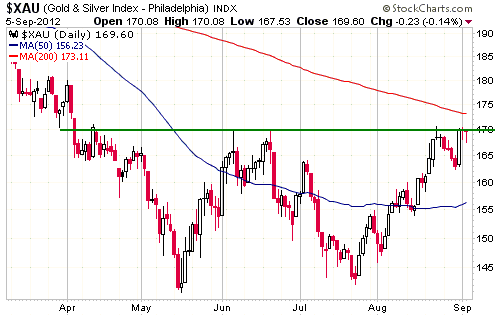
For a change, today we'll show a chart of the XAU rather than the HUI. The
picture is essentially the same, in that the XAU, like the HUI, is trading just
below intermediate-term resistance. For the HUI the resistance is at 460. For
the XAU the resistance is at 170.
An upside breakout continues to be a likely near-term outcome, but information
will be provided by either a breakout or a failure to break out by
mid-September. Refer to the latest Weekly Update for a discussion of the
scenarios.
Currency Market Update
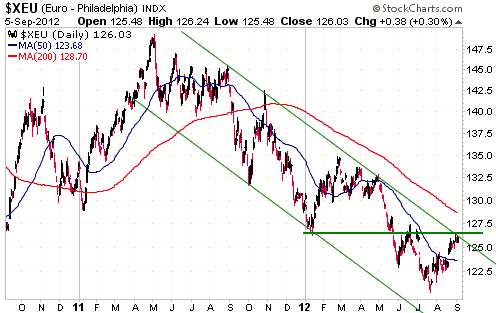
As the markets eagerly await the outcome of the ECB meeting, the euro is
delicately poised just below resistance (see chart below). Evidence of greater
inflation of either the euro supply or the US$ supply tends to be a short-term
plus for the euro, so confirmation that the ECB plans to use its money-creation
powers to cap the yields on EZ government bonds would most likely break the euro
above resistance. A new inflation program courtesy of the Fed would likely do
the same.
Our view continues to be that the Fed will do nothing in the near future, but
the ECB's course of action is more difficult to predict.
Update
on Stock Selections
Notes: 1) To review the complete list of current TSI stock selections, logon at
http://www.speculative-investor.com/new/market_logon.asp
and then click on "Stock Selections" in the menu. When at the Stock
Selections page, click on a stock's symbol to bring-up an archive of
our comments on the stock in question. 2) The Small Stock Watch List is
located at http://www.speculative-investor.com/new/smallstockwatch.html
 Mansfield
Resources (TSXV: MDR). Shares: 51M issued, 54M fully diluted. Recent price:
C$0.73 Mansfield
Resources (TSXV: MDR). Shares: 51M issued, 54M fully diluted. Recent price:
C$0.73
MDR's share price rose by more than 50% on Tuesday 4th September. We don't know
of any reason for the sudden price change. It could be that there is some good
news coming, or it could be that another newsletter recommended the stock, or it
could be that with selling having almost dried up it took only a small increase
in demand to bring about a large percentage increase in the stock price (the
fact that Tuesday's volume was not unusually high tells us that the increase in
demand was fairly small).
MDR has a very good exploration-stage gold project. The in-ground gold resource
isn't huge, but because almost all the gold is close to the surface and oxidised
it should be relatively easy and cheap to build a profitable mining operation.
One problem is that the project is located in Argentina. Another problem is that
the company is low on cash and will therefore need to do a financing within the
next few months.
MDR remains a stock with high risk and high potential reward. The high risk is
mostly due to the country in which its flagship project is located. The
country-related risk kept a lid on the stock price prior to this week and makes
financing more difficult than it would otherwise be. It should be noted,
however, that some gold producers are still prepared to invest in new
Argentina-based projects, as evidenced by Yamana's recent purchase of Extorre.
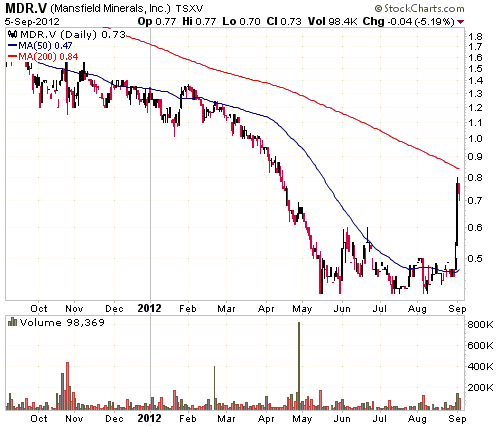
Regardless of what caused the sudden increase in MDR's stock price it shows what
can happen to a sold-out illiquid microcap stock in response to a small increase
in speculative demand. Something similar could happen without warning to stocks
such as Clifton Star (CFO.V) and Batero Gold (BAT.V) -- microcap gold stocks
with plenty of potential that are near their lows and are barely trading. The
risk is that although the stocks appear to be sold out, it would only take a
small increase in selling pressure to knock them down to new lows. The upside
potential is clearly a lot greater than the remaining downside risk, but they
definitely aren't for everyone.
Elgin Mining (TSX: ELG). Shares: 148M issued, 206M fully diluted.
Recent price: C$0.46
ELG, a junior gold miner with an operating mine in Sweden and a
couple of exploration-stage projects in northern Canada, has been
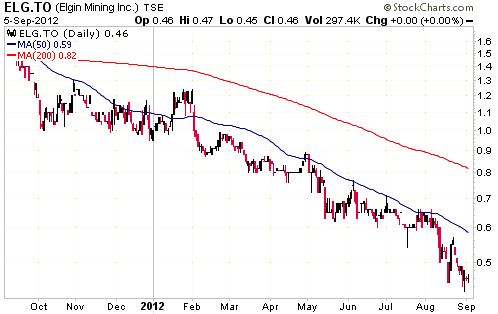
the worst-performing TSI gold stock since the HUI's May-2012 bottom.
As evident from a glance at the following daily chart, there is no
sign yet that ELG's trend has reversed from down to up.
One positive is that Patrick Downey, ELG's CEO, has been a
consistent buyer of the company's shares this year, including 11
separate purchases during the month of August. Details of Downey's
purchases and other insider trading activity for ELG are located
HERE. So, the guy who should understand the company's prospects
and value better than anyone remains optimistic.
As an aside, the above-linked web site can be used to check insider
trading activity for any US or Canadian traded stock. Just enter the
stock symbol in the "Get Quote" box near the top of the screen
(":CA" after the symbol for a Canadian stock), then click on
"Insiders", then click on "All Insiders Activity..."
Chart Sources
Charts appearing in today's commentary
are courtesy of:
http://stockcharts.com/index.html
http://www.economagic.com/

|









