|
- Interim Update
5th November 2014
Copyright
Reminder
The commentaries that appear at TSI
may not be distributed, in full or in part, without our written permission.
In particular, please note that the posting of extracts from TSI commentaries
at other web sites or providing links to TSI commentaries at other web
sites (for example, at discussion boards) without our written permission
is prohibited.
We reserve the right to immediately
terminate the subscription of any TSI subscriber who distributes the TSI
commentaries without our written permission.
The Fed
is trapped in a logical circle
The Fed uses economic models loosely
based on Keynesian theory. According to these models, the economy
can be strengthened by pushing interest rates below where they would
otherwise be and creating money out of nothing. Good economic theory
informs us that the economy could only be hurt by the effects of
such actions, the effects being the forced transfer of wealth from
savers to borrowers and carry-trading speculators and the distorting
of the price signals that guide investment and spending decisions.
However, as mentioned above the Fed's models aren't based on good
economy theory, they are based on Keynesian theory. In any case, the
point we want to make is that if a central planner is being guided
by a model that generates a sustainably higher economic output when
the interest-rate input is reduced and the money-supply input is
increased, then the central planner is essentially trapped in a
logical circle.
What we mean is that if a faulty model is used to guide policy and
the same model is then used to ascertain the effects of the policy,
there is no escape because regardless of what happens it will always
appear as if the policy worked. For example and with regard to the
case in point, if a central planner lowers the interest rate in
accordance with a model that outputs a higher economic growth rate
in response to a lowered interest-rate input, then even if the
economic growth rate falls in the aftermath of the interest-rate
reduction the model will confirm that the central planner's action
was correct. Why? Because the model will indicate that if not for
the interest-rate reduction, the economic growth rate would have
fallen even further.
Taking another example that has relevance to the experience of the
past several years, government economic policy is regularly
determined by Keynesian models that show increased government
spending leading to the creation of jobs. These models will always
show that an increase in government spending was successful in
creating jobs, regardless of what actually happens. For instance, if
a model shows that a $500B increase in government spending leads to
the net creation of 1M jobs within 1 year, and the economy actually
ends up losing 1M jobs during the year following a $500B increase in
government spending, then an economist operating the aforementioned
model will claim that if not for the increased government spending
the economy would have lost 2M jobs. That is, even though 1M jobs
were lost in our hypothetical example, the models being used to
guide policy will still 'prove' that 1M jobs had been created by the
boost in government spending.
This, in a nutshell, is why the Fed and other central banks, most
notably the BOJ, never learn from their mistakes. They keep creating
unsustainable booms that lead to devastating busts and slower rates
of long-term progress because according to their models they aren't
doing anything wrong.
Putting it another way, regardless of the outcome the Fed will keep
doing what it has been doing, because it is caught in a logical trap
that prevents it from correctly interpreting reality. This means
that if the US economy and stock market were to tank over the coming
12 months, the Fed's senior managers would not take such an outcome
as evidence that the QEs of the past had hurt rather than helped;
instead, they would take it as evidence that the 2012-2014 QE
program was ended prematurely and that more QE was needed.
Joseph Heller, the brilliant author of "Catch 22", could have had a
field day with this.
The Stock Market
Current Market Situation
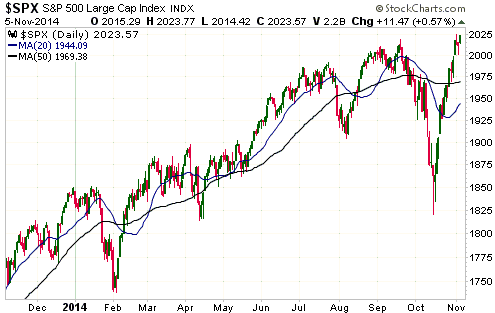
The results of the US Mid-Term Elections fueled an extension of the S&P500's
near-vertical three-week rise and improved the chances that a short-term top
will be put in place this week. With the market now very stretched to the
upside, the most likely direction of the next 5%-10% move is down.
A Japanese pair trade
We initiated an option trade in our own account on Wednesday 5th November that
may be of interest to some of our readers. Before we describe the trade and the
logic behind it, some background is appropriate.
The bulk of our cash is in US dollars or US dollar surrogates such as the HK$.
This has been the case for many years. Additionally, we hold some Australian and
Canadian dollars, mainly to facilitate the trading of stocks in Australia and
Canada. This has also been the case for many years. The only other currency to
which we have some 'long' exposure is the Yen. This exposure constitutes a bit
less than 10% of our total cash.
Our Yen position was established at the very end of 2012, which is something we
noted for information purposes at TSI at the time. Since then, Yen futures have
fallen from around 116 to 87, so it obviously wasn't a well-timed move. On a few
occasions over the past year we've been tempted to average down on this
unleveraged, long-term Yen exposure, but until this week we decided against it.
One reason we decided against it was the Yen's strong positive correlation with
gold. We have a lot of exposure to gold and didn't want to indirectly boost this
exposure by increasing our Yen position.
At the end of last week we made a plan to double our Yen cash position (and
reduce our US$ cash position accordingly) if the results of the US mid-term
elections caused another surge in the US$. The US$ did surge upward in reaction
to the election results on Wednesday so we went ahead and increased our exposure
to the Yen, but not in the way we originally planned. Rather than doubling our
Yen cash position, we purchased January-2016 $90 FXY call options. The number of
options we purchased gives us similar exposure to a 15% rally in the Yen as we
would have obtained by denominating another 8%-10% of our cash in Yen terms, but
with a small fraction of the outlay.
In addition, we purchased January-2016 EWJ (Japan iShares) $12 call options,
thus establishing long exposure to the Japanese stock market. We consider the
FXY and EWJ positions to be a pair trade. The positions, together, create a
higher probability of success than would be obtained by either position alone.
By the way, we will probably double our financial commitment to the EWJ side of
this pair trade if there is a significant stock market pullback over the next
few weeks.
There is a realistic possibility that we will make a profit on both of these
option positions, but there is a higher probability that only one of them will
be profitable, with the gains on the winner likely dwarfing the losses on the
loser. The reason is that Yen strength over the coming 6-12 months would likely
go with a downward-trending Japanese stock market and Yen weakness over the
coming 6-12 months would likely go with an upward-trending Japanese stock
market. There is also a possibility (with a lower probability) that both the Yen
and the Japanese stock market will trend upward over the coming 6-12 months,
leading to profits on both positions.
The Yen and EWJ could rise together over the next 6-12 months because of the
concerted efforts being made in Japan to directly manipulate equity prices
upward. Of particular relevance, along with the BOJ's announcement regarding
more QE late last week came an announcement from Japan's Government Pension
Investment Fund (GPIF), a fund with 127 trillion Yen (about US$1.2T) of assets
under management, that it would be reducing its allocation to JGBs from 60% to
35% and increasing its allocation to equities (half local, half foreign) from
25% to 50%. Also of relevance is that a small part of the BOJ's QE is channeled
towards the purchase of equity ETFs, so a precedent for direct central-bank
support of the stock market is already in place. Note that even if the BOJ
remains unable to boost Japan's monetary inflation rate much beyond 3%, the
stage could be set for a meaningful -- albeit artificial and based on policy
lunacy -- increase in the demand for Japanese stocks.
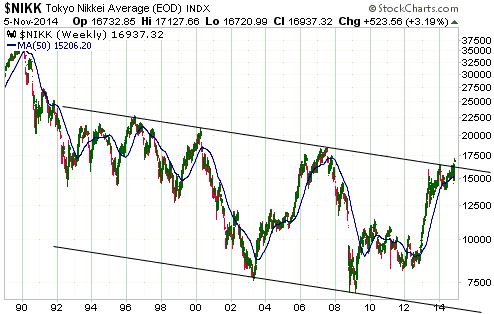
The following weekly chart shows that the reaction to the developments of the
past week has broken the Nikkei225 Index above the top of a very long-term
channel, which is evidence that demand has begun to increase. The increasing
demand is undoubtedly from traders front-running the GPIF and the BOJ, but the
reality is that institutions with extremely deep (infinitely deep in the BOJ's
case) pockets are trying to boost Japanese stock prices and stand a decent
chance of being successful over the coming 12 months.
We are going to follow this trade at TSI and have added the aforementioned FXY
and EWJ call options to the TSI List at US$1.70 (the middle of the closing
bid-offer spread on Wednesday) and US$0.75 (Wednesday's closing price),
respectively.
Gold and the Dollar
Gold
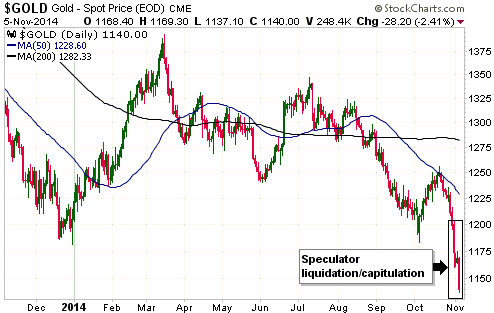
The gold market broke below important support at the end of last week. This
opened up a few possibilities for this week, one of which was a downside
blow-off. A downside blow-off is in progress and there is no evidence yet that
it is complete, but it should be complete by the end of this week.
The silver market has been hit much harder than the gold market. Silver's
dramatic price decline pushed Market Vane's bullish percentage down to 18 on
Tuesday and probably even lower on Wednesday (we don't yet have the Wednesday
number). This represents extreme negativity consistent with a major price
bottom, but bearish sentiment already appeared to be at an extreme in late
September when Market Vane's bullish percentage was at 22.
The performances of silver and the euro over the past couple of months exemplify
the inherent weakness of sentiment as a buy/sell indicator. The weakness is that
there are no absolute sentiment benchmarks, meaning that the situation can
always become more extreme. In the euro's case, sentiment already appeared to be
near a pessimistic extreme -- as indicated by the speculative net-short position
in euro futures having risen to near an all-time high -- in August when the
price was at 134, but the price has since dropped another 10 points.
Gold Stocks
Current Market Situation
The gold-mining crash has now extended to 6 trading days, which is typical for
such an event.
The price crash constitutes a capitulation of monumental proportions, as
evidenced by the trading volumes shown at the bottom of the following GDXJ
chart. Daily GDXJ trading volume made a new all-time high on Wednesday 5th
November, pushing last Friday (31st October) into second place. Furthermore, the
past 5 trading days have been 5 of the 6 highest volume days in GDXJ's history.

Similar gold-sector events include the 1998 crash, which lasted 7 days (all of
them down) and resulted in a peak-to-trough HUI decline of 25%; the 2002 crash,
which lasted 5 days (4 of them down) and resulted in a peak-to-trough HUI
decline of 29%; and the final capitulation in the 2008 crash, which lasted 5
days (4 of them down) and resulted in a peak-to-trough HUI decline of 33%. To
date, the current crash has resulted in a peak-to-trough decline of 21%. Note
that there was no high-volume capitulation/crash during the days leading up to
the 2000 bottom, just a slow and relentless loss of value.
With the crash having now reached an average number of trading days for such an
event, the first up day will probably mark the culmination. Based on the
historical record of financial-market price crashes, there should then be a 1-3
week rally followed by a decline to test the crash low.
Note that at major bottoms the gold stocks tend to dramatically underperform
gold until the day after the bottom, at which point they start to dramatically
outperform. For example, the HUI/gold ratio fell sharply during the days and
weeks leading up to the 1998, 2000 and 2008 lows in gold and the gold-mining
sector, and then rebounded strongly.
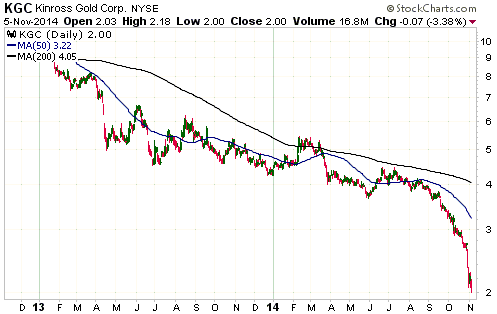
Opening a short-term trading position in Kinross Gold (KGC)
KGC appeared to offer good value when it was trading at US$4.00 in August, but
its market value has since been cut in half. This massive loss of value is not
due to any missteps on the company's part, it is due to a 12% decline in the
gold price and extremely negative sentiment towards gold mining.
On the operational front the company has actually performed well while its stock
price has been cut in half. Specifically, financial results reported after the
close of trading on Wednesday 5th November reveal that KGC's all-in sustaining
cost (AISC) fell by 15% over the past 12 months to a very reasonable $911/oz and
that the company added about $100M to its balance sheet over the first 9 months
of this year.
KGC has a strong balance sheet and should still be marginally profitable at the
current gold price, but the stock market is valuing the company as if it were
about to go bust. This has prompted us to add a short-term KGC trading position
to the TSI List at Wednesday's closing price of US$2.00. The objective is to
sell within the next three months following a rebound to around US$3.00.
Note that despite its absurdly low current valuation, country risk (Russia and
Mauritania) prevents us from being interested in taking a long-term position in
KGC.
On a related matter, the fall in production costs just reported by KGC is part
of a sector-wide phenomenon. The average cost of mining gold is now in a
downward trend and this trend will almost certainly continue over the coming 12
months. The trend is primarily driven by decreasing demand for and increasing
supply of the labour and materials used in the gold-mining process. For example,
companies are now spending less on exploration, which reduces the costs of
geologists, drilling equipment and support crews. For another example, when
high-cost, financially-weak producers are driven out of business by the lower
commodity price, all the resources that would have been used by these companies
become available at discounted prices for use by the financially-stronger,
lower-cost producers.
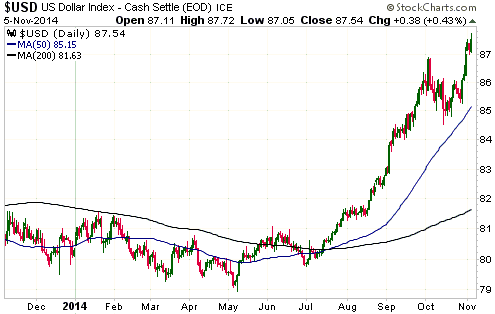
The Currency Market
The blow-off moves to the downside in gold, silver and the mining stocks along
with the extension of the US stock market's rally into 'overbought' territory
point to the second half of this week (right now, that is) as a likely time for
a short-term top in the Dollar Index.
Updates
on Stock Selections
Notes: 1) To review the complete list of current TSI stock selections, logon at
http://www.speculative-investor.com/new/market_logon.asp
and then click on "Stock Selections" in the menu. When at the Stock
Selections page, click on a stock's symbol to bring-up an archive of
our comments on the stock in question. 2) The Small Stock Watch List is
located at http://www.speculative-investor.com/new/smallstockwatch.html
Chart Sources
Charts appearing in today's commentary
are courtesy of:
http://stockcharts.com/index.html

|









