- Interim Update 6th February 2019
Copyright
Reminder
The commentaries that appear at TSI
may not be distributed, in full or in part, without our written permission.
In particular, please note that the posting of extracts from TSI commentaries
at other web sites or providing links to TSI commentaries at other web
sites (for example, at discussion boards) without our written permission
is prohibited.
We reserve the right to immediately
terminate the subscription of any TSI subscriber who distributes the TSI
commentaries without our written permission.
A story from the weird
world of crypto
Canadian crypto exchange
QuadrigaCX filed for Creditor Protection earlier this week. While there is
nothing unusual about a company running into financial problems and
seeking time to get its house in order, the story behind the QuadrigaCX
filing is strange indeed.
As explained in the article posted
HERE, the source of QuadrigaCX's financial problems is that the owner
of the company kept the bulk of the exchange's customer-owned
cryptocurrency on his personal laptop computer. Then he died, apparently
leaving no record of the codes needed to access the cryptocurrency
"wallets" stored on his computer. A consequence is that about $190M of
cryptocurrency effectively has gone missing. The company's line is that
the crypto is locked inside one dead man's computer, so what they need to
do is either find the key or find a way of breaking in. However, it's also
possible that the cryptocurrency is not where it is supposed to be, either
because it has been stolen or because it has been shifted to a different
exchange in an effort to generate interest income.
Whatever happens
from here, the QuadrigaCX saga is a glimpse into the strangeness of the
cryptocurrency world. To keep your cryptocurrency safe you must keep it in
a cold (off-line) electronic wallet, but in order to use or trade it you
must go on-line and expose yourself to the risk of loss via hacking or
exchange mismanagement/failure. Also, if you keep most of your
cryptocurrency in an off-line wallet, you run the risk of losing it all
due to loss of or damage to the device on which it is stored. For example,
it seems to us that QuadrigaCX would be in an even worse predicament if
the owner hadn't died but had simply lost his laptop. Paper backups of
electronic wallets can be made to guard against the risk of damage to or
loss of the physical device on which the cryptocurrency is stored, but
that creates a new risk because anyone who obtains the paper backup then
will have access to the cryptocurrency.
The distributed ledger
(blockchain) is a brilliant concept and is here to stay, but in our
opinion the most popular cryptocurrencies of today will never be
generally-used media of exchange (money).
Industrial metals
catch a bid
The Base Metals
The base metals markets were forecast to be strong during the first
half of this year due to the combination of low inventory levels, a stock
market recovery, the temporary winding-down of the US-China trade conflict
and US$ weakness. It's a case of so-far-so-good, but the year is still
young and a lot could go wrong.
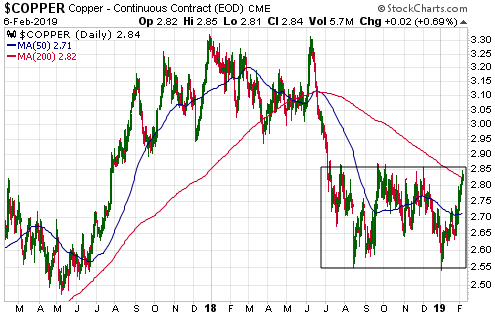
The copper price has gained about
10% since bottoming in early January. It has moved up to near the top of
its 7-month horizontal trading range and its 200-day MA, which means that
the heavy lifting lies immediately ahead.
We expect that the copper
price will rise to $3.15 or higher within the coming three months.
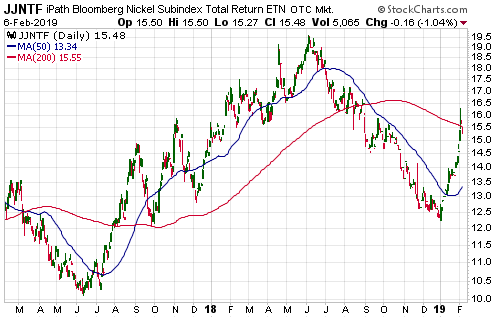
So far this year, nickel has been the star performer among the base
metals. The sharp rise in the nickel price since the beginning of the year
propelled the price of JJNTF (the iPath Nickel Total Return ETN) to a gain
of 32% from its 2018 close to this week's high. Some 'corrective' activity
should be expected over the next few weeks.
Iron-Ore
Considering the economic backdrop and
in particular the signs of weakness in China's economy, the iron-ore
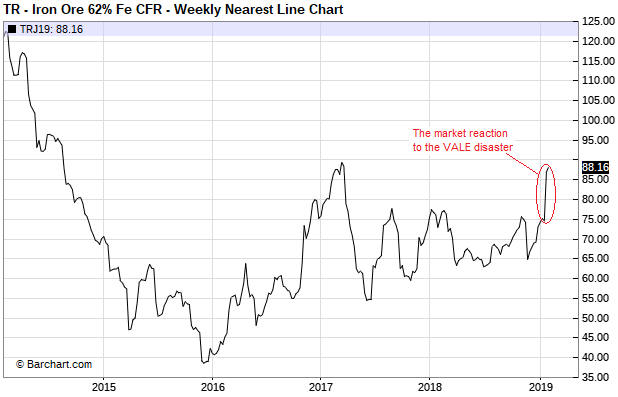
market has been surprisingly strong over the past 2-3 months. The price is
up by a remarkable 35% since late November, with more than half the gain
occurring over just the past two weeks.
The catalyst for the price
surge of the past two weeks was the collapse, on 25th January, of a
tailings dam at one of VALE's iron-ore mines in Brazil. We discussed this
environmental disaster in the 28th January Weekly Update.
In
response to the tailings dam collapse at one of its mines, VALE, the
world's largest iron-ore producer, has been forced to curtail production
at other mines to enable safety checks to be carried out. This has led to
a decline in its annual iron-ore production rate of 70M tonnes and an
inability to meet its delivery commitments on some contracts, which, in
turn, has led to the upward price spike illustrated on the following
chart.
Other iron-ore producers, including TSI stock selection
Mineral Resources (MIN.AX), are benefiting from VALE's mishaps at the
moment and should continue to do so in the short-term, but we see no
reason to be bullish on iron-ore beyond the next few months.
The Stock Market
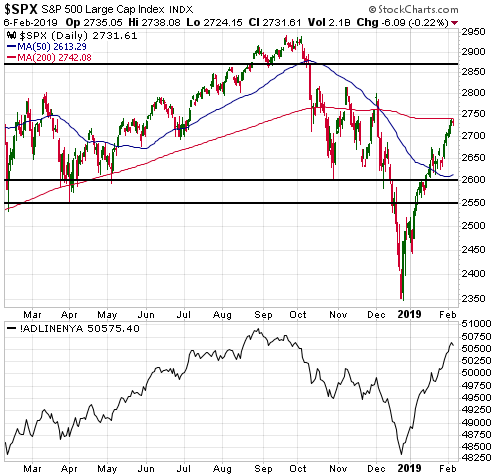
The SPX's initial rebound from
its December low has reached the target we had in mind for the total
rebound. The target was the 50-week MA or the 200-day MA. This probably
means that almost all of the upside potential has been exhausted during
the initial rally and that any subsequent rally will do little more than
test the February high. Also, it probably means that the intervening
pullback will do no more than retrace 50% of the initial rebound, but even
retracing 50% will require a 200-point decline assuming that a top is in
place.
We can't be sure that a top is in place, because at this
stage there hasn't been a downward reversal. As illustrated below, what we
have at the moment is a market that has risen to the 200-day MA and
stopped.
In the email sent after Monday's trading session we wrote that
short-term traders could attempt to profit from the anticipated pullback
(50% retracement) via leveraged inverse index funds or put options
expiring in March or April, whereas traders with longer timeframes should
wait for a multi-month topping pattern to develop before entering bearish
speculations.
In the same email we added another SPY put-option to
the TSI List (the SPY $260 put that expires on 15th March 2019). The small
additional gain in the SPY since then makes this put option a slightly
better buy.
Gold and the Dollar
Gold
For
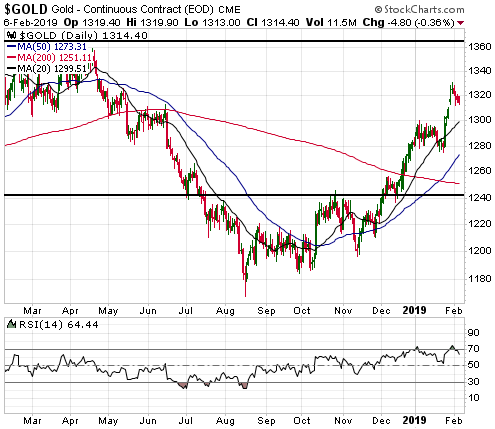
all intents and purposes, nothing happened in the gold market over the
first three days of this week. The market entered the week in a position
where it was stretched to the upside on a short-term basis and likely to
soon commence a multi-week correction, but mainly due to the bullish
fundamental backdrop an end to the upward trend did not appear to be
imminent. There was a minor pullback over the past three days, but the
market remains stretched to the upside.
There is a realistic
chance that the US$ gold price will spike up to major resistance in the
1360s prior to the start of a correction, but a more likely near-term
scenario is a multi-week correction prior to a test of major resistance.
Gold Stocks
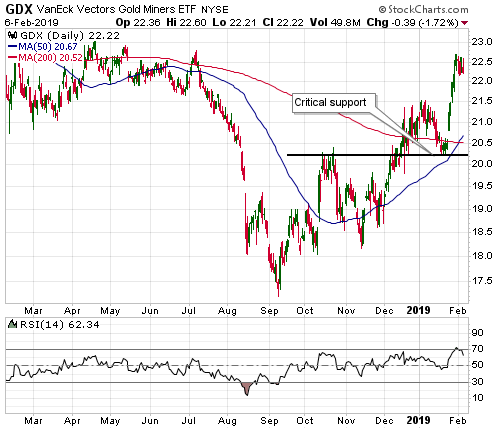
The Gold Miners ETF (GDX)
consolidated over the first three days of this week. Ideally, the rising
50-day MA (the blue line on the following chart) will act as support
during 'corrective' activity over the coming 2-3 weeks, but the most
important nearby support is defined by the January low ($20.22). This
support must hold to keep the upward trend intact.
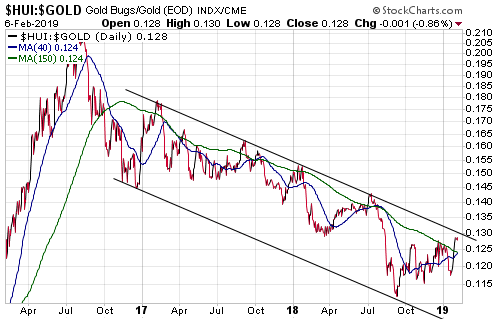
As mentioned in the latest Weekly Update, if the gold-mining sector is
immersed in something more bullish than a counter-trend rebound then the
HUI/gold ratio should hold above its 150-day and 40-day MAs (the green and
blue lines on the following chart) during pullbacks over the weeks ahead.
By the same token, if HUI/gold drops below these MAs within the next few
weeks it will be a warning that the rally from the September-2018 low is
no more significant than the other rebounds of the past two years.
The Currency Market
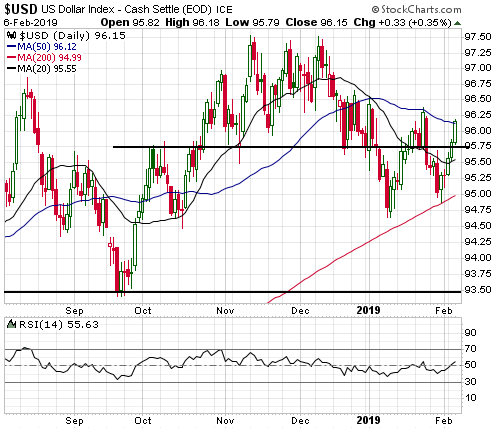
The Dollar Index (DX) has
spent the past 6 weeks oscillating around 95.75. The true fundamentals are
in the DX's favour, but not decisively so.
We are waiting for
either the fundamentals or the price action to signal the direction of the
next multi-month trend.
Updates on Stock Selections
Notes: 1) To review the complete list of current TSI stock selections, logon at
http://www.speculative-investor.com/new/market_logon.asp
and then click on "Stock Selections" in the menu. When at the Stock
Selections page, click on a stock's symbol to bring-up an archive of
our comments on the stock in question. 2) The Small Stock Watch List is
located at http://www.speculative-investor.com/new/smallstockwatch.html
 Stocks
List Review, Part 1
Stocks
List Review, Part 1
Over the coming week or so we will do
a general review of the TSI Stocks List, starting today with the "Trading
Positions" section of the List.
The Trading Positions section is
supposed to contain stocks and funds that have a shorter-term focus. The
objective with these trading ideas usually is to capitalise on something
that is expected to happen within the ensuing few months, although the
planned duration could be as long as 9 months. Trading Positions certainly
shouldn't be in the List for longer than 12 months, but in the past we
have been lax and some short- or intermediate-term trades have become
long-term. In the future we will be more disciplined in the way we manage
this section of the Stocks List.
Also, in the TSI commentaries we
generally don't follow the trading positions as closely, from a
fundamentals perspective, as we follow the long-term positions. In
particular, whereas for the long-term positions we endeavour to cover all
significant company-specific news, for the trading positions we only cover
news that could have a big effect on price action over the intended
duration of the trade.
The most egregious example of a so-called
trading position remaining in the List for too long is the Prudent Bear
Fund (BEARX). This open-end fund has been in the List for more than 5
years. Even though the US stock market probably is close to an important
price top, we will remove BEARX immediately and record a loss of about
50%. Our plan is to add a new bear fund position to the List as a trade
with an expected duration of 3-6 months following a test of the SPX's
February high.
The other Trading Positions have been added within
the past 10 months. Here's a brief comment on each one:
1)
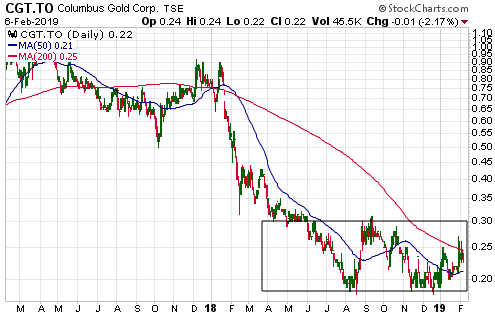
Columbus Gold (CGT.TO) is a junior gold miner operating in French
Guiana. Its principal asset is its 45% stake in a joint venture with
mid-tier Russia-based gold producer Nordgold at the Montagne d'Or (MDO)
gold project. The MDO project has a completed FS and is in the permitting
phase. The plan is to build a mine with average annual production of 237K
ounces (CGT share: about 100K ounces).
CGT is about 20% below the
price at which it was added to the List back in April-2018. It is trading
at a very low valuation and would be a reasonable long-term speculation in
anticipation of an eventual takeover by its JV partner, but our goal is to
exit within the next three months.
The stock has built a base in
the C$0.18-C$0.30 range. Breaking above the top of this base would suggest
an initial target in the low-C$0.40s.
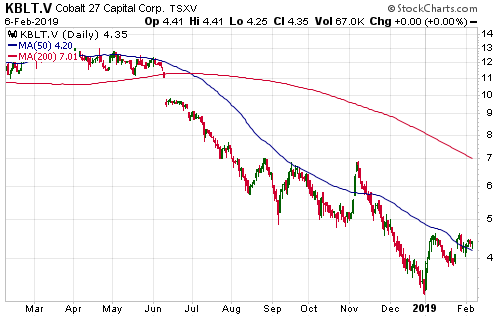
2) The TSI List contains a long-term position in Cobalt 27
Capital (KBLT.V), but a separate trading position was added at
the end of December due to the stock's extreme undervaluation and
potential for a strong multi-month rebound. The stock has since rebounded
from C$3.30 to the C$4.30s.
We have C$6.00-$7.00 in mind as a
short-term target.
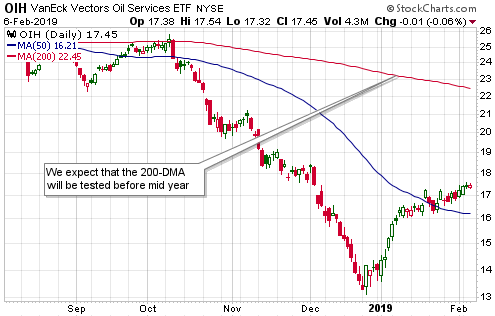
3) The Oil Services ETF (OIH) was added on 10th
December in anticipation of a strong rebound during the first quarter of
2019. The anticipated rebound began only two weeks later, but our timing
was bad because OIH crashed during this 2-week period. However, the
scaling-in process that we advocated would have established a position at
a very good average price.
OIH still has interesting upside
potential on both a short-term and an intermediate-term basis, but a
multi-week correction should begin soon.
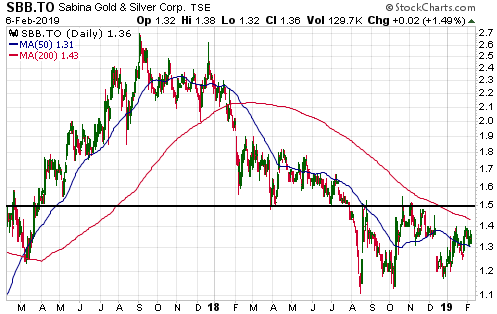
4) Sabina Gold and Silver (SBB.TO) was added as a
trade with an expected duration of up to 9 months last July. The company
has three valuable assets: the 100%-owned, fully-permitted,
construction-ready 7M-ounce Back River gold project in Nunavut (northern
Canada), a substantial silver royalty associated with Glencore's Hackett
River zinc-silver project in Nunavut, and cash of around C$50M.
The
idea was that the stock price could return to its 2017 high in the
C$2.50-$2.70 range if the gold price rose above US$1310/oz, but it hasn't
worked out to date. Gold has done its part by moving above US$1310/oz, but
the SBB stock price has dropped by 12% (from C$1.53 to C$1.35).
SBB's weakness is solely related to sentiment (the general lack of
interest in exploration/development-stage gold-mining stocks), in that the
company's operational progress and news flow have been good.
As is
the case with CGT, SBB would be a reasonable long-term speculation in
anticipation of an eventual takeover. However, at this stage our goal is
to exit within the next few months.
5) Sprott Resource Holdings (SRHI.TO) was added as a
trade in November due to its large discount to our estimated valuation and
our view that industrial commodity prices would rebound during the first
half of 2019. The trade is off to a bad start, with the stock price having
dropped from C$1.42 to C$1.05. However, industrial commodity prices are
rebounding as expected and nothing has happened to alter our valuation
estimate (we think that SRHI is worth at least C$2.50/share).
We
are going to give the trade some more rope, but we expect to exit before
mid-year.
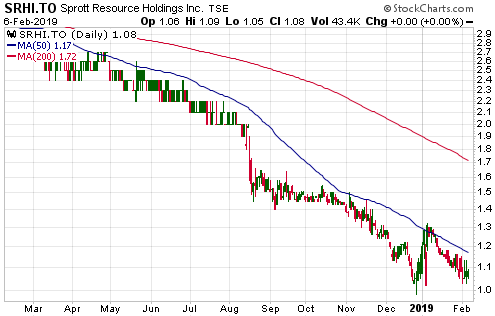
Chart Sources
Charts appearing in today's commentary
are courtesy of:
https://stockcharts.com/
https://www.barchart.com/