|
- 06 June 2001
Inflation
Update
It's official - inflation is not
a problem!
Here are extracts from a 4th June Bloomberg
article, with our comments shown in brackets:
"Inflation is not a significant
problem," Greenspan told delegates at the International Monetary Conference
in Singapore. Inflation among the 12 nations sharing the euro is likely
to drop below 2 percent next year, from 2.9 percent in April, Duisenberg
said at the same conference.
[As we've said before, there will be
no reason for us to stop focusing on inflation until the central
bankers start focusing on it. As long as they are ignoring
inflation and putting all their efforts into stimulating growth, the markets
will most likely continue to 'bid up' the investments that benefit from
higher inflation.]
The euro region's inflation rate
has been above the ECB's 2 percent ceiling for 11 consecutive months, reaching
2.9 percent in April. Economists expect a report on June 18 to show inflation
rose above 3 percent in May. Inflation will probably ease in the second
half of the year, economists said.
[Who are these economists and why do
they think that? With inflation clearly trending higher, on what objective
evidence are they basing this conclusion?]
The strength of the dollar is evidence
that inflation is not a short-term concern in the U.S., Greenspan said.
The Fed's trade- weighted dollar index, which measures the dollar against
a basket of currencies from the country's largest trading partners, is
at its highest level in two months.
"Obviously our exchange rate is
firm and rising and that is not the type of thing one would ordinarily
envisage in the context of inflationary pressures," Greenspan said.
[We certainly agree that a rising exchange
rate is not the type of thing one would ordinarily envisage in the
context of inflationary pressures, but there is nothing ordinary about
the greatest credit bubble in the history of the world. Greenspan's willingness
to continually switch indicators until he finds one that supports his argument
is almost laughable. Two year's ago the change in labour costs included
within each quarter's productivity report was one of Greenspan's favourite
measures of inflationary pressures. However, now that labour costs are
rising at the annualised rate of 6.3%, the highest rate of increase in
more than 10 years, this indicator has apparently disappeared from the
Fed Chief's radar screen. In fact, now that almost all the US Government's
own inflation indicators are finally revealing worrisome price increases
we should, according to Greenspan's latest words of wisdom, ignore them.
We should, instead, consider the Dollar's exchange rate to be proof that
inflation is not a problem.]
The Big Easy
This is how things have worked in the
past: The money supply growth rate rises to a level that causes the market
to anticipate an inflation problem and, after a delay, prompts the Fed
to hike the Fed Funds Rate (FFR). The Fed keeps raising the FFR until it
figures out that inflationary pressures have subsided, a realisation that
tends to occur after the money supply growth rate has plunged and the economy
has entered a recession. It then begins to cut rates in an attempt to rejuvenate
growth. When the difference between the M3 growth rate and the FFR is strongly
positive and moving higher it is a sign that the Fed is pursuing an 'easy'
monetary policy. When the difference between the M3 growth rate and the
FFR is contracting it is a sign that the Fed is pursuing a 'tight' monetary
policy. In the past, tightening cycles typically haven't ended and easing
cycles haven't begun until the FFR was higher than the M3 growth rate.
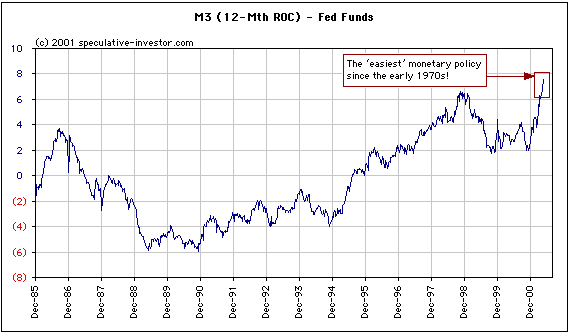
Below is a chart showing the M3 growth
rate minus the FFR. The chart only goes back to the mid-80's, but the current
difference between the money supply growth rate and the official interest
rate is the highest it has been since the early-1970s. Unlike rate-reduction
cycles of the past, the current 'easing' began while the M3 growth rate
minus the FFR was already quite high. With inflation currently not a problem
(chuckle, chuckle), Greenspan may be about to go for the record - the 'easiest'
monetary policy in the history of the Federal Reserve.
We've mentioned in prior commentary
that we expect the first decade of the new millennium to have more in common
with the 1970s than with either the 1980s or 1990s. As well as a high average
level of money supply growth, the 1970s were characterised by huge swings
in the rate of money supply growth. Huge swings may be in store for the
US over the next 3 years, with this year's explosion in the money supply
growth rate being followed by a sharp slowdown next year that will, in
turn, be followed by another 'ramp job' during 2003-2004.
The US
Stock Market
Current Market Situation
The April/May rally - the first up-leg
of this cyclical bull market - ended on May-21. Since that time the market
has been in a 'raggedy' correction that we expect will continue for another
two weeks or so.
From the May-28 WMU: "If we could
ignore valuations and just look at the market action, the sentiment picture
and the monetary environment, we would be very confident that the coming
correction will be shallow with the greatest risks, in the medium-term,
being on the upside." Although valuations are still a concern we are
becoming increasingly confident that this correction is going to be shallow,
primarily because a very supportive 'sentiment platform' is being built
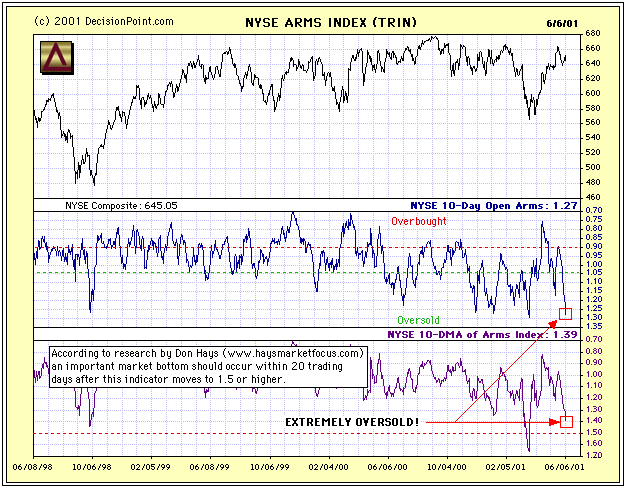
under the market. By some measures the market has already reached an extremely
oversold condition, despite the fact that yesterday's S&P500 close
was only about 3% below the May-21 peak. For example, the following chart
(provided courtesy of www.decisionpoint.com) shows that the Arms Index
has already hit a level normally associated with an important bottom (the
Arms Index measures the volume in advancing issues relative to the volume
in declining issues and becomes oversold when declining volume is high
relative to the number of declining stocks).
With the market being as oversold as
it is we expect to see some spirited rallies interspersed amongst the on-going
erosion. However, lower levels are likely before the next sustainable up-move
gets underway. As far as the next 2-3 months are concerned, the major risk
is firmly on the upside.
Gold and
the Dollar
The Trend
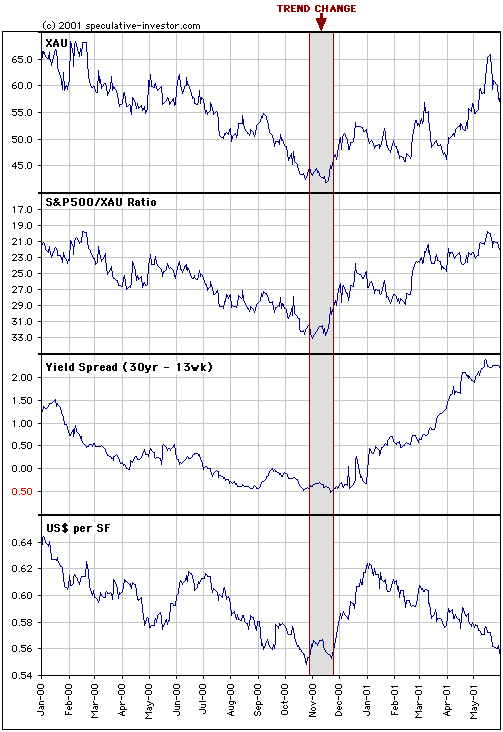
The underlying trend for gold has been
positive since last November, although on some days it certainly doesn't
feel like it. Around November 2000 the following trend changes occurred:
a) Gold stocks, as represented by the
XAU, bottomed and began trending higher.
b) The XAU, which had been dramatically
under-performing the S&P500 up until that time, began to dramatically
out-perform the S&P500.
c) Long-term interest rates began trending
higher relative to short-term interest rates, indicating that the market's
expectations for future inflation were increasing relative to its expectations
for future growth.
d) The European currencies stopped
falling relative to the US$ (for this to continue to be the case the SF
and the euro need to hold above their October-2000 lows).
The below chart illustrates the changes
that occurred during the final quarter of last year. This chart paints
a picture of an environment that is conducive to a rising gold price. The
gold price itself, of course, has barely moved, but the pressure continues
to build.
Gold Price Manipulation
Many gold bulls not only believe that
the gold market is manipulated, but that manipulation is the major determinant
of the gold price. Whilst it is clear to us that the gold price has been
and continues to be manipulated, we do not believe that market manipulation
can create a trend or change a trend. The reason that attempts to suppress
the gold price have been successful in the past is that the manipulators
were, in a sense, swimming with the current. Gold was in a bear market
and, as such, the trend was the friend of those who desired to limit the
upside. As noted above, the underlying trend for gold appears to have changed,
meaning that those who attempt to suppress the gold price in the future
will be swimming against a very strong current. Most likely they will either
drown or reverse course.
Current Market Situation
As outlined in the latest WMU, the
first two trading days of June presented an ideal time frame for a Dollar
peak and downward reversal. This is all well and good, but the Dollar has
so far given no indication that it is about to embark on a substantial
decline. A preliminary sign that a top is in place would be a daily close
below 118.70 (basis June). If this doesn't occur by the end of this week
then the Dollar will likely remain firm until the final week of June as
discussed below.
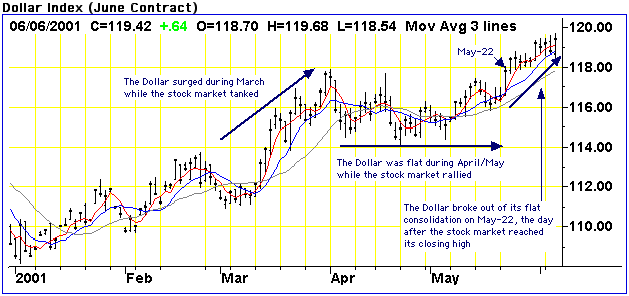
Below is a chart of the June Dollar
Index. The Dollar has been moving counter to the stock market for the past
few months, a pattern that appears to be continuing. The current up-swing
in the Dollar began on May-22, the day of the stock market's intra-day
high and the day after the stock market's closing high. If the stock market's
correction continues for another 2 weeks, as we currently expect, then
the Dollar could remain firm for another 2 weeks.
If the Dollar hangs in there for another
fortnight and the stock market continues its raggedy correction, then gold
and gold stocks will probably remain under pressure for the next 2 weeks.
As previously noted, support for the XAU exists in the 55-57 range and
we expect this support to get a thorough testing before the correction
is complete.
As was the case during April and May,
the next rally in gold and gold stocks should occur in parallel with the
next rally in the overall stock market (we expect the pattern that was
established in early-April to continue). With another FOMC Meeting (and,
therefore, another official interest rate cut) scheduled for Jun-27, the
period of Jun-21 through to Jun-27 provides a likely time for important
turning points in the currency, stock and gold markets. With gold and gold
stocks oversold and the Dollar overbought, an intervening gold/gold-stock
rebound and Dollar pullback would not be surprising.
Please note that the above analysis
is an attempt to explain the short-term action and finesse the turning
points, but should be of academic interest only to anyone who is not a
short-term trader. Our main objective is to stay in synch with the medium-term
trends, which are UP for gold, gold stocks and the stock market. Our work
suggests that the gold price, gold stock prices and the overall stock market
are headed substantially higher over the next 2-3 months.
Changes
to the TSI Portfolio
No changes.

|









