|
- Interim Update 6th July 2011
Copyright
Reminder
The commentaries that appear at TSI
may not be distributed, in full or in part, without our written permission.
In particular, please note that the posting of extracts from TSI commentaries
at other web sites or providing links to TSI commentaries at other web
sites (for example, at discussion boards) without our written permission
is prohibited.
We reserve the right to immediately
terminate the subscription of any TSI subscriber who distributes the TSI
commentaries without our written permission.
Protecting against "tail risk"
There
is an interesting article in the latest edition of Barrons magazine
about the increasing popularity of financial products and funds that
purport to insulate investors against so-called "tail risks"
(low-probability financial-market calamities, or "black swans" as they
are sometimes called). The fact that such products have come into vogue
over the past couple of years is a typical reaction to the events of
2008. As is their wont, investors are today doing what they wished they
had done a few years ago.
The article mentions the opinion of James Montier, who is a portfolio
manager, an author and an astute observer of the investment world.
Montier's impressions of "tail risk" vehicles are portrayed as follows:
"Montier makes the point
that defining the precise risk, then designing its antidote, and then
weighing exactly when one should begin shouldering the cost of carrying
such insurance, is easier said -- and sold -- than done. One must, he
says, be a value investor when considering all these factors, and in
the end plain old cash is probably an under-appreciated cushion against
bolts from the blue. "Over-engineering" is an important hazard, he
notes, as "it is too easy to construct an option that pays out under a
very specific set of circumstances," yet that does not by definition
offer broad tail-risk protection."
The above paragraph meshes with a point we have regularly made over the
years, which is that the best way for the vast majority of investors to
hedge against unexpected market events is to maintain a large cash
reserve. If you have a sizable 'cash cushion' then you will be half way
to being able to view market calamities as opportunities rather than
problems. Getting all the way there involves having the ability to
remain emotionally detached, thus making it possible to act objectively
in the face of extreme market-wide sentiment.
The Stock Market
The
US stock market moved sideways over the first two trading days of this
week and is probably in the process of consolidating last week's strong
advance. Our guess is that it is close to a short-term peak, but that
it will make some additional headway over the next couple of weeks.
Gold and
the Dollar
Gold and Silver
The real interest rate and gold
The Erste Group
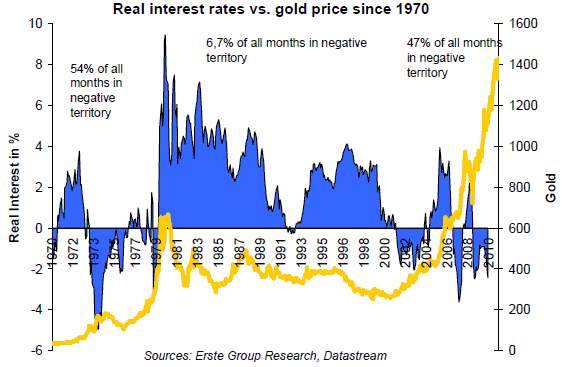
recently issued a lengthy (bullish) report on gold. Included within
this report was the following chart that compares the US$ gold price
with an estimate of the US real interest rate. In this case, the real
interest rate is calculated by subtracting the Shadowstats CPI from the
yield on 10-year US government bonds.
We have some qualms about this method of determining the real interest
rate, the main reason being that the CPI is a bogus number regardless
of whether we are talking about the official version or the Shadowstats
version (the Shadowstats version is just the old official version).
However, determining the real interest rate in this way is probably OK
when dealing with very long-term trends and looking for general
tendencies, as is the case here.
The chart constitutes evidence that gold does well during long periods
when the real interest rate spends a substantial portion (at least 40%)
of its time in negative territory, and does poorly during long periods
when the real interest rate spends almost all of its time in positive
territory. Its overarching message is that the current long-term upward
trend in the US$ gold price should remain intact until after the Fed
becomes sufficiently concerned about inflation risk to push the real
interest rate well into positive territory.
Note that the relationship between gold and the real interest rate only
works over periods of at least a few years, which means that it can't
be used to determine the likely performance of the gold price over the
next few months.
Current Market Situation
In the latest Weekly Update we noted that sentiment indicators for both
gold and silver had reached levels that were consistent with short-term
price lows. There was the potential for a final downward spike, but
especially in gold's case the remaining short-term downside risk
appeared to be minimal.
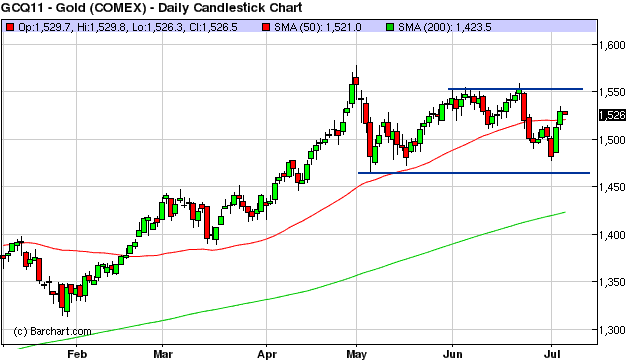
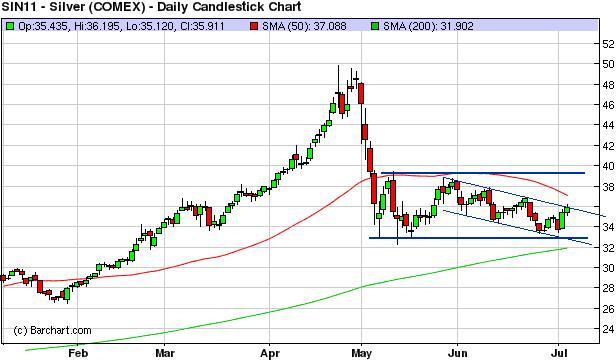
Gold and silver futures rebounded over the past two trading days, which
simply means that both remain within the consolidation ranges of the
past two months (the low-$1460s to the low-$1550s for gold, $33-$39 for
silver). There's a reasonable chance that the tops of these ranges will
be tested within the next several weeks.
The aforementioned consolidation ranges are indicated on the following daily charts.
Note that silver's position is still precarious, in that it hasn't yet
broken out of the short-term downward-sloping channel that began to
form in late May. It needs a daily close above $36.20 to break out to
the upside and project a further advance to around $39.
Gold Stocks
Current Market Situation
The following daily chart shows that this week's action has pushed the
HUI above resistance defined by its 50-day moving average. This doesn't
exactly clear the way, though, because there are many resistance levels
between the current price and the April high of 610, beginning with the
200-day moving average at 541.
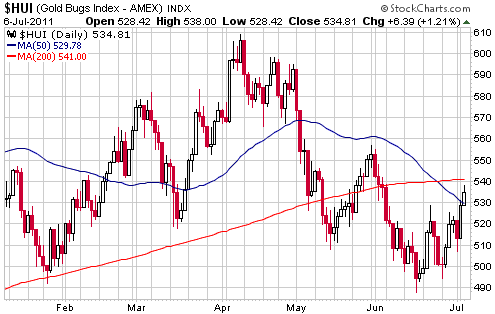
In our opinion, the
most likely scenario entails the HUI maintaining a positive bias over
the next several weeks and making its way up to at least 580 before
reversing direction and heading down to an October-November bottom.
However, we don't base buy/sell decisions on predicted short-term
scenarios; rather, we base such decisions on real-time analysis.
Recently, with the HUI in the 490s and the low-500s we were focused
mostly on opportunities for new buying. If the HUI moves up to the
mid-to-high 500s over the weeks ahead then we will likely become
focused on short-term selling opportunities, although it will depend on
the overall market situation and individual stock-price action at the
time.
Another note on drilling results
In the 14th February Weekly Update, we wrote:
"When a junior gold
mining company reports a wide gold intercept from a drill hole it will
often also report one or more narrower intercepts of higher-grade gold
that were included in the overall intercept. It's important to pay
close attention to these narrower intercepts, because they can
completely change the meaning of the drilling result."
In this earlier commentary we used a hypothetical example to explain what we meant, and concluded by saying:
"...narrow high-grade
intercepts are sometimes averaged over large widths in the reported
drilling results, which means that the 'headline numbers' in press
releases are not always representative of the actual situation."
Most of the time the regulators let junior mining companies get away
with the misleading averaging of narrow intercepts over much larger
distances, which, by the way, we have no problem with because the
practice falls well short of being fraudulent and because speculators
in the stocks of these companies should have enough knowledge to
determine the true situation. It therefore caught our attention when
Bayfield Ventures (TSXV: BYV) was recently forced by the British
Columbia Securities Commission (BCSC) to put out a press release clarifying the details of its "technical disclosure of drill results". Here's an example of what BYV was forced to clarify:
An announcement
by BYV on 27th June 2011 was headlined "Bayfield Drills 79.50m of 8.66
g/t Gold". This 79.5m intercept was reported as beginning at 15.5m
below surface.
79.5m of 8.66 g/t can be expressed as 688 gram-metres (79.5*8.66),
which is excellent. However, later in the press release the company
notes that the aforementioned intercept includes 11.2m of 60.05 g/t,
which can be expressed as 672 gram-metres, beginning at 47.8m below the
surface. This means that about 98% of the gold in the reported 79.5m
intercept was contained within an 11.2m section of the overall
intercept. What the company really discovered, therefore, was 11.2m of
high-grade gold-bearing rock beginning 47.8m below the surface. The
remaining 68.3m of the reported 79.5m intercept contained almost no
gold.
Now, 11.2m of 60.05 g/t gold beginning at 47.8m below surface is still
a good result, but it is a very different result to 79.5m of 8.66 g/t
gold beginning 15.5m below surface. This is especially the case if the
ultimate goal is to establish an open-pit mining operation.
All the information needed to understand the true situation was
provided by BYV in its 27th June announcement, albeit in a slightly
misleading way. Also, we've seen far more egregious attempts by junior
miners to create false impressions by averaging narrow intercepts over
large distances, so we are a little surprised that the BCSC decided to
single-out BYV. But because BYV has been singled out by the regulators
we thought we'd use it as a specific example of what we were talking
about in our 14th February commentary.
The moral of the story is that speculators in junior mining stocks
should look beyond the headline drilling results reported in press
releases to the details of each hole that are generally included in
tabular form in the bottom half of the press release.
Currency Market Update
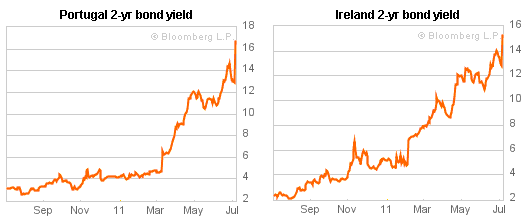
Moody's downgraded Portuguese government debt to junk status early this
week. This provoked a significant reaction in the debt market, as
illustrated by the following Bloomberg charts (the charts show that
yields on 2-year Portuguese and Irish government bonds rocketed upward
on Wednesday).
The Moody's downgrade
also provoked a reaction in the currency market, but in this case the
reaction was not significant. As illustrated below, there was a small
bounce in the Dollar Index.
If the currency
market follows the 2008 model then the Dollar Index will drop back to
the 73-74 range within the next three weeks before commencing a
powerful upward trend. However, a daily close above 76 would suggest
that the aforementioned upward trend had already commenced.
Update
on Stock Selections
(Notes: 1) To review the complete list of current TSI stock selections, logon at http://www.speculative-investor.com/new/market_logon.asp
and then click on "Stock Selections" in the menu. When at the Stock
Selections page, click on a stock's symbol to bring-up an archive of
our comments on the stock in question. 2) The Small Stock Watch List is
located at http://www.speculative-investor.com/new/smallstockwatch.html)
 Atna Resources (TSX: ATN). Recent price: C$0.57 Atna Resources (TSX: ATN). Recent price: C$0.57
We have decided to remove ATN from the TSI Stocks List at roughly
break-even (Wednesday's closing price was 1c below our December-2010
entry price).
There are possibly things going on behind the scenes that we aren't
aware of, but as far as we can tell the company's management continues
to focus almost exclusively on the low-margin Briggs gold mine. The
Briggs mine could turn into a reasonable cash generator, but our
primary motivation for adding ATN to the TSI List was the upside
potential provided by its other projects. Unfortunately, there is no
evidence that significant progress is being made in the development of
these other projects.
The lack of progress on the non-Briggs assets is one of two reasons for
exiting ATN. The other reason is that ATN's stock price has moved
sideways over the past few months while the prices of many other junior
gold stocks have tanked. As a result, there are now several junior gold
stocks that we like more than ATN that are currently not in the TSI
Stock Selections List. We plan to add two or three of these stocks at
opportune times over the next few months.
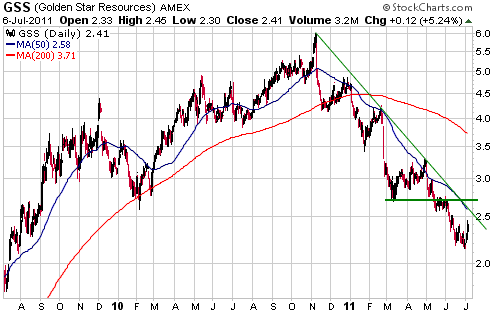
Golden Star Resources (NYSE: GSS, TSX: GSC). Shares: 259M issued, 265M fully diluted. Recent price: US$2.41
It's hard to imagine that 'the market' could become any more
disenchanted with GSS than it is right now. The company's management
has downgraded its 2011 production forecast multiple times over the
past 8 months, in the process taking market sentiment from optimism to
disgust. This doesn't mean that the stock price won't go lower, but it
does insulate the stock against additional bad news.
Although GSS bounced over the past two days along with most other gold
stocks, it remains at a very depressed level. It is a candidate for new
buying near Wednesday's closing price of US$2.41.
Kinross Gold (NYSE: KGC, TSX: K)
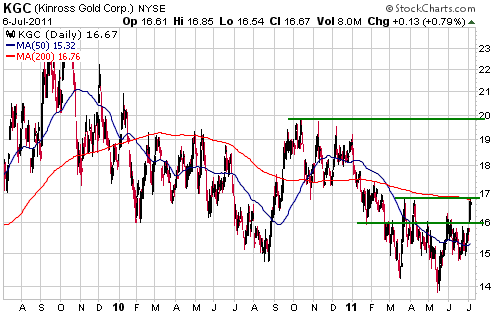
In last week's Interim Update we explained that after being relatively
weak for a long time, KGC had recently begun to exhibit relative
strength. Consequently, we thought that the time was ripe to take an
initial position, or add to an existing position, in the Kinross
D-Series warrants (TSX: K.WT.D). KGC has since risen from US$15.51 to
US$16.67, and the D-Series warrants have since risen from C$2.35 to
C$2.75.
With reference to the following daily chart, a normal pullback over the
days ahead would take KGC back to the vicinity of short-term support at
US$16.00. Also, a solid daily close above short-term resistance at
US$16.80 would suggest that the stock was on its way to
intermediate-term resistance at around $20. Therefore, in our opinion a
decline in the stock price to the low-US$16s would create another
short-term buying opportunity in the warrants, whereas a rise in the
stock price to near US$20 would create a short-term selling opportunity
in the warrants.
Buying uranium for 7c/pound
In the 11th May Interim Update we mentioned Tigris Uranium (TSXV: TU),
an exploration-stage uranium miner with projects in New Mexico. The
stock is too small, illiquid and risky to be in the TSI Stocks List,
but it is a member of the TSI Small Stocks Watch List.
We are mentioning it again for two reasons:
First, it has dropped back to a level where its 34M pounds of in-ground
uranium is being valued by the market at only slightly more than zero.
Specifically, the stock closed on Wednesday at C$0.25 -- after trading
as low as C$0.23 -- and the company has cash of around C$0.21/share,
which means that the market is presently valuing the company's
in-ground uranium at around 7c per pound.
Second, the stock traded huge volume over the past two days, so it
looks like a large holder of TU shares has just exited. That the stock
managed to hold its ground while this was happening points to there
being strong demand in the low-C$0.20s.
TU is a risky proposition because its in-ground uranium resource is
very low grade, but it could still be a worthwhile speculation near the
current price.
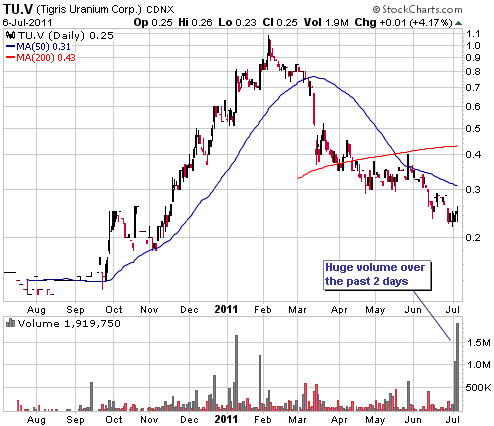
Chart Sources
Charts appearing in today's commentary
are courtesy of:
http://stockcharts.com/index.html
http://www.barchart.com/

|









