- Interim Update 7th October 2020
Copyright
Reminder
The commentaries that appear at TSI
may not be distributed, in full or in part, without our written permission.
In particular, please note that the posting of extracts from TSI commentaries
at other web sites or providing links to TSI commentaries at other web
sites (for example, at discussion boards) without our written permission
is prohibited.
We reserve the right to immediately
terminate the subscription of any TSI subscriber who distributes the TSI
commentaries without our written permission.
Commodities
Did Cameco kill the
uranium bull?
In late-July Cameco (CCJ), the world's
second largest uranium producer, announced that its Cigar Lake mine would
be put back into production in September-2020. Cigar Lake produced 18M
pounds of U3O8 in 2019 and had been placed on "care and maintenance" in
March-2020 in response to the low uranium price and the 'coronacrisis'
lockdowns. This prompted us to write (in the 29th July Interim Update):
"The decision to restart the Cigar Lake operation is significant
because the potential for a cyclical bull market in uranium is based on
the combination of reduced supply and stable demand. Our view, and likely
the view of many other speculators/investors, was that Cigar Lake would
remain off-line until after the per-pound uranium price made a sustained
move into the US$40s. The fact that it is being restarted with the
per-pound uranium price in the low-$30s is therefore a surprise.
CCJ's management knows the supply-demand situation in the uranium market
better than anyone, so it is possible that global supply has tightened to
the point where Cigar Lake can be put back into production without
derailing the upward trend in the uranium price. Also, it is not 100%
certain that Cigar Lake will reopen in September as currently planned,
because virus-related restrictions or a drop in the uranium price to below
$30 could prompt another re-think. However, we have decided to retreat to
the sidelines while waiting to see whether the Cigar Lake restart proceeds
and, if so, what effect it has on the market."
With regard to
bullish uranium-related speculations, the sidelines have been the place to
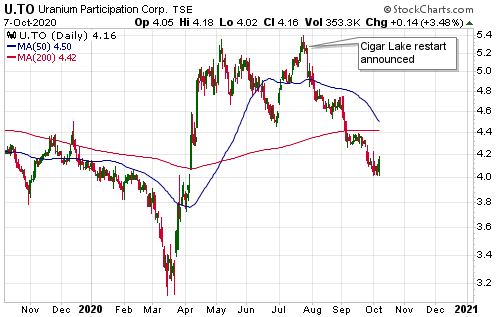
be over the past two months. This is evidenced by the following daily
chart of the Uranium Participation Fund (U.TO), a fund that invests in
physical uranium. The chart shows that U.TO has trended downward from
around C$5.20 to the low-C$4 area since the announcement of CCJ's decision
to re-open the Cigar Lake mine.
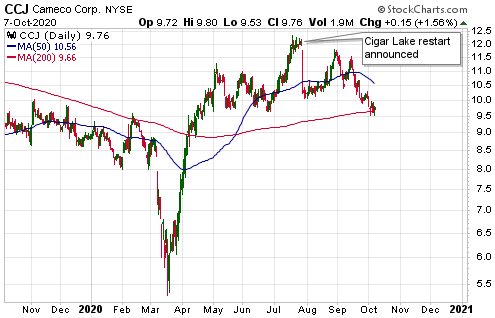
CCJ's stock price has held up better than the U's stock price, but the
news clearly marked a significant top for CCJ and on Tuesday of this week
it closed at a 5-month low.
The question is: Did CCJ's decision to restart Cigar Lake sooner and
at a lower uranium price than expected bring the nascent uranium bull
market to a premature end?
The answer is: Probably not, although
uranium's upside price potential has been reduced.
The uranium bull
is probably still alive because the combination of reduced supply and
stable demand still exists. This is partly because Kazatomprom, the
world's largest uranium producer, currently plans to maintain this year's
production curbs (production was reduced by 20% in response to the low
uranium price and the COVID-19 pandemic) until 2022. Kazatomprom's
production satisfied 23% of global uranium demand in 2019.
We view
the current weakness in the uranium market as a buying opportunity, but
not an aggressive buying opportunity. Rather than buying leveraged plays
on uranium such as the stocks of uranium mining companies, at this time we
like the idea of buying exposure to the physical commodity via U.TO. Even
if you aren't short-term bullish on uranium, buying U.TO near its current
price of C$4.16 could make sense because it is trading at a 19% discount
to its net asset value*. This creates upside potential of about 20%
without the need for any increase in the uranium price.
A trading
position in U.TO was removed from the TSI List (for a 50% gain) at C$4.97
in July, immediately after the Cigar Lake restart was announced. We are
now returning it to the List at Wednesday's closing price of C$4.16 as a
trade with an expected duration of up to 12 months. A 20% trailing stop
loss will be applied for risk management purposes.
*The net asset value was C$5.13/share on 30th September and would be
about the same now.
Critical support for oil
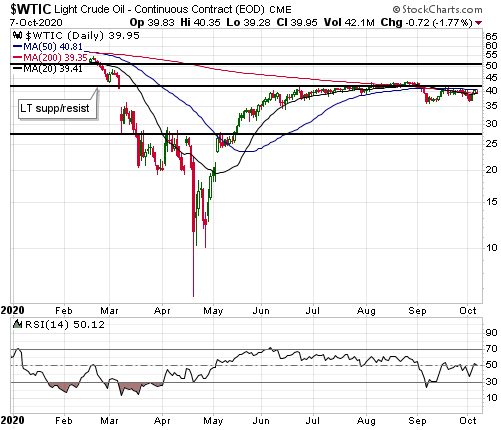
The short-term performance of the oil price has been difficult to
predict over the past few months. Late last week, for instance, the price
seemed to be about to break out to the downside from the relatively narrow
range of the past 3.5 months, which would be consistent with the bearish
supply-demand fundamentals and the strengthening US$. However, over the
first two days of this week it rebounded to the upper half of its
3.5-month range due to the likelihood that some US offshore oil production
will be curtailed by a hurricane.
The recent price action has
defined US$37.00 as a significant support level. Closing below this
support would suggest short-term downside potential to around $30 --
within the context of a cyclical advance expected to extend well into next
year.
The Stock Market
US politics and the
stock market
In the latest Weekly Update we wrote that the
potential news item that could have a significant effect on the US stock
market is a Democratic-Republican agreement regarding a new 'stimulus'
program. Specifically, we wrote that agreement on a $1.5T-$2.5T stimulus
program within the next couple of weeks probably would push most US stock
indices up to near or slightly above their September highs.
The
probability of a pre-election deal superficially seemed to plummet on
Tuesday 6th October when President Trump ordered his team to halt
negotiations with senior Democrats. Trump stated: "I have instructed my
representatives to stop negotiating until after the election when,
immediately after I win, we will pass a major Stimulus Bill that focuses
on hardworking Americans and Small Business."
We say
"superficially" because the decision to halt talks with the political
opposition is most likely a negotiating tactic from a president who should
know that a pre-election stimulus deal boosts his chances of remaining in
the White House (Trump actually 'softened' his stance via additional
tweets the same night). Furthermore, a promise to immediately pass a major
stimulus bill following victory at the November election is hollow, since
the best-case scenario for the Republican Party is that the composition of
the government remains as is. We are referring to the reality that the
Democratic Party retaining control of the House is one of the few
certainties about the coming election. It's the Republican-controlled
Senate and the Republican-held Presidency that are up for grabs. In other
words, even in the best possible election outcome for Trump, the passing
of a Stimulus Bill will require agreement from Democrats.
The way
things look at the moment, the election outcome that would generate the
most bullish 3-6 month performance by the US stock market and economy is a
Democratic sweep, even if the initial knee-jerk reaction to the news was a
sell-off. This is because it's the outcome that would involve the least
resistance to a Stimulus Bill and a huge infrastructure spending program.
However, it's common for the policies that provide the biggest
short-term economic boost to have the worst long-term consequences. In
this case, a Democratic sweep could be short-term bullish because it would
smooth the way to the immediate distribution of a lot more money, but the
additional spending would be counterproductive and the government would
become more interventionist and thus a greater economic burden. Also, if
the Democrats controlled the legislative and executive branches there
would be a much higher probability of something along the lines of
Universal Basic Income (UBI) being introduced, which would have
far-reaching and largely negative ramifications for the US economy.
We aren't expressing a political preference (we aren't members of any
political 'team'), but politics has a big influence on the investing
landscape and therefore must be taken into account.
Current
Market Situation
Trump's Tuesday tweet regarding the
temporary end to 'stimulus' negotiations was good for only a half-day
sell-off. The next day the SPX fully retraced the post-tweet plunge and
closed at a 3-week high.
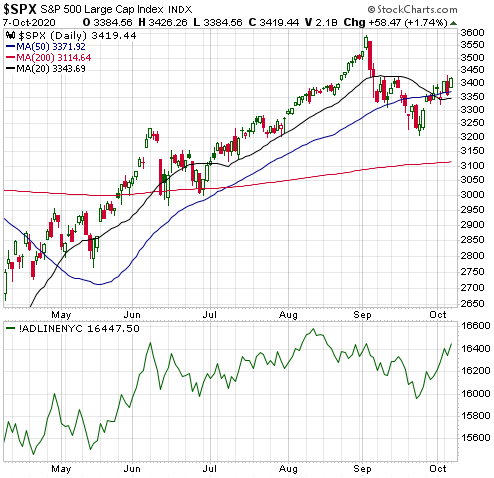
The following daily chart shows the SPX's
marginal new 3-week high. It also shows that the NYSE Advance-Decline Line
(ADL) has been stronger than the SPX since late-September. After bearishly
diverging from the SPX during August the opportunity for a bullish
divergence -- in the form of a lower high for the SPX and a higher high
for the ADL -- now exists.
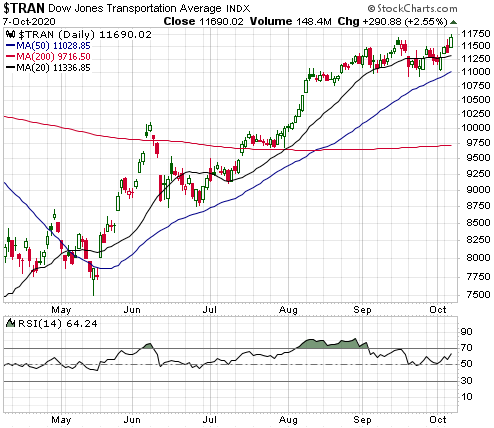
The Dow Transportation Average (TRAN) did even better than the SPX and
closed at a new all-time high on Wednesday 7th October.
The message from the market action of the past two days is: Everyone
knows that a roughly $2 trillion 'stimulus' package is coming, regardless
of what Trump says. If it doesn't come prior to the election, that is,
within the next three weeks, it will come shortly after the election.
The main risk is that the election will be a close-run affair and as a
result will be contested, thus making it very difficult to approve a major
new spending bill for at least a few months. This risk seemingly has been
reduced by Biden's increasing lead in the polls, but we aren't confident
that the polls are accurate. In our opinion the risk of a contested
election is not high, but it is high enough to warrant caution (in
practical terms this means hedging) until a result -- regardless of what
the result happens to be -- is known and generally accepted.
At
this stage the US stock market is adhering to the 1980 Model, which
suggests that over the remainder of this year there will be multi-week
swings of up to 10% in both directions but no major decline.
Hedging
There currently are two option positions
in the TSI List that could be viewed as either bearish stock market
speculations or hedges against stock market turmoil. One is an IWM
(Russell2000 ETF) October-2020 put option and the other is a QID
(leveraged NDX bear fund) October-2020 call option. Both options are a
long way out of the money and almost certainly will expire worthless at
the end of next week.
For hedging purposes we possibly will add a
QQQ put option with a December-2020 expiry date within the coming week if
the NDX moves up to near its early-September high, but note that the only
short-term risk that concerns us at the moment is the possibility of a
contested election. We think that any other election outcome would be
taken in stride or greeted with relief by the stock market.
Gold and the Dollar
Gold
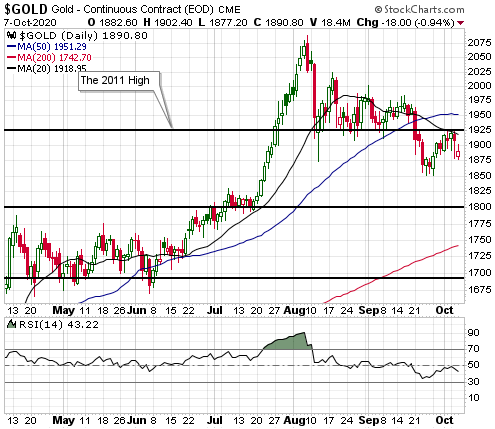
The
US$ gold price broke out to the downside in mid-September and made an
interim low in late-September. It then experienced a routine countertrend
bounce (rebounds within short-term downward trends often last 5-8 trading
days) that tested the breakout and the 20-day MA before resuming its
downward trend on Tuesday of this week. At least, that's our
interpretation of the following daily chart.
The HUI's price action has been similar.
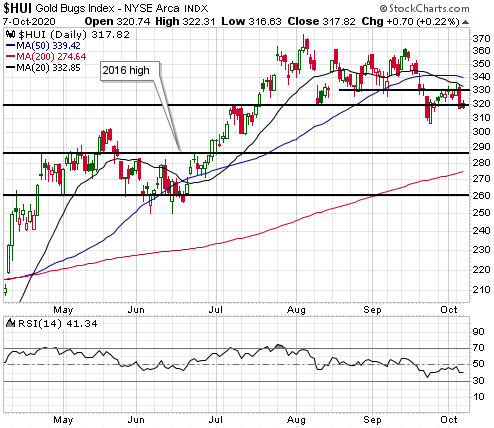
Both gold bullion and the HUI appear to be on their way to new
multi-month lows, potentially bringing their respective corrections to an
end this month. If we get correction lows this month then prices could be
above their August highs as soon as December and should be above their
August highs by February.
Attempting to sell the top and buy the
bottom doesn't work consistently, because tops and bottoms are known only
with the benefit of hindsight. In a crash scenario such as occurred in
March of this year the bottom usually can be identified within a few days
of its occurrence, but in most cases a lot more time has to transpire.
Consequently, rather than trying to do all of your buying/selling at what
you think is the ultimate low/high and running the high risk of going
all-in or all-out at an inopportune time, it is better to acknowledge the
reality of an uncertain future and methodically scale in/out based on the
weighing of risk against reward.
For gold, silver and the
associated mining stocks, there were many opportunities to reduce exposure
at attractive prices during the run-up to the early-August high and the
topping process that unfolded over the ensuing several weeks. It should be
a similar story with regard to increasing exposure over the next several
weeks. We can make educated guesses about where prices will make
correction lows (our current guesses are: around $1800 for gold, $20 for
silver and 270 for the HUI), but we acknowledge that the actual lows could
be above or below those levels and that in the absence of a crash there
could be at least a few weeks between the price low and the receipt of
definitive evidence that the correction is over.
So, the idea is
to scale in at attractive levels based on risk/reward considerations
linked to what's likely to happen over the next 6+ months. Don't focus on
doing all of your buying at the bottom, that is, don't try to do something
that requires more luck than good judgment.
A final point is that
the greater your current exposure the stingier you can afford to be with
new purchases. In other words, the greater your existing exposure the
lower the price you should insist on for new buying. That's generally the
case, not just right now with regard to precious metals and the associated
equities.
The Currency Market
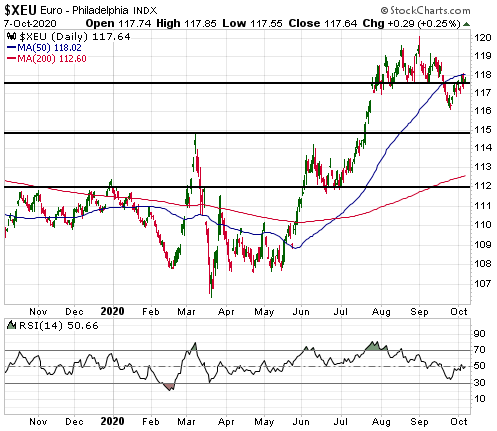
The
countertrend move in the gold price from a late-September low to a high
early this week went with a similar countertrend move in the euro.
Tuesday's downward reversal wasn't as pronounced in the euro as it was in
gold, but it's likely that a typical 5-8 day rebound has run its course.
We continue to think that the euro probably will drop to 115 and
could drop as far as 112 before resuming its longer-term upward trend.
Updates on Stock Selections
Notes: 1) To review the complete list of current TSI stock selections, logon at
http://www.speculative-investor.com/new/market_logon.asp
and then click on "Stock Selections" in the menu. When at the Stock
Selections page, click on a stock's symbol to bring-up an archive of
our comments on the stock in question. 2) The Small Stock Watch List is
located at http://www.speculative-investor.com/new/smallstockwatch.html
Chart Sources
Charts appearing in today's commentary
are courtesy of:
https://stockcharts.com/