|
- Interim Update 7th November 2012
Copyright
Reminder
The commentaries that appear at TSI
may not be distributed, in full or in part, without our written permission.
In particular, please note that the posting of extracts from TSI commentaries
at other web sites or providing links to TSI commentaries at other web
sites (for example, at discussion boards) without our written permission
is prohibited.
We reserve the right to immediately
terminate the subscription of any TSI subscriber who distributes the TSI
commentaries without our written permission.
On the
plus side
Obama's victory can be viewed as a plus for the free market. The
reason is that with a president in the White House who is generally
perceived to be a borderline socialist, the free market will not get
the blame for what's coming. Looking from a different angle, if
Romney, a man who is wrongly perceived to be inclined towards
economic freedom, had been elected then "the market" would
undoubtedly have copped a lot of the blame for the coming economic
malaise. The reality is that both Obama and Romney are big
government devotees, with the only differences being in the details
and in the way they are portrayed.
The way that politicians get labeled in the press and in the minds
of voters is often based less on what they do than on what they say
and the reputation of the party they belong to. G.W. Bush is a
classic example. Few US presidents did more to hobble the free
market and expand the tentacles of central government than he did,
but because he was a "Republican" who paid lip service to economic
freedom many people jumped to the conclusion that the major economic
problems that bubbled to the surface in 2007-2008 were caused by
insufficient government control. The idea that the 2007-2008
financial crisis was largely a consequence of unfettered capitalism
became far more popular than would otherwise have been the case
thanks to the public's incorrect perception of the junior George
Bush.
There will very likely be another financial crisis within the next
four years. Like the previous one, it will be caused by the central
bank's manipulation of interest rates and money supply and by the
government's interventions and spending. That's the bad news. The
good news for the pro-freedom minority is that with Obama at the
helm there is less chance of the next crisis being blamed on the
market.
Cash on
the Sidelines
This is a topic that we discuss about once a year
at TSI, but the repetition is worthwhile because the underlying concept is
widely misunderstood and yet fundamental to the way the monetary system works.
If you understand this concept you will also understand that there is never any
"cash on the sidelines" waiting to go into any market.
Cash, or in more general terms money, never goes into or out of any market.
Money simply gets transferred between buyers and sellers. Furthermore, aside
from a relatively small physical float of notes and coins, ALL of the money in
the economy is ALWAYS in the banking system. This means that any trade that
involves money and that doesn't involve the physical exchange of notes/coins
will involve a transfer from one bank account to another. Even when the buyer
and seller make and receive payment via money-market funds (money-market funds
are not money, they are investments in short-term interest-bearing securities),
completion of the transaction will involve the transfer of money from one bank
account to another. By way of further explanation, consider the hypothetical
example of Bill buying $1000 of Newmont Mining shares from Fred. In this case,
stockbrokers and MMFs (money-market funds) act as intermediaries, so the share
transaction involves the following 'monetary' transactions: On instruction from
Bill's stockbroker, the MMF linked to Bill's brokerage account sells $1000 of
interest-bearing securities to a buyer named Bob. This results in a transfer of
$1000 of cash from Bob's bank account to the bank account of Bill's MMF. This
$1000 of cash then gets transferred to Fred's MMF and is immediately used by
Fred's MMF to purchase $1000 of interesting-bearing securities from a seller
named John. $1000 of cash thus gets transferred to John's bank account, while
Fred (the seller of the Newmont shares) gets $1000 of additional MMF units.
Bill's purchase of $1000 of Newmont shares from Fred therefore results in a
change in Bill's investment mix ($1000 more shares and $1000 less MMF units), a
change in Fred's investment mix ($1000 less shares and $1000 more MMF units),
and a transfer of $1000 of cash from the bank account of Bob to the bank account
of John.
As evidenced by the above example, following the money can be complicated when
intermediaries are involved. The underlying concept, however, is simple: every
transaction in any financial market is completed via the transfer of money
between bank accounts. No money ever goes into or out of the financial market.
All the money remains within the banking system.
It therefore makes no sense to think in terms of there being "cash sitting on
the sidelines" ready to propel a particular market upward. In effect, all the
money in the economy is always "on the sidelines" in that all money is held by
someone. If there is monetary inflation then the so-called "cash on the
sidelines" will increase. End of story.
The Stock Market
The US stock market was quite weak on Wednesday, but this
weakness didn't appear to be a reaction to Obama's victory. Equities and other
beneficiaries of monetary inflation rallied on Tuesday in apparent anticipation
of an Obama victory and extended their gains during the Asian trading session on
Wednesday after Obama's re-election was confirmed. It appears that the attention
of the markets almost immediately shifted from the US presidency to other
issues, such as the coming "fiscal cliff" in the US and blatant economic
weakness in Europe.
In the latest Weekly Update we wrote:
"We will re-assess our short-term stock market outlook after we see the
reaction to the US Presidential election. If Obama gets re-elected and there's a
strong negative knee-jerk reaction in the stock market then we will almost
certainly upgrade our short-term view. The reason is that an Obama victory
should not be considered bearish for the stock market. In fact, it would
arguably be the more bullish outcome because it would ensure that the 'Great
Inflator' remained at the helm of the Fed. Just to be clear: there's a good
chance that the stock market will be trading a lot lower by this time next year
regardless of the election result, but a sharp sell-off prompted by the mistaken
view that an Obama presidency would be worse for the stock market than a Romney
presidency would likely set the stage for an advance into early-2013."
Despite Wednesday's sell-off we are still short-term bearish. This is because
the sell-off to date hasn't been substantial enough to bring short-term risk and
reward into balance, let alone skew the risk/reward in favour of reward. As
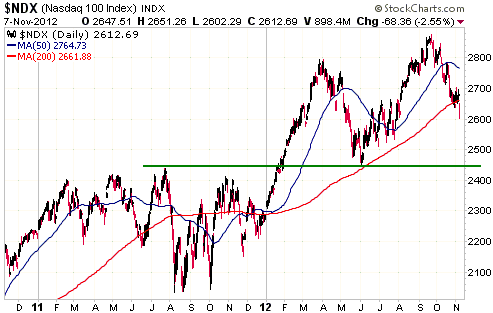
evidenced by the first of the following daily charts, the NASDAQ100 Index (NDX)
has suffered a meaningful decline over the past several weeks and is now
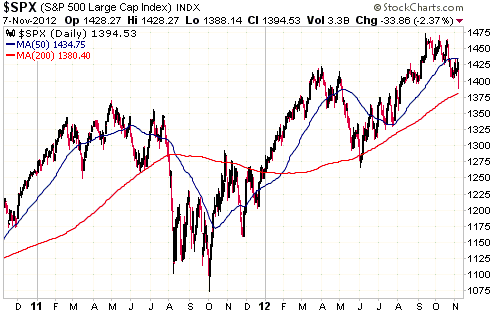
sufficiently 'oversold' to enable a multi-week rebound. The problem is that the
second of the following daily charts reveals a relatively minor decline, to
date, in the S&P500 Index (SPX). It fell 33 points on Wednesday, but the SPX is
only down by 19 points (1.3%) since the end of last week and 71 points (4.8%)
since its 14th September peak.
None of the sentiment, breadth and momentum indicators we track point to the US
stock market being 'oversold' at this time. Furthermore, many Asian and European
stock markets appear to be just starting to roll over after making short-term
peaks.
The bottom line is that there is scope for significant additional downside over
the weeks ahead. This is not a forecast that there will be significant
additional downside, it is an assessment that there is still enough risk to
warrant a short-term bearish outlook.
Gold and the Dollar
Gold
Gold and the US Election
In the 15th October Weekly Update there was a discussion titled "Preparing for
the US Presidential Election". Here's how we concluded this discussion:
"...there is very little difference between the two possible election
outcomes with regard to the intermediate-term prospects for the US economy, US$
inflation and the financial markets. It's likely that an Obama victory would be
more supportive for gold in the short term, but in any case there's a good
chance that the result of the election will largely be factored into the market
before election day."
The outcome that was thought to be the more short-term supportive for gold has
occurred. The jury is still out, but this increases the probability that the
gold market made a correction low last week. Also, based on the sizes of the
market moves on Wednesday 7th November it is clear that the result of the
election was, indeed, largely factored in beforehand. Either that or the markets
figured out that the election didn't matter in the grand scheme of things.
Current Market Situation
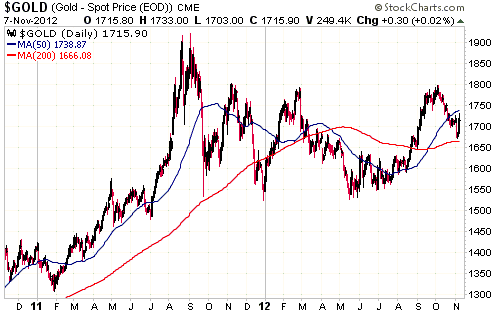
Gold bounced strongly on Tuesday 6th November, seemingly in anticipation of an
Obama victory, and then held its gains on Wednesday. This week's price action is
preliminary evidence that gold's correction bottomed in US$ terms last week at
marginally above its 200-day moving average.
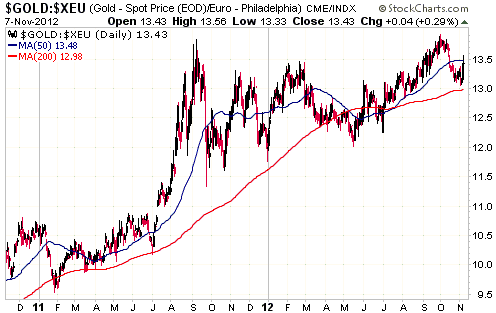
It's the same story for gold in euro terms.
Gold Stocks
The HUI/gold ratio's recent bullish divergence from both gold and the HUI was
eliminated during the first two days of this week. Interestingly, however, the
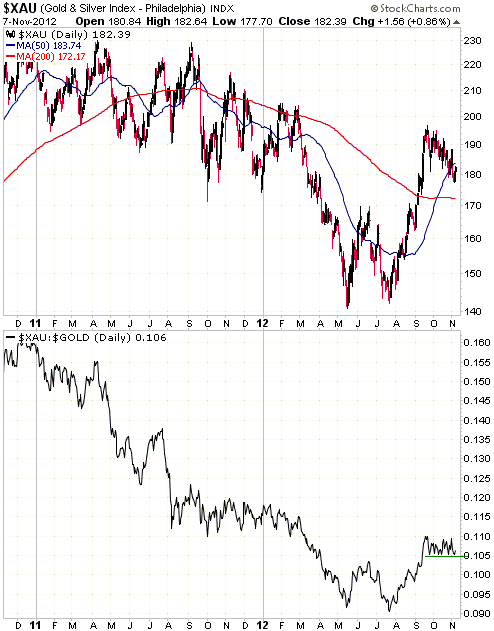
XAU/gold ratio's recent bullish divergence remains intact. The following chart
shows that the XAU has been steadily working its way downward in stair-step
fashion (a normal 'corrective' price pattern) over the past several weeks while
the XAU/gold ratio has been moving sideways.
Nothing has changed in the gold sector. There wasn't even an increase in
volatility due to the election. The correction that began in September might or
might not have ended. We won't know until the price either breaks to a new low
or moves much higher (a daily close by the XAU above 190 would be a clear sign
that the correction had ended). What we do know is that the price action
continues to have the look of a correction within the context of an upward
trend.
Currency Market Update
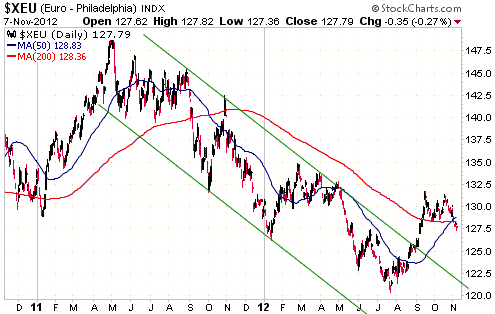
In the 29th October Weekly Update we noted the tendency for the euro to make
important reversals during November-January. We then said: "The euro could be
headed for another November-January reversal, in this case a reversal from up to
down. However, for this to be the case it will have to break above its September
high over the weeks ahead and rise to at least 135. Price action of this nature
would probably eliminate the remaining speculative net-short position in euro
futures and establish a sentiment platform capable of supporting an
intermediate-term euro decline and Dollar Index rally."
The euro has since lost about 1.5 points. It is therefore not yet doing what it
needs to do to set the stage for an important November-January high, but there
is still time.
Update
on Stock Selections
Notes: 1) To review the complete list of current TSI stock selections, logon at
http://www.speculative-investor.com/new/market_logon.asp
and then click on "Stock Selections" in the menu. When at the Stock
Selections page, click on a stock's symbol to bring-up an archive of
our comments on the stock in question. 2) The Small Stock Watch List is
located at http://www.speculative-investor.com/new/smallstockwatch.html
Chart Sources
Charts appearing in today's commentary
are courtesy of:
http://stockcharts.com/index.html

|









