|
- Interim Update 7th December 2011
Copyright
Reminder
The commentaries that appear at TSI
may not be distributed, in full or in part, without our written permission.
In particular, please note that the posting of extracts from TSI commentaries
at other web sites or providing links to TSI commentaries at other web
sites (for example, at discussion boards) without our written permission
is prohibited.
We reserve the right to immediately
terminate the subscription of any TSI subscriber who distributes the TSI
commentaries without our written permission.
Can the euro experiment
be salvaged?
Europe's monetary union is clearly stressed and at risk of breaking apart. The solution, according to some pundits, is massive monetary inflation by the ECB. According to other pundits, a strict fiscal union is the optimum solution. The first of these solutions is plain silly because it effectively involves destroying the euro in order to save the euro. It brings to mind George W Bush's moronic statement in December of 2008 that he had abandoned free-market principles to save the free-market system, and the famous
comment by a US army officer
during the Vietnam War: "It became necessary to destroy the town to save it." The second solution is not as blatantly silly as the first, but it is still illogical. Here's why:
The second solution is based on the idea that lack of political union is a major flaw in the monetary union. Or, to put it another way, it is based on the idea that a common currency could work if a supranational institution had control over the government budgets of individual nations. However, there is a major problem with this whole line of thinking. The problem is evidenced by the fact that during the 100 years prior to WWI almost the entire world was able to use a common currency (gold) to good effect without any need for political or fiscal union. If the government of one country that used gold as money got into financial trouble, it neither limited the ability of other countries to continue using gold as money nor imposed any requirement for greater fiscal/political unification. Why, then, do the debt and budgetary problems of some eurozone governments necessitate the establishment of closer political and fiscal ties throughout the eurozone?
The answer is that they don't. The genuine solution is for over-indebted governments to directly and massively default on their debts, thus causing the lenders to these governments to suffer the deserved consequences of their bad investment decisions.
It is, however, argued that if governments default then a lot of banks will go bust. Our response is: so what? Isn't it time that banks stopped being protected at the expense of everyone else from the consequences of their investing mistakes?
But ..., the interventionists will undoubtedly retort, if banks go bust then innocent bystanders will be hurt. Specifically, depositors will lose their hard-earned savings!
While it is possible to imagine a scenario in which bank failures caused deposits to be wiped out, the bank bailouts that have happened to date have had absolutely nothing to do with protecting depositors. It is important to understand that a bank's depositors would only ever be at risk after the investments of the bank's equity-holders and bondholders had been written down to zero. To put it another way, there would be no risk to depositors as long as bondholders were able to recoup at least 1 cent on the dollar. During the US banking crisis of 2007-2009, bank bondholders generally ended getting 100 cents on the dollar.
Even in cases where equity and bond investors are wiped out, the depositors might not be at risk. The reason is that the traditional banking businesses of most banks (the business of taking deposits at X% and making loans at X+Y%) are profitable and valuable. If a bank went bust, this part of
its business could potentially be separated out and sold to new owners with no financial effect on depositors.
As an aside, we are against creating money out of nothing regardless of how the new money is used, but if the central bank is going to engage in monetary inflation it should at least be done with the sole aim of making depositors whole.
Getting back to the euro and the euro-zone's debt predicament, greater fiscal/political union is obviously not required for the euro to remain a viable currency. However, it is required if banks are to continue being shielded from the consequences of their investing mistakes. This is one of the two keys. The other key is that fiscal union paves the way for more central planning, which is the unstated goal of many politicians and technocrats.
Summing up, the increasingly popular idea that fiscal union is needed to save the euro is just propaganda designed to pave the way for more central planning and more bailouts of the financial elite. Markets
to gyrate wildly in response to the coming EU summit
The leaders of European Union countries will meet on 9th December in Brussels in an effort to come up with a solution to the sovereign debt predicament. They won't come up with a genuine solution, because -- as discussed above -- the only genuine solution entails massive direct default on government bonds and massive direct default does not appear to be open for consideration. They might, however, come up with something that excites the markets, leading to large rises in equities and commodities and large declines in US Treasury bonds. Alternatively, if nothing is seen to be achieved then in response the equity and commodity markets would probably plunge and US Treasury bonds would probably surge. Either way, the world's major financial markets will likely make some big moves in days following the completion of the EU summit.Government
of Portugal seizes pension funds
Hat tip to Franklin Sanders of the-moneychanger.com for making us aware of the article posted
HERE. The article states that Portugal's government has decided to transfer about 5.6 billion euros of pension funds onto its own balance sheet in a bid to meet its fiscal target, and asks the question: With its European counterparts seizing public pension and retirement funds, will the US find itself "righted" to do the same?
The moral of the story is: do not put or leave your financial security in the hands of any government. Governments are capable of doing anything to ensure their own survival. Absolutely anything.The Stock Market
US corporate earnings reported for the final quarter of this year are going to be OK, but the trend has clearly turned for the worse. As stated in the article posted
HERE:
"...analysts and corporations have significantly tempered expectations for earnings growth for Q4 2011 for the S&P 500. Since the start of the quarter, the estimated earnings growth rate for the S&P 500 has dropped to 13.6% today from 19.0% on September 30, due to broad-based cuts to earnings estimates. On a percentage basis, share-weighted earnings for the quarter have fallen by 4.6% during this time. This 4.6% cut reflects the sharpest reduction in estimates through the first nine weeks of a quarter since Q2 2009 (-5.8%). In terms of EPS guidance, companies have issued 81 negative preannouncements for Q4 2011. If the final number of negative preannouncements for the quarter is 81, it will tie the mark with Q4 2008 for the highest number of negative EPS preannouncements issued during a quarter (since 2006)."
The article goes on to point out that more than half of the 13.6% estimated year-over-year Q4 growth in S&P500 earnings is due to a single company: AIG. If AIG is excluded from the index, the estimated Q4-2011 earnings growth rate drops from 13.6% to 6%.
In any case, if earnings growth is going to be a problem it will be next year's problem. For the remainder of this year and at least the first half of January, technical factors, sentiment and the latest developments in Europe's sovereign debt saga will be the drivers. As discussed above, the 9th December EU summit is the most likely catalyst for the next significant move in the stock market.
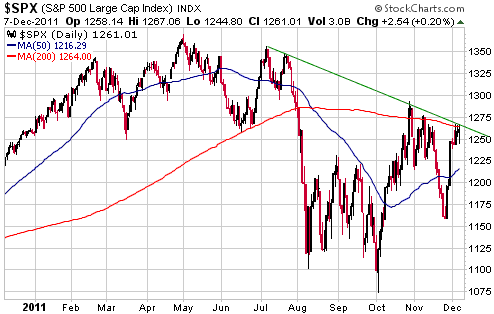
The following daily chart shows that the S&P500 Index is presently consolidating just below its 200-day moving average and a downward-sloping trend-line. The stage is therefore set for either an upside breakout or a rally failure within the next several trading days. If we had to bet one way or the other we'd bet on an upside breakout, but, fortunately, we don't have to bet.
Gold and the Dollar
Gold and Silver
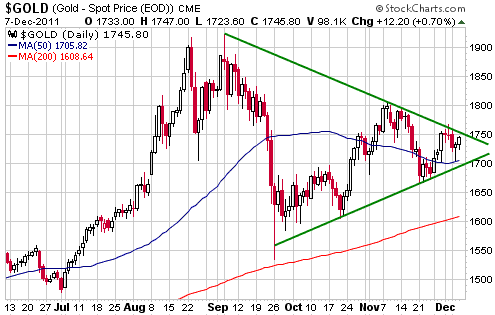
Gold pulled back to its 50-day moving average during the first two trading days of this week and then rebounded.
Prior to the start of this week the odds were in favour of gold breaking out to the upside from its contracting range. If anything, this week's action has shifted the odds a little more in favour of an upside breakout.
In last week's Interim Update we noted that silver had spent 8 trading days oscillating between $31 and $33. It has now spent 13 trading days within this narrow horizontal range.
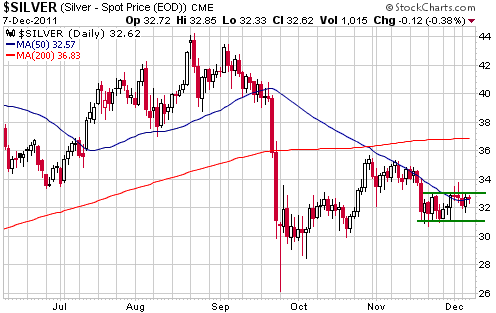
If gold breaks out to the upside then silver should do the same. As mentioned in previous commentaries, silver has the potential to rally to the high-$30s over the weeks ahead while remaining in a longer-term downward trend.
Gold Stocks
Current Market Situation
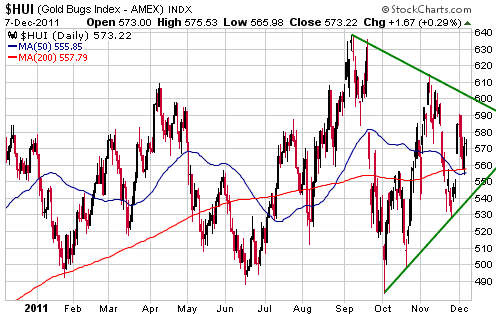
As is the case with gold bullion, the HUI dropped back to its 50-day moving average during the first two days of this week and then rebounded. It ended Wednesday's session in the middle of its contracting range.
An upside breakout from the declining-tops/rising-bottoms pattern is the most likely short-term outcome, but what happens to the gold stocks over the days immediately ahead will be strongly influenced by what happens at the EU summit. If the average trader comes to believe that the EU leadership has 'bought some more time', then the gold sector will likely be propelled upward along with the broad stock market.
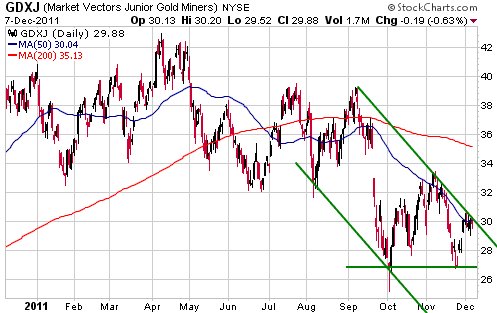
GDXJ, the Junior Gold Miners ETF, is positioned in a way that it could be the first gold-stock ETF or index to break out. As illustrated below, GDXJ is not far from the top of its downward-sloping channel.
Why have gold stocks under-performed?
Jordan Roy-Byrne's recent article about the weakness of gold stocks relative to gold bullion is interesting, despite the fact that he references one of our charts. His conclusion is:
"...the gold equities are coming to the end of the consolidation, and a resolution within months is likely. Sentiment is bullish from a contrary perspective. The consolidation has weeded out the weak and impatient as earnings and cash flows for gold companies have improved and stock valuations have moved to multiyear lows. Even in gold and silver we see that speculative long positions are near multiyear lows. This setup combined with the forthcoming monetization in Europe, stimulus in China, and more monetization from Fed Chairman Ben Bernanke could produce quite the launch pad for the gold shares in early 2012."
This conclusion is reasonable. We note, however, that while monetization in Europe, stimulus in China and more monetization from Fed Chairman Ben Bernanke are things that almost certainly will happen at some point, they haven't happened yet and the timing is unknown.
Rather than assuming that something will happen at a specific future time and gearing yourself up for that eventuality, just be patient and take the evidence as it comes.
Ecuador
Gold mining companies with projects in Ecuador have been weighed down for years by uncertainty surrounding the terms of mining licences, because the government stopped issuing new licences while it tried to figure out -- with input from miners -- how licencing deals should be structured. From the perspective of a mining investor, this uncertainty made Ecuador a country with high political risk.
Due to this week's announcement of the near-finalisation of a deal between Ecuador's government and Kinross Gold (KGC) regarding the exploitation of the Fruta del Norte (FDN) gold project, much of the uncertainty has been removed. In this case, however, the removal of uncertainty has exposed a reality that is far worse than most rational observers would have feared. Here are two of the salient features of the proposed deal:
1. An obligation to maintain the government's share of project economic benefits at a MINIMUM of 52 per cent. Project economic benefits are defined as the cumulative sum of the government's share (comprising the royalty, corporate income tax, the state portion of the profit-sharing contribution and windfall profit tax, as described below, plus a 12-per-cent value-added tax applied to customary project expenditures) and Kinross's share (comprising the after-tax free cash flows of the project)
2. A windfall profits tax, whereby the government receives 70 per cent of the excess of the realized gold price above an agreed base gold price. The base gold price is defined as the greater of $1,650 per ounce and the spot gold price at the time of signing of the definitive exploitation agreement.
So, in exchange for taking 100% the risk KGC will end up with a MAXIMUM of only 48% of the project's economic benefits. Moreover, KGC's share of the economic benefits would drop substantially at a much higher gold price (due to the windfall tax) and could potentially drop to zero if there were large increases in both the gold price and the cost of production. Detailed analysis of how the tax/royalty deal affects FDN's economics under various scenarios can be found
HERE.
The most shocking aspect of this deal is that KGC's management agreed to it.
Perhaps, due to the size and quality of its gold deposit, KGC will still be able to make a decent return from FDN, but the vast majority of projects would not be worth developing under such terms. It therefore makes sense to steer clear of mining companies that have their major asset in Ecuador, at least until there is evidence that better deals can be negotiated with the government.
Currency Market Update
It is worth keeping an eye on the progress of the financial transactions tax discussed in the NYT article posted
HERE. At this stage it looks like the tax stands the best chance of being implemented in the euro-zone.
If the tax is implemented globally it would be equally bearish for all economies, asset markets and currencies, although it would be a long way from being the most important bearish factor. If it is only implemented in the euro-zone it would be another reason to expect relative weakness in the euro.
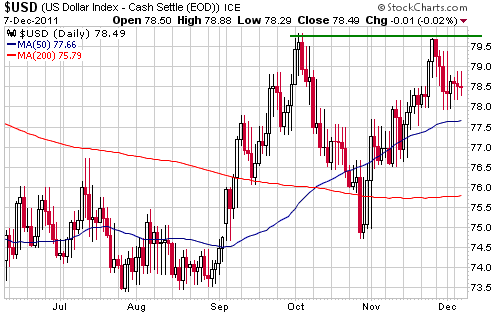
The following chart shows the current position of the Dollar Index. Ideally, the Dollar Index will spend the next few weeks in consolidation mode, thus enabling the Commitments of Traders situation to become less lopsided. However, if this week's EU summit fails to buy some time then the dollar's upward trend will probably resume.
Update
on Stock Selections
Notes: 1) To review the complete list of current TSI stock selections, logon at
http://www.speculative-investor.com/new/market_logon.asp
and then click on "Stock Selections" in the menu. When at the Stock
Selections page, click on a stock's symbol to bring-up an archive of
our comments on the stock in question. 2) The Small Stock Watch List is
located at http://www.speculative-investor.com/new/smallstockwatch.html
 Evolution Mining (ASX: EVN) (Formerly Catalpa Resource, CAH). Shares: 693M issued, 709M fully diluted. Recent price: A$1.74 Evolution Mining (ASX: EVN) (Formerly Catalpa Resource, CAH). Shares: 693M issued, 709M fully diluted. Recent price: A$1.74
EVN shareholders who chose not to exercise their rights to purchase 3 new shares at A$1.45 for every 17 shares held, will receive a payment of A$0.25 per right. This works out to 4.4c per share (3/17 * A$0.25).
For record purposes, we will treat the 4.4c/share as a capital return and adjust our cost base accordingly.
Clifton Star (TSXV: CFO)
Although CFO is not mentioned in the 7th December article titled "Passport Capital's Top Stock
Picks", the article could be of interest to holders of CFO shares. The reason is that Passport Capital owns about 20% of CFO, making it the junior gold miner's major shareholder. Furthermore, Passport Capital's ownership stake increased from 17% to 20% in July -- just prior to the halting of trading in CFO shares.
Jaguar Mining (NYSE and TSX: JAG). Shares: 84M issued, 88M fully diluted. Recent price: US$6.55
A Jaguar Mining press release issued after the close of trading on Tuesday announced that the company's CEO had stepped down. The fact that the departure was immediate (there was no transition period from the old CEO to a new CEO) suggests that this was a firing rather than a resignation.
The performance of JAG's former CEO was terrible, so the news of his departure would ordinarily be viewed as a minor positive. However, with JAG's stock price having recently been given a hefty boost by a rumour that a Chinese company had expressed interest in making a $9.30/share bid, the news was perceived as decidedly negative.
Since the initial large price jump in response to the rumoured bid, JAG has not traded as if a serious $9.30 bid were on the table. The CEO's sudden departure casts more doubt on whether a genuine bidder is stalking the company.
The stock was trading in the mid-US$5 area just prior to the surfacing of the bid rumour last month, so at the close of trading on Wednesday there was still a modest bid premium built into the stock price. Based on what we know today, we wouldn't consider JAG to be a good candidate for new buying unless this premium was eliminated. At the same time, JAG currently isn't a good candidate for selling because the short-term downside risk is probably limited by support at $5.50-$6.00 and because there is significant upside potential regardless of whether or not a takeover bid is in the works.
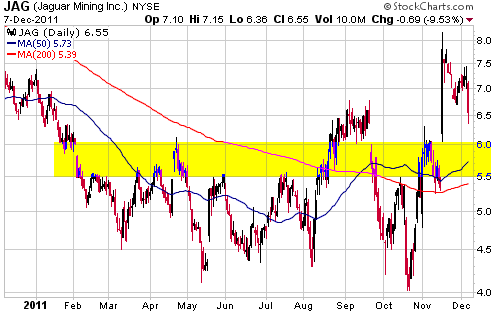
Chart Sources
Charts appearing in today's commentary
are courtesy of:
http://stockcharts.com/index.html

|









