|
- Interim Update 8th May 2013
Copyright
Reminder
The commentaries that appear at TSI
may not be distributed, in full or in part, without our written permission.
In particular, please note that the posting of extracts from TSI commentaries
at other web sites or providing links to TSI commentaries at other web
sites (for example, at discussion boards) without our written permission
is prohibited.
We reserve the right to immediately
terminate the subscription of any TSI subscriber who distributes the TSI
commentaries without our written permission.
The Stock Market
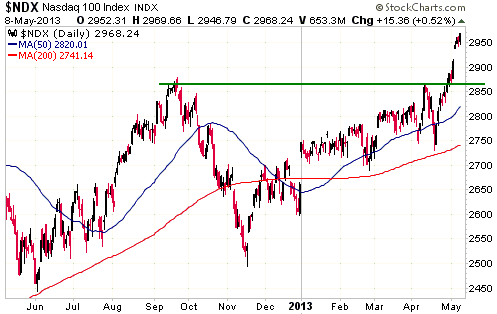
Regardless of the longer-term outlook, the NASDAQ100 Index (NDX)
is likely to pull back to test its recent break above resistance at 2850-2870
within the coming few weeks. The further it moves away from this former
resistance (now support) in the very short-term, the larger the eventual
pullback will have to be.
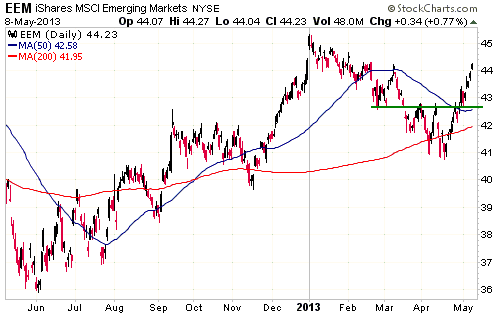
There's no way of knowing how long it will continue, but an equity-market
rotation is underway. The rotation began late last month and entails a shift
away from the "defensive" dividend plays, most notably the utility stocks,
towards global growth plays such as mining and emerging-market equities.
The rotation can be seen by comparing the following charts of the Dow Jones
Utility Average (UTIL) and the iShares Emerging Markets ETF (EEM).
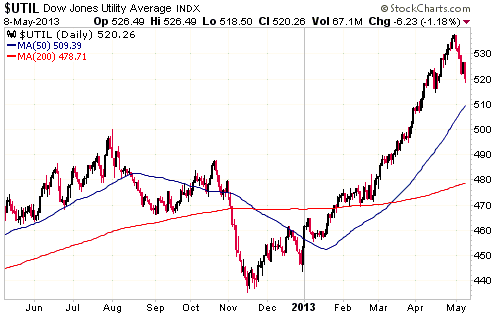
Note that regardless of reputation, no sector of the stock market can be
genuinely defensive after it has gone parabolic to the upside. Parabolic
up-moves usually lead to crashes, with the main question being one of timing
(how far will the parabolic up-move go before the inevitable collapse occurs?).
So, while it could reasonably be said that buyers of utility stocks near last
year's lows were playing defense, the same couldn't be said of buyers of utility
stocks near the April-2013 highs.
Also note that we perceive substantial intermediate-term downside risk in both
UTIL and EEM, but on a short-term basis EEM has the advantage that it is
rebounding from an 'oversold' extreme.
In early January, when we wrote our Yearly Forecast for 2013, we had no opinion
on what the stock market would do over the course of the year and saw no point
in pretending otherwise. However, for what it's worth (probably not much) the
price action of the past couple of weeks has led us to a forecast of what the
stock market is likely to do over the final 7.5 months of this year. We'll
outline this forecast in the next Weekly Update.
Gold and the Dollar
Gold and Silver
Five basic FACTS that many commentators on the gold market either don't know or
deliberately ignore:
1) The amount of gold produced by the mining industry is not the supply of gold.
The supply of gold is the sum total of all the gold mined throughout the ages
that is still available in saleable form today. This is at least 100,000 tonnes
and could be as much as 150,000 tonnes. The amount of gold produced by the
mining industry each year can reasonably be thought of as the gold inflation
rate. Over the past 100 years the gold inflation rate spent almost all of its
time in the 1.7%-2.0% range.
2) Further to 1) above, any analysis of the gold market will be illogical if it
is based in any way on the premise that the supply of gold is the amount of gold
produced in a year by the mining industry.
3) The demand for gold cannot be determined independently of price. To be more
specific, the change in the price over a period is the only reliable indicator
of what happened to the demand for gold relative to the supply of gold over the
period.
4) The volume of gold moving from one part of the world to another part of the
world provides no reliable information about the past, present or future
performance of the gold price.
5) Reliable information about the overall demand for physical gold cannot be
obtained by looking at demand in one small part of the market. Of special
relevance at this time, the change in the public's demand for gold coins and
small gold bars is not a reliable indicator of the overall change in the demand
for physical gold.
Something that isn't a fact, but is highly probable: If at any time there is a
'disconnect' between the physical and "paper" gold markets, with the total
demand/supply ratio for physical gold increasing sharply relative to the total
demand/supply ratio for "paper" gold, the disconnect will be indicated by
substantial and sustained backwardation in the gold futures market.
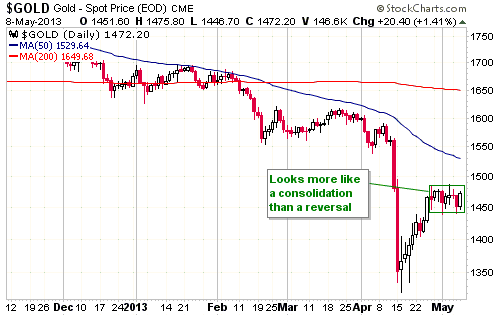
Gold's price action since the 26th April high is looking more and more like a
consolidation within a short-term upward trend, as opposed to the start of a
decline that ultimately takes the price back to the vicinity of its mid-April
low. If so, gold's next move of significance will be a rise to former support
(now resistance) at $1525-$1550.
Note that a daily close below $1445 would invalidate the idea that gold is
consolidating ahead of a rise to new multi-week highs. Also note that an
eventual test of the mid-April low is likely. If the test doesn't happen within
the next couple of weeks then it will probably happen during the final quarter
of this year.
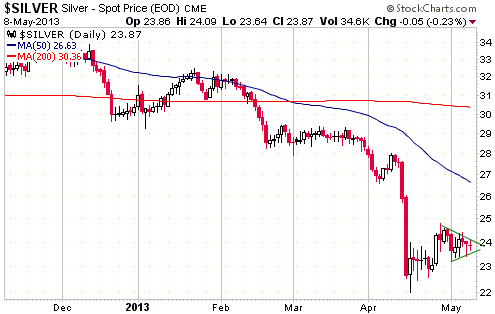
Silver's rebound from its mid-April low has been weaker than gold's. However, on
a short-term basis the overall financial-market backdrop is more bullish for
silver than for gold. Whether rational or not, the performances of broad stock
indices and credit market indicators suggest that we are in a period of rising
economic confidence. This has just begun to support the base metals and should
create strength in silver relative to gold. Therefore, if gold manages to break
out to the upside from its range of the past 9 trading days then we will
probably get a decent bounce in the silver price.
Resistance for gold at $1525-$1550 is equivalent to resistance for silver at
$26-$27.
Gold Stocks
Comparing long-term bull markets in gold stocks
The last long-term bull market in gold-mining stocks, which ran from the
early-1960s through to 1980, occurred in parallel with a major upward trend in
interest rates, a steady undercurrent of "inflation" fear, and the occasional
dramatic "inflation" scare. However, the current -- we think it's still current,
although this won't be proven until the gold-stock indices exceed their 2011
peaks -- long-term bull market in gold-mining stocks has unfolded in parallel
with a major downward trend in interest rates, a steady undercurrent of
"deflation" fear, and the occasional dramatic "deflation" scare. These
differences could have -- and preferably would have -- resulted in gold-mining
stocks performing differently relative to gold and the broad stock market during
the current bull market than they did during the last bull market, but that
wasn't to be. Gold-mining stocks are putting in a similar showing this time
around.
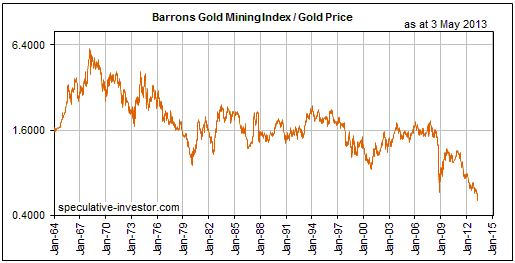
The following weekly chart of the BGMI/gold ratio (the Barrons Gold Mining Index
relative to the bullion price) reveals that the gold mining sector did very well
relative to gold during 1964-1968 and then embarked on a substantial long-term
decline. The major bottom for the BGMI/gold ratio actually coincided with the
major peak in the gold price in January of 1980, at which point the gold-mining
stocks commenced a 2-year rally relative to gold. Something similar has
transpired during the current bull market, in that strength in the gold-mining
sector during the first few years of the bull market was followed by a
substantial long-term decline.
Notice that BGMI/gold's long-term decline of 1968-1980 was interrupted by two
meaningful (1-2 year) counter-trend rallies, one during 1970-1971 and the other
during 1973-1974. To date, the long-term decline in BGMI/gold that began in 2006
has only been interrupted by one meaningful counter-trend rally (the sharp
12-month rally that began in October of 2008). It's a good bet that a second
counter-trend rally will begin this year -- from either an April-May low or an
October-November low.
The next chart reveals that while the BGMI/SPX ratio (the gold-mining sector
relative to the broad US stock market) trended higher during the 1960s and
1970s, there were two substantial counter-trend moves. The current long-term
upward trend in the BGMI/SPX ratio is immersed in its first substantial
counter-trend move.
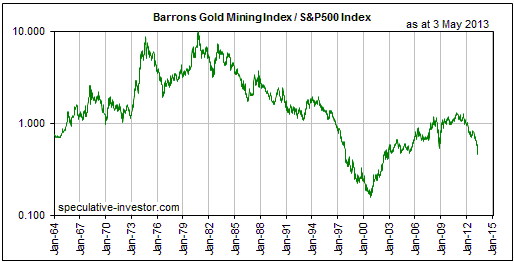
The bottom line is that rather than being evidence that the gold sector's
long-term bull market has come to an end, the recent extreme weakness in gold
mining stocks relative to gold bullion and the broad stock market is consistent
with what happened during the middle stages of the last bull market.
Current Market Situation
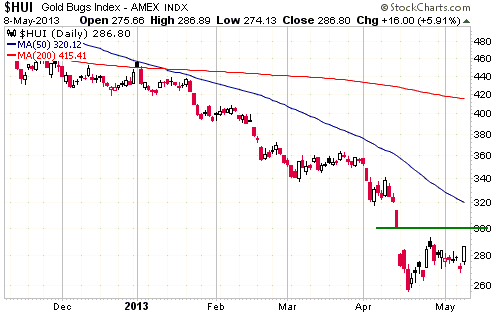
The HUI dropped to short-term support at 270 on Tuesday then moved up to just
below resistance at 290-300 on Wednesday. The testing/holding of support
followed by the surge to resistance is bullish. As is the case with gold, the
price action since the late-April interim high is looking more and more like a
consolidation within a short-term upward trend.
If the HUI can end this week above 300 it will be a clear sign that a
multi-month low was put in place in mid-April and that additional upside is
likely over the weeks ahead.
Update
on Stock Selections
Notes: 1) To review the complete list of current TSI stock selections, logon at
http://www.speculative-investor.com/new/market_logon.asp
and then click on "Stock Selections" in the menu. When at the Stock
Selections page, click on a stock's symbol to bring-up an archive of
our comments on the stock in question. 2) The Small Stock Watch List is
located at http://www.speculative-investor.com/new/smallstockwatch.html
 Eliminating
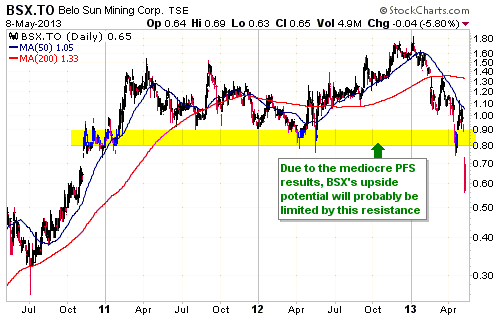
Belo Sun Mining (BSX.TO) from contention Eliminating
Belo Sun Mining (BSX.TO) from contention
BSX owns the multi-million-ounce exploration-stage Volta Grande gold project in
Brazil. We have never previously mentioned this company at TSI, but based on the
size, grade, location and open-pit-able nature of its project we have had it in
mind over the past several months as a potential future addition to the TSI
Stocks List. However, that is no longer the case. Even though BSX is down by
more than 60% from its early-2013 high and is now trading at its lowest level in
more than two years, the stock is no longer on a short list of potential future
TSI stocks. The reason is basic economics.
According to the just-completed Pre-Feasibility Study (PFS), the results of
which were announced after the close of trading on Monday, the Volta Grande
project has an after-tax NPV(5%) of $472M at a gold price of $1450/oz and an
initial capital cost (CC) of $750M. The stock's enterprise value (EV) at
Wednesday's closing price of C$0.65/share is about $133M (266M shares at
0.65/share minus $40M of cash). This means that the sum of the CC and the EV is
almost twice the NPV at a gold price of $1450/oz. That is, the EVCC/NPV ratio is
almost 2.
With valuations for many exploration-stage gold mining stocks at extraordinarily
depressed levels, we would need a very good reason to be interested in an
exploration-stage gold miner that had been shown, via a PEA, PFS or FS, to have
an EVCC/NPV ratio of well over 1. In the absence of a much higher gold price or
new information that indicates a much improved cost structure for Volta Grande,
we can therefore remove BSX from consideration.
The Volta Grande project still has significant value and the stock is
dramatically 'oversold', so BSX will probably enjoy a sizeable rebound in the
near future. Its problem is one of relative unattractiveness in a market
environment where terrific values are plentiful. For example, at its current
stock price SBB.TO has an EVCC/NPV ratio of only 0.50, even if no value is
assigned to its Hackett River silver royalty.
Kinross Gold (KGC) reports good quarterly results
For a pleasant change, KGC reported good operating results for the
latest quarter. We have an interest in KGC via some long-dated call
options.
Production during the March quarter was slightly ahead of plan at
649K ounces, but the most positive aspect of the production
performance was the relatively low cost. The reported "cash cost"
was $729/oz, which is $9 lower than the March quarter of last year.
The "all-in" cost was $1038/oz, versus $1180/oz during the March
quarter of last year. However, the large reduction in the "all-in"
cost is mainly due to the timing of capital expenditures and
therefore won't be sustained. KGC has maintained its 2013 "all-in
cost" guidance of $1100-$1200/oz, which is in the same ballpark as
the costs expected by Barrick Gold, Newmont Mining and Agnico Eagle.
KGC's balance sheet is in good shape. Of particular significance,
the company had working capital of $2.20B at 31st March. This is
down from $2.28B at 31st December 2012, but the reduction is due to
the payment of a cash dividend to shareholders.
The financial statements reveal that KGC's book value is
$8.75/share, so at Wednesday's closing price of $5.60 the company
was trading at a 36% discount to book value. In a more normal market
environment a senior gold producer would trade at a substantial
premium to book value.
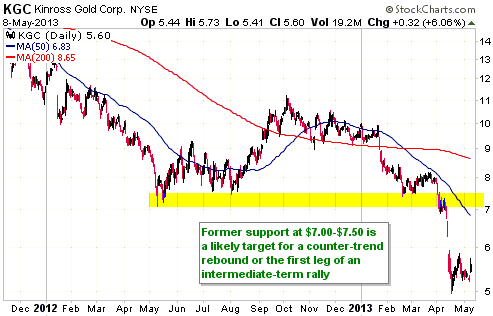
Chart Sources
Charts appearing in today's commentary
are courtesy of:
http://stockcharts.com/index.html

|









