- Interim Update 8th July 2015
Copyright
Reminder
The commentaries that appear at TSI
may not be distributed, in full or in part, without our written permission.
In particular, please note that the posting of extracts from TSI commentaries
at other web sites or providing links to TSI commentaries at other web
sites (for example, at discussion boards) without our written permission
is prohibited.
We reserve the right to immediately
terminate the subscription of any TSI subscriber who distributes the TSI
commentaries without our written permission.
It's time to start
buying industrial commodities
In the 6th May 2015 Interim
Update we wrote that it was time to start buying agricultural commodities, via
the PowerShares DB Agriculture Fund (DBA) and the iPath Grains Total Return ETN
(JJG). Our reasoning was simply that the long-term risk/reward had become
definitively skewed towards reward due to the extent to which prices had fallen.
We noted, in particular, that both DBA and JJG had dropped to near their 2008
Global Financial Crisis lows. Prices had become so depressed that substantial
additional weakness was very unlikely and even a minor positive change in the
news backdrop could prompt a decent rally*. It's now a similar story with some
industrial commodities, thanks, in part, to the meltdown in China's stock
market.
With regard to the agricultural commodities opportunity it made sense to buy
direct exposure to the commodities rather than indirect exposure via the shares
of related companies. This is because the commodity prices were depressed, but
the share prices of agriculture-related companies were generally not. For
example, when DBA and JJG were near their all-time lows in May, the Market
Vectors Agribusiness ETF (MOO) was near an all-time high. With the industrial
commodities, however, the situation is different. In this case the shares of the
commodity producers are generally even more depressed than the commodities,
leading us to favour equity ETFs over the associated commodity ETFs.
The commodity-related equity ETFs that we advocate averaging into over the weeks
ahead are COPX (for copper exposure), FCG (for natural-gas exposure), and URA
(for uranium exposure). Weekly charts of these ETFs are displayed below. KOL
(for coal exposure) is also a worthy candidate, although with FCG having been
driven into the bargain basement it isn't necessary to take on the
political-environmental risk associated with coal. Note that we currently do not
advocate buying XLE (the Energy Select Sector ETF), because it made an all-time
high as recently as mid-2014 and still looks extended to the upside on a
long-term basis.
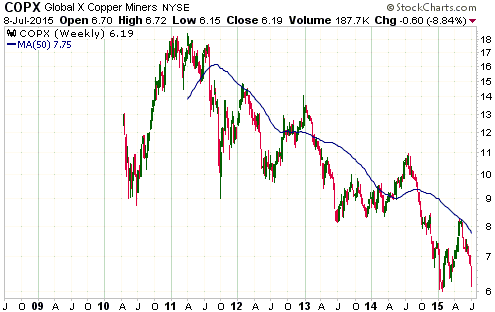
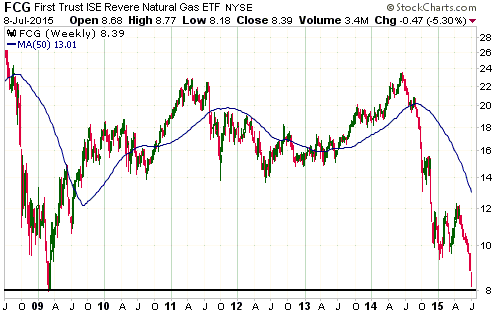
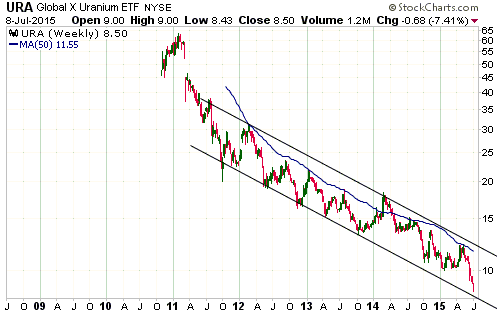
We expect that each of the ETFs charted above will be a lot higher in six
months' time, but they could spike to significantly lower levels in response to
a commodity-selling climax over the next couple of weeks. When managing money
this risk can be mitigated by scaling into positions over time, but for the TSI
Stocks List, which is not a recommended portfolio and is not run like a
portfolio, we have to pick our spots to add and remove positions. We have
decided that Wednesday's closing prices are good enough and have added COPX, FCG
and URA to the List at these prices.
Assuming that a short-term bottom is put in place this month (very likely, in
our opinion), the July low could subsequently be used as an initial 'stop' on
these positions.
As mentioned in the first paragraph, the meltdown in China's stock market has
played a part in the recent downward accelerations in the prices of industrial
commodities and the related equities. The performance of China's stock market is
generally not an indicator of China's economic performance, but the public's
losses from its latest foray into stock-market speculation could reduce economic
activity. Also, what's happening in China has an effect on the sentiment of
commodity speculators outside China, so it's a good bet that the implosion of
China's stock-market bubble has prompted speculators outside China to liquidate
long positions and take short positions in industrial commodities such as copper
and oil.
*JJG subsequently gained almost 20% and is now beginning
to consolidate. DBA 'only' gained about 5%, but this was enough to generate
evidence of an intermediate-term price reversal.
The Stock Market
The US
More thoughts on the possibility of a crash
In last week's Interim Update we noted that stock-market crash predictions were
becoming increasingly popular. The article posted
HERE is an example that came along a few days later. This article shows that
regardless of the US stock market's price action leading up to an important
peak, with the benefit of hindsight you can always draw two diverging lines to
show that the market traced out a "Megaphone Top" pattern.
Crash predictions are increasing in popularity because the market is expensive,
the bullish trend has been unusually long, earnings growth has been weak or
nonexistent, sentiment is complacent, and the Fed keeps talking about
normalising monetary policy (potentially very important because 'easy money' has
been the primary driver of the upward trend). It's also the case that the
reward/risk of a crash prediction is always high, which leads to such calls
always being more popular than they should be given their success rate. We are
referring to the fact that careers can be built on a single successful crash
prediction, whereas unsuccessful crash predictions can be quickly pushed aside
and forgotten. For example, Robert Prechter still gets introduced in interviews
as someone who correctly predicted the 1987 stock market crash.
In last week's Interim Update we also noted that the US stock market was
currently NOT tracing out a crash pattern, although it was tracing out a pattern
that could -- but not necessarily will -- mark a transition from cyclical bull
market to cyclical bear market. The situation could obviously change over the
next couple of months, with the market forming a pattern that has a realistic
possibility of leading to a crash. If so, we will act and advise accordingly.
Right now, our own account has a bearish bias. This is not in anticipation of a
crash, it's in anticipation of a 10%+ pullback. If such a pullback unfolds
within the next month or so it could turn out to be the initial decline in a
cyclical bear market, but it could also be a bull-market correction. The price
action usually doesn't differentiate between these two scenarios, which is why
most market participants assume that a bear market's first significant decline
is just a 'pause to refresh' in a continuing bull market.
Current Market Situation
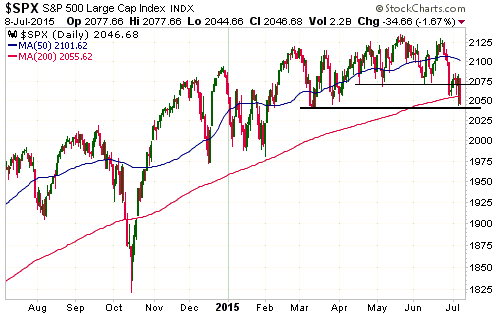
As it did early last week, the S&P500 Index (SPX) has again fallen below initial
short-term support at 2070-2075. It is now testing the more important short-term
support that lies at 2039. A weekly close below 2039 is needed to confirm a
trend reversal.
If the confirming weekly close below 2039 is going to happen, it will probably
do so this week or next week.
Hong Kong gets hit by China
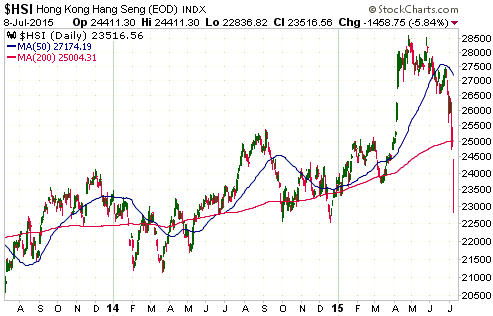
During March-April of this year, stock-market gamblers in Mainland China turned
their attention to the lagging Hong Kong market and caused Hong Kong's Hang Seng
Index (HSI) to rocket upward from 23500 to 28500. Over the first three trading
days of this week, and especially on Wednesday, some of these gamblers panicked
out of their HK shares and caused the HSI to plunge. At Wednesday's low the HSI
was down by more than 8% on the day and had given back all gains achieved since
the beginning of the year.
A major contributor to Wednesday's panic in Hong Kong was undoubtedly the
inability of leveraged speculators to get out of their positions in Shanghai and
Shenzhen. Apparently, at one point on Wednesday the trading was halted on more
than 80% of China stocks due to company request or the hitting of the 10%
downward limit. Unable to sell in China, traders sold in HK.
Europe
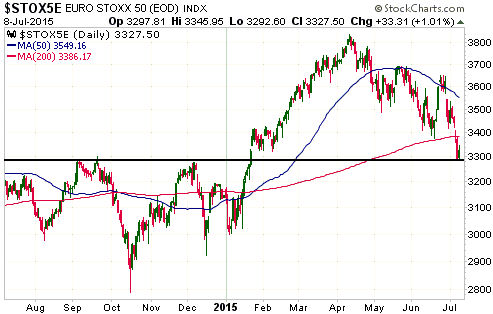
The EURO STOXX 50 Index (STOX5E) has dropped to the bottom of its 3300-3400
support range. Breaching this support on a weekly closing basis would indicate
that something more bearish than a routine bull-market correction was underway.
The situation in Greece is obviously still the focal point of the news media and
many market participants. Exactly how this situation temporarily resolves itself
over the days ahead is still unknowable, but what is knowable is that Greece has
major economic problems that are not going to go away regardless of whether the
country stays with the euro or goes back to the Drachma (or some other
fiat-money concoction).
We might talk more about Greece in the Weekly Update, but suffice to say at this
time that the Greek population currently has such a strong attachment to an
economy-suffocating welfare state that years of economic hardship lie ahead
regardless of whether or not the Greek government and its creditors come to
terms between now and Sunday (the new deadline for an agreement). However,
although we have nothing but contempt for the euro-zone's political and monetary
leadership we think that Greece will fare even worse with a new currency that
its government will be able to devalue at will. Devaluation won't fix any
problems, it will just add an inflation problem to the mix.
Gold and the Dollar
Gold
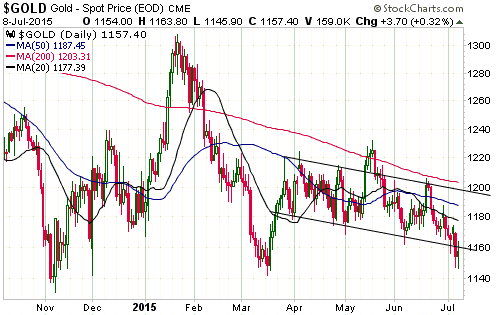
The US$ gold price broke below the bottom of its 3-month channel during the
first half of this week, which was not a surprise. A sustained upward reversal
could come at any time and is likely to happen this month, although a decline to
around $1130 could happen first.
As previously advised, evidence of an upward reversal will probably appear in
the gold-stock indices before it appears in the bullion market.
There is much talk that gold hasn't performed as it should have in reaction to
Greece's unfolding crisis, but this is not so. For one, there is scant evidence
of fear in any of the major financial markets at this time. If economic
confidence indicators such as credit spreads are revealing only minor concern
and safe havens such as Treasury Bonds are doing very little, why should there
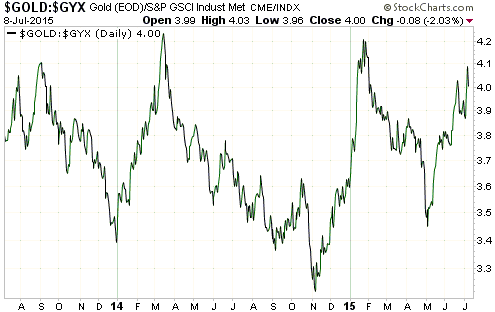
be much action in the gold market? For another, the following chart shows that
gold has been very strong over the past two months relative to the industrial
metals. This represents a good-sized response by the gold market to the small
increase in risk aversion evident in the other major financial markets.
Platinum
The people who think it's strange that gold hasn't rallied over the past few
weeks should tear their eyes away from the news headlines and look at what's
actually happening in the world. If they do they might see that gold has held up
remarkably well in the face of dramatic price weakness in other metals. For
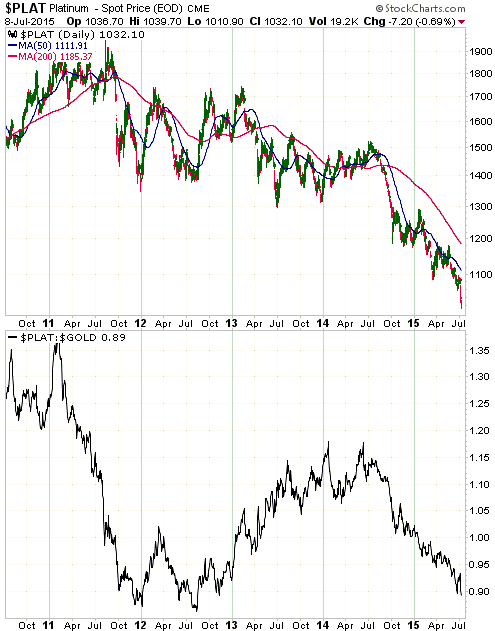
example, they might see that the price of platinum has plunged to a 6-year low
and that the platinum/gold ratio is nearing its lowest level of the past 30
years. Early-February of 2009 was the last time platinum was trading as low as
it is right now. At that time, gold was around $900/oz.
Platinum now offers very good value in US$ terms and gold terms. It would be
reasonable to buy platinum near its current price in the low-$1000s -- perhaps
via a fund such as PPLT -- for an intermediate-term or a long-term trade.
Gold Stocks
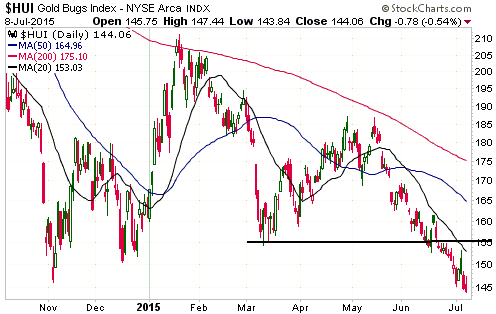
The HUI's relentless decline continued over the first three days of this week.
As previously advised, a bottom would be signaled by either a reversal day (a
new low for the move and then a higher close) or a daily close above 155.
GDXJ, a proxy for the junior end of the gold-mining sector, succumbed to the
weakness in the senior gold-mining stocks over the past few days after being
remarkably resilient over the preceding few weeks. However, the best-quality
juniors are still holding up well, which is frustrating if, like us, you are
looking for opportunities to buy.
The Currency Market
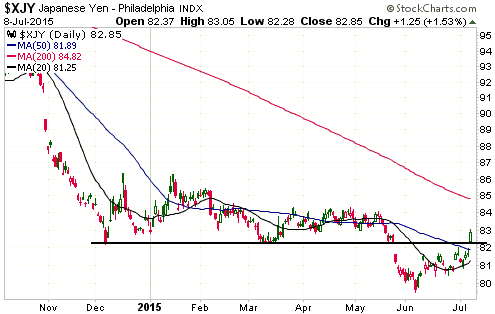
The Yen broke above resistance at 82 on Wednesday. We view this as an early
warning that an intermediate-term bottom is in place for this currency, but the
breakout will have to be sustained through to week's end to be confirmed.
Updates on Stock Selections
Notes: 1) To review the complete list of current TSI stock selections, logon at
http://www.speculative-investor.com/new/market_logon.asp
and then click on "Stock Selections" in the menu. When at the Stock
Selections page, click on a stock's symbol to bring-up an archive of
our comments on the stock in question. 2) The Small Stock Watch List is
located at http://www.speculative-investor.com/new/smallstockwatch.html
 It's
time to buy (or buy more) gold-stock call options
It's
time to buy (or buy more) gold-stock call options
There are January-2016 Gold Fields (GFI) and Kinross Gold (KGC) $5 call options
in the TSI List, but these options are now too far out of the money (having been
added in untimely fashion between Dec-2011 and Aug-2013). If we were now buying
GFI call options we would choose a $3.50 or $4.00 strike price and if we were
now buying KGC call options we would choose a $2.50 or $3.00 strike price.
GFI and KGC are likely to rebound strongly from this month's lows, but so are
most gold-mining stocks. To avoid the risk of buying options on a stock that for
company-specific reasons doesn't do well during the coming sector-wide rally, it
could make sense for bullish option speculators to buy GDX (Market Vectors Gold
Miners ETF) call options rather than call options associated with a particular
gold-mining company.
At current prices we like the GDX January-2016 $20 calls and have added this
option to the TSI List at US$0.70 (Wednesday's closing bid-ask spread was
$0.68-$0.72).
Chart Sources
Charts appearing in today's commentary
are courtesy of:
http://stockcharts.com/index.html