|
- Interim Update 8th September 2010
Copyright
Reminder
The commentaries that appear at TSI
may not be distributed, in full or in part, without our written permission.
In particular, please note that the posting of extracts from TSI commentaries
at other web sites or providing links to TSI commentaries at other web
sites (for example, at discussion boards) without our written permission
is prohibited.
We reserve the right to immediately
terminate the subscription of any TSI subscriber who distributes the TSI
commentaries without our written permission.
The relationship between money supply and prices
Kel Kelley's article at http://mises.org/daily/4654
does a good job of explaining why long-term economy-wide increases in
prices -- regardless of whether we are talking about consumer prices or
asset prices -- are SOLELY due to increases in the money supply, and
why monetary inflation these days tends to have a much greater effect
on asset prices than consumer prices. The article also covers some of
the points we touched on in our latest Weekly Update. Specifically, the
wrongheaded notion that government or central bank "stimulus" helps the
economy, and the difference between GDP growth and genuine economic
progress. Here's an excerpt:
"Government spending
harms the economy and forestalls its healing. The thought that stimulus
spending, i.e., taking money from the productive sector (a
de-accumulation of capital) and using it to consume existing consumer
goods or using it to direct capital goods toward unprofitable uses,
could in turn create new net real wealth -- real goods and services --
is preposterous.
What is most needed
during recessions is for the economy to be allowed to get worse -- for
it to flush out the excesses and reset itself on firm footing. Broken
economies suffer from a misallocation of resources consequent upon
prior government interventions and can therefore be healed only by
allowing the economy's natural balance to be restored. Falling prices
and lack of government and consumer spending are part of this process.
Given that government
spending cannot help the real economy, can it help the specific
indicator called GDP? Yes it can. Since GDP is mostly a measure of
[monetary] inflation, if banks are willing to lend and lenders are
willing to borrow, then the newly created money that the government is
spending will make its way through the economy. As banks lend the new
money once they receive it, the money multiplier will kick in and the
money supply will increase, which will raise GDP."
Actually, the so-called "money multiplier" isn't relevant because as
soon as the government borrows/spends new money into existence the
money supply grows by the amount of the borrowing/spending, thus paving
the way for an increase in the calculated GDP number. In other words,
boosting the GDP number is even simpler than suggested in the above
paragraph. The commercial banks don't have to do anything.
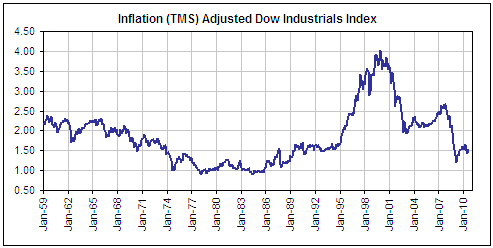
The following chart
of the Dow/TMS ratio (the Dow Industrials Index divided by True Money
Supply) is consistent with the idea that the broad stock market's
long-term capital gain is solely a function of the change in the money
supply. The chart shows that when the Dow is adjusted for monetary
inflation it is lower today than it was 50 years ago. Stocks for the
long-term? Only if you are a very good stock-picker!
By the way, we aren't
in complete agreement with the above-linked article. We disagree, for
example, with the author's argument that monetary inflation generally
results in rising profits. He argues that due to the way accounting is
done, inflation causes revenues to rise faster than costs and thus
results in rising profit margins (the idea is that inflation-fueled
revenue increases hit the bottom line immediately, while some costs,
such as the depreciation of plant and equipment, are spread over
several years). In reality, however, any company failing to take into
account the TRUE increase in its costs will eventually get into
financial trouble, and far more mal-investment occurs in inflationary
environments than in non-inflationary ones. Consequently, there is
often an increase in profits during the first half of an inflation
cycle, but eventually the proverbial chickens come home to roost.
We also disagree with the author's assertion that "more
new money being channeled into asset prices...results in the
traditional range of stock valuations moving to a higher level. For
example, the ratio of stock prices to stock earnings (P/E ratio) now
averages about 20, whereas it used to average 10-15. It now bottoms out
at a level of 12-16 instead of the historical 5."
In our opinion it's way too early to state that the stock market's P/E
ratio now bottoms at 12-16 instead of 5, because the secular bear
market is far from over.
The Stock Market
The economic data looks set to worsen, but perhaps not immediately
Last week's ISM report on manufacturing in the US was better than
feared and interrupted a trend of worsening US economic news, thus
helping an 'oversold' stock market to rebound. However, the following
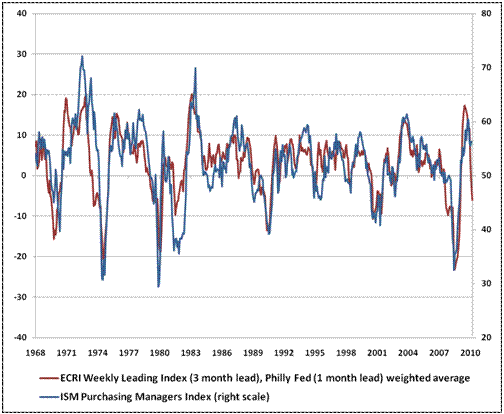
chart from John Hussman's latest Weekly Market Comment
suggests that the interruption will be brief. The chart shows that
there has been a very close relationship over the past 42 years between
the ISM Manufacturing Index and an indicator constructed by taking a
weighted average of ECRI's Weekly Leading Index (shifted ahead by 13
weeks) and the Philadelphia Fed Index (shifted ahead by 1 month). The
recent plunge in the aforementioned indicator (the red line on the
chart) tells us that unless it is different this time, the ISM Index
will commence a steep decline within the next few months.
Current Market Situation
When taking everything into account (the action in all the financial
market, sentiment, and economic news), the US stock market's short-term
downside risk appears to have lessened over the past fortnight.
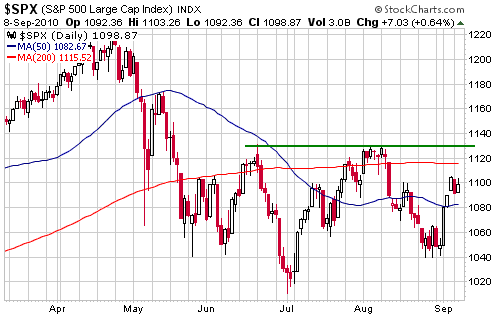
However, at this stage the S&P500 Index has not deviated to a
significant degree from the Presidential Cycle Model. Therefore, if we
were taking nothing into account apart from the US stock market's price
action we would have no reason to expect that the S&P500 was not on
its way to an important October low.
It will be interesting to see if the S&P500 is able to strengthen
sufficiently over the next few days to test resistance at 1130, because
if it does so and then pulls back the chart pattern will begin to look
quite bullish. A subsequent break above 1130 would then project a test
of the April high.
Gold and
the Dollar
Gold
The anticipation of QE2
Until recently the stock market appeared to be on track to reach a new
low for the year by October, and other 'inflation plays' also appeared
to be headed for October lows. However, there has been a distinct
change in the character of trading throughout the financial world over
the past 2-3 weeks. This change has been most noticeable at the
speculative end of the gold/silver sector, with some junior mining
stocks rocketing upward and strength becoming evident across a
broadening spectrum of juniors, but the change certainly hasn't been
limited to junior mining stocks. For example, silver, which until three
weeks ago appeared to be readying itself for a return to its February
low of $15, broke out to the upside. Also, platinum held support,
copper moved to a new multi-month high, the broad stock market reversed
upward, and gold continued to make headway despite being short-term
'overbought'.
The change in character could be due to the markets beginning to
discount the next round of central bank monetary largesse, known as QE2
(Quantitative Easing version 2). However, it will be difficult for the
Fed to announce another round of QE with the stock market in rally mode
and gold threatening to make a new all-time high. To be comfortable
with a shift to a more overt inflation policy we suspect that the money
manipulators at the Fed will want the cover provided by a widespread
deflation scare or, at least, the combination of worsening economic
data and a downward-trending stock market.
With rising metal prices signaling that the market's focus is moving
away from the near-term threat of deflation, with the stock market
beginning to strengthen and with last week's ISM Index showing a
modicum of resilience in the manufacturing sector, how could the Fed
justify the injection of more 'monetary fuel' at this time? In other
words, the markets' attempts to discount QE2 -- if that's what they
are, indeed, doing -- are making it less likely that QE2 will actually
happen in the near future.
Further to the above, a major multi-month extension of gold's (and
silver's) rally will probably require significant stock market weakness
(to create the appropriate backdrop for the introduction of QE2). On
the other hand, if the stock market continues to trend upward over the
weeks ahead then the monetary inflation that the markets have been
discounting will probably be postponed and the current gold/silver
rally will end.
Current Market Situation
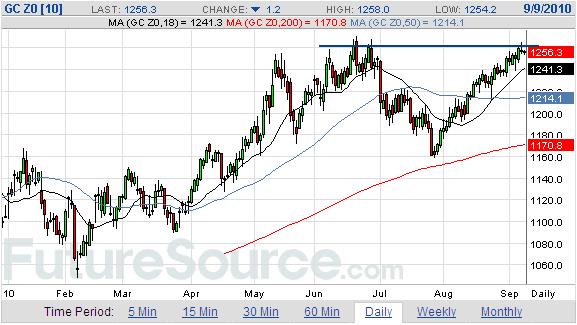
December gold tested its June high during the first half of this week.
It remains 'overbought' and vulnerable to a pullback to the 50-day
moving average.
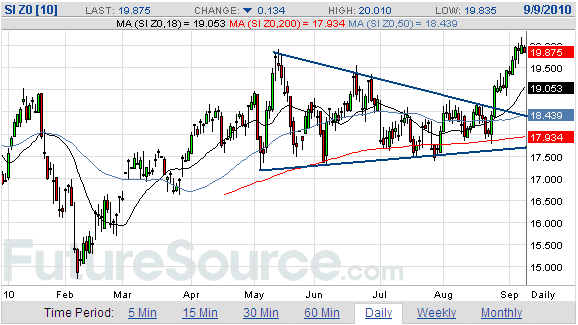
The following daily
chart shows that silver has risen in almost a straight line from $18 to
$20 over the past 11 trading days. The price action suggests that
significant additional gains lie in store, but that a pullback is
likely prior to the aforementioned gains being made. Former short-term
resistance at $18.50-$19.00 is now support.
Gold Stocks
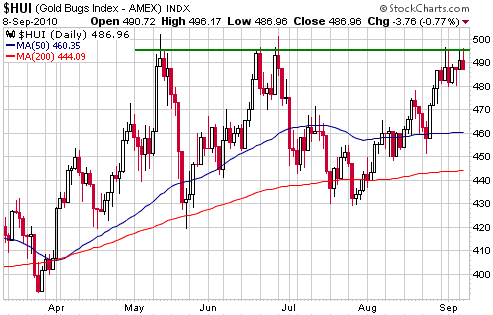
The following chart shows that the HUI has tested resistance at 495 on
4 of the past 6 trading days. The more times a support or resistance
level is tested, the weaker it becomes and the higher the probability
that it will eventually be breached. That, by the way, is why triple
tops are more rare than double tops. Consequently, this week's price
action has increased the probability of an upside breakout -- with or
without an intervening pullback. As noted in earlier commentaries, if
an upside breakout is going to occur it will likely do so within the
first 14 trading days of September. This suggests that a breakout will
occur within the next 9 trading days.
Any intervening pullback should do no worse than take the HUI back to the 460s.
For the first time in
more than 12 months, the prospects for gold stocks (as a group) look
more bullish than the prospects for gold bullion on both a short-term
and an intermediate-term basis. And within the gold sector, it is still
the case that the best opportunities can be found amongst the juniors.
Some juniors have recently run-up in price, whereas others haven't yet
done very much. We think it makes sense to take partial profits on some
of the big upward movers and put a portion of the sale proceeds to work
in high-potential laggards. As always, though, the appropriate course
of action will differ from person to person depending on current
positioning.
Within the ranks of the very small juniors, two stocks that look
particularly interesting at this time are Clifton Star Resources (TSXV:
CFO) (ideally below C$4.30) and Gold-Ore Resources (TSX: GOZ) (ideally
at C$0.58-C$0.60). With regard to the larger juniors, near current
prices we like Crew Gold (CRU.TO), Jaguar Mining (JAG), and Northgate
Minerals (NXG).
Currency Market Update
There was a sudden re-emergence of fear regarding European debt
problems on Tuesday, which brought about a sharp one-day slide in the
euro. However, it appears that this debt-related fear was akin to a
24-hour virus, because by Wednesday everything was again deemed to be
under control.
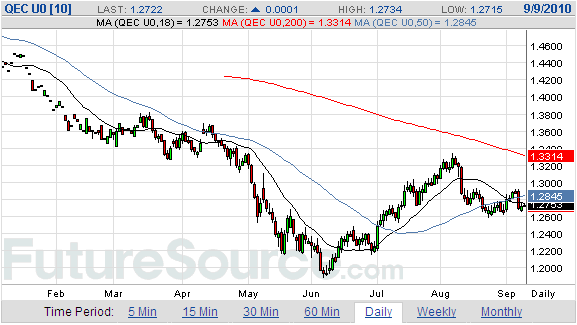
A daily chart of September euro futures is displayed below. We have no
opinion as to the most likely direction of the euro's next 3-point
move. A move up to 1.30 wouldn't surprise us, but neither would a move
down to 1.24.
The Australian Dollar
remains very extended to the upside relative to both the US$ and the
euro. It is also at, or just below, intermediate-term resistance in
both US$ and euro terms. What's missing is a catalyst for a substantial
decline. As noted many times in the past, the A$ will probably take a
tumble AFTER global equities begin trending downward in earnest, but
not before.
The Yen is also extended to the upside at this time, which is strange
considering that the A$ and the Yen have generally been on opposite
sides of the 'risk trade' over the past several years. The coincident
strength in the A$ and the Yen is puzzling, although it does make sense
that the Yen has been the stronger of the two currencies since the
April stock market peak.
Update
on Stock Selections
(Notes: 1) To review the complete list of current TSI stock selections, logon at http://www.speculative-investor.com/new/market_logon.asp
and then click on "Stock Selections" in the menu. When at the Stock
Selections page, click on a stock's symbol to bring-up an archive of
our comments on the stock in question. 2) The Small Stock Watch List is
located at http://www.speculative-investor.com/new/smallstockwatch.html)
 New stock selection: Crew Gold (TSX: CRU). Shares: 107M. Recent price: C$4.24 New stock selection: Crew Gold (TSX: CRU). Shares: 107M. Recent price: C$4.24
We provided some information on CRU in the 30th August Weekly Update.
The company is currently producing gold at the annual rate of around
210K ounces from a mine in Guinea, West Africa.
CRU has an unusual share structure in that 93% of the shares are owned
by its two largest shareholders -- Severstal with 50% and Endeavour
Financial with 43%. We expect that one of these large shareholders will
buy out the other and offer to purchase the 7% owned by the public at
some point over the next 6 months. Ideally (from our perspective),
Severstal will be the buyer, thus leaving Endeavour cashed up and in a
position to make a bid for another West African gold miner (Resolute?).
So, we are essentially speculating on a takeover. We don't necessarily
require a takeover for this to be a successful speculation, though,
because CRU has a low valuation relative to most other >200K-oz/yr
gold producers and could therefore make a catch-up move. Also, evidence
that the company was making progress with its plans to grow production
to 270K ounces/year would likely result in a sizeable upward re-rating
in the stock market.
Assuming no change in the gold price, we think CRU has the potential to
double over the coming 6-12 months. With regard to risks, the one we
are most concerned about is political (the risk of political
instability in Guinea and the risk that the Guinean government will do
something stupid). This risk is mitigated to some extent by having most
of the shares owned by two strong shareholders with political
influence.
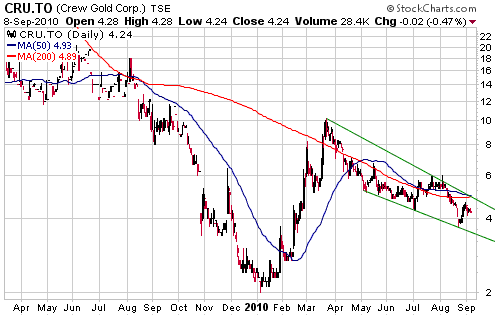
Chart Sources
Charts appearing in today's commentary
are courtesy of:
http://stockcharts.com/index.html
http://www.futuresource.com/

|









