|
- Interim Update
8th October 2014
Copyright
Reminder
The commentaries that appear at TSI
may not be distributed, in full or in part, without our written permission.
In particular, please note that the posting of extracts from TSI commentaries
at other web sites or providing links to TSI commentaries at other web
sites (for example, at discussion boards) without our written permission
is prohibited.
We reserve the right to immediately
terminate the subscription of any TSI subscriber who distributes the TSI
commentaries without our written permission.
The Stock Market
Dip-buyers have again prevented the SPX from signaling a
downward reversal of significance. At the same time, the Russell2000 SmallCap
Index (RUT) and the NYSE Composite Index is each very close to confirming that a
major top is in place. Also, the number of individual NASDAQ stocks making new
52-week lows just hit a new 2-year high and the number of individual NYSE common
stocks making new 52-week lows just hit a new 3-year high. In other words, a lot
of bearish price action within the US stock market continues to be masked by the
stability of the senior stock indices.
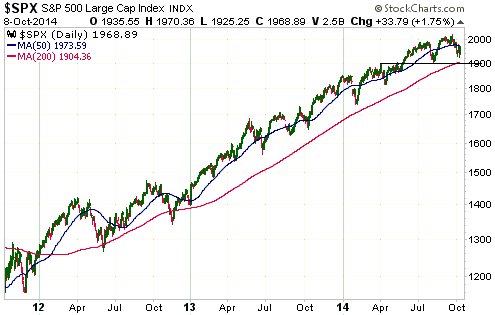
As illustrated by the following daily chart, every pullback in the SPX over the
past two years has bottomed above the low of the preceding pullback. The low of
the most recent completed pullback was at 1900. A daily close below 1900 would
therefore be important because it would break the pattern of the past two years.
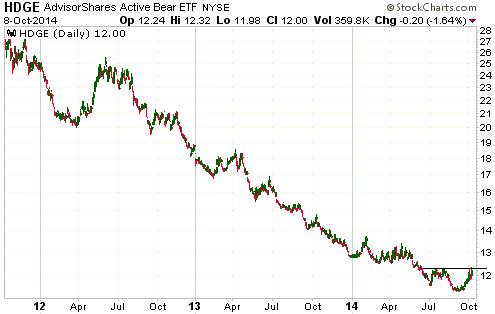
In the latest Weekly Update we mentioned that a relatively low-risk way of
betting on a major decline in the US stock market would be to accumulate the
shares of BEARX and/or HDGE (unleveraged, actively-managed bear funds) during
market rallies. Unlike leveraged inverse index funds such as SDS and QID, which
are only suitable for short-term trades, it would be reasonable to average into
BEARX and/or HDGE positions over time with the aim of holding for 1-2 years. A
daily chart of HDGE is displayed below.
Keep in mind that unless it is different this time, a major stock market top
will gradually evolve over many months. Therefore, even if the SPX is very close
to its ultimate top, a major decline probably won't get underway until well into
next year. In the intervening period there would likely be multiple declines
followed by rallies that make lower highs but are strong enough to shake the
conviction of the bears.
Gold and the Dollar
Gold
Does the US monetary base drive the gold price?
Two weeks ago we discussed the claim that the US debt/GDP ratio (the debt of the
US federal government divided by US GDP) drove the gold price, with a rising
debt/GDP ratio resulting in a higher gold price and a falling debt/GDP ratio
resulting in a lower gold price. We explained that the claim was misleading, and
that a chart purporting to demonstrate this relationship was both an example of
data mining (in this case, cherry-picking a timescale over which the
relationship worked while ignoring more relevant timescales over which it didn't
work) and an example of confusing correlation with causation. We also mentioned
in passing that there was a similar misleading claim doing the rounds regarding
the relationship between gold and the US monetary base (MB). Considering that
the failure of the gold price to follow the US MB higher over the past two years
is being cited by the usual suspects as evidence of gold-market manipulation, it
makes sense for us to briefly address the question: Does the US monetary base
drive the gold price?
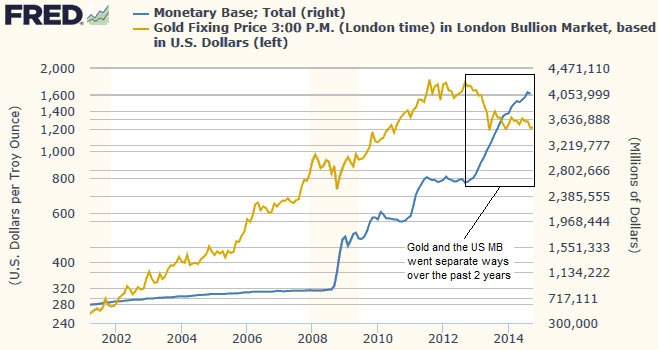
Those who believe that the answer to the question is "yes" will sometimes show a
chart like the one presented below to prove the correctness of their belief.
Clearly, if you were armed only with this chart and the conviction that a
substantial rise in the US MB should always go hand-in-hand with a rallying gold
price, then you would likely take the happenings of the past two years as
definitive evidence of artificial gold-price suppression. Of course, you would
also have to put aside the fact that the gold price rose 300% from its 2001 low
to its early-2008 peak with only a minor increase in the US MB, but this
wouldn't be a problem because it is always easy to come up with a fundamental
reason for a large rise in the gold price. It's only a large price decline that
needs to be explained-away by a manipulation theory.
So, is gold's divergence over the past two years from the on-going rise in the
US MB strange or suspicious, such that it can be best explained by market
manipulation?
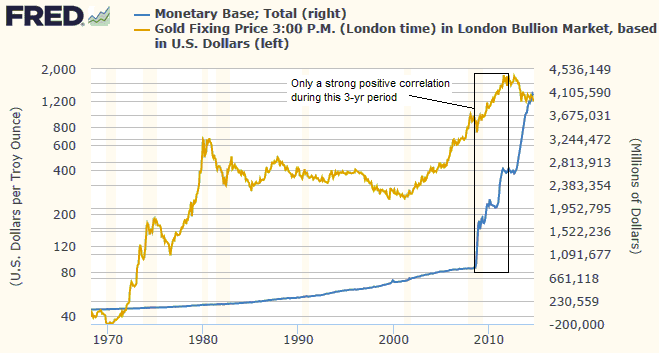
The answer is no. As is the case with the relationship between the gold price
and the debt/GDP ratio, the visually-appealing positive correlation of the past
several years disappears when the gold-MB relationship is viewed over a much
longer timescale. Specifically, the following chart shows that the only period
over the past 45 years during which there was a strong positive correlation
between the gold price and the monetary base was the three-year period from
late-2008 through to late-2011.
We wish that anticipating the performance of the US$ gold price were as easy as
monitoring the US monetary base or the Fed's balance sheet (the monetary base is
controlled by the Fed via the expansion/contraction of its balance sheet), but
unfortunately the gold market isn't that simple. The reality is that like a
rising debt/GDP ratio, a sharply rising monetary base can be a valid part of a
bullish gold story. However, this is only to the extent that it helps to bring
about lower real interest rates and/or a steeper yield curve and/or a weaker US
dollar and/or rising credit spreads. It isn't directly bullish.
We think that the first leg of the next substantial multi-year rally in the gold
price will be linked to the Fed's efforts to stabilise or contract the monetary
base, because these efforts will expose the mal-investments of the past few
years.
Current Market Situation
In the latest Weekly Update, we wrote: "There will probably be some
follow-through to the downside early this week due to margin-related selling, so
a quick decline in the gold price to the mid-$1100s is certainly possible. This
would potentially be the final shakeout/capitulation. However, considering the
extent to which the gold market and many related markets are now stretched, it's
also possible that support defined by last year's low will hold for now. In this
case a break below the aforementioned support would likely be delayed until the
first half of next year, with a strong intervening rebound. Either way, triple
bottoms are rare, so it now looks like last year's lows will have to be taken
out prior to a final low."
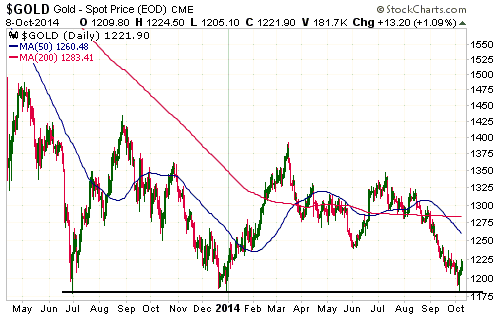
There was some follow-through to the downside on Monday, but support defined by
last year's low ($1180) has held. If it continues to hold over the days
immediately ahead it will probably mean that gold's basing will continue for
several more months, with one or two intervening multi-week rebounds and a
short-lived spike below $1180 during the first half of next year.
The gold price rallied on Wednesday after the release of the minutes of the
September FOMC Meeting. The meeting minutes apparently revealed Fed officials
worrying about slowing global economic growth and a strong US$, creating the
impression that the ultra-accommodative monetary policy (ZIRP) will remain for
longer than previously expected by the markets.
On a fundamental basis, Wednesday's developments were neutral for gold. There
was relative strength in the US stock market (bullish for the US$) and a slight
narrowing of credit spreads, which are gold-bearish developments, offset by a
small reduction in real interest rates.
More than anything, Wednesday's market action showed the extent to which gold,
and especially gold-mining equities, had become stretched to the downside. When
a market becomes extremely extended to either the upside or the downside it will
sometimes react very strongly to news that would not ordinarily provoke much of
a reaction.
Silver
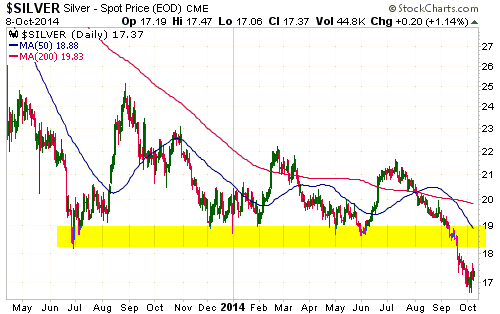
Although gold's decline to last year's low reduces the probability of this
happening, there is still a chance that silver's recent break below last year's
low will turn out to be the sort of downside breakout that marks the end of a
multi-year bearish trend. For this to be the case, silver should move back above
$19 within the coming two weeks.
Platinum
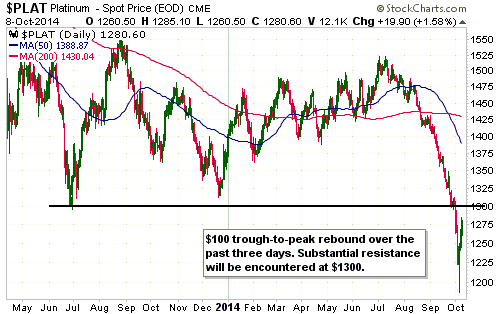
This week's most impressive reversal occurred in the platinum market. The
platinum price plunged again during the Asian session on Monday and briefly
traded at the same price as gold, before experiencing a frenzy of short covering
that resulted in a trough-to-peak gain of $100/oz within three days.
The platinum price is now approaching former major support (now resistance) at
$1300. We will be surprised if this resistance is decisively breached in the
near future, regardless of whether or not an important bottom was put in place
at the beginning of this week. If an important bottom has been put in place then
the market will probably spend at least a couple of weeks consolidating in the
$1240-$1300 range before breaking out to the upside.
We are not interested in buying any exposure to platinum at this time, but we
are paying close attention to its performance due to the fact that it was the
leader to the downside during the commodity liquidation of the past few weeks.
Gold Stocks
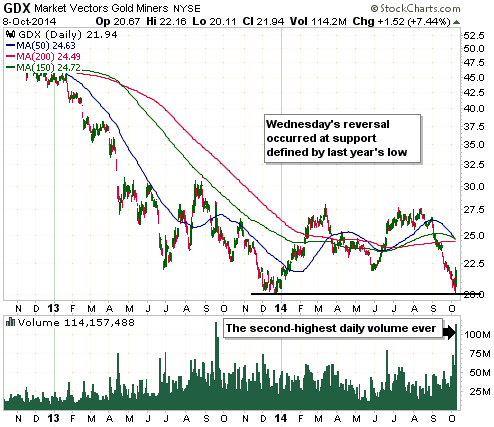
After Tuesday's dismal action in the gold-mining sector we had planned to
include charts of GDX and GDXJ showing a surge in volume that was suggestive of
capitulation. These charts are still applicable, except that the volume surge in
parallel with Wednesday's upward reversal in price dwarfs the volume of the
preceding days. In fact, on Wednesday 8th October we had the second-highest
daily trading volume in GDX's history and by far the highest daily trading
volume in GDXJ's history. Here are the relevant charts:
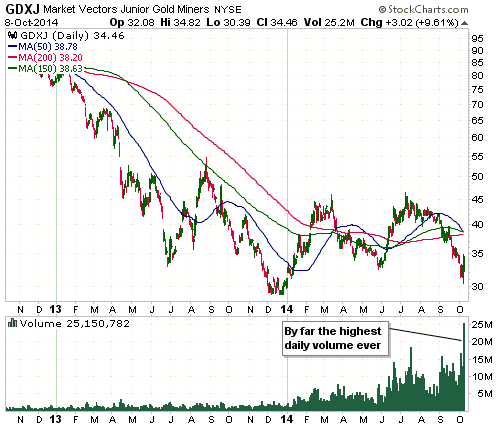
There are now three plausible possibilities. The first is that Wednesday's price
action was part of a ferocious 1-2 day counter-trend rebound to alleviate an
'oversold' extreme -- similar to the big single-day rebound in September of
2013. This possibility is supported by the fact that Wednesday's gold-sector
strength occurred in parallel with broad stock-market strength and the general
belief that the Fed might extend the boom by remaining ultra-accommodative for
longer than previously expected. In other words, the first possibility is
supported by the fact that Wednesday's rebound was not driven by gold-bullish
developments. The second is that a multi-month bottom, but not the final bottom,
is now in place, with the gold-mining sector set to trend upward for at least a
few weeks. The third is that the gold-mining sector has just completed a
long-term double bottom. The second and third possibilities are supported by the
fact that the upward reversal began from major support and from an 'oversold'
extreme at a time of the year when important gold-sector turning points have
often occurred in the past.
The first possibility will be eliminated if there is some follow-through to the
upside over the final two days of this week. If this happens then a confluence
of MA resistance at $38-$39 will become a likely 2-4 week upside target for GDXJ.
The Currency Market
Current Market Situation
The Dollar Index hasn't yet signaled a reversal of its short-term trend.
However, we are now starting to get 2-way volatility, which could be an early
warning of a trend reversal.
If a short-term peak was put in place at the end of last week then the Dollar
Index will probably drop to the vicinity of its 20-week MA within the coming
month or so. The 20-week MA is at 82.2 and is rising at the rate of about 0.25
points per week, so the Dollar Index could intersect this MA by dropping to
83.0-83.5 during the first half of November. The most likely alternative is that
the Dollar Index will make a marginal new high for the move (at 87.5-88.0)
within the next several days and then commence a pullback to its 20-week MA.

Reiterating a point regarding the dollar's so-called "reserve status"
We've dealt with this issue a few times in TSI reports over the past year, most
recently under the headings "Revisiting the "Reserve Currency" Myth" in the 16th
June 2014 Weekly Update and "Relative popularity as an international medium of
exchange" in the 4th August 2014 Weekly Update. In today's report we aren't
going to regurgitate the entire argument, just the conclusion, which is: The US$
isn't the most commonly-used currency in global trading and investing because it
is the most popular "reserve" currency; rather, the US$ is the most popular
"reserve" currency because it is the most commonly-used currency in global
trading and investing. In other words, the markets, not governments, determine
relative popularity as an international reserve.
Yes, the US government's actions around the world are generally deplorable. In
fact, as a threat to world peace nothing comes close to the US federal
government. And yes, the US central bank is unwittingly taking actions that
destroy wealth, make the US economy less efficient and reduce the US dollar's
suitability as money. These actions on the parts of the US government and
central bank will eventually result in the US dollar becoming far less popular
as an international medium of exchange, but the markets will decide the timing.
An implication is that the governments of Russia, China, France, Iran, etc, have
no say in what happens to the US$ over the years ahead, so you can safely ignore
the dollar-related propaganda emanating from these sources.
Updates
on Stock Selections
Notes: 1) To review the complete list of current TSI stock selections, logon at
http://www.speculative-investor.com/new/market_logon.asp
and then click on "Stock Selections" in the menu. When at the Stock
Selections page, click on a stock's symbol to bring-up an archive of
our comments on the stock in question. 2) The Small Stock Watch List is
located at http://www.speculative-investor.com/new/smallstockwatch.html
Chart Sources
Charts appearing in today's commentary
are courtesy of:
http://stockcharts.com/index.html
http://research.stlouisfed.org/

|









