|
- Interim Update 9th January 2013
Copyright
Reminder
The commentaries that appear at TSI
may not be distributed, in full or in part, without our written permission.
In particular, please note that the posting of extracts from TSI commentaries
at other web sites or providing links to TSI commentaries at other web
sites (for example, at discussion boards) without our written permission
is prohibited.
We reserve the right to immediately
terminate the subscription of any TSI subscriber who distributes the TSI
commentaries without our written permission.
2013
Forecast, Part 1
We are splitting our Yearly Forecast for 2013 into two parts,
with Part 1 included in today's report and Part 2 included in the
coming Weekly Update. Random Thoughts, the Stock Market and the US
Dollar are covered in Part 1 (below). Bonds, Gold, Gold Stocks and
Industrial Commodities will be covered in Part 2.
Random Thoughts
1) There are similarities between the current situation in the US,
the US of the 1930s and post-bubble Japan, but the monetary backdrop
is very different in the US today than it was in the earlier
post-bubble periods. The most obvious effect of the monetary
difference is that the prices of most goods and services have
continued to rise in the US since the bursting of the private-sector
credit bubble in 2007.
2) The less obvious effects of the current period's much higher rate
of monetary inflation include the slowing of the corrective process
and the introduction of additional price distortions and
inefficiencies.
3) The US eventually recovered from the bursting of the 1920s bubble
despite the many idiotic policies implemented by the Hoover and
Roosevelt administrations, but the US will not be able to recover
from the bursting of the more recent credit bubble if the Fed
continues to engineer a high rate of monetary inflation. If current
Fed policies continue for at least a few more years, the US economy
will end up in a far worse state than it has ever been before.
4) The above three points are copied from our 2012 Yearly Forecast.
It has become clear that the Fed's policy of throwing new money at
the economy in a horribly misguided effort to generate real growth
is not only going to continue in 2013, but also going to be applied
more aggressively than was the case in 2012. This money-pumping
could prevent widespread recognition of recessionary economic
conditions for several more months, but only at a substantial
long-term cost. For an economy to function efficiently, price
signals must be genuine; that is, price signals must accurately
reflect sustainable consumption and production trends.
5) At the beginning of last year we wrote that there was nowhere
near as much scope for a negative surprise out of China in 2012 as
there had been in 2011, because China's central planners had begun
to loosen the monetary reins and because China's economic problems
had come to be more widely recognised. In a nutshell, we thought
that China-related risk had fallen. This assessment appears to have
been close to the mark, or at least wasn't disproved by events.
Our thinking is unchanged. China has huge economic problems, but
these problems will come to the fore gradually over the space of a
few years and won't likely be the cause of big moves in global
financial markets during 2013.
6) At the beginning of last year we thought that the euro-zone's
government debt problem was still a sizeable risk, but that its
potential to wreak global havoc had been substantially reduced by
virtue of the fact that it had been a "Page 1" story for many
months. This assessment was largely validated by events, as the news
out of Europe continued to get worse over the first seven months of
2012 and yet the euro didn't collapse and severe stock market
weakness was restricted to the small number of euro-zone countries
at the centre of the debt crisis.
'Everyone' is now confident that the worst is over for the
euro-zone's financially-challenged governments and banks.
Paradoxically, this means that the risk is now much greater. The
cause of all the gnashing of teeth that occurred during the second
half of 2011 and the first half of 2012 hasn't disappeared, it has
only been temporarily put aside. The bailouts will continue, with
Spain's government probably requesting an aid package during the
first quarter of this year and Greece's government confessing that
it is once again in need of help. Spain will get a bailout and the
markets will breathe a sigh of relief, but by the third quarter of
this year it should be apparent that France's government is in
danger of defaulting on its debt. After all, the finances of
France's government looked precarious even before a socialist
president came to power and began to enact policies that are sure to
drive many of the country's most productive people and highest
tax-payers elsewhere.
We expect that the euro-zone's government debt disaster will return
to "Page 1" during the second half of 2013.
7) Due to a mismatch between expectations and reality, we thought
that last year's biggest issue for the financial markets would turn
out to be weakness in the US economy (most people were expecting the
US economy to "muddle through" and most equity analysts were
anticipating good earnings growth during 2012). We were wrong. Even
though the US economy was lacklustre and the rate of US corporate
earnings growth dropped to almost zero, the popular "muddle through"
view proved to be closer to the mark.
Unexpected weakness in the US economy is still an intermediate-term
threat worthy of attention, but it is no longer one of our top three
risks. The three biggest risks are the likelihood of the euro-zone's
government debt predicament returning to centre stage (Point 6
above) and the issues outlined in Points 8 and 9 below.
8) Going into 2012 we thought that the second biggest
intermediate-term risk facing the markets involved the potential for
greater instability in the Middle East. We didn't think that there
would be open military conflict between Iran and the US or between
Iran and Israel, but we were concerned that escalating tension
between these countries could have a big effect on the markets. We
were also concerned that the political situations in Egypt and Syria
would become more turbulent, and that there was an outside -- but
not insignificant -- chance of Saudi Arabia getting caught up in the
'revolutionary wave'.
This risk partly materialised, in that the political situations in
Egypt and Syria certainly became more turbulent (Syria's instability
degenerated into civil war, and Egypt's population, having thrown
out their long-serving dictator in 2011, began to experience 'revolter's
remorse' as the democratically-elected replacement showed signs of
being equally bad). However, the financial markets ignored the
troubles in Syria and Egypt, and the possibility of military
conflict between Iran and US/Israel never became a big issue.
As 2013 begins, the potential for greater political and geopolitical
instability in the Middle East remains one of the biggest
intermediate-term risks facing the financial markets. This risk is
more likely to materialise during the second half than the first
half of the year, the reason being that the US government will be
more inclined towards aggressive military action after it becomes
clear that the US economy is in recession. Governments tend to view
external threats as useful distractions during periods of economic
weakness. Also, a real or imagined urgent need for military action
provides an excuse for more government spending and more inflation.
9) There's a new big intermediate-term risk facing the financial
world as 2013 gets underway: the risk that the government bond
bubble will burst. The bursting of the government bond bubble is a
more pressing concern today than it was, say, 6 months ago due to
the immense political pressure being put on the Bank of Japan (BOJ)
to reduce the purchasing power of the Yen. We don't know yet if the
BOJ will actually take the actions required to reduce the Yen's
purchasing power at the rate demanded by Japan's new government, but
if it does then bond yields will be pushed a lot higher in Japan and
the yields on other 'safe haven' government bonds will likely
follow.
The potential for a large decline in government bonds is not only
linked to the goings-on in Japan. Clearly, the Fed and the ECB are
taking actions that will eventually lead to much higher inflation
expectations and bond yields regardless of whether or not the BOJ
joins the inflation party. The big unknown is -- and has always been
-- the timing.
10) We think that 2013's best profit-creating opportunity will be
provided by -- dare we say it -- the gold mining sector.
11) Going into both 2011 and 2012 we thought that money-making would
be far more challenging over the year ahead than it had been during
2009-2010, and that our primary focus should therefore be on
'playing defense'. Unfortunately, as 2013 gets underway we still
think it is appropriate to maintain a moderately defensive posture,
meaning that we continue to advocate an above-average cash position.
The Stock Market
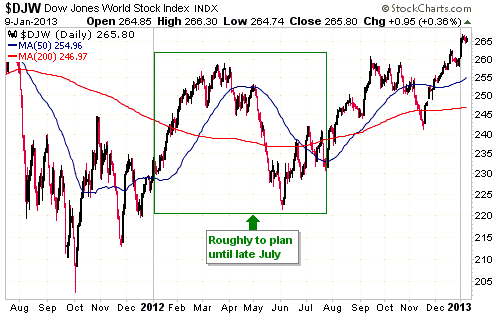
As is our wont, we were too bearish on the stock market in 2012. At
least, our concerns weren't validated by the price action. We
expected the market to hold up fairly well during the first few
months of the year and then roll over into a major downward trend,
with spreading recognition of a US recession being a primary driver
of the downward trend. The first half of 2012 went according to
plan, but the global stock market fared much better during the
second half than we thought it would. The deviation from our 'plan'
began in late July, not coincidentally around the time of ECB chief
Mario Draghi's promise that the ECB would "do whatever it takes". We
under-estimated the importance of the ECB's July-2012 shift.
Although this is the time of year when it is traditional for a
newsletter writer to express an opinion on what will likely happen
over the year ahead, right now we simply have no opinion on what the
stock market will do during 2013 and see no point in pretending
otherwise. The market is 'overbought' on a short-term basis, but
sentiment is neutral and the 'overbought' condition could be
eliminated by a routine consolidation. We think that the risk/reward
balance is skewed towards risk in the short and intermediate terms,
but a perception that risk is markedly higher than potential reward
doesn't necessarily translate into a forecast. It doesn't even
necessarily translate into a view that the market is more likely to
rise than fall. To use an analogy, we would reasonably expect to win
a round of Russian roulette, but it wouldn't make sense for us to
play because the cost of losing would be too great. We view the
current stock market situation in a similar way. Due to how the
risk/reward is skewed, the cost of being wrongly bullish would be
far greater than the cost of being wrongly bearish.
Lastly, as we've done in every yearly forecast beginning with the
2010 edition we reiterate our view that the S&P500's March-2009 low
will prove to be its ultimate bear-market bottom in nominal dollar
terms. This is due to the Fed-promoted depreciation of the US$.
Another consideration noted in previous yearly forecasts is that a
floor has effectively been placed under the US stock market's
dollar-denominated price by the virtual certainty that the Fed will
be a lot quicker to crank up the money pumps in reaction to stock
market weakness in the future than it was during 2007-2008. Based on
the Fed's actions over the past four months a rational observer
could no longer doubt that this is the case. After all, the Fed is
now introducing new money-pumping schemes for no reason other than
the high unemployment rate, as if counterfeiting money could
possibly bring about sustainable gains in employment.
The US Dollar
Most gold bulls are constantly expecting the US$ to tank, but this
expectation is unrealistic considering the dollar's fiat-currency
competition. It should always be remembered that the USD/EUR
exchange rate comprises almost 60% of the Dollar Index, which means
that a bearish view on the Dollar Index equates to a bullish view on
the euro. Based on various considerations including interest-rate
differentials, monetary-inflation differentials and sentiment, there
are times when it makes sense to be bullish on the US$ relative to
the euro and times when it makes sense to be bearish.
Here is how we stated our 2012 forecast for the euro and,
consequently, the Dollar Index (the Dollar Index effectively being
the reciprocal of the euro):
"...for 2012 we are anticipating a multi-month euro rebound,
either beginning near the current level or after a capitulation (a
final blow-off decline) that pushes the euro down to around 1.20. At
this stage there's no point thinking beyond the likely euro rebound.
Instead, we'll wait for the market to work off the massive euro
net-short position and then consider whether or not a major new euro
decline (US$ advance) is likely."
It took longer than expected for the euro to rebound and for the
euro net-short position to be worked off, but it eventually
happened. As things now stand, the euro has rebounded for about 5
months and speculators have shifted from being massively net-short
euro futures to being approximately flat.
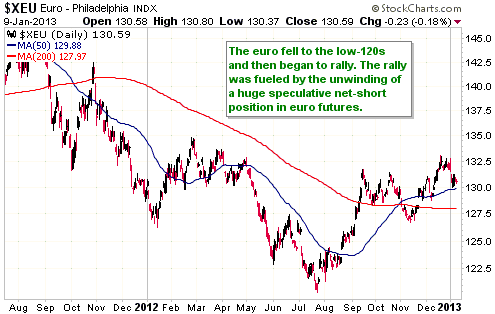
Once a sentiment swing from an optimistic or pessimistic extreme
gets underway in the financial markets it usually doesn't end until
the opposite extreme is reached. Given that sentiment in the
currency market has shifted from an anti-euro extreme to neutral,
this probably means that the euro will gain some additional ground
before making an intermediate-term peak (a peak that holds for more
than a few months). Our best guess at this stage is that the euro
will peak at somewhere between 135 and 140 during the first half of
this year and then roll over into a major multi-quarter decline
driven by the resumption of the euro-zone's government debt crisis.
We now turn our attention to the most interesting currency of the
moment: the Yen.
In our 2012 forecast we wrote:
"At some point over the next three years the Yen is likely to
become very weak in response to huge-scale monetisation of Japanese
Government debt, but right now the supply of Yen is growing at a
much slower pace than the supply of dollars and the Fed is making
sure that the US$ has no interest rate advantage over the Yen.
Therefore, over the months ahead the Yen will probably experience
nothing more bearish than a routine correction to its up-trend.
Furthermore, the Yen could benefit from stock market weakness during
the second half of the year."
The Yen has become very weak over the past few months in response to
the ANTICIPATION of huge-scale monetisation of Japanese Government
debt. At this stage it isn't known if the anticipated monetisation
will begin in the near future, although there's a high probability
of it beginning within the coming two years. It's the logical (from
a political perspective) next step along the road to debt default.
We think the Yen is positioned similarly today to how the euro was
positioned at its low points during the first seven months of 2012.
Almost everyone is bearish for reasons that everyone is well aware
of. According to Market Vane's sentiment survey, only 19% of traders
were bullish on the Yen at the low point over the past week. By
comparison, 24% of traders were bullish on the euro when it was
bottoming in late-July of last year. It's possible that the
currency-trading community will become a little more anti-Yen before
we get a meaningful swing in the opposite direction, but there
doesn't seem to be scope for Yen sentiment to get a lot worse.
Primarily for sentiment reasons, we expect that a substantial
multi-month Yen rebound will begin by April. It should also be noted
that long-term fundamentals still favour the Yen over both the US$
and the euro, but that will change if the BOJ begins to increase the
Yen supply at a much faster pace.
Moving along, we expect that the main commodity currencies (the A$
and the C$) will be strongly influenced by the stock market during
2013 just as they were during each of the past several years. To be
a little more specific, the A$ and the C$ will be in rising trends
when the global stock market is strong and falling trends when the
global stock market is weak.
The Stock Market
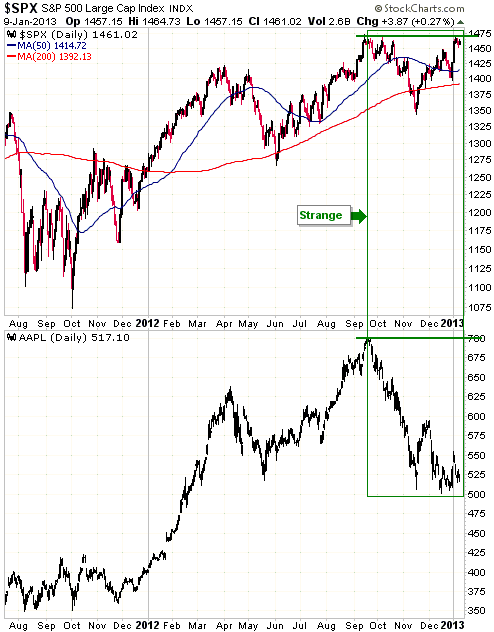
The following chart-comparison of the S&P500 Index and the stock
price of Apple (AAPL) is puzzling. Until September of this year, the strong
upward trend in Apple's stock price appeared to be a major contributor to the
rising trend in the broad stock market. Therefore, it would have been reasonable
to expect that a 25% decline in the price of Apple shares, with no important
negative company-specific news to explain it, would be accompanied by
significant weakness in the broad market. However, the chart shows that over the
past four months the S&P500 has essentially traded sideways while AAPL has lost
25% of its value. This is strange, especially considering that AAPL's valuation
is attractive based on what it earned over the past 12 months and what it is
expected to earn over the next 12 months.
It usually isn't difficult to come up with a plausible-sounding explanation for
market action after the fact, but in this case we didn't expect such a
divergence and we can't explain it now that it has happened.
Most stock indices are 'overbought' and close to important resistance. Also, the
VIX is at an unusually low level. This probably means that the indices will
trade 5%-10% below current levels within the next couple of months, even if they
maintain an upward bias for 2-3 more weeks.
That being said, sentiment surveys do not reveal rampant optimism. Actually, on
a scale of zero to ten, with zero representing abject pessimism and ten
representing manic optimism, we would put current stock market sentiment at six.
This opens up the possibility that a routine 5%-10% correction would clear the
way for another 2-3 month rally.
Gold and the Dollar
Gold
Basel III Progress
In three commentaries last November-December we discussed the potential impact
of the new "Basel III" banking regulations on the gold market. Our conclusion:
"Despite the breathless commentary of some pundits, at this stage it doesn't
look like Basel III will be a watershed event for the gold market. Moreover,
there is still doubt as to exactly what Basel III will entail, which parts of
Basel III will be implemented by the banking regulators of different countries,
and the implementation schedule."
There was a new Basel-related development early this week. The Basel Committee
announced that the first ever global liquidity standards would be less onerous
than expected and not be fully enforced until 2019, four years later than
expected. Of particular relevance, the list of assets taken into account when
calculating a bank's "liquidity coverage ratio" has been expanded to include
some equities and mortgage-backed securities, but not gold. Refer to the FT
article posted
HERE for more information.
This latest development effectively underlines two points. First, gold will not
be directly affected by Basel III. Second, the world's major central banks,
commercial banks, banking regulators and governments are in bed together.
Current Market Situation
The gold market drifted uneventfully over the first three days of this week,
leaving gold's price at the end of the US trading session on Wednesday 9th
January within $1 of its price at the end of last week.
Gold Stocks
There probably aren't many gold-stock bulls left. Being a contrarian investor
works well over the long term, but it often results in discomfort. That's why
many investors claim to be contrarians, but very few actually are.
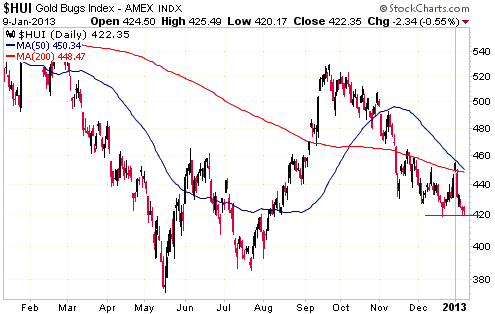
The HUI has tested its December intra-day low of 420 on each of the past two
trading days. Until now it has managed to hold above this level on a daily
closing basis, but it will obviously take only a small increase in selling
pressure or a small reduction in buying pressure to bring about a daily close
below 420. If the HUI were to close below 420 then the chart-based objective
would be major support at 375-385.
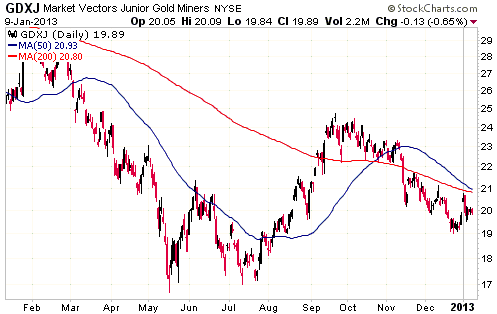
GDXJ and GLDX, ETFs that represent the junior end of the gold sector, have
recently traded more positively than the HUI. For example, whereas the HUI is
testing its December-2012 intra-day low and just achieved its lowest daily close
since early August of 2012, the following chart shows that GDXJ ended
Wednesday's session a few percent above its December low. However, a daily close
below 420 by the HUI will take us out of the GDXJ trade we initiated in the
latest Weekly Update, regardless of whether or not GDXJ remains above equivalent
support. This is being done to ensure that if there is a loss it will be small.
Update
on Stock Selections
Notes: 1) To review the complete list of current TSI stock selections, logon at
http://www.speculative-investor.com/new/market_logon.asp
and then click on "Stock Selections" in the menu. When at the Stock
Selections page, click on a stock's symbol to bring-up an archive of
our comments on the stock in question. 2) The Small Stock Watch List is
located at http://www.speculative-investor.com/new/smallstockwatch.html
Chart Sources
Charts appearing in today's commentary
are courtesy of:
http://stockcharts.com/index.html

|









