|
- Interim Update 9th February 2011
Copyright
Reminder
The commentaries that appear at TSI
may not be distributed, in full or in part, without our written permission.
In particular, please note that the posting of extracts from TSI commentaries
at other web sites or providing links to TSI commentaries at other web
sites (for example, at discussion boards) without our written permission
is prohibited.
We reserve the right to immediately
terminate the subscription of any TSI subscriber who distributes the TSI
commentaries without our written permission.
Will silver do better than gold?
Many analysts are convinced that silver is going to outperform gold this year and for years to come. Are they right?
We don't know. What we do know is that: a) most of the recent
silver-related commentary has focused on silver's upside potential and
has not mentioned, or has glossed over, silver's downside risk, and b)
silver bulls are generally ignoring the relationship between the
silver/gold ratio and the economic growth theme. These two points go
together in that silver's downside risk is linked to the potential for
the 'growth trade' to collapse.
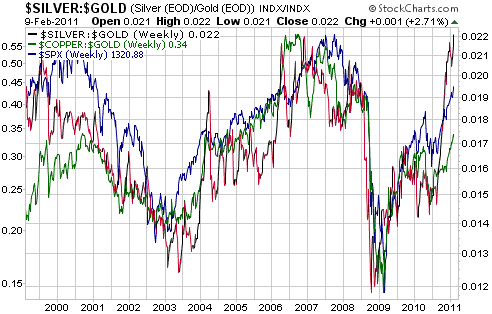
By way of further explanation we present, below, a weekly chart
comparing the silver/gold ratio with the copper/gold ratio (in green)
and the S&P500 Index (in blue). This chart shows that over the past
12 years silver has out-performed gold during periods when copper has
been out-performing gold and when the broad stock market has been
trending upward; in other words, when growth-oriented speculations have
been gaining in popularity. The chart also shows that silver has
performed very poorly relative to gold when growth-oriented
speculations have been falling in popularity, especially when there has
been a financial/banking crisis.
The chart's message is that you should be intermediate-term bullish on
silver relative to gold if you are bullish on the economy, and
intermediate-term bearish on silver relative to gold if you are bearish
on the economy and/or the financial system. Strangely, though, some of
the most vociferous silver bulls are bearish on the economy and the
financial system.
We have always said
that silver stood a good chance of out-performing gold over the course
of the long-term precious metals bull market, simply because silver is
a vastly smaller market than gold and therefore has the potential to
make disproportionately large gains in response to increasing
investment demand. However, we have also said that we favoured gold
over silver due to gold's lesser downside risk. It's the risk relative
to the potential reward -- not just the potential reward -- that
determines the merits of a speculation. The risk is that a future
banking crisis and/or major deflation scare will have the same effect
on the silver/gold ratio as the last three such episodes (the
early-1990s, the early-2000s, and 2007-2008), when silver cheapened
relative to gold to the point where it took 80-100 ounces of silver to
purchase an ounce of gold.
If you believe that there is almost no chance of a banking crisis or
major deflation scare happening over the next few years then you should
definitely favour silver over gold.
The Stock Market
The stock market has recently been quiet. Too quiet.
Here are a few of the observations we made over the first three trading days of this week:
1. The Brazilian and Indian stock markets continued to weaken and ended Wednesday's session at new 5-month lows.
2. The Hong Kong stock market, an important indicator of the global
trend, weakened a little but hasn't yet done anything definitively
bearish. Hong Kong's Hang Seng Index has short-term support at 22500.
3. The major mining stocks were noticeably weak on Wednesday. BHP made
a new high as recently as Tuesday 8th February, but FCX and VALE have
been declining for the past few weeks.
4. The senior US stock indices continue to trade as if there is absolutely nothing to worry about.
Gold and
the Dollar
Gold and Silver
A point we've tried to make over the past couple of weeks is that there
has been nothing in gold's price action to indicate that the decline
since the December peak is anything more serious than a routine
short-term correction. In particular, we noted that the US$ gold price
had reversed upward in late January after touching its 150-day moving
average, which is exactly what happened during every other short-term
correction of the past two years.
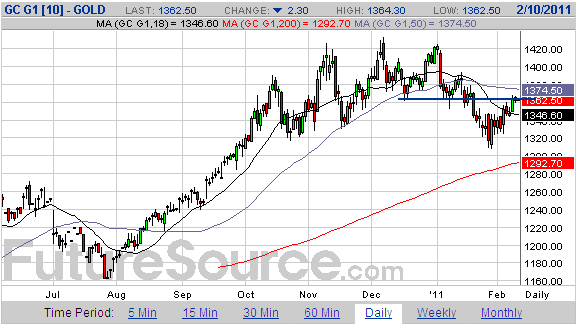
The following daily chart shows that March gold has rebounded from its
late January low of $1307 to short-term resistance in the $1360s. The
fact that gold has made it back to the $1360s doesn't mean much because
the first leg of a rally to new highs and a counter-trend reaction to
the January decline would both be expected to take the gold price up
this far. It's what happens next that should provide some useful
information. For example, a pullback from resistance followed by a move
above this week's high would suggest that gold was on its way to a new
all-time high.
The silver/gold ratio
made a new multi-year high earlier this week, an event that increases
the probability of both gold and silver making new multi-year highs
within the next few weeks. However, we would continue to be cautious
and only accumulate new positions on weakness. Our concerns are that
the silver/gold ratio never dropped enough to properly correct last
year's moon-shot, and that while sentiment in the gold market is
constructive the same can't be said of the silver market. There is a
lot of froth in the silver market and this froth will have to be
eliminated by a sizeable price decline that either begins from near the
present level or begins from a higher level a few weeks from now.
There is some talk about silver being in backwardation, but based on the quote table displayed HERE
it is more accurate to say that silver's forward price curve is flat.
There is almost no difference between the nearest futures price and the
prices of longer-dated contracts, so silver is neither in contango nor
in backwardation. The flat forward price curve suggests some tightness
in the silver market, which doesn't imply that the price is about to
move higher -- since the tightness is already discounted in current
prices -- but does suggest that the market will be more sensitive than
usual to a bullish change in the near-term supply/demand balance.
Gold Stocks
Current Market Situation
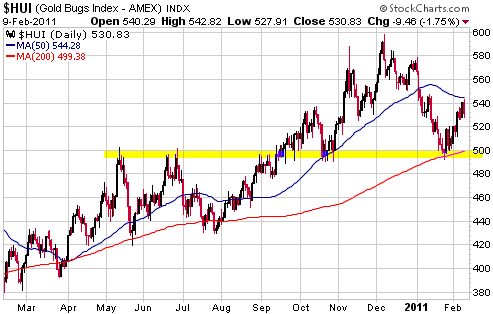
The HUI's recent rebound took it from support at around 500 to the
vicinity of its 50-day moving average. This is the minimum that would
be expected from either a counter-trend rebound or the first leg of a
rally to new highs.
We don't have any opinion on what will happen over the next several
days, other than we don't expect a sustained break below the recent
low. The HUI is not yet close to being 'overbought', so it wouldn't
surprise us if the rebound continued. However, it also wouldn't
surprise us if there were a pullback to re-test support.
As mentioned last week, on a very short-term basis we think that the
HUI in the low-500s constitutes a sector-wide buying opportunity while
a rise to 550 or higher creates a selling opportunity.
Financings Galore
There is obviously a lot of money sloshing around the financial system
at the moment, and junior gold/silver miners are taking advantage of
the 'excess liquidity' by stampeding towards the financing trough. For
example, five of the gold/silver stocks in the TSI List have announced
sizeable (relative to company size) financings over the past three
weeks.
Some of the financings have been well managed in that the companies
involved have done deals that substantially add to cash reserves
without significantly diluting the interests of existing shareholders.
Other financings, however, have been poorly timed/executed. Examples of
the latter include the Jaguar Mining (JAG) convertible note financing
discussed in the latest Weekly Update and the Catalpa Resource (ASX:
CAH) equity financing announced late last week. The CAH financing was
problematic from the perspective of existing shareholders because a) it
was arranged after the stock had just dropped to a 5-month low, b) it
involved selling new shares at a 10% discount to the current low price
and at a huge discount to full value, and c) the company did not have
an urgent need for additional funds. CAH's management subsequently
boasted that there was very strong demand for the new shares, to which
we respond: of course there was -- there will always be plenty of
demand if you set the price low enough. At the other end of the
financial management spectrum, on Tuesday of this week Sabina Gold and
Silver (TSX: SBB) announced that it was raising money by selling new
shares at, or near, an all-time high.
Anyway, the point we wanted to make is that the extremely accommodative
financial backdrop is bringing about a large increase in the supply of
shares at the junior end of the gold/silver sector. This increase in
share supply should be kept in mind because it WILL weigh on stock
prices during the second and third quarters of this year.
Currency Market Update
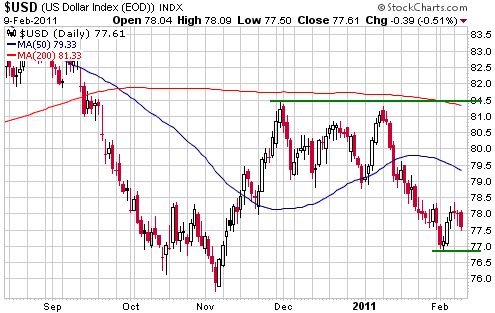
Over the first three days of this week the Dollar Index gave back about
half the gains it made during the final three days of last week.
With regard to chart-based support and resistance, here's the situation as we see it:
1. Consecutive daily closes above its 50-day moving average would be a
warning sign that the Dollar Index's bottoming process was about to end.
2. A solid daily close above 81.5 would remove all doubt that an intermediate-term advance began last November.
3. A daily close below the early February low would suggest that an intermediate-term bottom was NOT put in place last November.
Update
on Stock Selections
(Notes: 1) To review the complete list of current TSI stock selections, logon at http://www.speculative-investor.com/new/market_logon.asp
and then click on "Stock Selections" in the menu. When at the Stock
Selections page, click on a stock's symbol to bring-up an archive of
our comments on the stock in question. 2) The Small Stock Watch List is
located at http://www.speculative-investor.com/new/smallstockwatch.html)
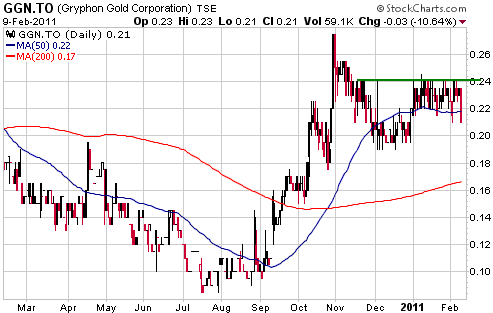
 Gryphon Gold (TSX: GGN). Shares: 88M issued, 99M fully diluted. Recent price: C$0.215 Gryphon Gold (TSX: GGN). Shares: 88M issued, 99M fully diluted. Recent price: C$0.215
GGN announced on Monday that it was in the process of arranging a $10M
equity financing. The details haven't yet been finalised, but our guess
is that the financing will involve 50M $0.20 units with each unit
comprising one share of common stock and one-half of one $0.30 warrant.
This would make the terms of the current financing the same as the
terms of the $1.3M private placement that was done last month.
If the abovementioned financing is 'put to bed' within the next couple
of weeks then GGN will have enough money to complete the first phase of
the two-phase development process outlined in its "Road to Production"
presentation. Phase 1 involves small-scale gold production from the old
dump sites at the Borealis project (Nevada), and at a gold price of
$1200/oz is expected to generate a gross profit of about $7M over 6
months. Phase 2 involves an expansion of the leach pad and the mining
of an existing pit, and is expected to generate a gross profit of about
$15M (at $1200/oz) over 12 months. Combined, Phases 1 and 2 are
expected to result in gold production of around 40,000 ounces over the
next 18 months, providing GGN with gross profit of around $22M. The
plan is for this profit to be used to ramp up the production rate to
50K ounces/year by mid-2012.
In the current environment a 50K oz/yr gold-mining operation in Nevada
would probably be worth at least $100M. Assuming no change in the
market environment and a share-count increase to 170M, this suggests a
valuation-based 18-month upside target of about $0.60/share for GGN.
As a result of what
happened in 2008 -- when the demand for the stocks of micro-cap mining
companies evaporated to the point where it was impossible to sell even
small stakes without driving stock prices downward -- we decided that
future inclusions in the TSI Stocks List would have to be sufficiently
liquid that we could suggest buying or selling the stock without having
a big effect on its price. Also, we established the Small Stocks Watch
List for the purpose of tracking high-potential stocks that weren't
liquid enough to be members of the TSI List.
Based on its size and liquidity, if we were introducing GGN to our
readership today we would put it in the Small Stocks Watch List rather
than the Stocks List. It has good upside potential (assuming that the
just-announced $10M financing is completed as planned), but on most
days it can only be traded in very small parcels.
Andina Minerals (TSXV: ADM). Shares: 108M issued, 129M fully diluted. Recent price: C$1.73
After the close of trading on Wednesday, ADM announced that the results
of the Pre-Feasibility Study (PFS) for its Volcan gold project will be
published on Monday 14th February. The PFS will tell us (and the
market) whether the company has been able to re-engineer the mine plan
in a way that makes the project economically robust, despite the
metallurgical issues previously discovered. It is therefore a critical
milestone.
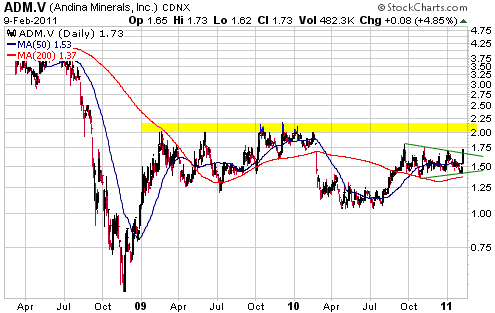
The bounce in the stock price over the past two days, which led to a
mini upside breakout on Wednesday, is most likely due to anticipation
of positive PFS results.
The following chart shows that ADM has substantial resistance in the
low-C$2 area. A break above this resistance would suggest a short-term
target of C$3.00, a price level that would be more than justified by
the stock's valuation IF the PFS proves to be positive.
Duoyuan Global Water (NYSE: DGW). Shares: 25M. Recent price: US$8.35
DGW's decline accelerated this week on higher-than-average volume. We
aren't aware of any new developments that would explain the decline.
DGW is now trading at about 5.5-times its trailing 12-month earnings
and at less than 5-times what it should earn this year, assuming that
its accounting can be trusted. Of equal importance, the company has no
debt and working capital of $7.44/share (including $6.08/share of
cash). This means that if DGW's stock price is pushed down much
further, its fast-growing, profitable water treatment/purification
business will be valued by the stock market at zero.
There is an unusually large short interest in DGW's shares.
Specifically, as at 14th January the stock's short ratio was 15.5,
which means that the number of shares sold short was equivalent to 15.5
days of average trading volume (note: a short ratio of more than 6 is
considered to be high). And the recent price action suggests that the
short interest would now be even higher. This short selling could be
due to traders betting on accounting problems, or it could be due to
traders making bearish bets on China by shorting the most vulnerable
US-traded China stocks regardless of company-specific fundamentals. The
latter possibility is suggested by the fact that quite a few US-traded
China stocks have unusually large short ratios. Examples, with the
associated short ratio shown in brackets, are: YONG (8.5), DEER (13.6),
SNDA (13.0), CHBT (10.3), CAGC (8.5), FSIN (7.6), LFT (11.1), ACH
(13.5), CBPO (14.5), HRBN (15.6), GFRE (12.7), CRIC (39.3), GSH (24.0),
MR (18.0), CMED (17.2), and CSR (8.3).
For information purposes, this is how we are handling DGW in our own account:
- We bought half of what we would consider a full position in the mid-$12 area
- We bought another 25% in response to this week's pummeling
- We plan to buy the final 25% following a stock price decline
to the vicinity of cash value, or evidence of a turnaround in the stock
price, or the company receiving a clean bill of health from its
independent auditors, whichever happens first.
Chart Sources
Charts appearing in today's commentary
are courtesy of:
http://stockcharts.com/index.html
http://www.futuresource.com/

|









