- Interim Update 9th March 2016
Copyright
Reminder
The commentaries that appear at TSI
may not be distributed, in full or in part, without our written permission.
In particular, please note that the posting of extracts from TSI commentaries
at other web sites or providing links to TSI commentaries at other web
sites (for example, at discussion boards) without our written permission
is prohibited.
We reserve the right to immediately
terminate the subscription of any TSI subscriber who distributes the TSI
commentaries without our written permission.
Commodities
Many industrial commodities have
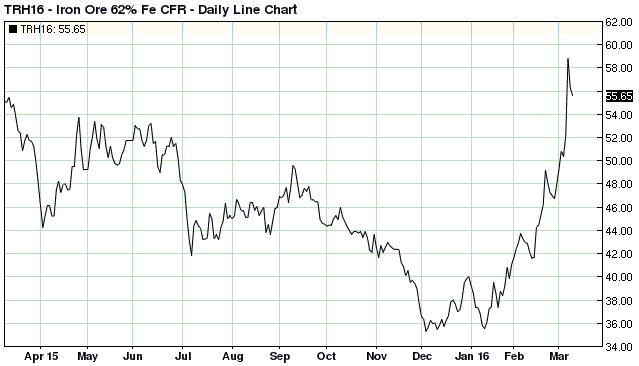
rebounded over the past several weeks, none more impressively than iron-ore. The
following chart shows the recent fast 70% rise in the iron-ore price from a
January bottom to a peak early this week.
Analysts from Goldman Sachs, along with numerous others, have warned that the
rallies in iron-ore and other commodities are unsustainable and doomed to be
followed by declines to new bear-market lows. Regardless of whether or not this
conclusion turns out to be correct, the analysis is wrong because it is based on
supply-demand fundamentals. Commodity supply-demand fundamentals are ALWAYS very
bullish at major price tops and very bearish at major price bottoms, so
commodity analysts that base their forecasts on the supply-demand fundamentals
are guaranteed to be wrong at major turning points.
That doesn't mean that a major turning point has happened; it means that you
cannot possibly tell if a major turning point has happened by assessing the
supply-demand fundamentals.
Our view is that a sustained turn to the upside could have begun. At this stage
it's a realistic possibility that will have to be confirmed by additional
evidence. At the same time, the prices of some high-profile industrial
commodities and the associated equities are stretched to the upside on a
short-term basis. Pullbacks are therefore likely over the weeks ahead even if
long-term price trends are in the process of shifting from down to up.
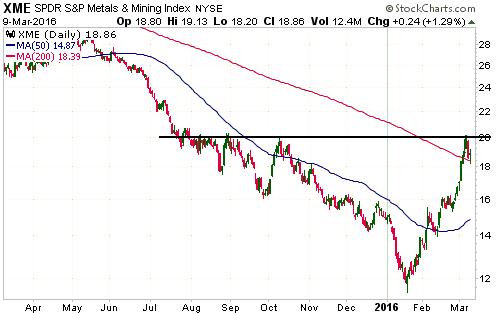
The following daily chart of the S&P Metals and Mining ETF (XME) shows the
extent to which the mining universe is now stretched to the upside. At its high
of the past few days XME had fully retraced its October-January collapse.
The Stock Market
The US
From David Stockman's
7th March article:
"The S&P 500 is heading through 1300 from above long before it ever again
penetrates from below its old May 2015 high of 2130. And now that 97% of Q4
results are in, there is a single number that proves the case.
Reported LTM [last twelve months] profits as of year-end 2015 stood at just
$86.46 per S&P 500 share. That particular number is a flat-out bull killer. At a
plausible PE multiple of 15X, it does indeed imply 1300 on the S&P 500 index.
It also represents an 18% decline from peak S&P 500 reported earnings of $106
per share back in September 2014. And more importantly, it means that the robo-machines
and hedge fund gamblers have traded the market back up to 23.1X earnings.
That's off the charts...except for when recession has already arrived
unannounced by the hockey stick factories of Wall Street."
If you want to get the bear case and nothing but the bear case, David Stockman's
site is the best place to go. That's not just because the site has a strong
bearish bias. There are, after all, many sites like that. Stockman's site is the
best because even though there is a strong bearish slant, the bearish slant is
supported by reams of factual information. It's important, however, to always
keep in mind the biases in your information sources. Stockman's site will give
you numerous good reasons related to earnings and economic data as to why the
stock market should go down, but the stock market doesn't always go down in the
face of weak earnings and economic performance. There are other influences that
must be taken into account.
One of these other influences is sentiment. Due to the sentiment that prevailed
during the first half of February there was a high probability of a sizable
rebound and no realistic chance of a crash (sentiment at that time was already
nearing the extremes of negativity found at crash lows).
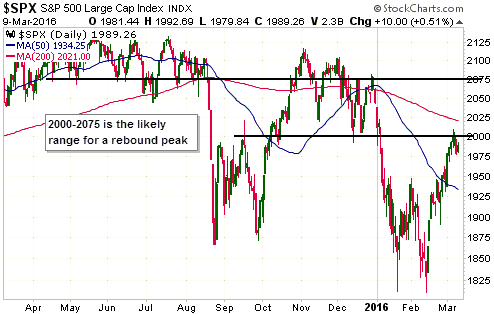
By the time the SPX had rebounded from the low-1800s to around 2000, sentiment
was no longer supportive. In particular, with the SPX hovering around 2000 early
this week the 10-day MA of the equity put/call ratio indicated that the "dumb
money", which was very fearful near the February bottom, had become complacent.
This suggested that downside risk was again worth worrying about, although it is
fair to say that sentiment had not yet become a clear-cut negative. There was
still scope for additional short-term upside within the overarching context a
cyclical bear market.
Nothing changed over the first three trading days of this week. Sentiment is no
longer supportive, but it hasn't yet transformed into a substantial head-wind.
Furthermore and as discussed in previous commentaries, the unusually high level
reached by the NASDAQ's McClellan Oscillator over the past week or so suggests
that the market is likely to maintain an upward bias or trade sideways for a few
weeks before commencing its next downward leg.
Looking beyond the next few weeks, we aren't as bearish as Stockman. At least
not yet. We do, however, see a risk/reward ratio that is decisively skewed
towards risk. We do not think the SPX will trade as low as 1300, even though
this year's earnings could well justify such a level, but we do think it stands
a realistic chance of trading below 1600 later this year. This means we perceive
about 400 points of downside risk. At the same time, we perceive maximum upside
potential of about 80 points from Wednesday's closing price.
The upshot is that we have a good set-up for a 2-6 month bearish speculation,
although the set-up could get a little better over the next few weeks.
Europe
The negative-interest-rate and bond-monetisation policies implemented by the ECB
could never have done anything other than reduce economic progress in Europe and
weaken the banking system, and yet a few hours after today's Interim Update is
published the ECB is expected to announce the ramping-up of such policies. This
is perfectly logical, because the ECB is committed to economic models that show
stronger economic performance being the result of lower interest rates and
faster money-creation. If you are committed to such models and stronger economic
performance fails to materialise in the aftermath of interest-rate suppression
and faster money-pumping, the logical deduction is that you should ramp-up the
same old policies.
The fact is that the ECB's policies are strangling Europe's banks and getting in
the way of an economic recovery, but the ECB's senior policy-makers cannot
possibly see this reality because they are looking at the world through a
Keynesian lens. They are like astronomers trying to understand the paths of the
planets based on the theory that the Earth is the centre of the universe.
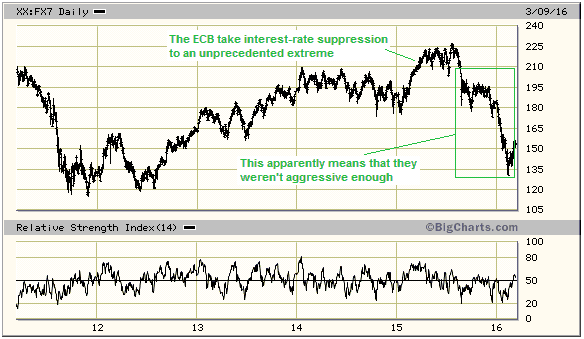
The Europe 600 Banks Index (FX7) has rebounded with most other stock-market
indices over the past few weeks, but the rebound has been unimpressive and new
multi-year lows remain likely. The question revolves around the timing, which
will be influenced by what the ECB announces after its 10th March meeting.
Gold and the Dollar
Gold
The US$ gold price dropped a little over the first three trading days of this
week, but a short-term top has still not been signaled. This means that a rise
to $1300-$1308 remains a realistic possibility prior to such a top (a price peak
that holds for 1-3 months).
As noted in earlier TSI commentaries, the first clear sign that a short-term top
was in place would be a daily close below the 20-day MA. This MA is now at $1235
and should be above $1240 by the end of the week.
In addition, the $1240 level is now shaping up to be significant lateral
support, given that the gold price reversed upward on Wednesday following a
decline to slightly above this level. Therefore, over the next few days gold's
position relative to $1240 could also be used to confirm/deny a short-term top.
Specifically, it would now be reasonable to interpret a daily close below $1240
as evidence that the US$ gold price had made a top that will hold for at least a
month.
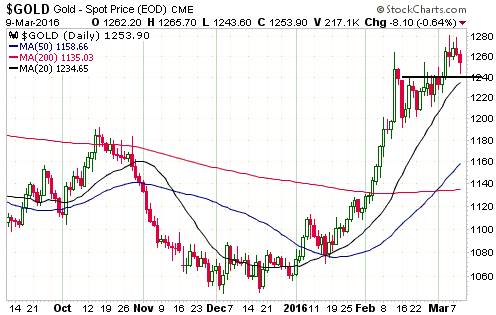
Taking a step back, there isn't much more that gold can do on the upside in the
near future to validate the view that a bull market has commenced. For example,
a surge to the $1300-$1308 resistance area or even a bit higher within the
coming 1-2 weeks will not create additional evidence of a long-term reversal,
because gold's rally from its December bottom has already done as much as it
needed to do in terms of breaking above long-term trend-defining moving
averages. Instead, to provide further validation of the bull market scenario
what must happen from here is a significant downward correction to a higher low
followed by a rise to a new high for the year. In this case, significant means
"to the 50-day MA or lower".
Gold Stocks
Current Market Situation
Two-way volatility is increasing in the gold-mining sector, probably due to a
battle between the profit-taking of speculators who trade based on value and
sentiment (the buy-low-sell-high group) and the burgeoning enthusiasm of
trend-following speculators (the buy-high-sell-higher group).
For the HUI, support for the short-term upward trend is at 160. That is, a daily
close below 160 would indicate that a short-term price top was in place. Until a
short-term top is signaled there will remain a realistic chance of a surge to a
new high for the year, with round-number resistance at 200 probably defining the
maximum upside following a break above the recent high in the 180s.
A decline to the 50-day MA or a little lower will be a good bet once a
short-term top is in place. The 50-day MA is at 136.6 and will soon be above
140, at which point lateral support at 140 will become the most likely target
for a correction low.
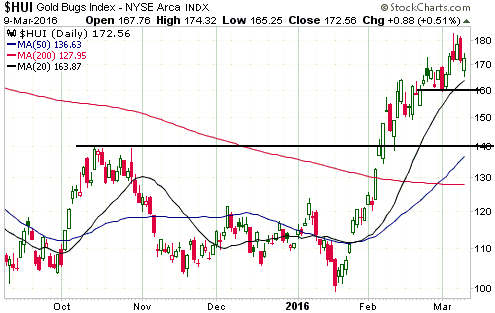
As is the case with gold, the next piece of the gold-mining puzzle -- in terms
of validating the bull-market scenario -- involves a significant downward
correction followed by a rise to a new high for the year.
Optionality Plays
Rick Rule, a very successful speculator in resource stocks, has
recently been talking about buying gold and other mining stocks that provide
"optionality". Most mining stocks have in-ground resources that become more
valuable as mineral prices rise and therefore have option value, but that's not
what he is talking about. According to his definition, an "optionality" play is
a company that owns a large in-ground metal resource that a) could not be
profitably mined near current commodity prices, b) could become economically
viable at the higher commodity prices that will possibly be reached within the
next few years, and c) is being assigned a very low per-ounce (or per-pound or
per-tonne) valuation by the stock market. In addition, an "optionality" play
will have managers who plan to do very little to move the project towards
production and who get paid appropriately for doing very little.
There are currently no "optionality" plays among the mining stocks in the TSI
List. All of our current mining-related stock selections are companies that are
already in production or are moving purposefully towards production or, in the
case of Pilot Gold, are exploring aggressively. However, the "optionality"
strategy worked well for us in the past (in particular during 2003-2007 and
2009-2010) and could work well over the next few years, so we are certainly not
averse to adding some optionality plays to the TSI List.
With regard to recommending and tracking "optionality" plays TSI, one problem is
that such stocks tend to be dormant for very long periods (a year or longer)
while bases are built. A lot of patience can therefore be required.
Consequently, if you get antsy and irritated when a stock you own is not fully
participating in a sector-wide rally, then "optionality" plays are not for you.
Another problem is that when these stocks do move higher they tend to do so in
spectacular fashion, after which they crash, after which they base for a
prolonged period before embarking on the next spectacular advance. As a result,
the approach that works the best involves scaling out during the occasional
moon-shots and then scaling back in during the long base-building periods. This
is an approach that we are very comfortable with and use extensively in our own
money management, but that we can't reflect in the TSI Stocks List. A stock is
either 100% in or 100% out of the List, meaning that adding to and removing from
our list of stock selection ideas is a digital process. This is different to
practical speculation, which should be an analogue process.
In the commentary linked above, Rick Rule mentions some stocks that could be
viewed as "optionality" plays. Of these, the two that are of most interest to us
are discussed below.
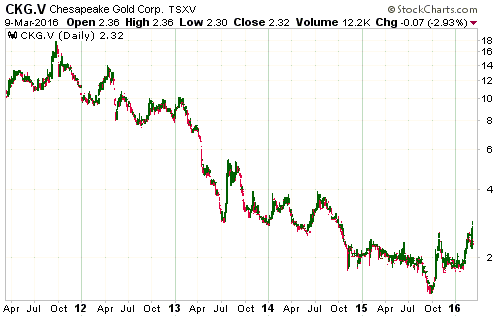
The first is Chesapeake Gold (CKG.V), an old friend of ours. CKG was added to
the TSI List in April-2006 at $3.50 and removed in January-2011 at $14.70, for a
gain of about 320% during the 'holding' period. We have since stayed away due to
the high capital cost and unattractive economics of its Metates gold-zinc
project in Mexico.
The viability of the Metates project at lower metal prices has been improved
over the years, but it will still require a gold price of at least $1500/oz
before any large gold-mining company even begins to think about investing in
this project. However, that's what the "optionality" strategy is all about. The
idea is to buy massive in-ground resources -- and with 18M ounces of gold
reserves plus 4B pounds of zinc reserves, Metates is definitely massive -- when
those resources are a long way out of the money and being valued by the stock
market at almost nothing.
CKG is currently trading in the low-to-mid-C$2 area, where it has a market cap
of around C$100M (44M shares at C$2.32/share). This is probably a little rich at
this time given that Metates is effectively just a long-dated,
far-out-of-the-money call option on gold and zinc. However, it is well-financed
with C$24M of working capital, well-managed, and on our radar screen.
Importantly, having published the results of an updated Pre-Feasibility Study
early this week the company does not plan to undertake further detailed
engineering and development work at Metates. In other words, CKG's management
appears to understand "optionality" and is going to treat Metates the way it
should be treated at current commodity prices.
The other "optionality" play mentioned by Rick Rule that is of interest to us is
Victoria Gold (VIT.V). VIT isn't a pure optionality play in that its flagship
Eagle gold project (Yukon) has a completed Feasibility Study and is fully
permitted, but the project will stand no chance of advancing to the construction
phase until the gold price makes a sustained move above US$1300/oz.
VIT's Eagle project has about 6.4M ounces of low-grade gold resources that could
potentially be extracted via an open pit mine and heap-leach operation. A
Feasibility Study (FS) completed way back in 2012 showed that the project would
have a post-tax IRR and NPV of 18% and C$227M, resp., at a gold price of
US$1325/oz, but these figures are too old to be relied on. That's why the
company is working on an updated FS, the results of which are expected late this
year.
VIT is currently being valued by the stock market at around C$80M (361M shares
at C$0.22/share).
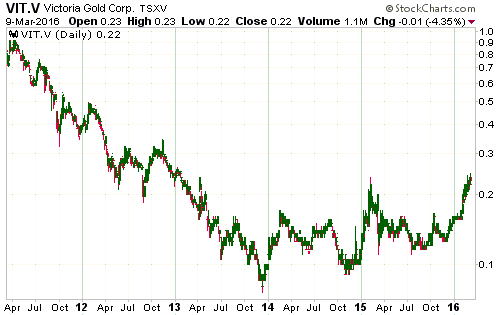
Of the above-mentioned stocks, VIT appears to be the better speculation at this
time. That's largely because it is NOT a pure optionality play (VIT's project
actually stands a fighting chance of being moved into the mine construction
phase within the next two years). That being said, the time is not yet ripe to
'pull the trigger' on either stock.
The Currency Market
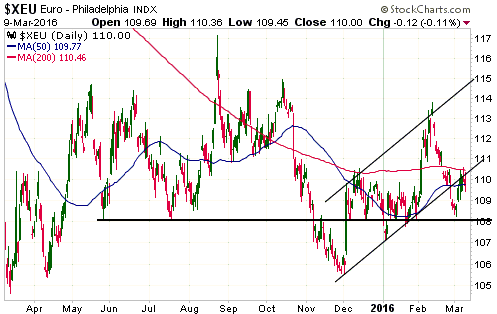
The euro's chart looks slightly bearish, in that the rebound of the past week
looks like a counter-trend move. However, that doesn't mean much with the ECB
scheduled to wreak havoc later today (10th March).
There's a lot of anticipation regarding what the ECB will decide at its 10th
March meeting. Many people expect a further push into negative interest-rate
territory and an increase in the bond-buying (money-pumping) program, but there
is no way of knowing what will be announced and in any case it's impossible to
determine what has already been factored into the market price. It's therefore
best to stay out of the way.
Note that a daily close above 111 would be short-term bullish and a daily close
below 108 would be short-term bearish.
Updates on Stock Selections
Notes: 1) To review the complete list of current TSI stock selections, logon at
http://www.speculative-investor.com/new/market_logon.asp
and then click on "Stock Selections" in the menu. When at the Stock
Selections page, click on a stock's symbol to bring-up an archive of
our comments on the stock in question. 2) The Small Stock Watch List is
located at http://www.speculative-investor.com/new/smallstockwatch.html
Chart Sources
Charts appearing in today's commentary
are courtesy of:
http://stockcharts.com/index.html
http://www.barchart.com/