|
- Interim Update
9th April 2014
Copyright
Reminder
The commentaries that appear at TSI
may not be distributed, in full or in part, without our written permission.
In particular, please note that the posting of extracts from TSI commentaries
at other web sites or providing links to TSI commentaries at other web
sites (for example, at discussion boards) without our written permission
is prohibited.
We reserve the right to immediately
terminate the subscription of any TSI subscriber who distributes the TSI
commentaries without our written permission.
Non-receipt of TSI emails
Many subscribers experienced a problem with non-receipt of
Sunday's email notification about the TSI Weekly Market Update. We
actually sent the email twice in case the problem was due to a
temporary glitch, which resulted in about 70% of subscribers getting
two emails and the rest getting no email due to the persistence of
the aforementioned problem.
Last Sunday's non-receipt problem was due to some email service
providers, including Yahoo, Comcast, SBCglobal, Gmail and Hotmail,
blocking our messages due to new spam-fighting policies.
We have made a small change to our method of email delivery that
will hopefully resolve this issue, but want to remind our readers
that if you do not receive the email notification with a direct link
to a new TSI commentary you can always access the commentary by
logging on at
http://www.speculative-investor.com/new/market_logon.asp and
then clicking on "Weekly Market Update" or "Interim Update". Note
that in the more than 13 years of TSI's existence there has not been
a single occasion when a TSI commentary was not published on
schedule without a prior warning.
Final
comment on HFT
If HFT is a problem (we haven't seen any evidence
that it is), it is such a minor one that it wouldn't have warranted a mention
from us if it hadn't been blown-up into a huge issue by other writers and
commentators. For what will probably be our final comment on this particular
molehill-turned-mountain, we will leave you with some reading/listening material
that we found informative.
First, there's the
2nd April Businessinsider article in which professional money manager Cliff
Asness explains how HFT has helped drive down the cost of trading for most other
traders. Here's an excerpt:
"How do we feel about high-frequency trading? We think it helps us. It seems
to have reduced our costs and may enable us to manage more investment dollars.
We can’t be 100% sure. Maybe something other than HFT is responsible for the
reduction in costs we’ve seen since HFT has risen to prominence, like maybe even
our own efforts to improve. But we devote a lot of effort to understanding our
trading costs, and our opinion, derived through quantitative and qualitative
analysis, is that on the whole high-frequency traders have lowered costs."
Second, there's the lengthy -- but easy to read -- 31st March article titled "No,
Michael Lewis, the US Equities Market Is Not Rigged". Here's an excerpt:
"The development of multiple execution venues has changed the economics of
trading. If we look back on equity trading even as recent as a decade ago, the
brokers and exchanges were standalone profitable powerhouses. Today, equity
exchanges are not in the same financial shape. Derivative exchanges are driving
exchange growth, and equity exchanges need to be lean and mean to survive.
Brokers are not prospering either, as traders and experienced sales people are
being swapped for machines and less experienced sales support. ETFs,
self-empowering technology and investor pressure have reduced the cost of
execution and have caused brokers to reduce their staffs.
So where is all of this value going? To high-frequency traders? We don't see
them doing much better than the exchanges or brokers. The pressure to invest in
expensive technology and infrastructure, colocation and connections to many more
markets, as well as improvements in vendor-based solutions, have caused a hit to
their revenues. TABB Group estimates that US equity HFT revenues have declined
from approximately $7.2 billion in 2009 to about $1.3 billion in 2014. Looking
at recent public data, the profitability of HFT firms in the US equities market
has declined, just as the number of players has decreased."
Third, there's the CNBC interview
from October of 2012 in which the Chief Investment Officer of Vanguard said:
"There are literally hundreds of strategies that are high-frequency trading,
ranging all the way from those that really perform much of a market-making and
liquidity-providing function to perhaps some on the opposite end of the
spectrum, where they are abusive and trying to manipulate the market. Obviously,
we need to get rid of those types of high-frequency traders, but I think the
bulk of them are creating liquidity and reducing spreads for us, which has
dramatically reduced costs."
Note that the anti-HFT brigade is claiming that companies such as Vanguard --
companies that manage equity mutual funds, pension funds, IRA's and 401K plans
-- are the main victims of HFT, but here we have the CIO of the world's largest
mutual fund company stating that the net effect of HFT has been to lower his
firm's costs.
Fourth, Michael Santoli's
9th April article addresses the psychological reasons behind the public's
growing HFT-related indignation (even though someone is getting a good deal they
will tend to be disgruntled if they believe that someone else is getting a
better deal) and reiterates Vanguard's qualified support of HFT. Here's an
excerpt:
"Want some evidence...that HFT isn't poaching cash from Mom and Pop
retirement accounts in large amounts? The Vanguard Group, the mutually owned
index-fund manager of $2 trillion that's always been fanatical about keeping
investor costs to a minimum, has made its peace with HFT.
In a statement the company said: "We believe the majority of 'high-frequency
traders' play within the rules governing our current equity markets. We believe
a majority of 'high-frequency traders,' which is not a defined term, add value
to our current structure by 'knitting' together today's fragmented market
centers.""
Fifth, below is a link to an interview/debate involving someone with a vested
financial interest in perpetuating HFT and an HFT "whistleblower" (an HFT
insider who has made the regulators aware of problems and risks). If you only
have time to visit one of the links we are providing in today's report, this
should be it:
http://www.frequency.com/video/reuters-hft-debate-with-haim-bodek-manoj/160424082/-/5-1825
A few weeks from now HFT will probably have shuffled off centre stage and the US
media will be trumpeting a new reason for the average investor to be scared.
However, like HFT and the numerous scare stories that preceded it (for example,
the 'LIBOR Scandal', the Debt-Ceiling/debt-default issue, "Sequestration", the
'London Gold Fix Scandal', Cyprus, Syria, Ukraine), it won't be a genuine reason
for investors to be scared. The genuine reasons to be scared will be kept away
from centre stage for as long as possible.
The Stock Market
The US
Major stock-market tops are a process, not an event, and the process involves
some divergences/non-confirmations during the lead-up to the ultimate price
high. In the current US situation, the recent relative weakness in the NASDAQ100
Index (NDX) opens up the possibility that if the SPX achieves a new high in the
near future then the high won't be confirmed by the NDX.
Here are two other noteworthy and potentially-important divergences that have
been developing:
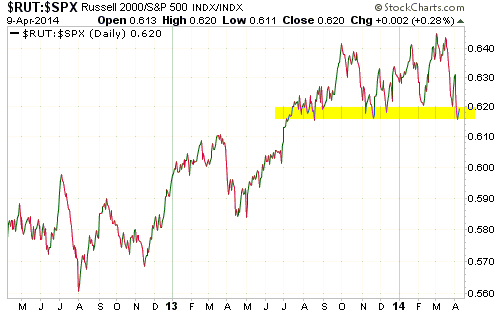
1) The RUT/SPX ratio (small cap stocks relative to large-cap stocks) made a
marginal new high at the beginning of March and in doing so confirmed the new
high made by the SPX a few days earlier. However, the RUT/SPX ratio not only
failed to confirm the new high made by the SPX in early-April, it also plunged
to a new low for the year shortly after the SPX made a new high.
The RUT/SPX ratio will almost certainly fail to confirm any new high made by the
SPX over the coming two weeks and is also in danger of breaking below the triple
bottom that formed over the past 9 months.
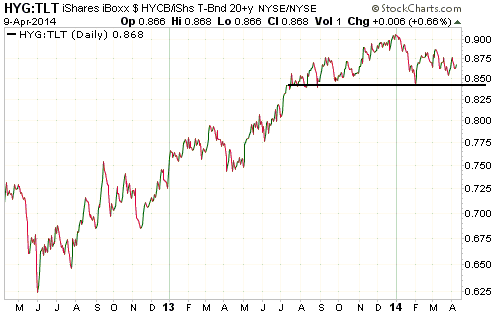
2) The HYG/TLT ratio, a credit-spread indicator, generally trends in the same
direction as the stock market. However, the following chart shows that HYG/TLT
peaked at the end of last year and therefore failed to confirm any of this
year's new SPX highs.
If HYG/TLT takes out its early-February low it will be a definitively bearish
omen for the stock market (and a bullish omen for gold).
China
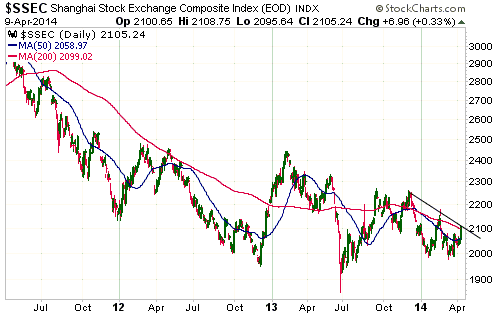
The asset-price-related effects of China's gargantuan credit bubble are almost
totally focused on the real estate market. There is no evidence of this bubble
in China's stock market, which probably means that a large decline in the
Shanghai Stock Exchange Composite Index (SSEC) won't be a knock-on effect if the
credit bubble bursts in the near future. In fact, it currently looks more like
the SSEC is completing a major base than a major top.
We aren't interested in 'going long' China's stock market, but 'going short'
this market is not the way to bet on the bursting of the world's greatest credit
bubble. Furthermore, the evidence of important upward reversals in commodities
and commodity-related investments that has emerged over the past three months
suggests that China's much-anticipated bubble-bursting will be postponed for
another year.
Gold and the Dollar
Gold and Silver
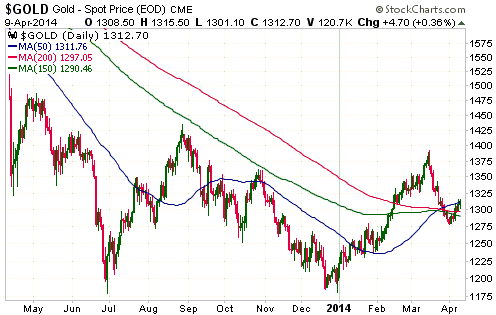
Gold has achieved the minimum that would be expected from a counter-trend
rebound. An average rebound would take the gold price up to around $1330, while
gold shouldn't trade much above $1350 IF this is nothing more than a rebound
within an on-going correction.
The recent strength is probably nothing more than a rebound within an on-going
correction, but as noted in a previous commentary we doubt that the market will
do significantly worse than test last week's low over the remainder of the
correction.
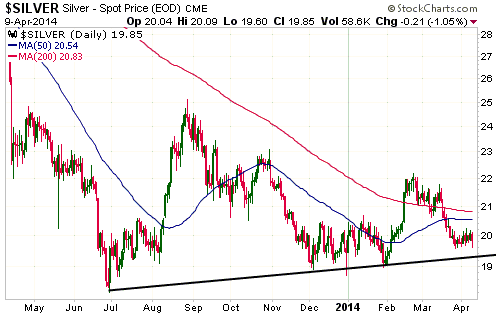
Silver continues to underperform gold and hasn't yet even begun to rebound. In
fact, it came close to making a new correction low on Wednesday 9th April.
On a long-term basis, silver's weakness is normal if we are in the early part of
a new cyclical precious-metals bull market. As explained in previous
commentaries, the historical record of cyclical bull markets within secular bull
markets suggests that silver's relative performance will tend to be unimpressive
until the second half of next year. However, on a short-term basis the
silver/gold ratio is sufficiently stretched to the downside to suggest that
silver will trade well above its current level in both dollar terms and gold
terms within the coming two months.
Silver has strong support at $19.00-$19.30, which could be tested before the
overall correction comes to an end.
Gold Stocks
Current Market Situation
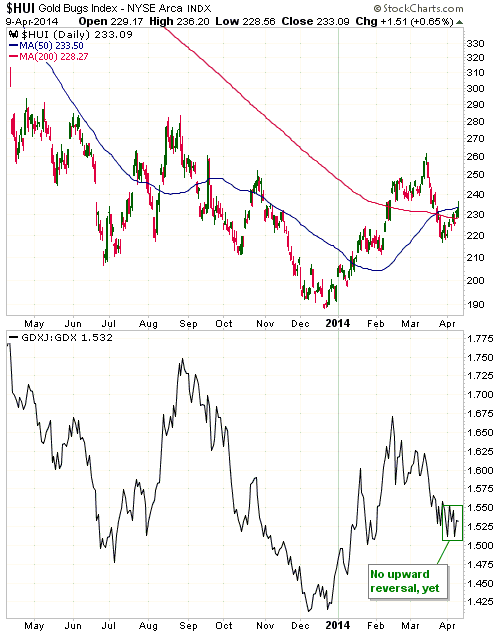
The following daily chart compares the HUI with
the GDXJ/GDX ratio (junior gold stocks relative to senior gold stocks). We
expect that the end of the current correction will be marked by obvious strength
in the juniors relative to the seniors as indicated by a clear-cut upward
reversal in the GDXJ/GDX ratio. Such a reversal has not occurred yet, which we
take as evidence that the overall correction is not over.
We suspect that the correction's price low is in place, but that this low will
be tested before the next short-term upward trend gets underway.
While an upward reversal in the GDXJ/GDX ratio is likely to occur at the same
time as or just prior to the end of the overall gold-sector correction,
confirmation that the correction is over will require a weekly close above 250
by the HUI.
Put the past behind you
In speculating and investing it's important to learn from the past, but to
otherwise put the past behind you and focus on doing what's right today.
Mistakes will compound if the psychological wounds stemming from a prior loss
prevent you from taking advantage of a current opportunity. For example, if you
bought gold stocks following a pullback early last year and then watched these
stocks collapse in price over the ensuing few months, then this experience could
now prevent you from buying short-term weakness in the gold-mining sector. The
fear is that the same fate will befall you this year. Thanks to the memory of
last year's crash you might be afraid to now do what an objective assessment of
the situation indicates you should do, but last year's crash actually makes it
much less, not more, likely that there will be a crash this year. It's the
market that rallied hard over the past 12 months, not the one that tanked, that
is now in greatest danger of suffering a large decline.
Looking at the psychological effects of past errors from a slightly different
perspective, there is a tendency to want to do this year or during the current
cycle what you wish you had done last year or during the previous cycle. This
tendency should always be fought and the current facts should always be allowed
to speak for themselves. For example, short-selling gold-mining stocks following
every downward reversal would have worked like a charm last year, because last
year's pullbacks evolved into major declines. The salient question is: Given
that the 2011-2013 decline in the gold-mining sector was of historic proportions
(as steep and as long as the worst cyclical gold-mining bear markets of the past
50 years) and that gold's fundamental drivers have become more bullish over the
past several months, is 2014 more likely to be another dismal year or a winning
year for the gold sector?
The Currency Market
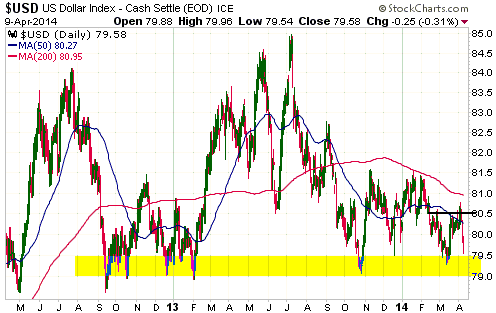
The Dollar Index broke above resistance at 80.5 last week, but this breakout
proved to be a fakeout. Over the first three trading days of this week the
Dollar Index dropped sharply and is now testing important support at 79.0-79.5.
As noted in the latest Weekly Update, we didn't think that last week's break
above 80.5 was significant. The reason is that the trend-defining resistance
lies a point higher at 81.5. The dollar's inability to muster enough strength to
test resistance at 81.5 is a little more significant, but oscillations between
79.0 and 81.5 are trivial in the grand scheme of things.
We continue to expect that as part of (the final phase of) its long-term basing
pattern the Dollar Index will drop to the low-70s by the end of this year, but
other than "by the end of this year" we don't have an opinion on when this will
happen. That's why we are intermediate-term bearish and short-term
neutral/undecided.
Updates
on Stock Selections
Notes: 1) To review the complete list of current TSI stock selections, logon at
http://www.speculative-investor.com/new/market_logon.asp
and then click on "Stock Selections" in the menu. When at the Stock
Selections page, click on a stock's symbol to bring-up an archive of
our comments on the stock in question. 2) The Small Stock Watch List is
located at http://www.speculative-investor.com/new/smallstockwatch.html
Chart Sources
Charts appearing in today's commentary
are courtesy of:
http://stockcharts.com/index.html

|









