|
- Interim Update 9th June 2010
Copyright
Reminder
The commentaries that appear at TSI
may not be distributed, in full or in part, without our written permission.
In particular, please note that the posting of extracts from TSI commentaries
at other web sites or providing links to TSI commentaries at other web
sites (for example, at discussion boards) without our written permission
is prohibited.
We reserve the right to immediately
terminate the subscription of any TSI subscriber who distributes the TSI
commentaries without our written permission.
Time to buy 'the grains'?
From the 26th April Weekly Update:
"..the downside risk in
"the grains" is probably a lot lower than it is for speculative
favourites such as oil, the base metals and the PGMs. At least, the
risk of a sharp price decline in response to the next market-wide
plunge in confidence appears to be a lot lower for the grains than for
most other important commodities. At the same time, there is the
potential for bullish speculators to eventually find their way to the
grain markets, as they did during 2007-2008, and/or for grain prices to
be boosted by the realisation that supply will be less plentiful than
currently anticipated.
The relatively small
downside risk combined with the potential for either a
speculation-related or a supply-related boost has piqued our interest
in being 'long' the grains via an agriculture fund such as DBA. We
aren't going to do anything yet, though, because the price action isn't
right."
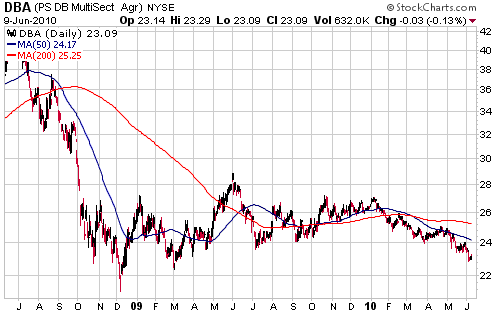
Since writing the above, near-perfect growing conditions and evidence
that the widely-touted economic recovery is running out of steam have
put additional downward pressure on grain prices and caused DBA to
decline from US$24.75 on 23rd April to a low of US$22.87 on Monday 7th
June. It ended Wednesday's session at $23.09.
DBA's recent decline has brought it to within spitting distance of the
Q4-2008 panic low (see chart below), and, in our opinion, has skewed
the intermediate-term risk/reward sufficiently toward "reward" to
justify taking an initial position. We are therefore going to add it to
the TSI Stocks List, using a 10% trailing stop for risk management
purposes (as usual, the trailing stop will be based on daily closing
prices).
Note that when averaging into a longer-term speculation or investment
it generally doesn't make sense to use a protective stop, but the TSI
Stocks List is not set up in a way that enables scaling into and out-of
positions (it is not operated like a portfolio). As a result, the
setting of protective stops is the only form of risk management that we
can ever reflect via the Stocks List.
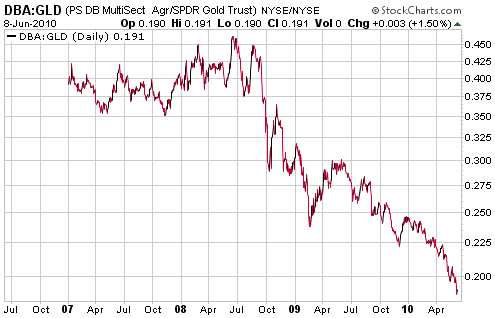
Relative to gold, the
grains have been in a bear market since 1998. The latest major downward
leg in this bear market began almost exactly two years ago and is
clearly evident on the following daily chart of the DBA/GLD ratio. This
bear market probably has a few more years to run, but the stage has
been set for a substantial counter-trend rebound because in gold terms
the grains are now cheaper and more 'oversold' than they have ever been.
An intermediate-term
rally in the grains could be 'played' via fertiliser stocks such as
POT, but at this stage we prefer direct exposure to the commodities.
This is mainly because the fertiliser stocks will likely be slaves to
the trend in the broad stock market.
The fertiliser stocks could become interesting speculations after the broad stock market bottoms out.
The Stock Market
China Update
The information in the short article linked HERE
could be significant. According to the article, Chinese steel mills
have begun to cut prices due to dwindling orders in downstream sectors
like auto, shipping, home appliances and property.
China's government has considerable control over the ebb and flow of
money and credit. This doesn't give it the power to create real
economic progress, but does give it greater power than its Western
counterparts when it comes to igniting and extinguishing
inflation-fueled booms. When considering the outlook for China's
economy it is therefore important to ask: What does the government
want? If China's government wants a rapid credit expansion and the
outward appearance of economic strength, then a superficially positive
outcome has a good chance of happening. On the other hand, if the
government's main concern is that prices are rising too quickly then
it's a good bet that a credit contraction and economic slow-down lie in
store.
Based on their words and actions, the high level of residential
property prices appears to be the dominant concern of China's senior
policy-makers at this time. Therefore, although there are warning signs
-- such as the decline in steel prices mentioned above -- that the
economy is slowing, government policy will likely be directed more
towards 'cooling' than 'heating' for a while yet.
We expect to see more evidence of economic weakness coming out of China
during the second half of this year, which will add to the downward
pressure on stock markets and industrial commodities.
Current Market Situation
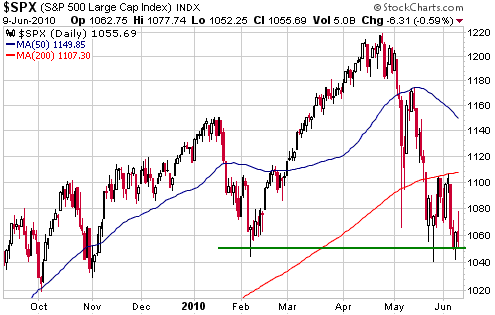
The S&P500 Index is holding above support (see chart below), but
only just. Our forecast has been for the downward trend that began in
April to continue until October, but if the S&P500 moves to a new
low for the year in the near future then an intermediate-term bottom
will probably be put in place well before October. To put it another
way, in order for the overall downward trend to extend into the final
quarter of this year there will probably have to be a larger and much
longer intervening rebound than we have seen to date.
The stock market has
obviously been affected by Europe's debt crisis, but the main problem
is that a mismatch between perception and reality developed during the
months leading up to the April stock-market peak. Whether it was
because they believed that the combination of monetary and fiscal
stimulus would really work or because they anticipated a traditional
post-WWII business-cycle recovery, market participants discounted a far
more substantial improvement in corporate earnings than could possibly
be delivered under the circumstances.
Evidence of the unrealistically-great expectations priced into the US
stock market earlier this year can be found in the earnings forecasts
of Wall Street analysts. According to John Hussman's latest Weekly Comment: "Several
weeks back ... Bill Hester plotted the operating profit margins that
were implicitly being forecast by Wall Street Analysts... noting "Last
October, analysts were about half way to pricing in profit margins that
matched the record levels of 2007. Now, they are just about there." If
this doesn't reflect the expectation of Wall Street analysts for a "V"
shaped recovery, I'm not sure what does."
Gold and
the Dollar
Gold
In Email Alert #206, which we sent to subscribers in response to Monday's market action, we wrote:
"The US$ gold price has
moved up to within $10 of its May peak. In terms of momentum and
sentiment indicators it is nowhere near as 'overbought' as it was at
the December-2009 and March-2008 peaks, so the potential exists for
significant additional gains over the weeks ahead.
We are more concerned
about the euro-denominated gold price. Gold/euro pulled back after
reaching an 'overbought' extreme in May, but the surge of the past few
days has already returned it to a similar extreme. In particular,
gold/euro has returned to the top of the moving-average (MA) envelope
that capped intermediate-term advances during 2005-2006 and 2007-2008.
We will include a chart in this week's Interim Update to illustrate
what we mean."
Here is the gold/euro chart mentioned above.
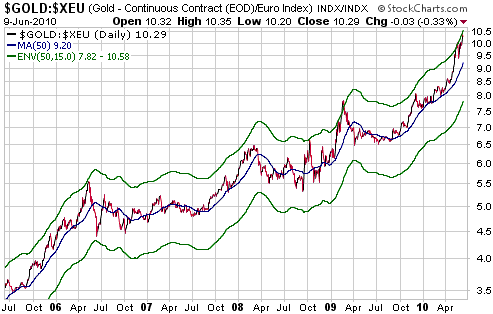
Gold has become far
more 'overbought' in euro terms than in US$ terms because the primary
driver of the gold rally that began in early February has been
euro-zone government debt problems and the associated weakness in the
euro. This probably means that there will be a sell-off in the gold
market if euro-related panic subsides. A temporary subsidence is the
most that's likely to happen, though, because the debt problems cannot
possibly be ameliorated by the 'solutions' currently being proposed and
implemented. After all, a problem of excessive debt can't be solved via
the creation of new debt.
In the above-mentioned email alert we said that with Europe's
government debt crisis being the dominant short-term driver of gold's
strength, long-side exposure to gold could potentially be hedged via
euro (or FXE) call options. This indirect hedge would not be ideal in
that it would not guard against a deflation scare that caused the US$
to strengthen against both gold and the euro, but it would offer one
advantage over a direct gold hedge: it could pay-off in the absence of
a decline in the gold price. It is possible, for example, that a strong
euro rebound would result in gold pulling back in euro terms while
holding its ground in US$ terms.
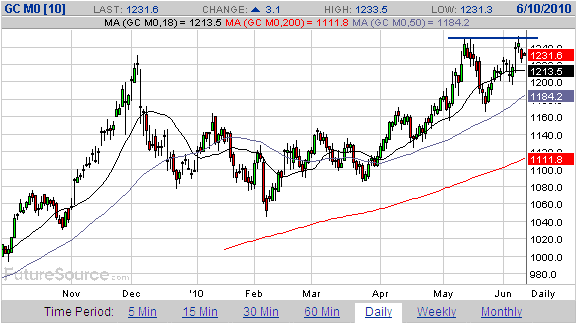
The following chart shows that the US$ gold price has just tested its
May peak. An upside breakout would suggest a near-term target of $1300.
Gold Stocks
From Email Alert #206:
"With the US$ bullion
price having moved up to just beneath its May peak, the 'risk' has
increased that the gold sector's anticipated catch-up move will start
sooner rather than later. Consequently, we are upgrading our short-term
HUI outlook from "bearish" to "neutral". In this case, "neutral" means
that there is large upside AND downside potential over the next few
months. Whether the next 70-100 HUI points are to the upside or the
downside will very likely be determined by whether gold makes a
sustained break above $1250 in the near future or rolls over to the
downside after testing its May peak.
We don't have any
short-term bets on the gold sector at the moment, but those who do
should seriously consider placing a 'stop' just below Monday's
intra-day HUI low. Specifically, exit any long-side trades if the HUI
closes below 440."
The following chart shows why 440 is shaping up as an important
demarcation level for the HUI. A daily close below 440 would breach
lateral support, moving average support (the 50-day moving average),
and trend-line support.

The HUI is set up to
make a sizeable (15% or greater) move over the next 6 weeks, but the
most likely direction is not clear to us. We think the odds currently
favour the downside, but not decisively so. Furthermore, if gold were
to make a sustained break above $1250 then the odds would shift in
favour of a sharp multi-week HUI advance.
This is not a good time to be making aggressive bets on any particular short-term outcome.
Currency Market Update
Over the past two years the A$/euro exchange rate has done a terrific
job of defining the overall trend in the financial world. As evidenced
by the following chart, this exchange rate plunged during the second
half of 2008, reflecting the rapid decline in the generally perceived
outlook for global economic growth, and then ramped upward until early
May of this year as investors around the world became more optimistic
about global economic growth. It dropped sharply from its
May-2010 peak, thus reflecting the emerging realisation that the
post-crash rebound would not likely evolve into a genuine recovery,
but, as is the case with most stock markets, it remains at a very high
level considering the underlying fundamentals.
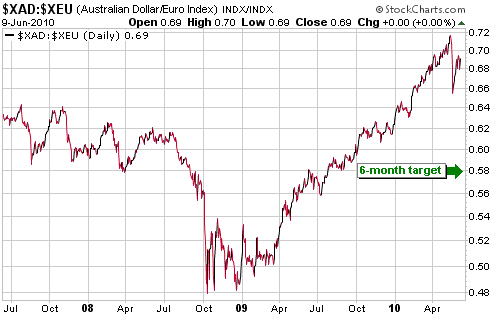
As noted on the above
chart, we see A$/euro dropping back to around 0.58 during the second
half of this year. This target is based on the assumption that the A$
will do no worse than lose the 'growth premium' that was built into its
relative valuation between October of 2009 and May of 2010. We are not
anticipating a repeat of 2008.
A risk with the aforementioned target for A$/euro is that Europe's
monetary union will break apart sooner rather than later. If this were
to happen then the A$ would likely do better against the euro and worse
against the US$ than we currently expect (we have previously mentioned
6-month targets of 0.72 and 0.66 for the A$ relative to the US$).
Update
on Stock Selections
(Notes: 1) To review the complete list of current TSI stock selections, logon at http://www.speculative-investor.com/new/market_logon.asp
and then click on "Stock Selections" in the menu. When at the Stock
Selections page, click on a stock's symbol to bring-up an archive of
our comments on the stock in question. 2) The Small Stock Watch List is
located at http://www.speculative-investor.com/new/smallstockwatch.html)
 If
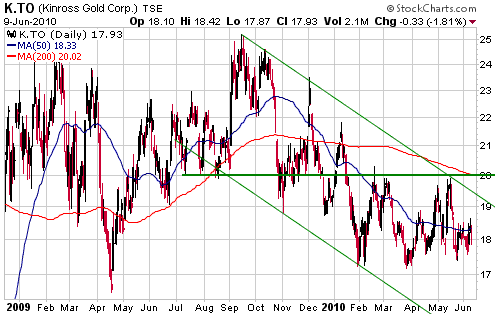
the following chart of senior gold producer Kinross Gold (TSX: K) was
all you had to go on, you would never guess that gold bullion was near
an all-time high in terms of all major currencies and the CRB Index. K
has been moving within a downward-sloping channel since September of
last year and is not far from an 18-month low. If
the following chart of senior gold producer Kinross Gold (TSX: K) was
all you had to go on, you would never guess that gold bullion was near
an all-time high in terms of all major currencies and the CRB Index. K
has been moving within a downward-sloping channel since September of
last year and is not far from an 18-month low.
We don't have any
interest in the stock, but we do have an interest in the Kinross
warrants that trade on the TSX under the symbol K.WT.C. These warrants
have an exercise price of C$32.00 and an expiry date of September-2013.
The Kinross warrants are currently not as attractive as the FNV
warrants we mentioned in the latest Weekly Update, because they are too
far 'out of the money'. They do, however, offer one significant
advantage in the form of an additional 18 months of time (the FNV
warrants expire in March of 2012).
It would be reasonable to take an initial position in the K warrants
near their current price (around C$2.80). Alternatively, speculators
could decide to wait for the stock to break above C$20 before doing any
buying. The warrants will naturally cost more after the stock breaks
above resistance at $20, but a breakout would provide some assurance
that K had bottomed and that a new intermediate-term rally had
commenced.
Uranium
One (TSX: UUU). Shares: 777M issued, 799M fully diluted (assuming that
all convertible debentures are converted to shares). Recent price:
C$2.19
UUU announced on 8th June that it had agreed to issue 356M new shares
to Russian nuclear company ARMZ in exchange for US$610M cash and ARMZ's
ownership in two Kazakhstan-based uranium mines. If this deal is
approved by regulators and UUU's other shareholders it will result in
ARMZ owning at least 51% of UUU and shareholders other than ARMZ
receiving a special cash dividend of at least US$1.06/share.
The market reaction to the proposed deal was negative, probably due to
concern that the post-deal UUU would be operated in a way that served
the interests of the Russian government rather than the interests of
all shareholders. This is a legitimate concern, although the increased
Russian involvement could reduce the political risk associated with
doing business in Kazakhstan.
The projects that are being acquired by UUU are expected to eventually
add 6M pounds of annual production, but the press release didn't
specify the capital expenditure and time needed to achieve this
production rate. Without this information it isn't possible to fully
assess the merits of the deal or to figure out what the post-deal UUU
would be worth. We therefore don't know whether the stock-price decline
of the past two days has created a buying opportunity.
We'll have more to say after we get some more information.
Chart Sources
Charts appearing in today's commentary
are courtesy of:
http://stockcharts.com/index.html
http://www.futuresource.com/

|