|
- Interim Update 9th October 2013
Copyright
Reminder
The commentaries that appear at TSI
may not be distributed, in full or in part, without our written permission.
In particular, please note that the posting of extracts from TSI commentaries
at other web sites or providing links to TSI commentaries at other web
sites (for example, at discussion boards) without our written permission
is prohibited.
We reserve the right to immediately
terminate the subscription of any TSI subscriber who distributes the TSI
commentaries without our written permission.
One
person's spending is another person's income??
The concept that one person's spending is another person's
income is both misleading and dangerous. While seeming to make sense
at a superficial level, it is misleading because it creates the
false impression that consumption drives the economy. It is
dangerous because an entire school of economics is based on this
false impression, and, unfortunately, this school now dominates
monetary and fiscal policy-making.
The concept that consumption drives the economy can most easily be
seen as a fallacy when money is removed from the equation. For
example, without money it would be obvious that a baker spends
bread. In order to consume the products of others the baker must
first bake bread, and in order to increase his consumption he must
first increase his production of bread.
The situation doesn't change when money is introduced. Money is just
a medium that facilitates exchange. It's still the case that a baker
doesn't really spend money, he spends bread. The difference is that
prior to spending he first converts his bread to money, thus giving
himself more spending options. (Note: In the absence of money there
would have to be a very specific coincidence of wants for a trade to
happen. For example, a baker who wanted his teeth fixed would have
to locate a dentist who wanted a large quantity of bread).
The point is that production must precede consumption, because
production funds consumption. People produce in order to consume,
and a person's real income is the stuff he obtains via his
production. This was known 200 years ago, but is not widely
understood today thanks to the 'great leap backward' taken by the
economics profession over the past 80 years.
Now, in a world where money can be conjured out of nothing by the
central bank and the private banks, it is possible for an increase
in the spending of money to occur without a preceding increase in
production. However, this causes problems by setting up exchanges of
nothing (money created out of 'thin air') for something. If such
exchanges are widespread, prices will be affected in two ways.
Firstly, prices will generally be higher than would otherwise be the
case. Secondly and more importantly, relative prices will be altered
due to the non-uniform way in which new money enters the economy.
The changes to relative prices will send wrong signals about the
likely future level of consumption, and a lot of investment will be
based on these wrong signals. For example, if the price of the
average house rises much faster than most other prices, then
businesses will respond to this price signal by building a lot more
houses. If this price signal is based primarily on the creation of
money out of nothing, the increase in demand will prove to be
temporary and all industries related to the housing sector will end
up being geared to a much higher level of production than justified
by sustainable demand. Sound familiar?
The bottom line is that it is more correct to say that one person's
PRODUCTION is another person's income. Trying to get around this
reality by creating money out of nothing or increasing government
spending (government spending is funded by theft or borrowing, not
production) will end up weakening the economy.
Default
Fear
Despite the attempts of some politicians, media
personalities and financial analysts to make it seem as if there is a
significant risk of the US government defaulting on its debt, there appears to
be only a small amount of debt-default fear in the financial markets. In this
case, the financial markets are right. The probability of the US government
defaulting on its debt this year is effectively zero.
A political deal to raise the "debt ceiling" will probably happen within the
next several days, but even if it doesn't there will not be a realistic chance
of default. Failing to raise the debt ceiling will prevent the government from
increasing its indebtedness, but won't hinder its ability to pay interest on or
roll over its existing debt. Keep in mind that although some "non-essential"
parts of the government have been shut down, the IRS is still hard at work
collecting money.
The possibility of a near-term debt default is therefore not a good reason to be
bullish or bearish on any investment.
The Stock Market
The BKX, a proxy for US bank stocks, broke below support at 62
during the first half of this week. This downside breakout boosts the
probability that an intermediate-term peak is in place for the US banking
sector. It is therefore a bearish omen for the US stock market and a bullish
omen for gold.
Ideally, the BKX will drop to the vicinity of its 200-day MA ($59-$60) or lower
before rebounding, as its breakdown is marginal at this stage and could be
negated by minor strength over the days ahead.

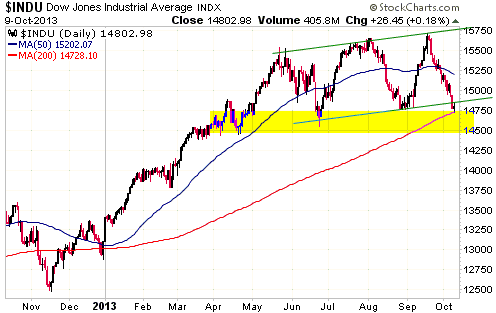
The Dow Industrials is the weakest of the senior US stock indices. As
illustrated by the following daily chart, it has just dropped back to its August
low and is not far above its June and April lows.
The Dow is very close to confirming a top of at least intermediate-term
significance. However, it is also 'oversold' on a short-term momentum basis and
right at support defined by its 200-day MA and its August low, making it likely
that a rebound will soon get underway even if a cyclical bear market is in its
infancy.
We doubt that the recent weakness in the Dow Industrials and some other US stock
indices is primarily due to the US government's in-fighting. With or without
this in-fighting, there are a lot of reasons to be concerned about downside risk
in the US stock market. For example, valuations are high, profit margins look
set to contract, earnings growth is almost non-existent, and -- aside from a few
minor worries stemming from the "government shutdown" and "debt ceiling"
negotiations -- sentiment is generally complacent.
On the bullish side of the ledger there is the Fed's relentless money-pumping.
That's pretty much it.
Here's a scenario that appeals to us: A stock market rally soon commences on the
back of political deals that ensure full government funding for at least a few
more months. This rally takes some stock indices to new highs for the year, but
the Dow doesn't come close to its September high before running out of steam.
Some indices, including the Dow, then fall to new multi-month lows, leading to
general fear that the future might not be as bullish as previously envisaged.
Gold and the Dollar
Gold
The New Fed Chair
President Obama has nominated Janet Yellen, the current vice chair of the Fed,
to take over from Ben Bernanke as Fed head next January. Yellen's nomination
will almost certainly be confirmed by the Senate.
Based on her public statements and Federal Reserve voting record, Yellen appears
to be even more clueless about economics and is likely to be even more reckless
on the monetary front than her predecessor. In particular, she appears to
strongly believe that a) the Fed can bring about a sustainable increase in
employment by creating money out of nothing, and b) it's best for the economy if
money loses purchasing power at the rate of at least 2%/year. Yellen's
appointment to the Fed's top job is therefore bearish for the US economy and
bullish for gold.
On a related matter, the Fed is essentially a dictatorship. Monetary policy is
voted on and some dissent is tolerated, but the chairman is never
out-voted/over-ruled. The beliefs of the Fed chairman are therefore critical,
although in our opinion the times determine the Fed chairman. It is par for the
course that at a time when Keynesian claptrap is popular, a deep believer in
Keynesian claptrap has risen to the top of the dung-pile.
Current Market Situation
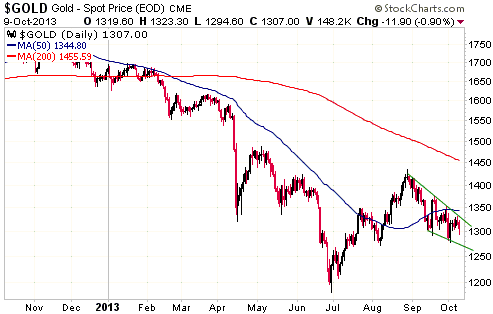
In US$ terms, gold is around the same price now as it was on 13th September. It
has therefore spent almost four weeks going nowhere, although the price chart
(see below) suggests that the short-term bias is to the downside. As previously
advised, a daily close above $1376 would confirm an upward trend reversal. A
daily close above the 50-day MA (currently at $1345) would be an early warning
that the short-term trend was reversing from down to up.
In the absence of the aforementioned evidence of a trend reversal it will make
sense to anticipate moderate additional weakness and a traditional
October-November turning point.
Gold Stocks
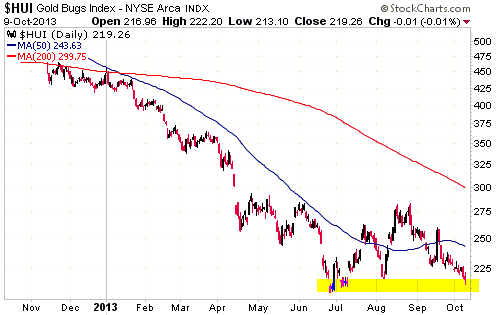
On Wednesday 9th October the HUI traded below its early-August low and to within
a few points of its late-June low. The price action therefore continues to set
the stage for a traditional October-November reversal. Considering the extent to
which the market is 'oversold', our guess is that the reversal will happen
before the end of this month.
GDXJ, a proxy for junior gold-mining stocks, will usually rise by more than GDX
(a proxy for large and mid-size gold miners) during sector-wide rallies and fall
by more than GDX during sector-wide declines. That explains why the GDXJ/GDX
ratio has been falling since late August. However, over the past few days GDXJ
has been materially weaker than would normally be expected, causing the GDXJ/GDX
ratio to drop like a rock. Refer to the bottom half of the following chart for
details.

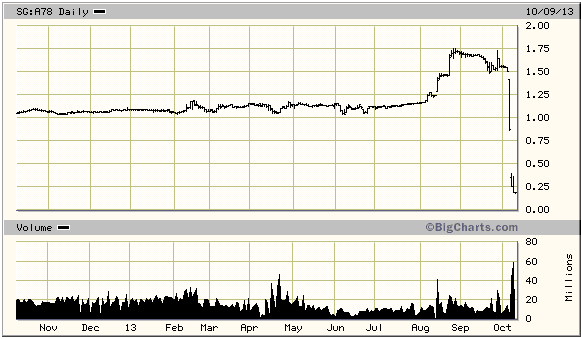
For those who are wondering, the sudden downward acceleration in GDXJ relative
to GDX was due to the performance of a single stock. We are referring to
LionGold Corp., a company that trades on the Singapore stock exchange under the
symbol A78 (see chart below). Over the three trading days from Friday of last
week through to Tuesday of this week, LionGold went from $1.50/share to
$0.18/share. The sudden near-90% decline in LionGold's stock price had a
significant effect on GDXJ because at 30th September this stock was 5.2% of the
ETF's portfolio. In fact, it was GDXJ's largest holding.
As far as we can tell, LionGold's price collapse was mostly due to the bursting
of a speculative bubble in Singapore-traded small-cap stocks rather than
company-specific developments.
This goes to show that traders who buy equity ETFs are not totally immune to
individual stock risk, but those who had some indirect exposure to LionGold via
GDXJ obviously fared much better than those who owned LionGold directly.
We like GDXJ as a short-term trading vehicle, but, despite the additional risk
and volatility, for long-term trades we prefer individual junior gold-mining
stocks.
Update
on Stock Selections
Notes: 1) To review the complete list of current TSI stock selections, logon at
http://www.speculative-investor.com/new/market_logon.asp
and then click on "Stock Selections" in the menu. When at the Stock
Selections page, click on a stock's symbol to bring-up an archive of
our comments on the stock in question. 2) The Small Stock Watch List is
located at http://www.speculative-investor.com/new/smallstockwatch.html
 Pretium
Resources (TSX and NYSE: PVG). Shares: 105M issued, 114M fully diluted. Recent
price: US$4.70 Pretium
Resources (TSX and NYSE: PVG). Shares: 105M issued, 114M fully diluted. Recent
price: US$4.70
PVG issued a press release prior to the start of trading on Wednesday 9th
October. We would normally cover this news in the Weekly Update on Sunday 13th
October, but due to the dramatic stock market reaction to the news (the stock
price fell 30%) we will deal with it now.
Prior to this week there were two independent consultants, also known as
Qualified Persons (QPs), working on PVG's Bulk Sample Program (BSP). Snowden
Mining was responsible for the review and sign-off of the milling and processing
component of the program. Strathcona Mineral Services was responsible for
overseeing and reporting on the overall program. Note that in addition to
milling and processing a 10,000-tonne bulk sample in Montana, the overall
program involves on-site sampling and underground drilling.
The news that shocked the market was that Strathcona had resigned from the
project. There was no information in PVG's press release to explain the
resignation, but PVG's management subsequently advised that it was due to a
disagreement between the two consultants. According to the Mineweb article
linked
HERE, "Snowden, which produced Pretium's latest resource estimate on the
Valley of the Kings, wants results from the whole bulk sample to be used as
validation, Ovsenek [PVG's Chief Development Officer] said, whereas Strathcona
prefers a series of smaller, representative "tower" samples."
What we understand is that there are no indications at this stage of any
problems with the resource. The underground drilling results* have been
consistent with the resource model and the first results of the sampling of the
bulk material are not yet in. What we don't understand is exactly why Strathcona
resigned. It doesn't make sense to us that the method of validating the resource
was not fully defined prior to the start of the BSP and that a disagreement over
methodology could not be sorted out. It also doesn't make sense to us that
Strathcona would insist on using representative samples of the extracted
material when all of the material was being analysed. After all, the main point
of sending 10,000 tonnes of material hundreds of miles to a special-purpose mill
is to confirm that the total amount of gold produced matches the assumptions
used in the resource model and Feasibility Study.
PVG expects the milling of the 10,000-tonne bulk sample to yield about 4,000
ounces of gold. Taking into account a recovery rate of 90%, this is the amount
of gold that should be produced if the average grade of the resource is around
13.6 g/t, which is the reserve grade assumed in the FS. If the bulk sample
actually does yield 4,000 ounces it would be clear-cut evidence that the
resource model is correct.
As per the current schedule, the total amount of gold extracted from the bulk
sample will be known and reported by year-end.
PVG's stock price is now a lot lower than it was and at a fundamental level
nothing appears to have changed, so a good argument can be made that new buying
would be appropriate. However, we generally avoid buying in the immediate
aftermath of a sharp sell-off prompted by unexpected company-specific bad news,
especially when -- as is the case with PVG right now -- we aren't sure that we
have the full story. Even when the market dramatically over-reacts to bad news,
as it has probably just done with PVG, it will usually take at least a few weeks
for a new upward trend to begin.
*As we were putting today's Interim Update to bed, PVG
issued a
press release reporting more bonanza-grade intercepts from underground
drilling associated with the BSP and from exploration drilling.
Chart Sources
Charts appearing in today's commentary
are courtesy of:
http://stockcharts.com/index.html

|









