- Interim Update 9th November 2016
Copyright
Reminder
The commentaries that appear at TSI
may not be distributed, in full or in part, without our written permission.
In particular, please note that the posting of extracts from TSI commentaries
at other web sites or providing links to TSI commentaries at other web
sites (for example, at discussion boards) without our written permission
is prohibited.
We reserve the right to immediately
terminate the subscription of any TSI subscriber who distributes the TSI
commentaries without our written permission.
The Trump Victory
Our initial thoughts on the
market-related consequences of Trump's election victory were in the
email
broadcast to subscribers early on Wednesday morning (US EST). As it
turned out, the financial markets' reaction to the event was both correct
and surprising.
It was correct in that the only market that became
significantly more bullish or bearish as a result of Trump's success was
the US Treasury market, which, as we mentioned in yesterday's email, would
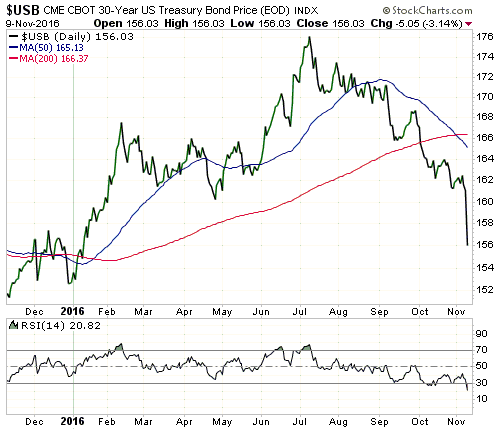
likely be affected in a significantly negative way. As illustrated below,
the T-Bond tanked during Wednesday's US trading session. Furthermore, the
T-Bond was the only major financial market to end Wednesday's US trading
session with a big gain or loss.
However, the financial world's
reaction was also surprising. This is because we expected that there would
be a sharp 1-2 day decline in the stock market and rise in the gold price
due to the uncertainty created by the generally-unanticipated event, and
that stock market weakness could support the T-Bond in the near-term.
In any case, it's too soon to draw any conclusions. The initial
reaction may well have been appropriate, but the T-Bond is now extremely
'oversold' on a short-term basis and the stock indices still need to
confirm their recent signs of strength by ending this week above certain
numbers.
Copper breakout or
fakeout?
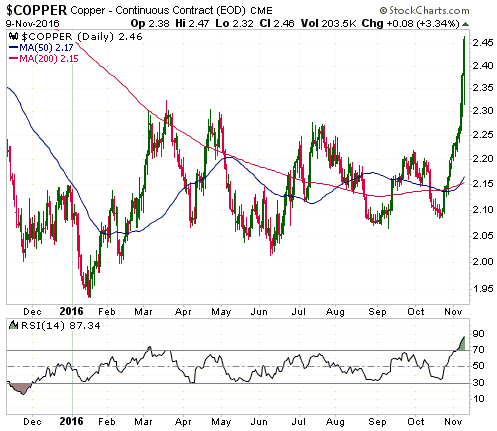
The copper price has risen
sharply and has decisively breached resistance in the low-$2.30s. Does
this mark the beginning of a major upward trend?
Possibly. After
all, while a sustained breakout at this time wouldn't fit with our
short-term expectation it would certainly be consistent with our
overarching expectation that the coming 1-2 years was going to be a very
bullish period for commodity prices. By the way, to confirm the upside
breakout the copper price must end the week above the March high of $2.33.
But regardless of the longer-term significance of this week's
performance by the copper price it should be taken into account that the
copper market is now extremely 'overbought' on a short-term basis. In
particular, an extraordinary 13-day winning streak has resulted in the
daily RSI (refer to the bottom section of the following chart) reaching
its highest level in more than 10 years. Furthermore, as we write the
price is up an additional 8c (at $2.54), so the market is working on its
14th consecutive up-day. This probably means that even if a long-term
shift has occurred there will soon be a 'correction' that takes the price
down to the vicinity of the rising 50-day MA.
The best and
worst places in the world for mining
Australia is the lowest-risk
country in the world for mining. Specifically, a well-managed mining
company is less likely to encounter a project-threatening political,
legal, environmental or community-relations obstacle in Australia than in
any other country. Furthermore, the geology in many parts of Australia is
conducive to economic mineral deposits.
That being said, in large
countries such as Australia, the US and Canada, some areas will be much
less risky than others for mining investment. This is due to
state/province/area-specific permitting and community-relations issues. In
Australia, for example, Western Australia is the best state for mining
investment from a political/legal/environmental risk perspective. This is
partly because a mining culture permeates the state. It is also because
the interesting mineral deposits tend to be located in the middle of
nowhere.
Our opinion regarding the relative attractiveness of
mining in Australia is based on our experiences investing in mining
companies over the past two decades, but our opinion on this matter is not
an outlier.
According to the
Fraser Institute's most recent annual survey of mining companies,
Western Australia is the number-one jurisdiction in the world for mining
investment taking into account policy and geology. The rest of the top 10
are Saskatchewan, Nevada, Ireland, Finland, Alaska, Northern Territory,
Quebec, Utah, and South Australia. The list of the best 10 jurisdictions
for mining investment therefore contains three Australian
states/territories, three Canadian provinces, three US states and
(surprisingly) Ireland.
The same survey lists the bottom 10
jurisdictions for mining investment (beginning with the worst) as La Rioja
(Argentina), Venezuela, Honduras, Greece, Solomon Islands, Chubut
(Argentina), Guinea, Kenya, Mendoza (Argentina), and Rio Negro
(Argentina). In other words, four Argentine provinces made the list of the
world's ten WORST jurisdictions for mining investment.
Given that
Argentina, with its new government, is supposedly now open for business,
some of our readers are probably surprised that Argentine provinces scored
so poorly in the Fraser Institute's latest survey. However, Argentina is
the best example of a country where it makes no sense to generalise about
the attractiveness of mining investment. Some Argentine provinces are open
to mining investment, some are almost completely closed and others are
somewhere in between. Before buying the shares of a mining company with a
project in Argentina, make sure you understand the local situation.
The Stock Market
The US
In after-hours trading on Tuesday night in the US (Wednesday morning in
Asia) the price of the December S&P500 futures contract traded as low as
2028. This means that the futures market came within about 1% of the
short-term downside target we've had in mind for the past couple of
months. However, by the time the cash market opened on Wednesday morning
in the US almost all of the losses had been recouped. This means that only
traders in the futures markets and traders in Asian markets were able to
take full advantage of the election-related volatility.
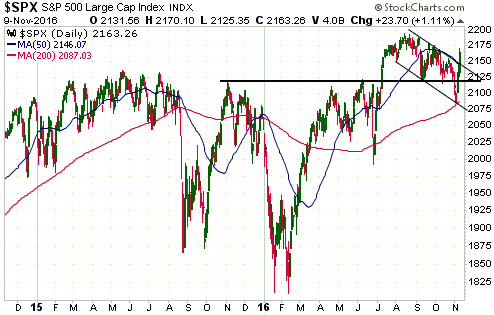
The cash
S&P500 never traded lower than 2125 and after some minor initial weakness
began to rally. At the end of the day it had not only managed to hold
above the 2120 demarcation level, it had broken above the top of its
short-term price channel.
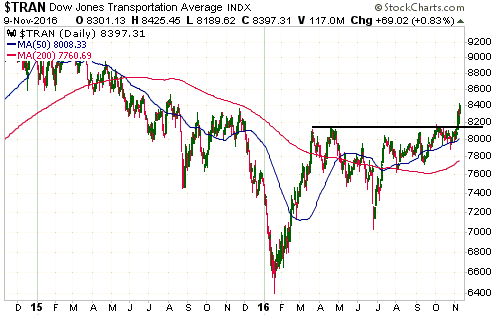
More importantly, the Dow Transportation Average (TRAN) has clearly
broken above intermediate-term lateral resistance at 8150.
The 'stock market' appears to have re-thought the situation and
concluded that Trump's victory is bullish for equities. Actually, it is
neither bullish nor bearish. If the stock market can maintain or extend
its high valuation it will be because of a ramp-up in the rate of monetary
inflation, not because of anything the government does. In other words,
the Fed and the commercial banks possibly have the power to extend the
bull market. However, they could only do so by creating even greater
valuation-related downside risk.
Finally, we'll repeat what we
wrote in the email that was sent to subscribers after the close of
Monday's trading session:
"Regardless of what happens over the
coming 1-2 days, what will really matter is where the various
markets/indices finish the week. For example, the Dow Transportation
Average (TRAN), which broke out to the upside and made a new high for the
year on Monday, needs to end the week above 8150 to confirm Monday's
upside breakout. A failure to end the week above 8150 would generate a
reliable bearish signal. For another example, the S&P500 Index, which
moved back above the 2120 breakdown level on Monday, must end this week
above 2120 to confirm that a short-term bottom was put in place last week."
Gold and the Dollar
Gold
As
soon as it began to look like Trump might win the election the gold price
shot upward. However, most of the price gain had been given back by the
time the US markets opened for trading on Wednesday and the rest of the
gain had evaporated by the time the US markets closed.
If Clinton
had won we suspect that the price action would have been the opposite,
with the gold price initially spiking downward and then reversing. A
downward spike following a Clinton win could have created a good
short-term buying opportunity in the gold market, but it wasn't to be.
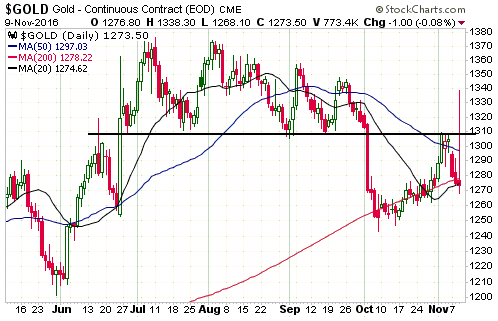
We don't view gold's post-election price reversal as bearish. It
actually hasn't changed our expectations at all. We continue to expect
that the US$ gold price will spend the bulk of the next two months in the
$1250-$1300 range, with moves outside this range proving to be
short-lived.
For reasons unrelated to the goings-on in the US there
has been panic-buying of gold in India over the past two days, with gold
apparently trading as high as US$3,000/oz at one point. The story is told
in Jayant Bhandari's article at
http://www.acting-man.com/?p=47768.
Gold Stocks
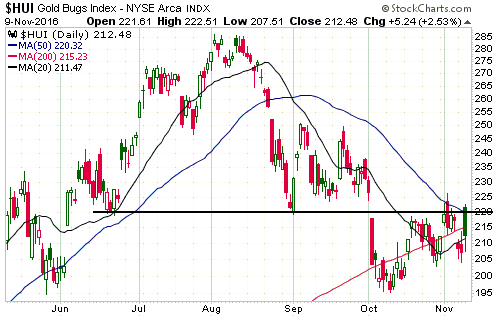
Wednesday 9th November was the fourth time in the past seven trading
days that the HUI traded above resistance at 220 and then reversed course.
On Wednesday it traded as high as 222 in the early-going, but ended the
day at 212.
Our opinion continues to be that a short-term bottom
was put in place in early-October, but a daily close above 220 is needed
to remove any remaining doubt.
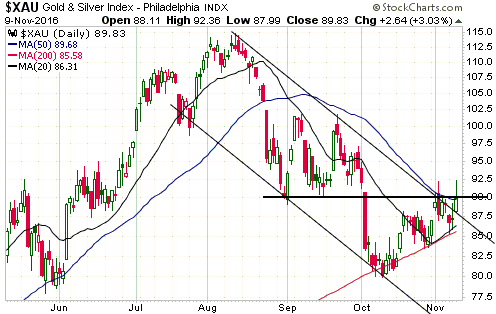
Although it is supposed to be a gold-stock index, the XAU has copper
producer Freeport McMoran (FCX) as one of its largest components. As a
consequence, the XAU tends to do well relative to the HUI during periods
when the copper market is much stronger than the gold market. The past two
weeks has been such a period, which is why the XAU's short-term chart
pattern currently looks more bullish than the HUI's short-term chart
pattern.
Like the HUI, the XAU hasn't yet managed to close above
resistance defined by its early-September low. However, the XAU ended
Wednesday's session right at this resistance whereas the HUI ended the
session more than 3% below it. Also, the XAU has broken above the top of
its 3-month price channel (refer to the following daily chart for details)
whereas the HUI remains below the top of a similar channel.
Some weakness in the gold-mining indices over the coming 1-2 days
could create a good short-term trading opportunity, but at this time the
right approach for most investors with sizable cash reserves is to simply
pick away at gold-mining stocks that offer reasonable value.
The Currency Market
The
Mexican Peso
Over the past few months the Mexican peso's
performance relative to the US$ has been strongly correlated with
expectations regarding Trump's chances of electoral success. On days when
it seemed like Trump's chances were improving, the USD/MXN exchange rate
rose (meaning: the peso weakened); and on days when it seemed like Trump
was losing ground, the USD/MXN exchange rate fell (meaning: the peso
strengthened).
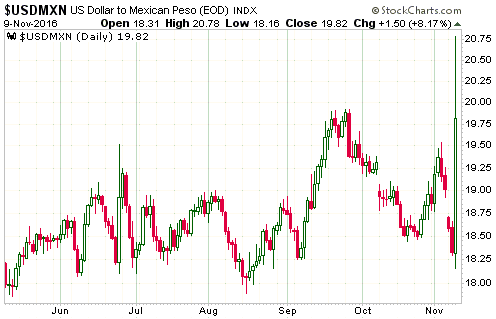
As illustrated by the following daily chart of
USD/MXN, the peso began to strengthen late last week and was very strong
over the first two days of this week as the markets became confident that
Clinton was going to win. USD/MXN then rocketed to an all-time high
(meaning: the peso plummeted to an all-time low relative to the US$) in
reaction to Trump's victory. Interestingly, however, USD/MXN wasn't able
to end the day in new-high territory.
We have no desire whatsoever
to be 'long' the Mexican peso. However, Trump's election victory doesn't
materially alter the peso's fundamentals, so it won't surprise us if the
peso's dramatic spike in reaction to the election news created an
intermediate-term extreme.
The Canadian Peso
The Mexican
peso was worth mentioning because of its huge move in reaction to the
election news. The Canadian peso (or dollar, as it's usually called) is
worth mentioning for the opposite reason.
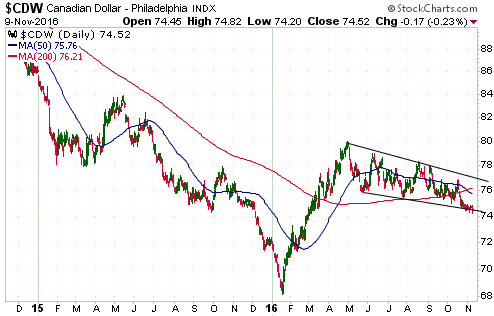
The C$ has hardly moved
at all over the past few days. Instead, it has been trading in a narrow
range near support at 74.5.
The C$'s on-going lethargy is a reason
to suspect that there will be significant additional weakness in the oil
price following a short rebound.
Updates on Stock Selections
Notes: 1) To review the complete list of current TSI stock selections, logon at
http://www.speculative-investor.com/new/market_logon.asp
and then click on "Stock Selections" in the menu. When at the Stock
Selections page, click on a stock's symbol to bring-up an archive of
our comments on the stock in question. 2) The Small Stock Watch List is
located at http://www.speculative-investor.com/new/smallstockwatch.html
 Removing
the Global X Copper Miners ETF (COPX) from the TSI List
Removing
the Global X Copper Miners ETF (COPX) from the TSI List
We
have removed COPX from the TSI List. It is only up by around 6% since our
poorly-timed entry in July of last year, but it is up by 66% since the
beginning of this year and is now stretched to the upside on a short-term
basis.
COPX will possibly return to the TSI List within the coming
few months, although we would prefer to add the stocks of one or two
individual copper-mining companies than an ETF containing a hotchpotch of
companies.
The TSI List still has exposure to copper via TGB,
IVN.TO and ESM.TO.
Chart Sources
Charts appearing in today's commentary
are courtesy of:
http://stockcharts.com/index.html