|
- 10 January 2001
The US
Bond Market and the A$
In the Jan-03 Interim Update we stated
our belief that the 30-Year T-Bond had peaked (long-term interest rates
had bottomed) and that T-Bond yields would move quickly up to the 5.75-6.00%
range. The following chart comparison of the Australian Dollar and the
T-Bond Yield supports that view.
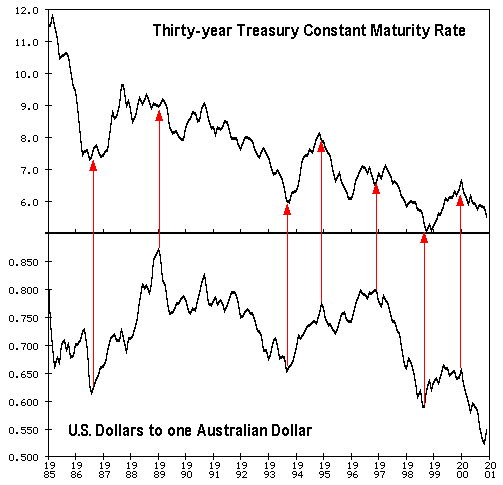
The chart is quite extraordinary in
that it shows a strong positive correlation between two seemingly-unrelated
items - US interest rates and the A$. Note that every significant turn
in the US bond market over the past 15 years has either occurred in parallel
with a turn in the A$ or has lagged a turn in the A$ by up to 3 months.
This relationship suggested that the upward reversal in the A$ during the
final 2 months of last year would soon be followed by an upward reversal
in US interest rates.
The positive correlation between the
A$ and the T-Bond Yield probably arises because the A$ tends to benefit
from both a weaker US Dollar and stronger commodity prices, whereas bonds
tend to be weak (bond yields tend to rise) during periods of USD weakness
and/or commodity price strength.
In addition to corroborating our existing
negative view (as of Jan-03) on the US bond market, the A$-bond relationship
has other potential uses. Firstly, a move in either market can be used
to confirm a move in the other market. For example, the A$ is currently
retracing some of its recent gains, a normal occurrence after a strong
up-move. However, if the A$ breaks to new lows we will know that Jan-03
represented only a short-term peak in the bond market, rather than a peak
of longer-term significance. Similarly, a move to new highs by the bond
market (a move to new lows by bond yields) would point towards a decline
to new lows by the A$. Secondly, if the moves in the A$ and the bond market
confirm each other we can confidently use this information to ascertain
trends in other markets. For example, if the A$ strengthens over the next
several months, as the A$-bond relationship currently suggests it will,
then we are going to see US Dollar weakness and/or commodity price strength
over this period.
Further to the above and assuming the
bond market continues to confirm, the A$ is likely to be one of the world's
strongest currencies over the next 12 months. There are certainly some
fundamental reasons not to be bullish on the A$, including a huge current
account deficit, the fact that Australia's net foreign debt rose by 23.5%
over the past 12 months (versus GDP growth of 4.7%), and evidence that
the Australian economy is slowing at a rapid pace. However, these problems
may have already been discounted by last year's plunge to around US$0.50.
Stocks
Stocks versus Liquidity
Below is an updated version of a chart
that originally appeared in the Dec-04 Weekly Market Update. The chart
compares the 13-week rate-of-change (ROC) of the NASDAQ Composite Index
with the 13-week ROC of the total money supply (M3) and indicates that
the NASDAQ's performance is closely linked to the M3 growth rate, with
changes in M3 often leading changes in the NASDAQ. When we showed this
chart in early December both the M3 and NASDAQ growth rates were declining
sharply. We now have a large divergence in that the M3 growth rate has
exploded higher whereas the NASDAQ is yet to respond to the additional
liquidity.
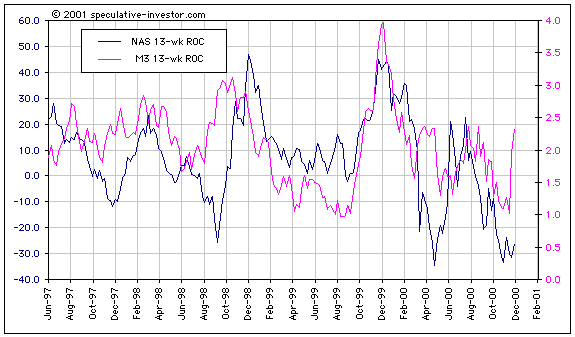
The above chart suggests that the NASDAQ
is about to move sharply higher.
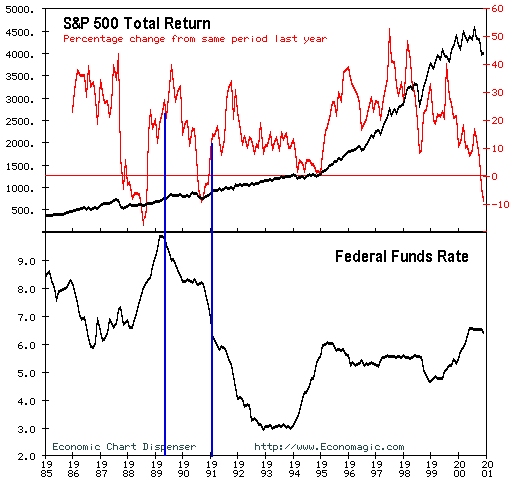
Below is a chart comparing the Fed
Funds Rate (FFR) with the 12-month ROC of the S&P500 Index (shown in
red). In the 1989-1992 easing cycle, a period during which the FFR was
slashed from 9.8% to 3%, it wasn't until early 1991 that a substantial
stock market rally erupted. In fact, during the first 18 months of the
rate-reduction cycle the market essentially went nowhere. It did, however,
climb 10% during the first 6 months of the cycle. We have specifically
mentioned the 89-92 cycle because it began prior to the onset of a recession
and may, therefore, be somewhat comparable to the current situation.
Cuts in official interest rates are
not a cure for all financial ailments, but they are generally beneficial
to stock prices. The potency of the recent rate cut, as far as its effect
on the stock market is concerned, was potentially increased by the surge
in money supply growth that preceded it.
Current Market Situation
It appears that the 2-3 week rally
mentioned in the latest WMU has begun, although Yahoo's earnings disappointment
could apply some downward pressure at the start of trading on Thursday.
We think the market will absorb the Yahoo news and move higher over the
next few sessions.
We do not think there is a short-term
bearish case to be made for the stock market. Either a) we get a rally
over the next fortnight, or b) the current rally falters immediately and
the market declines into late January, setting the scene for a multi-month
rally thereafter. Although alternative a) would provide some immediate
gratification for the bulls, alternative b) would eventually yield higher
numbers for the major indices. In both cases the NASDAQ Comp. and NASDAQ100
are likely to out-perform the S&P500.
If a near-term rally does occur, which
seems highly probable, the subsequent correction would probably be gut-wrenching
(for the bulls) but would not necessarily take the market to new lows.
The monetary environment has become extremely positive (as noted above)
and the sentiment picture, whilst not suggesting a major bottom, has certainly
reached a level of negativity sufficient to support a substantial counter-trend
up-move. In particular, the Consensus-inc sentiment survey (the survey
that has proven to be the most reliable contrary indicator over the past
few years) has just notched-up two consecutive 20% bullish readings (a
level that is usually only seen at intermediate-term bottoms). Furthermore,
the equity put/call ratio on Tuesday was 0.88, an extraordinarily-high
reading for a day during which the market achieved a modest gain.
We will add one more depressed tech
stock - Metricom (NASDAQ: MCOM) - to the Portfolio at $11-$12 (price to
be determined based on Thursday's trading).
Gold and
the Dollar
Judging by the reaction of the equity
market, yesterday's plunge in the gold price and surge in the oil price
were both head-fakes. The equity market is usually right about these things,
but not always. The failure of oil stocks to react to the sharp rise in
the oil price may be due to rising long-term interest rates (oil companies
are capital intensive and their stock prices therefore tend to move with
the bond market) or to the rotation of money from 'safety stocks' into
the technology sector. In other words, it may be saying nothing about the
future price of oil. Similarly, the ability of most gold stocks to hold
their ground in the face of the recent sharp fall in the gold price may
be related more to stubborn optimism than anything else.
The near-term picture for gold is uncertain.
A short-term divergence is building between the bullion price and the prices
of gold stocks that could be resolved by either a drop in the equities
or by a quick rebound in the commodity price (on a longer-term basis, gold
stocks are still extremely cheap relative to the gold price). At this stage
the sell-stop associated with our short-term trading position in gold stocks
(refer to the latest Weekly Update) has not been hit, so we will continue
to give the bullish case the benefit of the doubt.
The medium-term picture has certainly
not changed and, in fact, has probably improved if our bond market analysis
is correct.
As noted in the Jan-09 Market Alert,
a normal counter-trend bounce following the Dollar's recent slide could
take the Dollar Index back to the 112-113 range before its down-trend resumes.
Our minimum downside objective for the Dollar Index remains at 105.
Format
Change
Beginning with the next Weekly Market
Update (WMU) we will make a slight change to the format. At the top of
each WMU we will put a table that includes a summary of our forecasts for
the various markets on which we comment. For example, in today's Interim
Update (IU) we have stated that the A$ should be one of the world's strongest
currencies over the coming 12 months. This forecast will go into the table
with a reference to the Jan-10 IU. If our view on the A$ subsequently changes,
we will insert the new forecast into the table and also leave the old forecast
in the table. Our current view/forecast will be shown in bold type. We
are doing this so that:
a) As new subscribers come on board
they can immediately see our current position on each market and can quickly
refer back to previous issues to find out the reasoning behind those positions.
b) To provide a greater level of accountability
(the table will be an on-going report card).
Changes
to the TSI Portfolio
MCOM will be added as noted above.

|









