- Interim Update 10th January 2018
Copyright
Reminder
The commentaries that appear at TSI
may not be distributed, in full or in part, without our written permission.
In particular, please note that the posting of extracts from TSI commentaries
at other web sites or providing links to TSI commentaries at other web
sites (for example, at discussion boards) without our written permission
is prohibited.
We reserve the right to immediately
terminate the subscription of any TSI subscriber who distributes the TSI
commentaries without our written permission.
2017's most important
quote
In 2017, Xi Jinping consolidated
his position as the ultimate power in China. He effectively has become
dictator for life and is now referred to as the "core", implying that all
roads lead to Xi. This is a very important development as it leaves no
doubt that China has turned off the path to greater freedom and is moving
rapidly in the opposite direction.
The ideology that is now guiding
China's government is encapsulated by the following Xi Jinping quote:
"Government, military, society and schools, north, south, east and
west, the Party is the leader of everything."
With China's
government becoming increasingly authoritarian and putting the latest
technology to full use in its efforts to control every aspect of life, we
suspect that China has peaked economically. The entrepreneurship required
to bring about real economic progress simply cannot thrive under a strict,
totalitarian regime. However, if Xi remains in good health then China's
government will become a larger presence on the world stage.
Our financial
performance in 2017
We don't attempt to provide a
one-size-fits-all portfolio, because such a thing doesn't exist in the
real world. Instead, we provide investing and speculating ideas. Most of
these ideas are in the form of stocks and options listed at the TSI Stock
Selections page, although we sometimes mention ideas that don't get
included in the formal list.
From the emails we have received over
the years and from common sense, we know that different subscribers use
the information presented at TSI in different ways and in doing so achieve
very different results. Results will vary depending on the
money/risk-management techniques that are employed (not being a portfolio,
the TSI stocks/options list doesn't incorporate the money-management
techniques that should be used when speculating or investing) and on the
specific TSI ideas that are put into practice. We therefore can't report a
percentage gain or loss that an individual would have achieved by using
the TSI information. The best we can do is report our own performance.
We own most, but not all, of the stocks listed at the TSI Stock
Selections page, and there are positions that we take in our own accounts
that never get mentioned at TSI. However, the opinions espoused and the
positions (stocks and options) mentioned at TSI generally reflect what we
are doing with our own money.
At around this time two years ago we
reported that over the course of 2015 our equity portfolio (stocks,
options, warrants and cash in brokerage accounts) had a net gain of 8.5%
in US$ terms, which was neither good nor bad considering the
financial-market backdrop. Performance in 2016 was much better, with a
triple-digit (100%+) gain. This was mainly due to the huge rally in the
gold-mining sector during the first half of the year, although the surge
in the copper price during the final two months of the year was also a
significant help. We now move on to what happened last year.
Investing/speculating-wise, 2017 was one of the most challenging years we
ever had. Our equity portfolio had a net gain of 18% in US$ terms, but the
final result got a hefty boost from our participation in pre-IPO and
pre-RTO (Reverse Take-Over) private placements that were not available to
the average investor. In dollar terms the most significant of these was
Bankers Cobalt (BANC.V), a stock that we brought to the attention of the
TSI readership shortly after it began trading (refer to the 23rd October
Weekly Update).
To get a better indication of how we did with the
speculations/investments that were available to the general public and
that were covered at TSI we must exclude the effects of the aforementioned
private placements. Doing so results in a roughly break-even result for
the year.
A break-even result normally would not be viewed as a
disaster, but it was worse than normal last year because of the excellent
profit-making opportunities that were available across the financial
world. Last year provided almost no opportunities for a value-oriented
investing approach, but it was over-flowing with speculative potential.
That remains the case as we write today.
Some of our stocks
performed well last year, with gains in the 30%-60% range. However, there
were no big winners. It didn't help that gold stocks and
industrial-commodity stocks spent the bulk of the year in consolidation
mode and that many of the best performances came from sectors where
valuations were absurd to begin with. It also didn't help that the big
winners in the resource sector tended to be discovery stories that were
either baseless or extremely expensive. Most of these discovery stories
have since collapsed and not one of them has, to date, fulfilled the
dreams of the true believers. For examples, refer to the "year of the
over-hyped discovery story" piece included in the "Gold Stocks" section of
today's report.
One of our biggest mistakes in 2017 revolved around
our attempts to profit from a stock-market correction and/or a surge in
volatility that never came. These attempts were made via options and each
resulted in only a small monetary loss, but the small losses added up and
reduced our overall performance by several percentage points over the
course of the year.
There were also some stock selection mistakes,
the most significant for us (in dollar terms) being Blackham Resources
(BLK.AX). With the benefit of hindsight, which is always 20/20, this is a
stock we should have jettisoned when management deficiencies first became
apparent. Our decision to take a position in Asanko Gold (AKG) is another
stock selection mistake worth highlighting. In this case we were well
aware of the risks when the position was taken, but we wrongly thought
that these risks had been fully discounted by the preceding decline from
US$4.70 to the US$1.20s.
Both BLK.AX and AKG were value traps. They
looked cheap, but only because many weaknesses were yet to surface.
We aren't going to make any major changes in 2018, because although
our process wasn't successful in 2017 it has been very successful over the
long-term. However, two of our New Year's resolutions are to be quicker to
exit equity positions in response to signs of trouble and to wait for more
evidence of trouble before entering bearish speculations.
The Stock Market
2018 US Stock Market
Forecast
Our 2017 forecast for the US stock market was
vague, but in one respect it couldn't have been more wrong. We were
correct to write at around this time last year that the sort of collapse
that occurred in 2008 was not a realistic possibility for the year ahead
and that the bull market probably wouldn't end during the first half of
2017, but we were completely wrong when we wrote: "The market's
performance during the year will be characterised by the word
"volatility", with multiple declines of at least 8% followed by quick
recoveries."
As it turned out, the US stock market's
performance during 2017 was characterised by the phrase "lack of
volatility". For the first time ever there wasn't a single correction of
more than 3%. Furthermore, the VIX was below 10 on 52 trading days during
2017 after spending only a few days below 10 during the preceding three
decades.
A 2018 forecast that has almost no chance of being wrong
is therefore: the US stock market will be more volatile in 2018 than it
was in 2017.
Actually, we expect that 2018 will go part of the way
to counter-balancing 2017 by being more volatile than average, at least
when volatility is measured in terms of the average daily SPX change and
the number of 5%+ SPX declines.
The biggest difference between the
situation now and the situation near the start of each of the past few
years is that the monetary backdrop is no longer supportive. In fact, it
has become a slight head-wind and will become a strong head-wind by the
third quarter if the Fed and the ECB stick to their current plans.
That being said, the monetary backdrop only turned negative about three
months ago and it can take 6-12 months for the effects of such a shift to
become apparent in the financial markets and the economy. Also, there is
not yet any evidence in the yield curve or credit spreads that the
tightening of monetary conditions has become critical. We therefore expect
that the stock market will work its way upward during the first half of
2018, although we also expect that the advance will be 'choppy' and
include a Q1 correction of 5%-10%.
At some point during the second
half of 2018 the tightening of monetary conditions should become critical,
with a 15%-25% SPX decline being one of the most obvious consequences.
Whether or not this decline marks an end to the bull market will depend on
the central-bank reaction at the time, in that a rapid policy shift from
monetary tightening to loosening could extend the long-term advance.
We expect that commodity-related stocks will be among the best
performers during the first half of the year, but that all sectors of the
stock market will suffer large declines during the second half with the
possible exception of the gold-mining sector.
The gold-mining
sector can benefit from weakness in the broad stock market, but only if it
is not 'overbought' at the time that a period of extreme broad-market
weakness begins. For example, the gold-mining sector benefited in a big
way from the stock market weakness of 2001-2002 because it entered the
period at a low ebb, but it was hammered along with the broad market in
2008 and 1987 because it was stretched to the upside when large
broad-market declines got underway. In other words, if the gold-mining
sector were to trend upward with commodity stocks and the broad market
during the first half of this year then it would be acutely vulnerable to
substantial broad-market weakness during the year's second half.
Declining bond prices, a.k.a. rising interest rates, is the biggest
short-term threat to the equity bull market. To help explain why, here is
a chart that we have used in the past. The chart compares the SPX with the
price of the 30-year T-Bond during 1986-1987.
In 1987 the downward
trend in the T-Bond price (rising interest rates) didn't matter to the
stock market until August, when the T-Bond broke below an important
support level. After that, the T-Bond's trend was all that mattered to the
stock market.
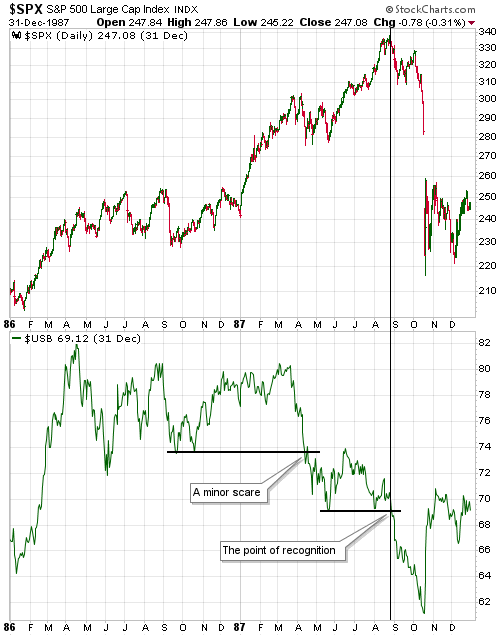
We suspect that the T-Bond's March-2017 low of 146, which is only
three points below the current price, is equivalent to the support level
that was breached in August-1987. If the T-Bond breaks below this support
within the next two months then the large stock market decline that we
presently envisage for H2-2018 may occur in H1.
Current
Market Situation
As far as we can tell, nothing
significant happened over the first three trading days of this week.
Gold and the Dollar
Gold
At
the end of last week the US$ gold price had risen on 11 days in a row and
on 15 of the preceding 16 days. Its new short-term upward trend was
therefore stretched and likely to be interrupted by some sort of
correction.
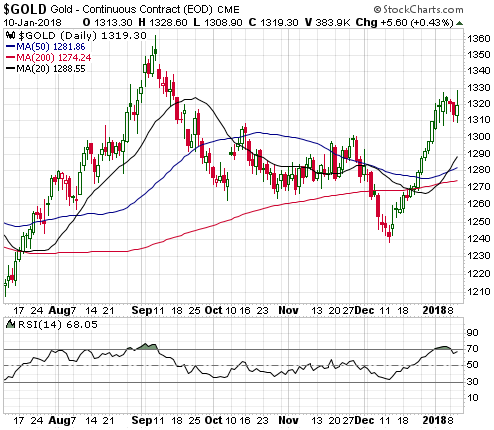
Some sort of correction has begun. Our guess is that it
will only last 1-2 weeks and do no more than take the price down to near
the 20-day MA (the black line on the following daily chart), which is at
$1288 and rising at the rate of about $3/day.
There is no good reason to believe that a major gold rally has begun
or will begin in the near future. This is because there is little chance
of the fundamental backdrop turning decisively gold-bullish and staying
that way for quarters on end until after the equity bull market has
terminated. The equity bull market could reach its conclusion this year,
but it hasn't concluded yet and is unlikely to do so within the next few
months.
However, gold's price action suggests that the short-term
upward trend that began last month will have another leg after a
correction. Also, general strength in commodity prices should support gold
during the first half of this year.
Gold Stocks
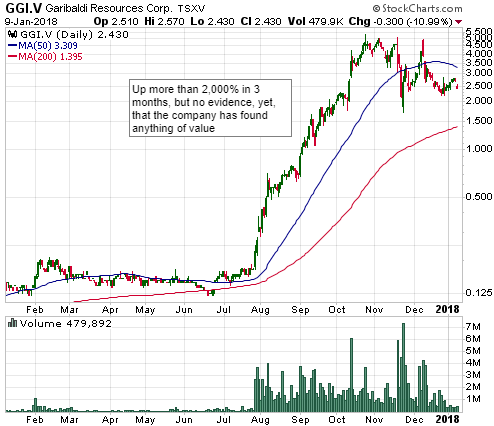
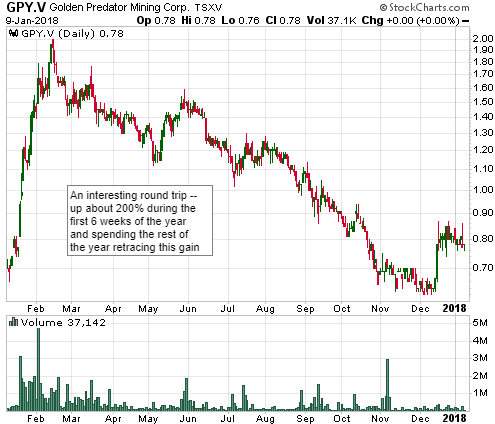
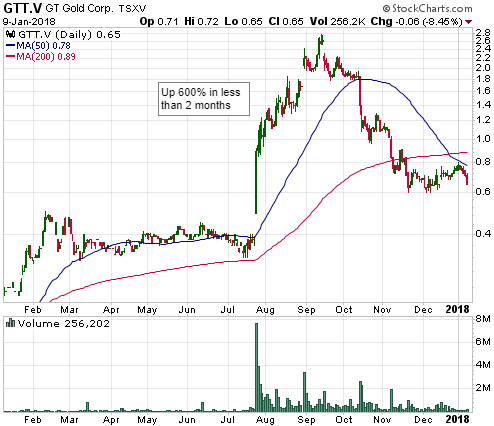
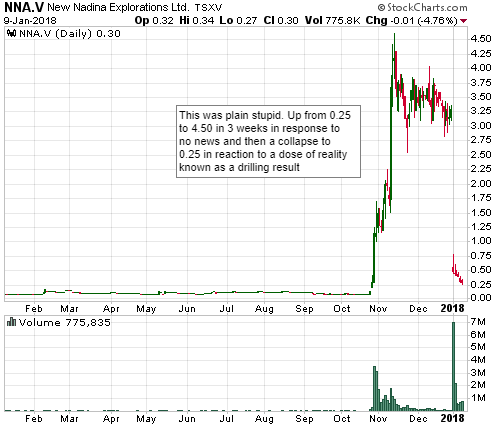
The year of the over-hyped discovery story
2017 was a boring year for most mining stocks, especially the stocks
of companies with existing production and/or substantial defined in-ground
resources that consistently met expectations. In general there was no
enthusiasm for such stocks, even if they were very under-valued.
Throughout the bulk of 2017 it seemed that only a hint of a discovery
could spark enthusiasm in the stock market, with "hint" being the
operative word. Investors (using the term very loosely) were extremely
eager to participate in a discovery story -- so eager, in fact, that some
stocks were bid up aggressively in anticipation of a discovery despite
there being literally no evidence that an economic discovery was likely.
Perhaps this is not surprising given that 2017 was also a year in which
investors (using the term even more loosely) went crazy for cryptoassets.
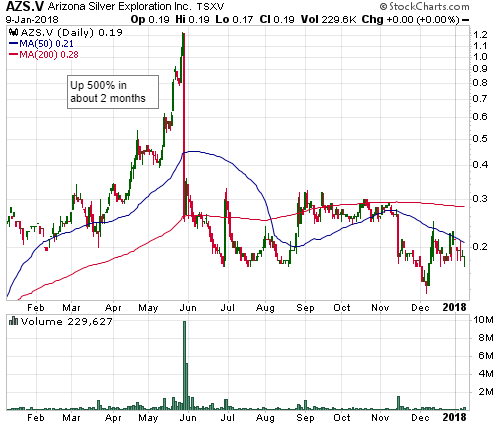
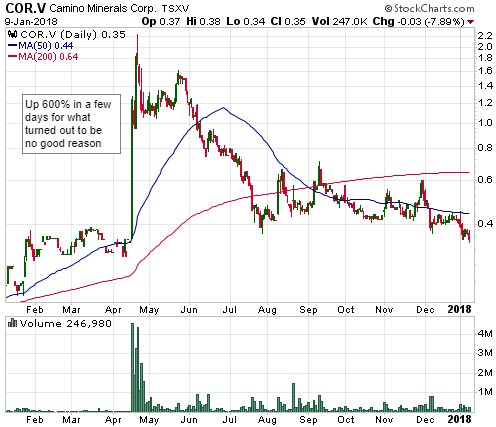
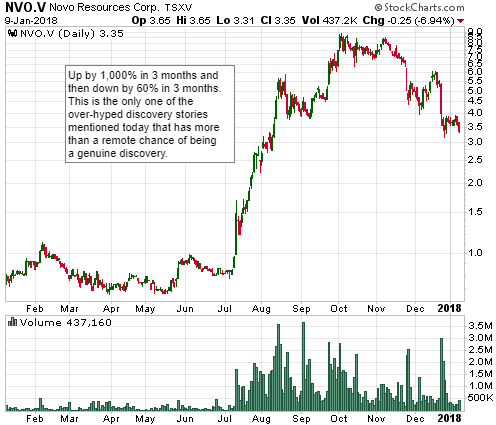
Here are charts showing some of the best examples of over-hyped
discovery stories. Usually it would take multiple exceptional drilling
results to generate the sort of price appreciation illustrated below, but
not last year. That's why in most cases the bulk of the price gain was
subsequently wiped out.
Current Market Situation
On
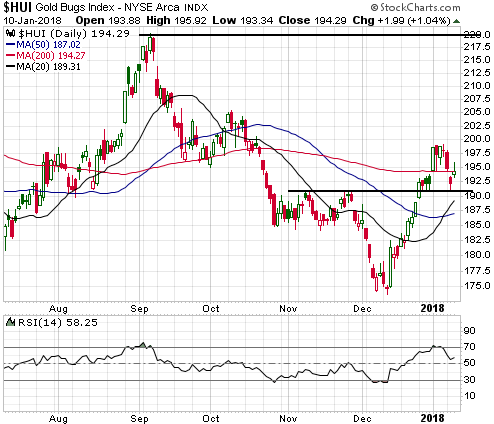
Tuesday 2nd January the HUI broke above its 200-day MA, but we didn't
expect the breakout to hold. Instead, in the 3rd January Interim Update we
wrote: "...it's reasonable to expect that a correction over the coming
1-2 weeks will take the HUI back below its 200-day MA and down to the
vicinity of its 50-day MA".
In the latest Weekly Update we
mentioned a minor bearish non-confirmation between gold bullion and the
gold-mining sector over the final three days of last week and reiterated
the likelihood that a brief correction was about to start. Our conclusion
was:
"We presently expect additional gains in the gold-mining
indices over the coming month or so, with a 1-2 week interruption to the
rally beginning very soon."
A correction is now underway. In
fact, in price terms it may have ended on Tuesday of this week when the
HUI touched the lateral support at 191 indicated on the following daily
chart, although we won't be surprised if there is some more corrective
activity incorporating a test of the 50-day MA over the coming few days.
Our conclusion is unchanged. We continue to expect that the
gold-mining indices will make additional gains over the coming month.
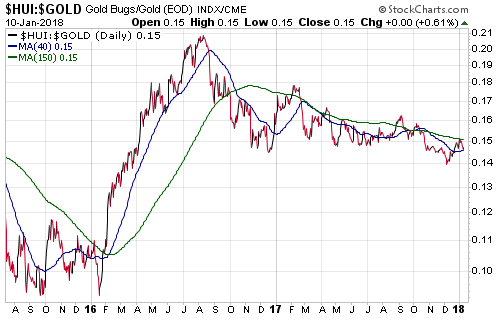
The HUI/gold chart displayed below shows that there has been a lot
less strength in the gold-mining sector relative to gold during the
current rally to date than there was during the first few weeks of the
rallies that began in January-2016 and December-2016. This suggests that
we are dealing with a 2-month rebound along the lines of what happened
between early-July and early-September as opposed to a new
intermediate-term upward trend. Even so, the gold-mining indices look set
to make additional progress before reaching multi-month tops.
The Currency Market
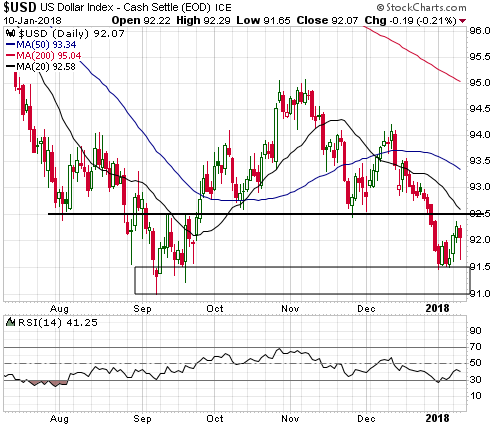
In late-December the
Dollar Index broke below support at 92.5. That former support is now an
important resistance level.
An 'oversold' DX has bounced while
remaining within the narrow range between support defined by last year's
low and resistance at 92.5. We are anticipating a multi-week rebound, the
start of which would be confirmed by a daily close above 92.5.
Updates on Stock Selections
Notes: 1) To review the complete list of current TSI stock selections, logon at
http://www.speculative-investor.com/new/market_logon.asp
and then click on "Stock Selections" in the menu. When at the Stock
Selections page, click on a stock's symbol to bring-up an archive of
our comments on the stock in question. 2) The Small Stock Watch List is
located at http://www.speculative-investor.com/new/smallstockwatch.html
Chart Sources
Charts appearing in today's commentary
are courtesy of:
http://stockcharts.com/index.html