- Interim Update 10th June 2015
Copyright
Reminder
The commentaries that appear at TSI
may not be distributed, in full or in part, without our written permission.
In particular, please note that the posting of extracts from TSI commentaries
at other web sites or providing links to TSI commentaries at other web
sites (for example, at discussion boards) without our written permission
is prohibited.
We reserve the right to immediately
terminate the subscription of any TSI subscriber who distributes the TSI
commentaries without our written permission.
Note regarding TSI web
site
If you are logged in, you can
now directly access the latest Weekly or Interim Update by clicking on the
relevant link in the box located near the bottom of the
TSI Home Page.
If you aren't logged in, clicking on one of these links will take you to the
login page.
The reversal in
euro-zone government bond yields continues to impress
In the euro-zone there are two
great inflations in progress. There's the great inflation of the money supply
and there's the great inflation in usage of the term "Greek tragedy" when
referring to the negotiations between the hopelessly-indebted Greek government
and its creditors. The first is the bigger problem and is the driving force
behind the spectacular reversal in bond yields, but the second is the more
annoying.
The ECB-promoted inflation of the euro supply is achieving its intended purpose,
which is to bury the expectation that the euro's purchasing power is going to do
anything other than fall. With a critical mass of market participants having
come around to the view that a euro will buy less in the future than it does in
the present, euro-zone government bond yields have done an impressive
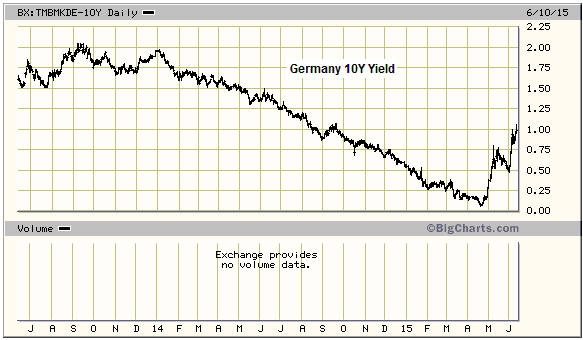
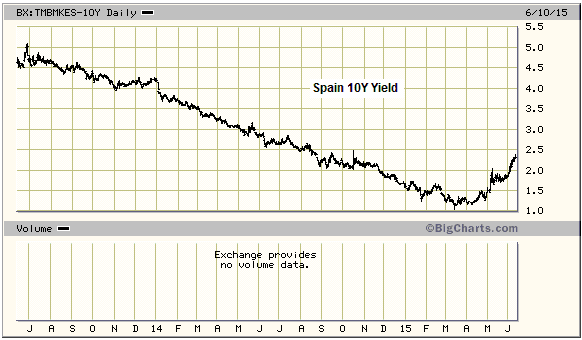
about-face. As illustrated by the following charts, this has involved the yield
on Germany's 10-year government bond rising from a low of around 0% in April to
around 1% today and the yield on Spain's 10-year government bond rising from a
low of around 1% in March to around 2.3% today. These are still paltry yields
considering the "inflation" risk and, in Spain's case, the direct default risk,
but the yield-changes reflect the beginning of a shift towards more realistic
pricing.
We don't know of an easy way for the average trader to bet on higher euro-zone
government bond yields. There are easy ways to bet on higher US government bond
yields, but US government bonds offer relatively good value and have much less
downside price risk.
The Stock Market
The US
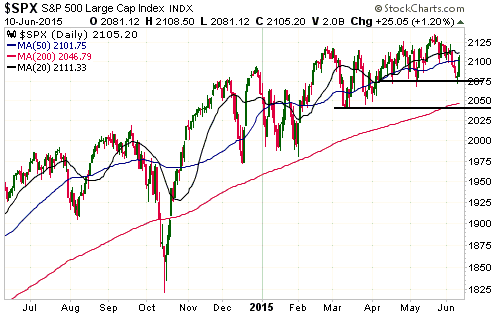
In terms of speculative positioning, we are operating under the assumption that
the S&P500 Index (SPX) has just made a top of at least intermediate-term
importance and will soon commence a sizable decline. Admittedly, however, there
presently isn't much evidence to support this position, as the price action
could just as easily be a consolidation as a top. Furthermore, the downside
breakout in the Dow Transportation Average, which is consistent with our bearish
position, has been counteracted by an upside breakout in the Bank Index.
Fortunately, it won't take much strength from here to prove that we are wrongly
positioned. As previously advised, all it would take is a weekly SPX close above
2126 (about 1% above the current level).
Going the other way, we would now view an SPX close below 2075 as an early
warning that a meaningful decline was getting underway, while a close below the
March low (2039) would still be needed to confirm a downward reversal.
Gold and the Dollar
Gold
Why Indians buy gold
Jayant Bhandari has written an interesting article titled "For
Indians, gold a barbarous relic for barbarous times". The article is an
insider's perspective on why Indians have traditionally favoured gold.
According to Jayant, the main reason for the popularity of gold in India is
that, due to widespread corruption and endemic inefficiency, most other
investments and forms of saving have had negative real yields for a very long
time. In effect, the reason that Indians have traditionally gravitated towards
gold is the same reason that gold periodically becomes popular in the West: Lack
of confidence in mainstream investments, government, financial institutions and
the official money.
Here are the article's concluding paragraphs:
"Over-taxed and over-regulated, and most importantly, with its rational
underpinnings increasingly weakened, the Western world's growth rate is falling
to a meaningless number, even before you account for the huge risks that
off-the-balance-sheet liabilities, and structural problems created by massive
personal and public debts.
The risks on your wealth are increasing, so are regulatory controls over it.
Most of what we own today is in electronic form and can be -- and will be --
frozen at a flip of an electronic switch.
No doubt Swiss bonds got sold at a high negative-yield, as people acclimatize,
albeit unconsciously -- as Indian cattle-owners do -- to the new reality that
losing a bit of your money to preserve the rest is "a good deal." For the same
reason, Euro-savers in search of liquidity have rushed to the over-priced US
dollar.
Eventually, once the big money and technical momentum has over-priced the most
liquid assets, it will start to over-flow into gold. People will then be
thinking that no-yield is better than negative yields."
Current Market Situation
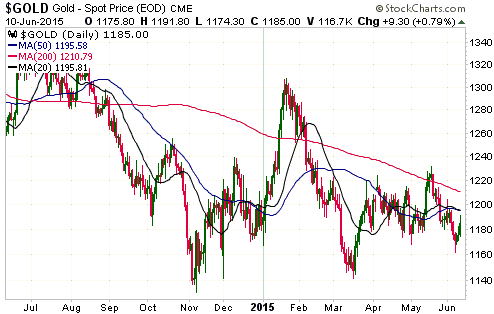
The gold price rose over the past three days, but not by enough to alter the
price pattern in a significant way.
The combination of price action, sentiment and fundamentals suggest that a
decline to around $1130 is the most likely near-term outcome. Assuming that
there are no major fundamental changes (such as Greece exiting the euro-zone),
this will remain the most likely near-term outcome unless gold is able to
achieve consecutive daily closes above $1196 (just above the 20-day and 50-day
MAs).
Consecutive daily closes above $1196 would increase the probability that gold
had done all of the bottom-testing it was going to do, although it would take a
weekly close above $1220 to completely eliminate the possibility that last
year's low in the $1130s will be tested or slightly breached prior to the start
of the next tradable advance.
Gold Stocks
Gold mining versus the broad stock market
On a long-term basis the relationship between the gold-mining sector and the
broad stock market is inverse, in that gold-stock bull markets coincide with
general equity bear markets and gold-stock bear markets coincide with general
equity bull markets. However, on an intermediate-term basis the relationship is
not consistent, in that there are numerous examples of 6-18 month periods during
which gold stocks trended in the same direction as the broad stock market and
numerous examples of 6-18 month periods during which they did the opposite. How,
then, do we know whether a particular intermediate-term trend in the broad stock
market is likely to be accompanied by a gold-mining sector trend in the same or
the opposite direction?
We never know, partly because there are always many influences on the gold
sector's trend. There are, however, two sets of circumstances under which the
intermediate-term relationship is very predictable.
The first is when the broad stock market commences a substantial decline with
the gold-mining sector near a multi-year high. In this case it's highly probable
that the gold-mining sector will tank with the broad market. The crashes of 1987
and 2008 are examples.
The second is when the broad stock market commences a 1-2 year (or longer)
bearish trend with the gold-mining sector near a multi-year low. In this case
it's highly probable that the gold-mining sector will embark on a powerful
upward trend at around the same time as the broad market begins its cyclical
decline. As far as we know, there is no historical exception to this
inter-market relationship. That is, we are not aware of any historical case of
the broad stock market commencing a large/lengthy decline with the gold-mining
sector at a depressed level and the gold-mining sector not rallying strongly
during the course of the broad market's decline. One example is 2000-2002.
Another example is illustrated by the following chart.
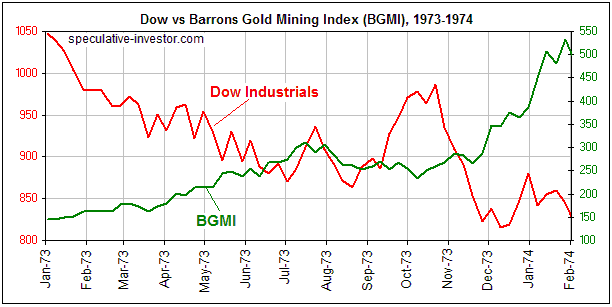
The historical sample size is small and past performance certainly doesn't
provide guarantees as to what will happen in the future, but the historical data
and logic tell us that if a general equity bear market were to soon begin then
it would far more likely result in substantial profits than losses for the
owners of gold-mining stocks.
Current Market Situation
Regardless of whether or not the broad stock market is now very close to a major
peak, gold bullion and the gold-mining sector will probably rally during the
second half of this year in response to a steepening yield-curve and declining
real interest rates. However, the rally won't mark the beginning of a new bull
market unless it coincides with the start of a multi-year bearish trend in the
broad stock market.
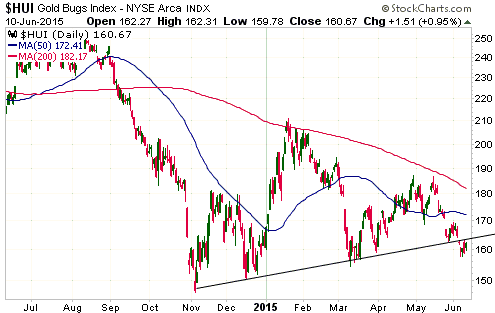
Between now and the start of a strong rally, the HUI could drop back to 145-150
in a test of last year's low. In fact, this is the most likely near-term
outcome, although it is far from a certainty. As previously advised, a weekly
close above 185 would alter the pattern and indicate that all the bottom-testing
that was going to happen had already happened.
Over the first three days of this week the HUI rebounded to the trend-line that
it broke below last week. This price action is not significant.
Relative strength in the high-quality juniors
Something that has been apparent for several months is that the stocks of
high-quality junior gold miners, that is, juniors with strong balance sheets,
projects in reasonable jurisdictions that 'work' at the current gold price and
no blatantly-negative company-specific issues, are strengthening relative to the
sector as a whole. This constitutes a positive change from 2013 and much of
2014, when it seemed that quality didn't matter.
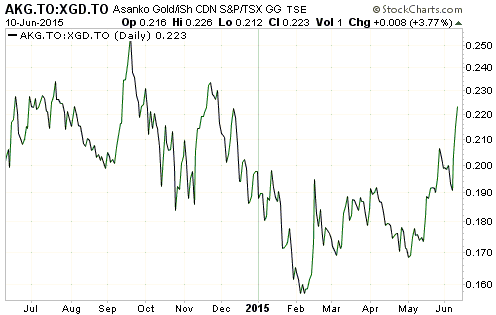
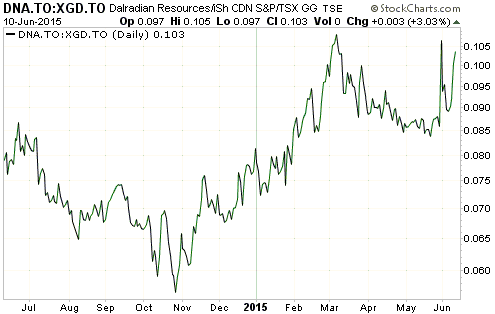
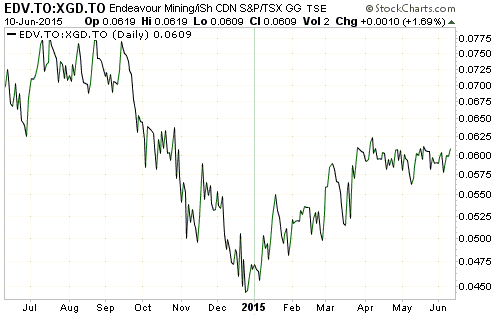
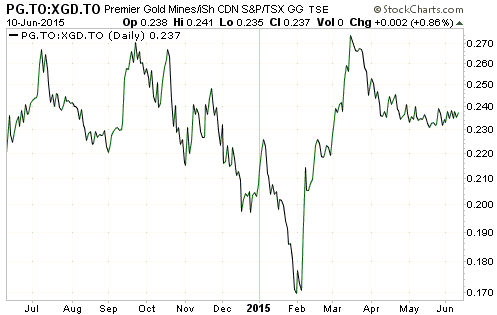
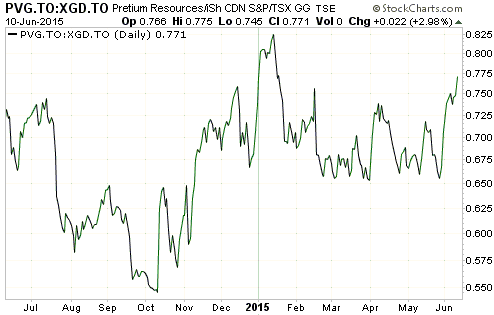
Here are charts showing examples from the TSI Stocks List. In these charts the
C$-denominated stock price of a junior gold miner is shown relative to the
C$-denominated iShares CDN Global Gold Index Fund (XGD.TO).
1) Asanko Gold (AKG.TO) bottomed on a relative-strength basis in February and
has been very strong since early-May.
2) Dalradian Resources (DNA.TO) has almost doubled relative to XGD since its
relative-strength bottom last October.
3) We have been frustrated by the stock market's failure to appreciate the
consistently good operational performance of Endeavour Mining (EDV.TO), although
EDV has been steadily working its way higher relative to XGD since late last
year.
4) Premier Gold (PG.TO) was very strong on a relative basis during
February-March. It has since consolidated its gains.
5) Pretium Resources (PVG.TO) bottomed on a relative-strength basis last October
and is now close to the top of its 12 -month range relative to XGD.
Updates on Stock Selections
Notes: 1) To review the complete list of current TSI stock selections, logon at
http://www.speculative-investor.com/new/market_logon.asp
and then click on "Stock Selections" in the menu. When at the Stock
Selections page, click on a stock's symbol to bring-up an archive of
our comments on the stock in question. 2) The Small Stock Watch List is
located at http://www.speculative-investor.com/new/smallstockwatch.html
Chart Sources
Charts appearing in today's commentary
are courtesy of:
http://stockcharts.com/index.html
http://bigcharts.marketwatch.com/